

Key takeaways
- 1
Choose a buyer task before choosing keywords. A specific question and a useful answer belong together on one page.
- 2
Give readers something they can verify: a documented procedure, a tested example, or a clearly explained comparison.
- 3
Keep evidence next to the claim it supports. Never turn a hypothetical example into a client result.
- 4
Publish an accessible page and record what changed. A later citation is an observation, not proof that one edit caused it.
The answer-page workflow
From buyer question to a checkable answer
- 1
Question
Name the reader, their task, and the decision they need to make.
- 2
Evidence
Find the source, conditions, and owner for each important claim.
- 3
Answer
Write the response, steps, example, and exceptions together.
- 4
Review
Check facts and access, publish, then observe with a recorded method.
What is AI citation optimization?
Here, AI citation optimization means improving content so that it is a relevant, accessible, well-supported candidate for a linked source in an AI answer. A citation is a source link; a brand mention can occur without one. A person visiting that link is a separate event. Publishing an accurate page gives readers a better answer even when an AI system never selects it.
This guide focuses on the content work: turning one buyer question into a page worth consulting. It fits within answer engine optimization (AEO) and generative engine optimization (GEO), while retaining ordinary SEO fundamentals. Google says those fundamentals still apply to AI search. The workflow below is our editorial recommendation, not a platform-endorsed ranking recipe.
Sources for this section: Google: optimizing for generative AI search.
1. Choose a buyer question and its search language
Start with a decision your reader needs to make: whether a product fits, how a process works, or what a limitation means. Collect exact wording from consented sales notes, support questions, site search, and Search Console. Treat an unfamiliar query as a research lead; its presence does not prove that the searcher is a qualified buyer.
In Search Console, use a stated date range and inspect the queries associated with the relevant page. Review impressions alongside clicks and position. A page appearing far down the results may need a stronger answer or better intent alignment; zero clicks alone does not diagnose a poor title. Read current search results to identify whether people expect a tutorial, comparison, product page, or definition.
Use Google Trends to compare relevant search terms under the same geography, period, category, and search type. Its 0–100 interest scale is relative, not monthly search volume or ranking difficulty. A narrow term can have too little data. Discard unrelated rising queries rather than squeezing them into the article.
Write a one-sentence brief: ‘For [reader] deciding [task], this page answers [question] using [evidence].’ Choose one primary phrase and a few natural supporting questions. Use the language readers recognize in the title and headings; let the explanation supply related terminology. Repeating every variation is not a content strategy.
Sources for this section: Google: Search Console Performance report, Google Trends: understanding the data, Google Search Essentials.
2. Decide whether to update a page or create one
Search your own site before drafting. If a useful page already answers the same question, improve its missing section. Create a separate resource when the reader needs a different task completed: an implementation tutorial can complement a service page, while a second definition with slightly different keywords adds little.
Record the intended page, reader, and next action in the brief. For example, a service page can explain who performs AI citation work and what an engagement includes. An editorial tutorial can show a content team how to build one supported answer. Link the two where it helps the reader move from learning to implementation.
What you find
Same question, incomplete answer
Editorial decision
Improve the existing page
Reason
Keep its useful context and links together.
What you find
Different task, enough evidence
Editorial decision
Create a focused guide
Reason
Give the new task a complete treatment.
What you find
No evidence for the promised answer
Editorial decision
Investigate before writing
Reason
A keyword cannot substitute for a supported explanation.
3. Build a claim-and-source ledger
Before writing persuasive copy, list the statements a buyer might rely on. For each, record the source URL or approved document, the relevant passage, the date checked, the applicable product version or market, and the person who can verify it. Flag unsupported claims instead of asking an AI writing tool to fill the gaps.
Match the evidence to the claim. Product documentation can establish that a feature exists, but not how much time every customer saves. A reproducible test can support a result under its stated conditions, but not a universal outcome. A customer quote needs permission and context; confidential customer material should not become public source content.
Use the downloadable blank brief to keep question, claim, evidence, limitation, and approval in one place. It is an editorial worksheet, not an automated scoring tool. Resolve conflicting sources with the responsible owner and omit claims that remain uncertain.
4. Structure an answer page readers can use
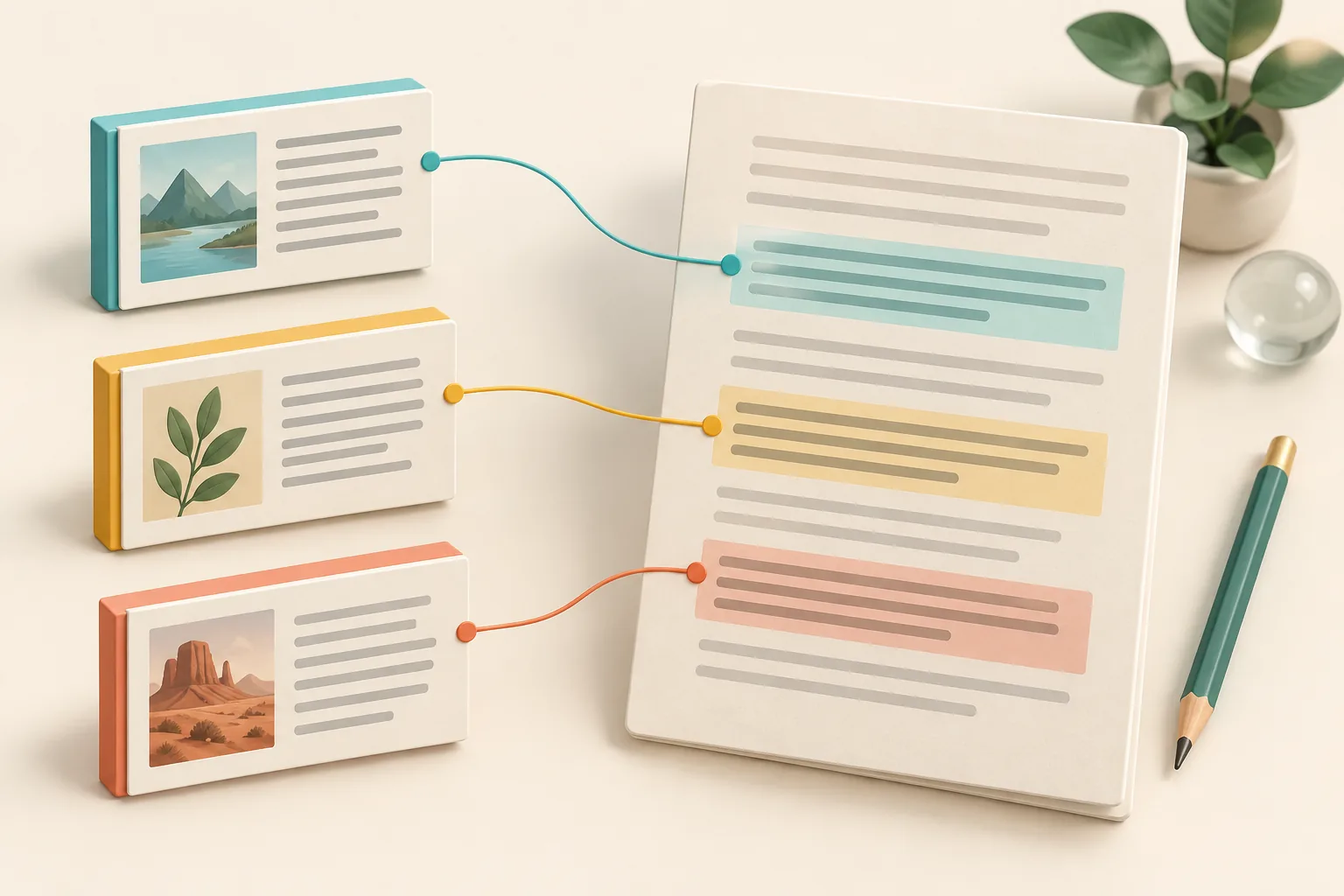
Put the direct answer near the start, including the condition that changes it. Then explain the steps, evidence, example, and exceptions. Make the answer understandable without a long promotional introduction. This is a readability choice; no particular paragraph length guarantees extraction or a citation.
Use descriptive headings that reflect genuine follow-up questions. Put a source link next to the claim it supports and identify what the reader will find there. Add an original diagram when it explains a relationship more clearly than another paragraph. Keep essential facts in HTML text so the image is not the only way to understand the answer.
- 01
Answer
State the decision or procedure, who it applies to, and the most important condition.
- 02
Explain
Show the steps in order and identify what the reader needs before starting.
- 03
Demonstrate
Use a specific example with visible assumptions and evidence beside the relevant claim.
- 04
Qualify
Explain exceptions, failure cases, and when a different approach is needed.
Sources for this section: Google: helpful, reliable content, Google: AI features and your website.
Worked example: replace a vague product claim
Consider a fictional project-management product. Its buyer asks: ‘Can I import project tasks from a CSV file?’ The draft answer says: ‘Our powerful platform seamlessly imports all your data in seconds.’ That sentence leaves the reader unable to check supported fields, exceptions, or the next step.
For this teaching example only, assume the product owner has verified that the importer accepts task title, due date, and assignee email, but does not import attachments or comments. No real product or customer result is represented. In an actual guide, replace these assumptions with approved documentation and a recorded test.
A more useful answer would be: ‘You can import task titles, due dates, and assignee email addresses from a CSV file. Attachments and comments are not included. Download the import template, map those three columns, and test a small sample before importing the full project.’ Place the real import-documentation link beside this answer when adapting the pattern.
The supporting section would show a sample header row, explain the accepted date format from the documentation, and describe how to handle an unrecognized assignee. It would also tell the reader where to check the import result. Those details let someone complete the task and identify when the advice does not apply.
Original wording
All your data
What to verify
Supported fields and exclusions
Editorial action
Name exactly what imports and what does not.
Original wording
In seconds
What to verify
Timed test and its conditions
Editorial action
Remove the speed claim unless substantiated.
Original wording
Seamlessly
What to verify
Setup, errors, and recovery steps
Editorial action
Explain the actual process instead of a vague benefit.
Example note: The example demonstrates clearer writing. It is not a TopFound client case study, platform screenshot, or evidence of improved rankings or citations.
5. Review facts, crawl access, and page presentation
Ask a subject expert to check the answer against the ledger. Confirm that examples match the current product, source links open, limitations are visible, and the next step is relevant. Check the mobile page: headings, tables, and images should remain readable without hiding important caveats.
For Google AI search, verify indexing, snippet eligibility, and inclusion in Search generative AI features. For ChatGPT search, check OAI-SearchBot access and relevant hosting controls. OpenAI distinguishes that search crawler from GPTBot for potential training use and ChatGPT-User for user-triggered requests. Preserve your site's training and privacy choices; a crawler request does not prove a citation.
Use one accurate title, description, and canonical URL, descriptive internal links, and appropriately sized images with meaningful alt text. Any structured data must match visible facts. Neither special AI schema nor an llms.txt file is a Google ranking shortcut. Keep discovery files accurate where your site uses them, without treating their existence as an outcome.
Sources for this section: Google: optimizing for generative AI search, OpenAI: crawler and user-agent documentation, Google: structured data policies.
6. Check outcomes without confusing the signals
Save the published URL, deployment date, changed sections, and reason for the change. After confirming discovery and indexing, review the relevant Search Console queries and page metrics over comparable windows. A new or small site may not produce enough observations for a reliable conclusion; report the sample rather than promising a deadline.
Google web-search clicks, impressions, CTR, and position do not measure ChatGPT citations. Google's separate generative AI report shows impressions within its supported AI features. For an actual consumer AI answer, save the prompt, product, date, relevant settings, answer, and linked URL. Record a brand mention separately from a linked citation. An API test is its own sample, not a reproduction of consumer-app results.
In site analytics, inspect identifiable referral visits and relevant actions separately. Visitors, sessions, and events use different units; bot requests are not human visits. A citation may produce no click, and a referral may not identify the exact answer. If the page gets impressions but no visits, investigate position and intent before rewriting the title. If visits arrive but readers do not act, inspect whether the page answers their decision and offers a suitable next step.
Sources for this section: Google: Search Console Performance report, Google: generative AI performance report.
Common questions
How do I get my website cited by ChatGPT?
Make the relevant public page accessible to ChatGPT search, answer the reader's question, and provide evidence people can check. OpenAI documents OAI-SearchBot controls, but access does not guarantee selection. Save actual answer observations to see whether your URL appears; do not infer a citation from a crawler visit.
Which keywords should an AI citation optimization guide target?
Use a primary phrase that matches the page's task and supporting questions your evidence can answer. Search Console shows queries where your site appeared; Google Trends adds relative-interest context. Neither establishes an easy ranking opportunity. Keep service-buying intent on the service page and practical instructions in the guide.
Do FAQs, schema, or a fixed word count guarantee AI citations?
No. Write FAQs for unresolved reader questions, use markup that accurately describes visible content, and let the task determine length. A short answer can introduce a substantial tutorial. Adding repeated questions or unsupported claims to hit a word count makes the page less useful.
Can I use AI to draft the page?
Yes, as an assistant to the editorial process. Give it approved facts and a clear brief, then check every claim, source, example, and limitation yourself. Do not ask it to invent experience, testimonials, results, or evidence. The publisher remains responsible for the finished page.
Primary sources
These product and search-platform documents were checked on 25 September 2026. Interfaces and policies can change.
- Google: optimizing for generative AI search
Current fundamentals, eligibility, and unsupported optimization shortcuts.
- Google: helpful, reliable content
Original value, clear sourcing, and useful editorial self-assessment.
- Google Search Essentials
People-first content and descriptive search language.
- Google: AI features and your website
Accessible text, internal links, and supported structured data.
- Google Trends: understanding the data
Sampling, normalization, and low-volume limitations.
- Google: Search Console Performance report
Query/page dimensions and web-search metric definitions.
- Google: generative AI performance report
Impressions from supported Google AI features, distinct from ChatGPT observations.
- OpenAI: crawler and user-agent documentation
Search crawling, potential training use, and user-triggered fetches.
- Google: structured data policies
Markup must accurately represent the visible page.
Want help applying this to your site?
Have a buyer question and a page that needs a stronger answer? TopFound can help research the evidence, improve the content, and define a reviewable measurement plan.
Explore AI Citation OptimizationRead next
Audit checklist
An AEO audit checklist for B2B SaaS websitesMeasurement guide
How to measure AI search visibilityMeasurement guide
AI citations vs. brand mentions vs. referral traffic