

The short answer
For B2B SaaS, treat SEO, AEO, and GEO as layered jobs—not rival religions. SEO is the foundation: crawlable, helpful, indexable pages that can rank in classic Google results and remain eligible for AI features that rely on Search quality. AEO (Answer Engine Optimization) focuses on earning accurate retrieval and citation across answer engines and AI features—ChatGPT, Google AI Overviews, Perplexity, Gemini, Claude, Grok, Copilot, plus classic Google—by clarifying entities, questions, and corroboration. GEO (Generative Engine Optimization) emphasizes visibility inside generative answers and generative search experiences; in practice, many “GEO agency” scopes that matter for SaaS look like AEO work plus content shaped for synthesis, not a wholly separate physics. Choose investment with a decision tree: fix crawl and helpful-content gaps first, then identity and answer-ready coverage for the prompts that drive pipeline, then generative-specific experiments—without paying twice for the same deliverable under two acronyms.
Key takeaways
- SEO remains the eligibility layer Google describes for AI features in Search; AEO/GEO do not replace technical and helpful-content fundamentals.
- AEO names the cross-engine citation and answer-readiness job; GEO names generative-answer visibility. Overlap is large—demand that vendors map deliverables, not only acronyms.
- B2B SaaS decisions should follow evidence: crawl health, identity accuracy, prompt coverage for buying questions, and measurement of mentions/citations/referrals/leads as separate rows.
- “Generative engine optimization” shows strong tool demand (Semrush US ~8.1K, KD 77% Hard, CPC $9.73, informational, AI Overview present; Ahrefs >1000 / Hard). That is demand for the topic—not proof any agency owns the SERP.
- This post is a decision tree with a labeled fictional SaaS example. Definitions overview: /aeo-explained. Purchase paths: /services/generative-engine-optimization, /services/aeo-services, /services/ai-seo-services—do not treat this blog as a services clone.
The direct answer: layered jobs, one decision tree
B2B SaaS teams are being sold three acronyms for overlapping work. SEO still means making pages discoverable and useful in classic search. AEO still means Answer Engine Optimization: earning accurate presence in answers people see when they ask AI systems and AI-assisted search. GEO still means Generative Engine Optimization: improving how generative systems represent you inside synthesized answers. The useful question is not “which acronym is true.” The useful question is which gap is blocking pipeline this quarter, and which deliverables close it.
Google’s public materials for AI features and generative AI optimization keep pointing at foundational Search quality: helpful content, indexability, and no magic file that guarantees an AI Overview. That is why this decision tree starts with SEO hygiene even when the executive ask is “get us into ChatGPT.” Skipping crawlable product pages, thin comparison coverage, or broken entity facts to chase a generative-only package usually wastes budget.
This article teaches decision criteria and a worked SaaS example. It is not a clone of /aeo-explained (definitions and overview), not a rewrite of /services/generative-engine-optimization, /services/aeo-services, or /services/ai-seo-services (purchase pages), and not a substitute for /resources/aeo-audit-checklist-b2b-saas (checklist execution). Use those URLs for depth; use this URL to choose where to invest first.
Sources: AI features and your website, Optimizing for generative AI features, Helpful, reliable, people-first content.
Plain definitions (short on purpose)
SEO: technical access, information architecture, helpful content, and classic ranking eligibility. If Googlebot cannot fetch a product page, or the page fails people-first standards, later AI work sits on sand.
AEO: answer-readiness across engines—clear entities, question-shaped pages, FAQ-quality direct answers, corroboration, and prompt measurement—so ChatGPT, Perplexity, AI Overviews, and peers can cite the right brand. AEO is additive to SEO.
GEO: optimization aimed at generative engines and generative answers—often overlapping AEO in SaaS practice. Many scopes labeled GEO include entity cleanup, citation-worthy assets, and synthesis-friendly explanations. When a vendor says GEO but the statement of work is “monitor prompts + rewrite service pages + earn mentions,” you are mostly buying AEO execution under a trending label.
For deeper framing and vocabulary, read /aeo-explained. The rest of this article assumes those definitions and focuses on sequencing investment for SaaS pipeline prompts.
Sources: Helpful, reliable, people-first content, AI features and your website.
The B2B SaaS decision tree
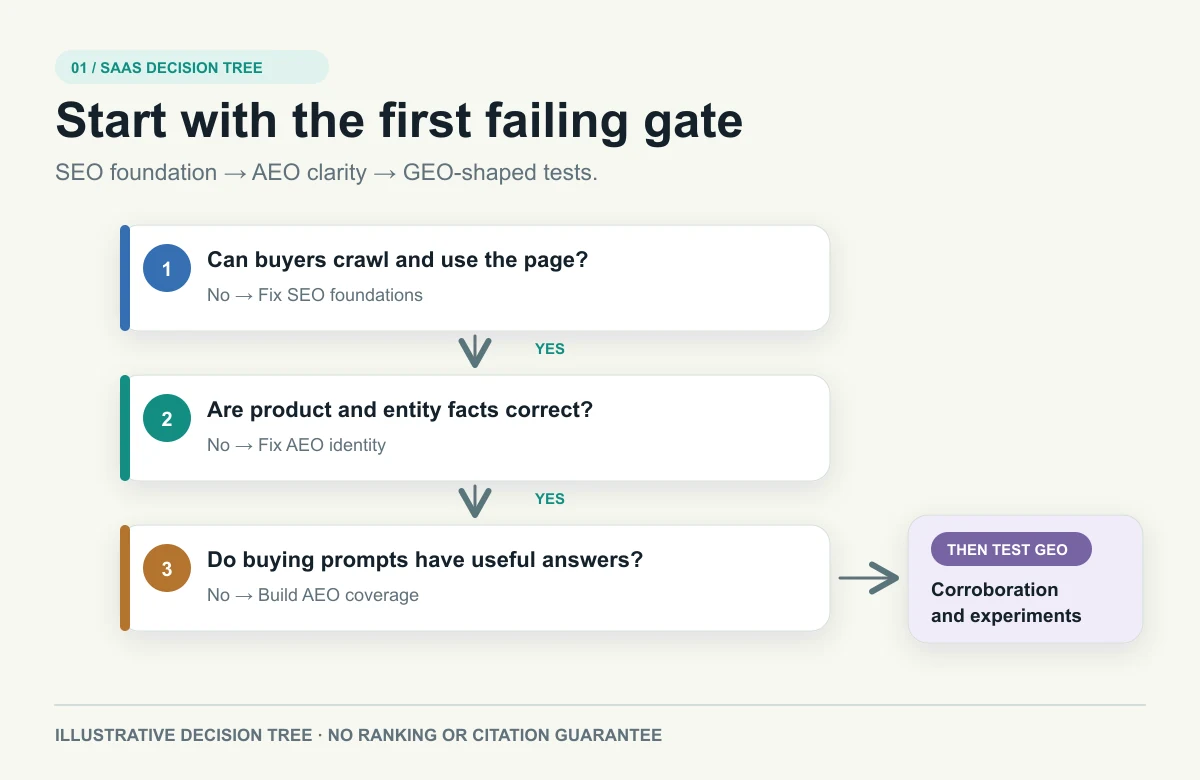
Walk the tree in order. Skipping a layer because an acronym is trendy is how SaaS teams fund duplicate work.
Decision tree (run top to bottom)
- Can buyers and crawlers reliably reach accurate product, pricing, and comparison URLs? If no → prioritize SEO fundamentals (indexation, IA, helpful content) before any AEO/GEO package.
- Do identity prompts (“What is [Brand]?”, “[Brand] vs [Competitor]”) return the correct company and category on two answer surfaces? If no → prioritize entity clarity and Organization-aligned facts (AEO identity work) before generative experiments.
- For the ten prompts that influence pipeline (category, alternative, integration, pricing-intent), do you appear with accurate claims and citeable URLs? If no → prioritize answer-ready pages, corroboration, and prompt coverage (core AEO).
- Are generative answers synthesizing competitors from third-party reviews, listicles, and docs you lack? If yes → add GEO-shaped assets (synthesis-friendly explainers, comparison clarity, earned mentions) on top of AEO—not instead of it.
- Is a vendor selling “GEO only” with no SEO or entity baseline? Treat that as a risk flag; ask for a mapped SoW against the layers above.
Sources: AI features and your website, Optimizing for generative AI features, Organization structured data.
Decision criteria SaaS teams can score
Score each criterion 0–2 (missing / partial / solid). Low SEO scores dominate the roadmap even if executives asked for GEO. Low identity scores mean AEO before generative flourish. High SEO and identity with weak generative presence is where GEO-labeled work earns its keep.
SaaS scoring sheet for SEO vs AEO vs GEO investment
| Criterion | Mostly SEO | Mostly AEO | Mostly GEO-shaped | Failure signal |
|---|---|---|---|---|
| Crawl / index / Core page quality | Primary | Depends on it | Depends on it | Key URLs absent or thin in classic results |
| Entity / category accuracy in answers | Supports | Primary | Overlaps | Wrong company or wrong category on name prompts |
| Buying-prompt coverage (alts, vs, integrations) | Supports | Primary | Overlaps | Competitors cited; you absent on pipeline prompts |
| Synthesis in generative answers / AI Overviews | Eligibility layer | Strong overlap | Primary emphasis | Answers paraphrase rival docs you never published |
| Measurement of mentions vs citations vs leads | Search Console + analytics | Prompt logs + citations | Same + generative-specific notes | One vanity “AI score” with no lead row |
Sources: Helpful, reliable, people-first content, AI features and your website.
When a “GEO agency” answer is really AEO work
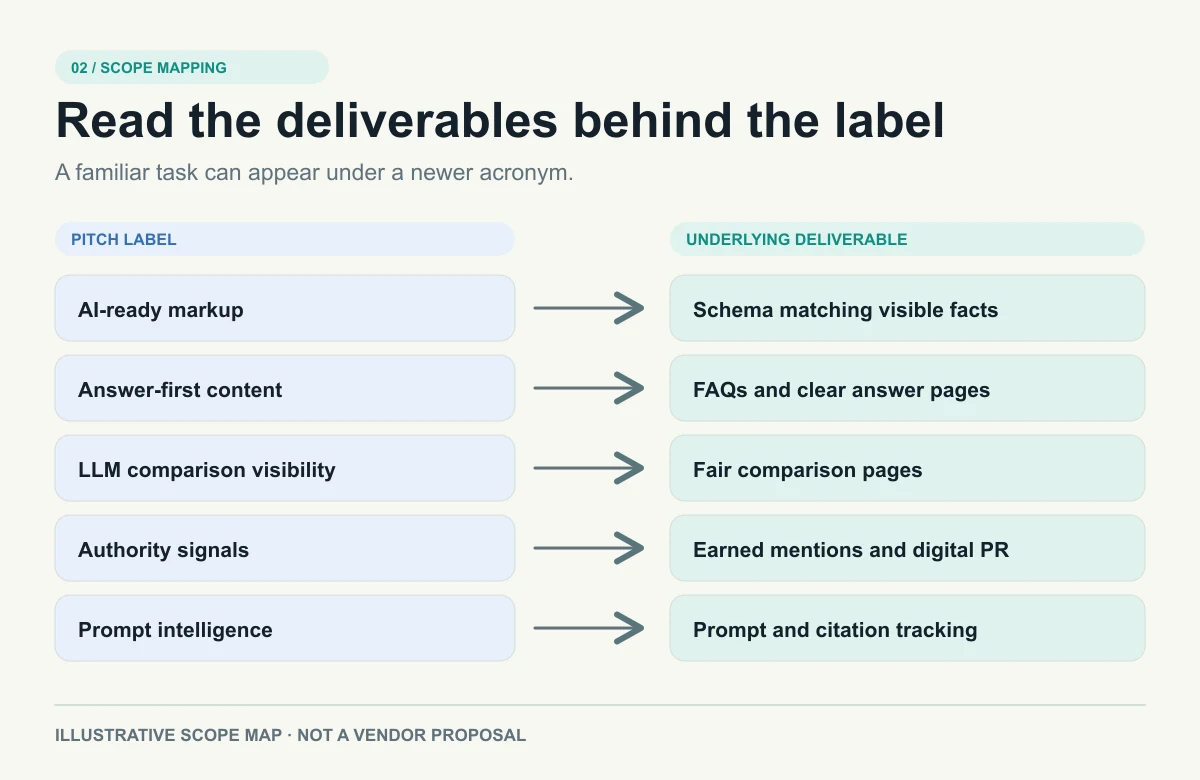
Sales language drifts faster than deliverables. A pitch deck that says GEO may still list: technical SEO fixes, Organization schema, FAQ blocks, comparison pages, digital PR for mentions, and weekly prompt tracking. That bundle is AEO (and often AI SEO) under a GEO headline. Paying separately for “AEO services” and “GEO services” that produce the same page set is how budgets evaporate.
Ask vendors to map every line item to a layer: SEO foundation, AEO answer-readiness, or GEO-specific generative experiment. Ask which engines they measure (ChatGPT, AI Overviews, Perplexity, Gemini, Claude, Grok, Copilot, classic Google) and how they separate mentions, citations, referrals, and qualified leads. TopFound’s measurement resource exists so buyers can insist on that separation: /resources/how-to-measure-ai-search-visibility.
Be equally skeptical of SEO-only agencies that rename last year’s content calendar as AEO without prompt logs or entity work. The acronym on the invoice matters less than whether identity accuracy and buying-prompt coverage improve on a dated schedule.
Sources: Optimizing for generative AI features, Organization structured data.
Worked example (fictional): Ledgerly, a B2B usage-billing SaaS
Label: fictional product. Ledgerly is an illustrative usage-billing platform for mid-market SaaS finance teams. It is not a TopFound client case study and the numbers below are teaching scaffolding, not measured results.
Week 0 snapshot (illustrative): Classic Google shows the homepage and docs for brand queries, but the “Ledgerly vs ChargePort” comparison URL returns soft 404s on mobile. ChatGPT describes Ledgerly as a consumer budgeting app (wrong category—entity collision with a same-name personal finance blog). Perplexity cites ChargePort and two review sites for “best usage billing software,” with no Ledgerly mention. Google AI Overview for a category prompt paraphrases a ChargePort integration guide. Executives ask for a GEO agency tomorrow.
Decision-tree application: SEO score is weak on a critical comparison URL—fix that before generative spend. Identity score fails on name prompts—AEO entity clarity is mandatory. Buying-prompt coverage fails—core AEO pages and corroboration required. Only after those layers does a GEO-shaped push (synthesis-friendly architecture explainers, earned mentions on credible review/list surfaces) make sense.
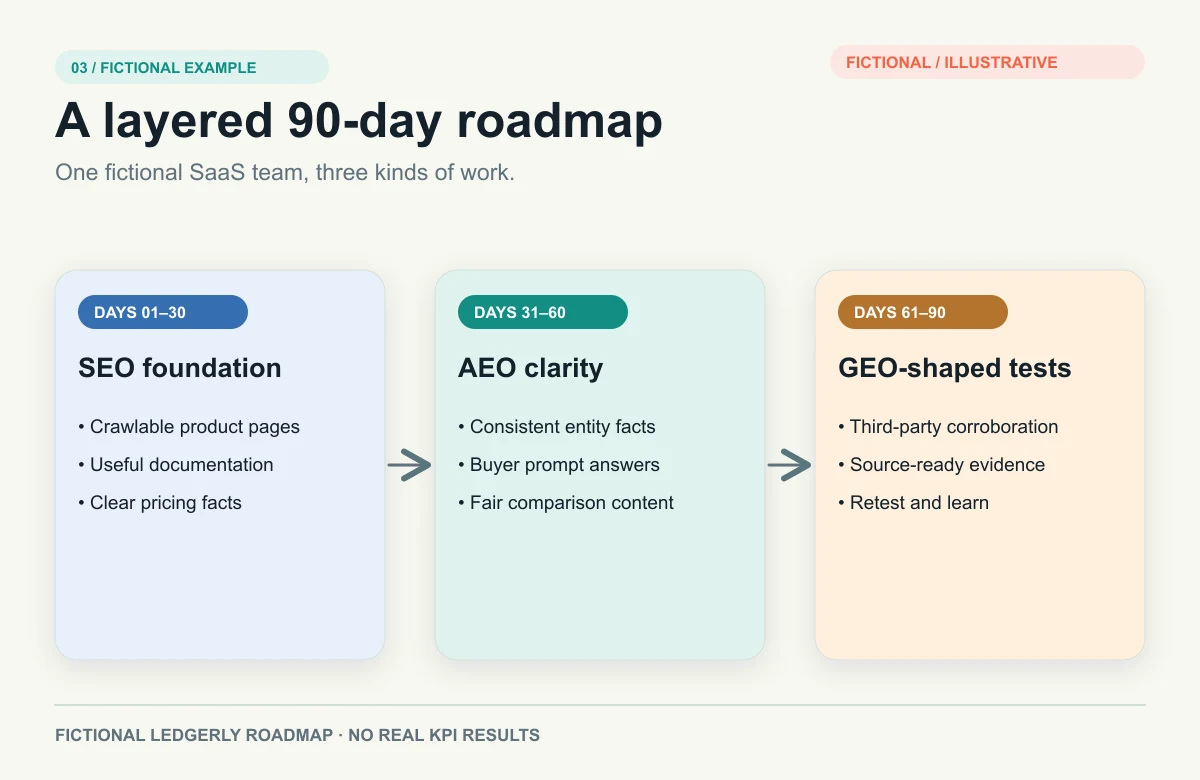
Ninety-day illustrative sequence: (1) Restore comparison and pricing IA; align helpful-content standards on money pages. (2) Publish a clear “What is Ledgerly?” answer, disambiguatingDescription-quality Organization facts, and llm-info style machine notes. (3) Ship answer-ready pages for the ten pipeline prompts; start a prompt log across two surfaces. (4) Add one generative-oriented architecture explainer and pursue two credible third-party mentions. (5) Report mentions, citations, organic/AI-assisted referrals, and qualified leads as separate rows—no single vanity score.
Illustrative week-12 pattern: brand identity prompts stabilize; two buying prompts begin citing Ledgerly docs; AI Overview still often omits them—UNKNOWN whether that clears without further corroboration. The team does not declare “#1 GEO win.” They keep the tree: foundations first, then answer coverage, then generative emphasis.
Illustrative Ledgerly scorecard (fictional)
| Layer | Week 0 | Week 12 pattern | Primary work type |
|---|---|---|---|
| SEO foundations | Broken comparison URL | Money pages indexable | SEO |
| Identity accuracy | Wrong category in ChatGPT | Mostly correct brand facts | AEO |
| Buying-prompt citations | Absent | Partial on 2/10 prompts | AEO |
| Generative synthesis presence | Competitor docs paraphrased | Still competitor-heavy | GEO-shaped next |
Sources: Helpful, reliable, people-first content, Organization structured data, AI features and your website.
An operating cadence that respects all three layers
Weekly: sample a fixed prompt set on at least two answer surfaces; log entity verdict, cited URLs, and date. Keep the SaaS audit checklist nearby (/resources/aeo-audit-checklist-b2b-saas) so technical and content gaps stay visible.
Biweekly: ship one foundation fix (SEO) or one answer-ready asset (AEO)—not five unfinished acronym initiatives. Prefer pages that map to pipeline prompts: alternatives, integrations, security, pricing intent, and implementation how-tos.
Monthly: review whether generative answers still synthesize only competitor material. If yes, add GEO-shaped work: clearer explanatory architecture, diagrams with HTML-visible lessons, and earned corroboration. Measure with the methods on /resources/how-to-measure-ai-search-visibility rather than a vendor’s unexplained composite score.
Quarterly: re-evaluate vendors and internal owners. If your “GEO retainer” never touched identity failures, re-map the SoW. If your SEO retainer ignores AI answer logs, add AEO ownership—internal or managed—without pretending classic rankings alone equal answer presence.
Minimum viable measurement set
- Ten pipeline prompts + five identity prompts, exact strings.
- Two surfaces minimum (for example ChatGPT and Perplexity, or AI Overview plus one assistant).
- Four report rows: mentions, citations, referrals, qualified leads.
- One owner for crawl/helpful-content defects; one owner for answer logs.
- No invented volumes; label any Semrush/Ahrefs/Trends figures with tool and date when used in decks.
Sources: AI features and your website, Optimizing for generative AI features.
Budget sequencing without double-paying for acronyms
A practical SaaS budget order: (1) fix blockers that prevent eligibility—crawl, thin money pages, contradictory product facts; (2) fund AEO identity and buying-prompt coverage; (3) fund GEO-shaped corroboration and generative-specific assets where the tree says you are ready. AI SEO retainers that already include technical SEO plus answer-ready content may cover large parts of (1) and (2); read the SoW before stacking a separate GEO fee.
TopFound publishes separate service URLs because buyers search different labels—/services/ai-seo-services, /services/aeo-services, /services/generative-engine-optimization—and an agency overview at /answer-engine-optimization-agency. That information architecture should help navigation; it should not encourage three overlapping invoices for one roadmap. On a sales call, ask which layer each deliverable serves.
Commercial honesty matters. TopFound’s public offer for qualified Growth and Scale plans is 30% more qualified organic and AI traffic in 90 days or work free until it lands (Growth $797/mo, Scale $1,297/mo, custom above), with a free audit path via /schedule-call or /aeo-report. That is a scoped commercial promise—not a claim that GEO, AEO, or SEO acronyms alone produce citations. Never invent “#1 agency” language to win a generative pitch.
Sources: Helpful, reliable, people-first content.
Honest limits
No keyword strategy, schema field, or diagram guarantees a ChatGPT citation or an AI Overview link. Google’s AI-features documentation is explicit about foundations and the absence of special guarantee markup. Treat every generative appearance as contingent on retrieval corpora that change.
Hard difficulty on “generative engine optimization” (Semrush 77% Hard; Ahrefs Hard) means many strong pages already compete. Publishing a thin “what is GEO” clone will not outrun that field—and would collide with /aeo-explained and service pages if TopFound tried it here. Decision-tree teaching plus a SaaS example is the distinct job.
OpenSEO credits were $0 at research time for this run; do not invent OpenSEO volumes. Use only labeled Semrush, Ahrefs, and Trends snapshots when you mention demand, and keep them out of fictional examples as if they were client KPIs.
Sources: AI features and your website, Optimizing for generative AI features.
Common questions about GEO vs AEO vs SEO for SaaS
What is generative engine optimization (GEO)?
Generative engine optimization is the practice of improving how generative AI systems and generative search experiences represent your brand inside synthesized answers. For B2B SaaS it usually overlaps with Answer Engine Optimization (entity clarity, answer-ready pages, corroboration, prompt measurement) plus synthesis-friendly assets. It does not replace SEO foundations and does not guarantee citations.
How is AEO different from SEO?
SEO focuses on crawlable, helpful, indexable pages and classic ranking eligibility. AEO (Answer Engine Optimization) is additive: it clarifies entities, questions, and corroboration so answer engines and AI features can retrieve and cite the right brand. Skipping SEO hygiene to chase AEO or GEO packages usually wastes budget.
What is the difference between GEO, AEO, and SEO for SaaS?
SEO is the foundation of crawlable, helpful pages for classic search eligibility. AEO focuses on accurate retrieval and citation across answer engines and AI features. GEO emphasizes visibility in generative answers; in SaaS practice it often overlaps heavily with AEO. Use a decision tree to sequence investment instead of treating them as mutually exclusive buys.
Is a GEO agency different from an AEO agency?
Sometimes in branding, not always in deliverables. Ask for a statement of work mapped to SEO foundations, AEO answer-readiness, and any truly generative-specific experiments. If the SoW is prompt tracking, entity cleanup, FAQs, comparisons, and PR mentions, you are looking at AEO-class work regardless of the GEO label.
Should SaaS teams skip SEO and go straight to GEO?
No. Google’s guidance for AI features still rests on foundational Search practices. Broken product or comparison URLs, thin helpful content, and contradictory facts undermine generative visibility. Fix eligibility and identity before funding generative-only experiments.
How should we measure progress?
Keep mentions, citations, referrals, and qualified leads on separate rows. Log exact prompts, surfaces, and dates. Use /resources/how-to-measure-ai-search-visibility for methods. Do not collapse everything into one vendor “AI score,” and do not invent tool metrics you did not pull.
Where should I go next on TopFound’s site?
Definitions: /aeo-explained. AEO meaning collision (not customs / not American Eagle): /blog/what-is-aeo-marketing-not-customs. SaaS checklist: /resources/aeo-audit-checklist-b2b-saas. Measurement: /resources/how-to-measure-ai-search-visibility. Services: /services/generative-engine-optimization, /services/aeo-services, /services/ai-seo-services. Agency overview: /answer-engine-optimization-agency. Monitor vs execute: /blog/aeo-agency-vs-ai-visibility-tools. Free baseline: /aeo-report or /schedule-call.
Sources: AI features and your website, Optimizing for generative AI features, Helpful, reliable, people-first content.
Pick the layer, then measure the prompts that matter
Use the SaaS audit checklist and measurement guide, compare service scopes, or request a free AEO audit if you want a baseline before a call.
Conclusion
GEO vs AEO vs SEO is a sequencing problem for B2B SaaS, not a tribal debate. Start with SEO eligibility, fix identity and buying-prompt coverage under AEO, then add GEO-shaped generative work where synthesis still favors competitors. When a GEO pitch maps to the same deliverables as AEO, buy the roadmap once.
Use dated prompt logs, separate commercial metrics, and hard differentiation from definition and service pages so this decision guide stays useful. When identity is the bottleneck before acronym sequencing, start with /blog/entity-seo-for-saas. Tool demand for generative engine optimization is real and competitive; that is a reason to teach clearly—not a reason to invent rankings, guarantees, or OpenSEO numbers. Keep AEO additive to SEO, keep GEO honest about overlap, and let the decision tree—not the trendiest acronym—set the next sprint.
Your next three actions
- Score your SaaS stack on the five criteria table; fund the lowest layer first.
- Map any GEO or AEO vendor SoW to SEO / AEO / GEO-shaped line items and delete duplicates.
- Stand up a ten-by-two prompt log this week and review it beside the B2B SaaS audit checklist before buying a new acronym retainer.