
The short answer
AI SEO means two things: using AI tools to do SEO work faster, and optimizing a site so AI search features such as Google AI Overviews, ChatGPT, and Perplexity can find and cite it. Both rest on ordinary SEO. Google allows AI-assisted content that helps people, but treats mass-produced, low-value pages as spam.
Key takeaways
- Demand note (labeled, 2026-10-31 lock): Ahrefs Lite US, 2026-10-31 — “ai seo” SV 7.8K / KD 60; related “seo ai” 3.2K, “ai for seo” 2.3K, “seo for ai” 1.6K. Tool readouts, not a TopFound traffic forecast.
- Meaning one, AI for SEO: Google says generative AI can be useful for research and for adding structure to original content, but generating many pages without adding value may violate its scaled content abuse policy.
- Meaning two, SEO for AI: Google says its AI features are rooted in core Search ranking and quality systems, and that optimizing for them is still SEO. There are no additional technical requirements.
- Each AI assistant documents its own search crawler: OAI-SearchBot for ChatGPT search, Claude-SearchBot for Claude, PerplexityBot for Perplexity, and Googlebot for AI Overviews and AI Mode.
- Google asks for a manual fact check of AI-generated content, including titles, meta descriptions, structured data, and alt text, because generative models can produce inaccuracies.
- Measure AI SEO with first-party data where it exists: Search Console’s Generative AI performance report, Bing Webmaster Tools’ AI Performance report, AI referrals in analytics, and a dated prompt log.
Who this guide is for
This guide is for marketers, founders, and SEO leads who keep hearing “AI SEO” and want a straight answer to what it is, what has actually changed, and what to do about it. It covers both common meanings of the term, the rules Google has published for each, and a checklist you can start this week.
Statements about Google, OpenAI, Anthropic, Perplexity, and Microsoft come from their own documentation, fetched between October 29 and 31, 2026 and linked below. These pages change, so check them before acting on a detail. We don’t rank tools or quote third-party studies on AI traffic; where nobody has published reliable numbers, we say so.
Page ownership: this URL owns the AI SEO definition and overview. Choosing AI SEO software lives on /blog/ai-seo-tools. Engine-by-engine crawler setup lives on /blog/llm-seo. Running it as a SaaS program lives on /blog/ai-search-optimization-playbook. Managed AI SEO services live on /services/ai-seo-services.
What is AI SEO?
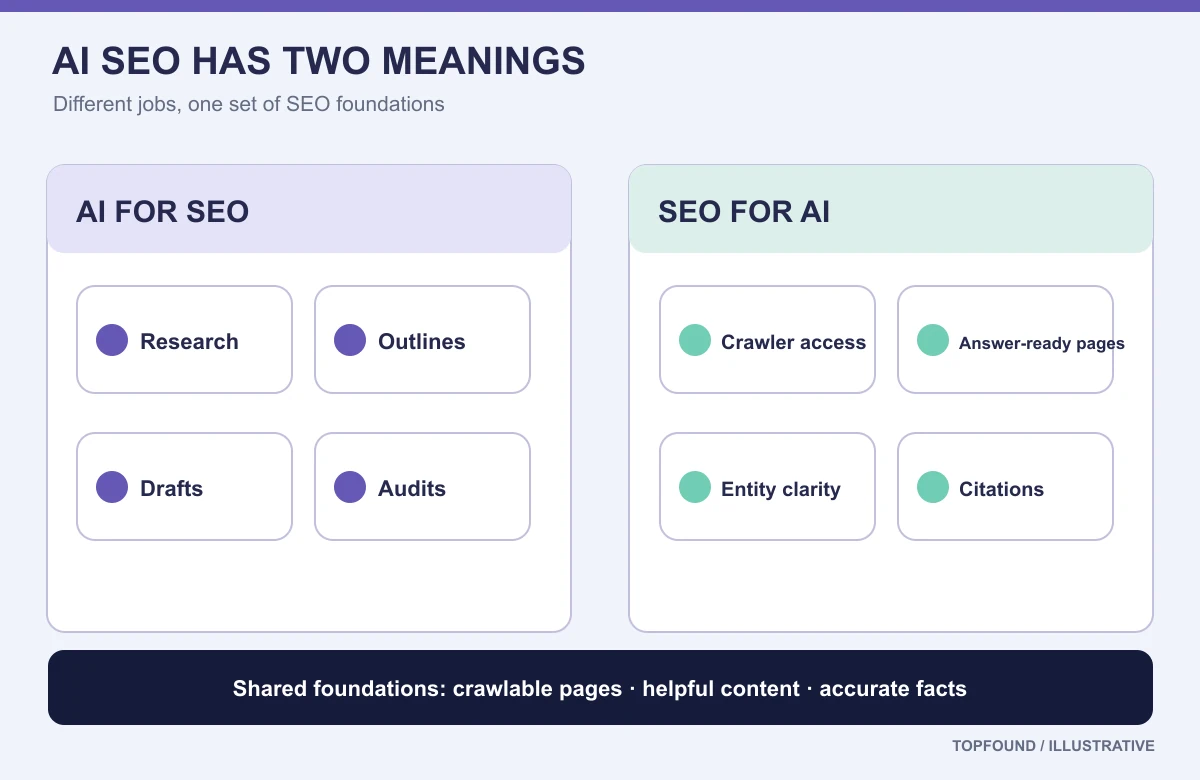
AI SEO is a label for two different jobs that often get mixed up. The first is AI for SEO: using AI tools, such as large language models and AI features inside SEO software, to do research, analysis, and content work faster. The second is SEO for AI: making a website easy for AI search features, such as Google AI Overviews and AI Mode, ChatGPT search, Perplexity, and Claude, to retrieve, understand, and cite.
The two meet in practice. A team might use AI to draft a comparison table and then publish it on a page designed to be quoted by AI answers. But they carry different risks. The risk in AI for SEO is publishing low-value or inaccurate pages at scale. The risk in SEO for AI is chasing shortcuts that the search engines say don’t work.
People search for the same idea in many ways: “SEO AI”, “AI for SEO”, “SEO for AI”, “AI and SEO”, and “AI SEO optimization”. Ahrefs groups the term under the broader parent topic “SEO artificial intelligence”. This guide treats them all as one topic with two halves.
The two meanings of AI SEO
| AI for SEO | SEO for AI | |
|---|---|---|
| Goal | Do SEO work faster or at larger scale | Get found and cited in AI answers |
| Typical work | Research, clustering, outlines, drafts, audits, code | Crawler access, answer-ready pages, entity clarity, corroboration |
| Main risk | Inaccurate or mass-produced pages | Shortcuts that engines ignore or penalize |
| Google’s rulebook | Generative AI content guidance, spam policies | AI features guide, Search Essentials |
| Deeper guide | /blog/ai-seo-tools | /blog/llm-seo and /blog/ai-search-optimization-playbook |
Sources: Guidance on using generative AI content on your website (fetched Oct 31, 2026), Optimizing your website for generative AI features (fetched Oct 30, 2026).
Is AI SEO different from regular SEO?
Less than the marketing suggests. The relationship between AI and SEO is closer to an update than a replacement. Google’s guide to its generative AI features says they are rooted in its core Search ranking and quality systems. They use retrieval-augmented generation, which pulls pages from the Search index, and query fan-out, which issues related searches to gather more results. Google states that, from its perspective, optimizing for generative AI search is optimizing for search, and thus still SEO. Its AI features page adds that there are no additional technical requirements beyond being indexed and eligible for a snippet, and the guide notes one Search Console condition: the site must be included in Search generative AI features, which is the default setting.
What has changed is the reader. Your page may now be read by a retrieval system that lifts a passage into an answer, not only by a person scanning a results page. That rewards pages with a direct answer near the top, clear sections, dated facts, and evidence a model can quote. It also adds new crawlers to allow, and new places to measure.
SEO vs AI SEO: what stays and what is new
| Area | Stays the same | New or more important |
|---|---|---|
| Eligibility | Indexed, crawlable, snippet-eligible pages | Allow AI search crawlers (OAI-SearchBot, Claude-SearchBot, PerplexityBot) |
| Content | Helpful, people-first, original | Direct, self-contained answers that can be quoted |
| Authority | Earned links and reputation | Genuine mentions in reviews, forums, and comparisons |
| Measurement | Search Console, analytics | Generative AI reports, AI referrals, prompt logs |
Sources: Optimizing your website for generative AI features (fetched Oct 30, 2026), AI features and your website (fetched Oct 30, 2026).
AI for SEO: where AI helps and where Google draws the line
Google’s guidance on generative AI content is short and worth reading in full. It says generative AI can be particularly useful when researching a topic and adding structure to original content. It also says that using generative AI or similar tools to generate many pages without adding value for users may violate Google’s spam policy on scaled content abuse. The spam policy itself defines scaled content abuse as many pages generated mainly to manipulate rankings rather than help users, “no matter how it’s created”.
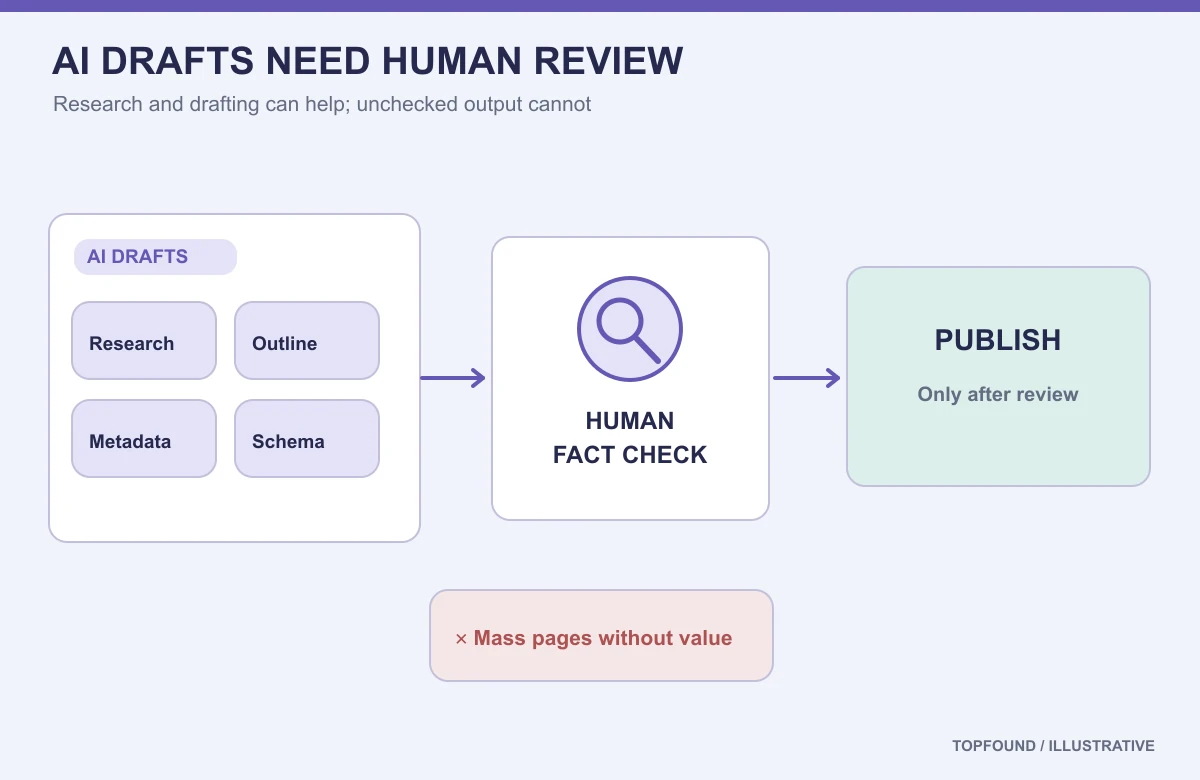
Google also asks for a human check. Its guidance notes that generative models predict likely words rather than retrieve facts, so their output can contain inaccuracies. Google says it is critical to fact-check and review all AI-generated content before publishing, and that this applies to titles, meta descriptions, structured data, and image alt text as well as body copy. It suggests telling readers how automation was used when that helps them.
AI SEO optimization done this way is mostly editorial discipline. In practice that gives a simple rule: use AI to speed up the parts of SEO work where a person still checks the result, and never use it to publish pages nobody would miss.
AI for SEO tasks and the human check each needs
| Task | Where AI helps | Human check |
|---|---|---|
| Keyword research | Grouping long lists, spotting intent | Volumes from a real tool, labeled with source and date |
| Briefs and outlines | First structure, question lists | Matches what buyers actually ask |
| Drafting | First drafts of sections or tables | Facts verified, first-hand detail added |
| Metadata | Title and meta description options | Accurate, unique, within length |
| Structured data | JSON-LD drafts | Matches visible content; validated |
| Technical audits | Reading crawl exports and logs | Fixes tested before release |
Sources: Guidance on using generative AI content on your website (fetched Oct 31, 2026), Spam policies (fetched Oct 31, 2026).
SEO for AI: how AI search engines find and cite pages
Every major AI search product retrieves web pages before it writes an answer, and each vendor documents the crawler that does it. If that crawler can’t reach your page, the page can’t be cited by that engine.
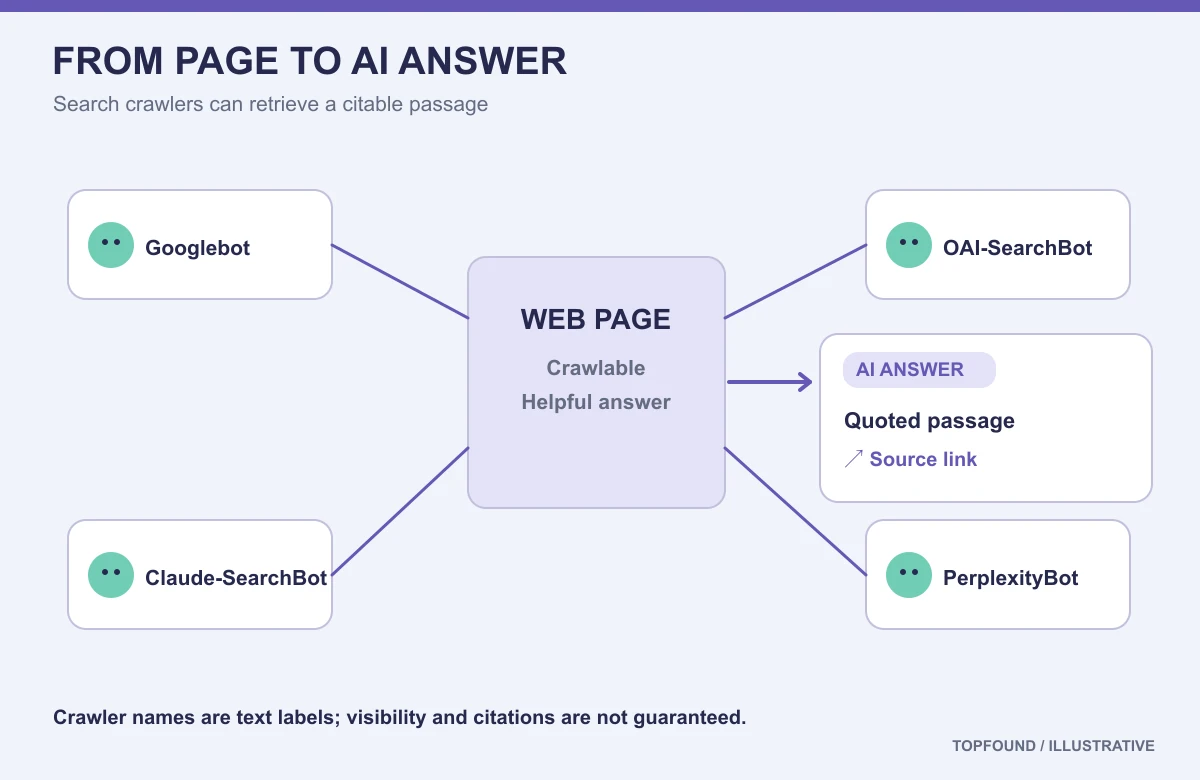
Google AI Overviews and AI Mode use the normal Search index, so Googlebot access, indexing, and snippet eligibility are the requirements. OpenAI says OAI-SearchBot is used to surface websites in ChatGPT’s search features and that sites opted out of it won’t be shown in ChatGPT search answers; GPTBot, its training crawler, is a separate setting. Anthropic lists Claude-SearchBot for search indexing and ClaudeBot for training. Perplexity says PerplexityBot surfaces and links websites in its results and isn’t used to train foundation models.
After access comes content. Google’s guide says unique, non-commodity content with a real point of view is likely to matter more than anything else in the long run, and warns that summaries of what others already say add little. Pages that answer a question directly, show evidence, and keep prices and features current give an AI system something worth quoting. The engine-by-engine setup, including a robots.txt checklist, is on /blog/llm-seo.
AI search crawlers to allow for AI SEO (vendor docs, checked Oct 29–30, 2026)
| Engine | Search crawler | Training control (separate) |
|---|---|---|
| Google AI Overviews and AI Mode | Googlebot | Google-Extended token (does not affect Search) |
| ChatGPT | OAI-SearchBot | GPTBot |
| Claude | Claude-SearchBot | ClaudeBot |
| Perplexity | PerplexityBot | Not used for training, per Perplexity |
Sources: AI features and your website (fetched Oct 30, 2026), OpenAI: Overview of OpenAI crawlers (fetched Oct 30, 2026), Claude Help Center: Does Anthropic crawl data from the web? (Apr 7, 2026; checked Oct 29, 2026), Perplexity Docs: Perplexity Crawlers (checked Oct 29, 2026), Optimizing your website for generative AI features (fetched Oct 30, 2026).
AI SEO shortcuts Google says you can skip
A lot of AI SEO advice is built on tricks. Google’s guide lists several things you don’t need for Google Search: llms.txt or other special AI files, which Google Search doesn’t use; breaking content into tiny chunks; rewriting pages in a special style for AI; seeking inauthentic mentions; and special schema for AI features. It also warns that creating separate content for every query variation, including the fan-out queries a model might run, violates the scaled content abuse policy when it is done primarily to manipulate rankings or AI responses, and calls it an ineffective long-term strategy.
Other AI systems may behave differently, and some do read llms.txt, so it isn’t harmful to keep one. But none of these files or formats replaces crawlable, helpful pages. The full myth-versus-guidance table is on /blog/ai-search-optimization-playbook, and the llms.txt details are on /blog/what-is-llms-txt.
Sources: Optimizing your website for generative AI features (fetched Oct 30, 2026).
An AI SEO checklist you can start this week
If you do nothing else, these ten steps cover both meanings of AI SEO. They are ordered so the cheap, high-leverage fixes come first.
AI SEO checklist
- Confirm your key pages are indexed in Google and eligible for a snippet.
- Check robots.txt and your CDN or firewall for Googlebot, OAI-SearchBot, Claude-SearchBot, and PerplexityBot. Decide training crawlers separately.
- In Search Console, confirm Settings > Search generative AI is set to Include.
- Put a two- or three-sentence direct answer near the top of each money page and key guide.
- Make prices, plans, limits, and integrations current and readable as plain HTML text.
- Describe your company and product the same way on your site, docs, and profiles.
- Write down where your team may use AI (research, outlines, drafts) and who checks facts before publishing.
- Fact-check every AI-assisted title, meta description, schema block, and alt text, as Google asks.
- Stop any plan to mass-publish near-identical pages for query variations.
- Set up measurement: Search Console reports, AI referrals in analytics, and a dated prompt log.
Sources: AI features and your website (fetched Oct 30, 2026), Search Console Help: Search generative AI control (fetched Oct 30, 2026), Guidance on using generative AI content on your website (fetched Oct 31, 2026).
How to measure AI SEO
There is no single AI SEO ranking to check, but there is more first-party data than a year ago. Google’s Search Console added a Generative AI performance report, rolled out to all sites by August 31, 2026, that shows impressions in AI Overviews and AI Mode by page, country, device, and date. Bing Webmaster Tools added an AI Performance report in February 2026 that shows how often your pages are cited in Microsoft Copilot and Bing’s AI summaries, with the grounding queries behind those citations. For ChatGPT, Claude, and Perplexity, use referral visits in analytics and a dated prompt log.
Here is what labeled first-party data looks like on TopFound’s own small site. In Google Search Console for September 30 to October 27, 2026, topfound.io had 7 clicks and 16,735 impressions at an average position of 57.5. Over a similar 30 days, DataFast logged 3 visitors referred from ChatGPT and about 1,400 requests from OpenAI’s indexing crawler. Those are our own readouts, not benchmarks for anyone else. The Google-specific method is on /blog/ai-overview-tracking, and cross-engine analytics on /blog/ai-search-analytics.
AI SEO measurement sources
| Source | What it shows | Limit |
|---|---|---|
| Search Console Performance (Web) | Clicks and impressions, AI features included | AI clicks not isolated |
| Search Console Generative AI report | Impressions in AI Overviews and AI Mode by page | No query dimension documented |
| Bing Webmaster Tools AI Performance | Copilot and Bing AI citations, grounding queries | Aggregated, sampled |
| Analytics referrals | Visits from chatgpt.com, perplexity.ai, claude.ai | Not every answer sends a click |
| Dated prompt log | Named? Cited? Described correctly? | Small, manual sample |
Sources: Search Console Help: Generative AI performance report (Search) (fetched Oct 30, 2026), Bing Webmaster Blog: Introducing AI Performance in Bing Webmaster Tools (Feb 10, 2026).
Choosing AI SEO tools without a fake leaderboard
AI SEO tools fall into a few groups: search data platforms, technical crawlers, content assistants, and AI visibility trackers. There is no neutral “best AI SEO tool”; the right one depends on the job and on how the tool collects its data. Ask how any AI visibility number is gathered, which engines and locations are sampled, and whether you can export raw rows. Google’s guide warns that no third-party tool has access to its internal ranking or AI systems.
Our /blog/ai-seo-tools guide covers the categories, verified examples, and a buying checklist in detail.
Sources: Optimizing your website for generative AI features (fetched Oct 30, 2026).
Common AI SEO mistakes
- Publishing AI drafts without a fact check, including titles, metas, and schema.
- Generating hundreds of near-identical pages for query variations.
- Blocking a search crawler such as OAI-SearchBot while trying to block training.
- Treating llms.txt or special markup as a ranking lever in Google.
- Buying or placing inauthentic mentions to influence AI answers.
- Letting prices, plans, and feature facts go stale.
- Reporting a single “AI score” instead of separate impressions, citations, and referrals.
- Trusting a tool that claims access to Google’s internal data.
Where managed help starts
Teams can run this guide themselves. Teams that want TopFound to audit crawler access, rewrite key pages for AI answers, and run measurement across Google, ChatGPT, and Perplexity can start with a free AEO report at /aeo-report or read about AI SEO services at /services/ai-seo-services. Public plans are on /pricing: Growth $797/month, Scale $1,297/month, and Custom scoped. For how this applies to a software company, see /blog/saas-seo.
FAQ
What is AI SEO?
AI SEO is using AI to do search engine optimization work, and optimizing a website so AI search features such as Google AI Overviews, ChatGPT, and Perplexity can find, understand, and cite it.
Is AI SEO different from SEO?
Mostly not. Google says its AI features are rooted in core Search ranking and that optimizing for them is still SEO. New parts include extra crawlers to allow, quotable answers, and new reports to measure.
Does Google penalize AI-generated content?
Google’s guidance targets value, not the tool. It says generative AI can help with research and structure, but generating many pages without adding value may violate its scaled content abuse policy.
What does AI for SEO mean?
Using AI tools to speed up SEO tasks such as keyword grouping, outlines, drafts, metadata, schema, and audit analysis, with a person checking facts before anything is published.
What does SEO for AI mean?
Making pages easy for AI search engines to retrieve and cite: allowing their search crawlers, keeping pages indexable, writing direct answers with evidence, and keeping facts current.
Do I need llms.txt for AI SEO?
Not for Google: Google says Search doesn’t use llms.txt or other special AI files. Some other systems may read it, so it is optional.
How do I measure AI SEO?
Use Search Console’s Generative AI performance report, Bing Webmaster Tools’ AI Performance report, AI referral visits in analytics, and a dated prompt log, kept as separate rows.
Where does TopFound fit?
TopFound (topfound.io) is a managed AEO / AI SEO agency. This guide is an explainer, not a case study. A soft next step is /aeo-report.
Use AI where it saves time, and optimize for AI where buyers ask
Go to the tools guide to pick software, the LLM SEO guide for crawler-by-crawler steps, and the playbook to run it as a program. TopFound (topfound.io) does not promise rankings or AI citations.
Conclusion
AI SEO is two jobs under one name. Using AI for SEO can save time on research, structure, and drafts, as long as a person checks the facts and nothing is mass-produced without value. Optimizing for AI search is still SEO at its core: let the right crawlers in, keep pages indexable, write direct and well-evidenced answers, and measure with the reports the engines now provide.
For software choices, continue to /blog/ai-seo-tools. For crawler-by-crawler setup, /blog/llm-seo. To run AI SEO as a weekly program, /blog/ai-search-optimization-playbook. For a software company’s whole SEO program, /blog/saas-seo.
Sources: Optimizing your website for generative AI features (fetched Oct 30, 2026), Guidance on using generative AI content on your website (fetched Oct 31, 2026).