

The short answer
LLM SEO is optimizing a website so AI assistants such as ChatGPT, Claude, Gemini, and Perplexity can retrieve, understand, and cite it. In practice that means allowing each engine’s search crawler, keeping pages indexable, writing direct, self-contained answers backed by evidence, and measuring citations separately from classic rankings.
Key takeaways
- Demand note (labeled, 2026-10-29 lock): Ahrefs Lite US — “llm seo” SV 1.6K / KD 20. A tool readout, not a TopFound traffic forecast.
- Every major assistant documents a separate crawler for search or retrieval: OAI-SearchBot (ChatGPT search), Claude-SearchBot (Claude), PerplexityBot (Perplexity), and Googlebot for AI Overviews and AI Mode.
- Training controls are separate: GPTBot and ClaudeBot are training crawlers, and Google-Extended is a robots.txt token for Gemini training and grounding. Per each vendor’s docs, opting out of training does not, by itself, block search retrieval.
- Google says AI features are rooted in core Search ranking, use query fan-out, and need no llms.txt, special schema, or chunked content.
- Measure LLM SEO with dated prompt logs and AI referrers, kept apart from rank tracking. TopFound’s own DataFast logs show OpenAI as the most active indexing bot on topfound.io in the 30 days to Oct 27, 2026.
Who this guide is for
This guide is for SaaS marketers, SEO leads, and developers who want their site to show up when people ask ChatGPT, Claude, Gemini, or Perplexity about their category. It is deliberately practical: what each engine has documented about how it finds pages, what to change on your site this week, and how to tell whether it worked.
Every technical claim here comes from the vendors’ own documentation, fetched on October 29, 2026. Crawler names and rules change, so check the linked pages before you edit robots.txt. Where a vendor has not documented something, we say so.
Page ownership: this URL owns LLM SEO as a hands-on, engine-by-engine how-to. The full generative engine optimization system lives on /blog/generative-engine-optimization. What LLM visibility means and how to track it lives on /blog/llm-visibility. The SaaS implementation cadence lives on /blog/ai-search-optimization-playbook. This page links to those instead of repeating them.
What is LLM SEO (LLM optimization)?
LLM SEO, also called LLM optimization, LLMO, or LLM search optimization, is the practice of making a website easy for large language model products to find, read, trust, and cite. Most AI assistants that answer questions about current products do not rely only on what the model memorized in training. They search the web, retrieve pages, and write an answer grounded in what they found, often with source links. LLM SEO targets that retrieval step.
Google describes the same mechanism for its own AI features. Its generative AI guide says AI Overviews and AI Mode are rooted in core Search ranking and quality systems, and use retrieval-augmented generation (grounding) plus query fan-out, a set of related searches the model issues to gather more results. Google’s position is that optimizing for its AI features is still SEO. That is a useful anchor: LLM SEO is not a separate discipline with secret rules. It is search optimization with a few new crawlers and a stronger premium on clear, quotable answers.
LLM SEO vs nearby terms on this site
| Term | What it covers | Where it lives |
|---|---|---|
| LLM SEO | Hands-on work so AI assistants can retrieve and cite your pages | This page |
| Generative engine optimization (GEO) | The full system: evidence, entities, synthesis-ready content, corroboration | /blog/generative-engine-optimization |
| LLM visibility | Whether assistants name, describe, and cite you, and how to track it | /blog/llm-visibility |
| AI search optimization | SaaS playbook: foundations, signals, testing, cadence | /blog/ai-search-optimization-playbook |
Sources: Optimizing your website for generative AI features (fetched Oct 29, 2026).
How ChatGPT, Claude, Gemini, and Perplexity find pages
Each vendor separates crawling for search from crawling for training. That split is the single most useful fact in LLM SEO, because it lets you decide independently whether your content can be cited in answers and whether it can be used to train models.
ChatGPT. OpenAI says OAI-SearchBot is used to surface websites in ChatGPT’s search features, and that sites opted out of OAI-SearchBot will not be shown in ChatGPT search answers, though they can still appear as navigational links. GPTBot crawls content that may be used for training, and OpenAI says the two settings are independent. ChatGPT-User fetches pages when a user’s request needs them; OpenAI says robots.txt rules may not apply to it because the action is user-initiated, and it is not used to decide search inclusion. OpenAI says robots.txt changes take about 24 hours to affect search.
Claude. Anthropic’s help article (April 7, 2026) lists three bots. ClaudeBot collects content that may contribute to training. Claude-User retrieves pages when a user asks Claude a question; Anthropic says disabling it may reduce visibility for user-directed web search. Claude-SearchBot indexes content to improve search results; disabling it may reduce visibility and accuracy in search results. Anthropic says its bots honor robots.txt and the Crawl-delay extension.
Perplexity. Perplexity’s docs say PerplexityBot surfaces and links websites in Perplexity search results and is not used to crawl content for AI foundation models. Perplexity-User supports user actions and, because the fetch is user-requested, generally ignores robots.txt. Perplexity says changes can take up to 24 hours and publishes WAF allow-list guidance.
Gemini and Google Search. For AI Overviews and AI Mode, Google says robots.txt rules for Googlebot are the control, and a page must be indexed and eligible to show with a snippet. There are no additional technical requirements. For the Gemini app, Google-Extended matters: Google’s crawler docs describe it as a robots.txt token (not a separate crawler) that controls whether crawled content may be used to train Gemini models and to ground answers in Gemini Apps and Vertex AI. Google says it does not affect inclusion or ranking in Google Search.
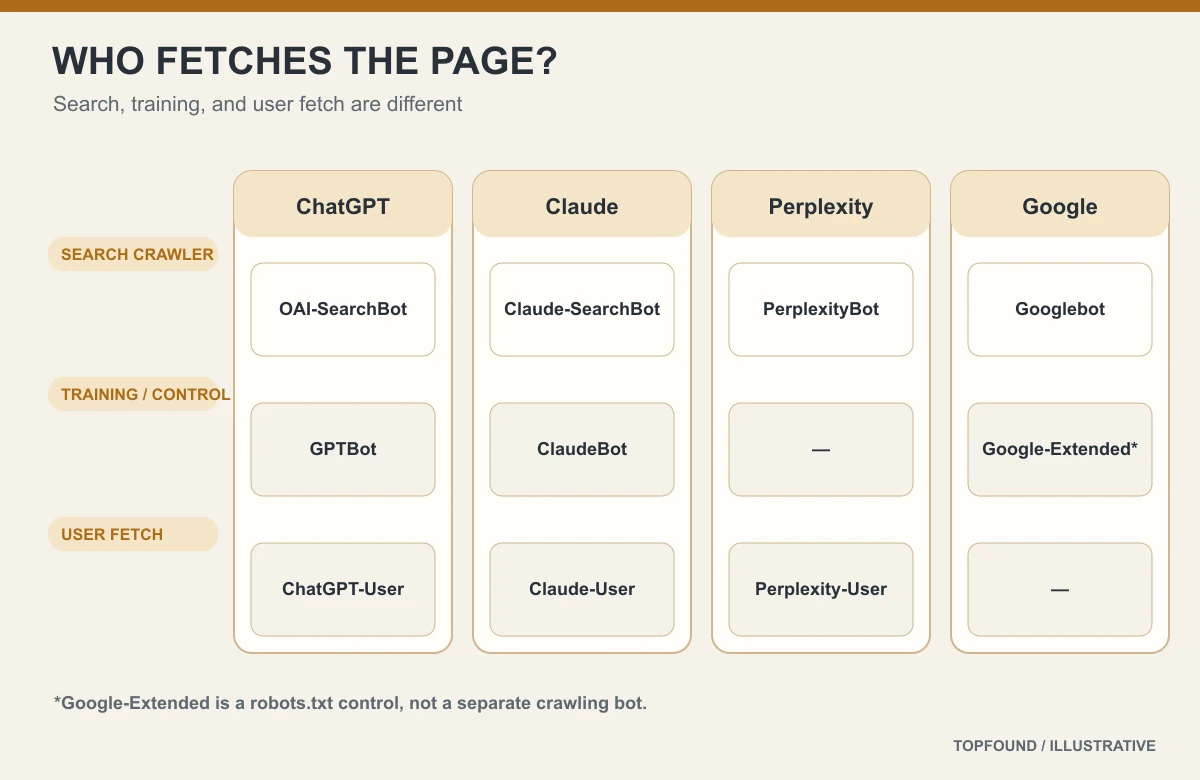
AI crawler map for LLM SEO (vendor docs, Oct 29, 2026)
| Engine | Search / retrieval crawler | Training crawler | User-initiated fetcher |
|---|---|---|---|
| ChatGPT (OpenAI) | OAI-SearchBot | GPTBot | ChatGPT-User |
| Claude (Anthropic) | Claude-SearchBot | ClaudeBot | Claude-User |
| Perplexity | PerplexityBot | None listed (PerplexityBot not used for training) | Perplexity-User |
| Google AI Overviews and AI Mode | Googlebot (standard Search index) | Google-Extended token (Gemini training and grounding) | Not covered here |
Sources: OpenAI: Overview of OpenAI crawlers (fetched Oct 29, 2026), Claude Help Center: Does Anthropic crawl data from the web? (Apr 7, 2026), Perplexity Docs: Perplexity Crawlers (fetched Oct 29, 2026), AI features and your website, Google Crawling Infrastructure: Google’s common crawlers.
Step 1 of LLM SEO: let the right crawlers in
If a search crawler cannot reach a page, no amount of content work will get that page cited by that engine. Start with an AI crawler robots.txt audit. Check robots.txt for each user agent above, then check what actually happens at the edge: CDN bot protection, firewall rules, and rate limits can block a bot that robots.txt allows. Google’s AI features page lists “crawling is allowed in robots.txt, and by any CDN or hosting infrastructure” as its first best practice, and both OpenAI and Perplexity recommend allowing requests from their published IP ranges.
Decide on training separately. Many teams allow the search crawlers so they can be cited, and make a deliberate, documented choice about GPTBot, ClaudeBot, and Google-Extended. Each vendor says these settings are independent, so a training opt-out does not need to cost you search visibility.
Make sure the content is actually in the HTML the crawler receives. Google says it can process JavaScript that is not blocked, but other crawlers document less about rendering. Server-rendered or static HTML for key facts, prices, and answers is the safe default.
LLM SEO access audit
- List each user agent: Googlebot, OAI-SearchBot, GPTBot, ChatGPT-User, Claude-SearchBot, ClaudeBot, Claude-User, PerplexityBot, Perplexity-User, plus the Google-Extended control token.
- Read robots.txt for each, on every subdomain that hosts content you want cited.
- Check CDN and WAF rules; allow published IP ranges where the vendor publishes them.
- Fetch key pages without JavaScript and confirm the answer text is in the HTML.
- Confirm key pages are indexed in Google and eligible for a snippet (no nosnippet or noindex by mistake).
- Re-check after robots.txt edits; OpenAI and Perplexity say changes can take about 24 hours.
Sources: AI features and your website, OpenAI: Overview of OpenAI crawlers (fetched Oct 29, 2026), Perplexity Docs: Perplexity Crawlers (fetched Oct 29, 2026), Claude Help Center: Does Anthropic crawl data from the web? (Apr 7, 2026).
Step 2: write content that LLMs can quote
Once a crawler can reach the page, the question becomes whether the page contains something worth citing. Google’s guide is direct about what helps most in the long run: unique, non-commodity content with a real point of view, first-hand experience, and clear organization by sections and headings. A summary of what everyone else already says gives an AI system nothing to add.
Put a direct answer near the top of each page, in two or three sentences that make sense on their own. Repeat the subject instead of starting with “It.” Follow with the evidence: numbers you can source, dates, steps, and comparisons. Mark facts that change with a date, because stale pricing and feature claims are a common source of wrong AI descriptions.
Cover the questions a buyer asks next. Google says AI Overviews and AI Mode use query fan-out, issuing related searches across subtopics. A page that answers the main question and its obvious follow-ups is more likely to be retrieved for one of them. But Google also warns that creating separate pages for every fan-out variation, primarily to manipulate rankings or AI responses, violates its scaled content abuse policy. Answer follow-ups in depth on the page that owns the topic.
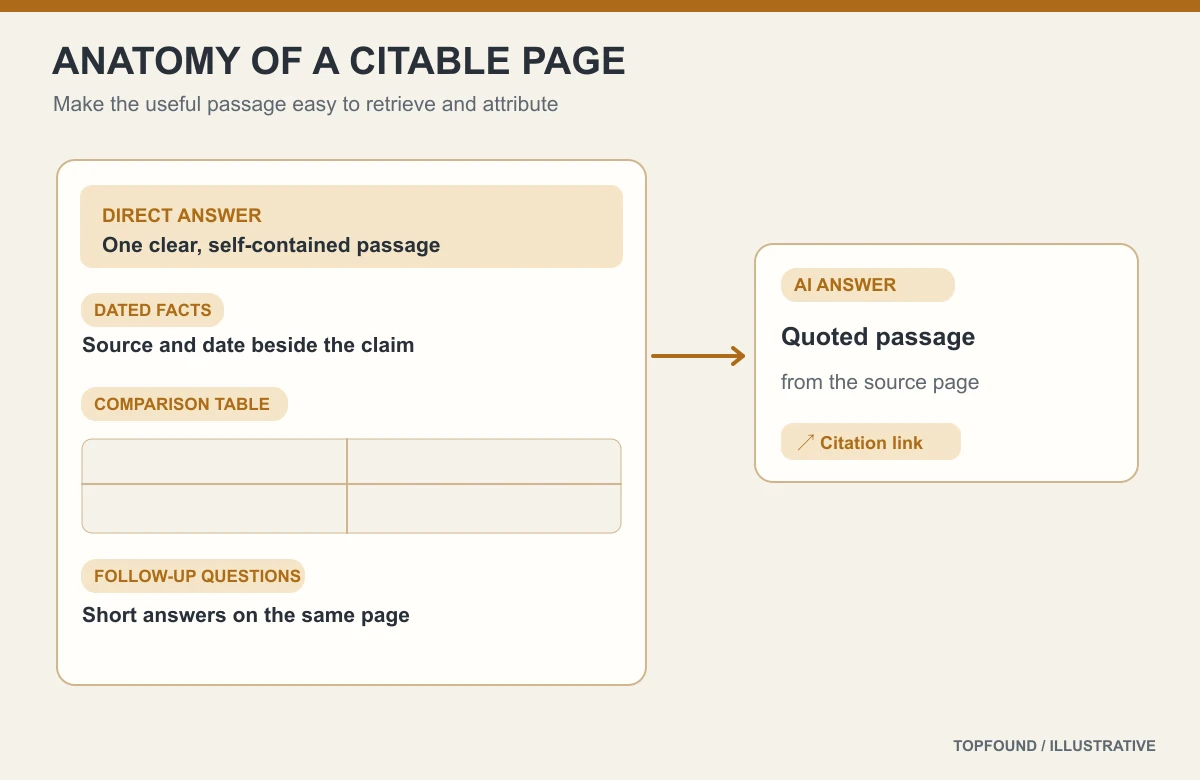
Weak vs citable passages
| Weak | Citable |
|---|---|
| “Our platform is the leading solution for modern teams.” | “[Product] is a [category] for [audience] that [does one specific thing]; plans start at [price] as of [date].” |
| “It integrates with lots of tools.” | “[Product] has native integrations with [A], [B], and [C]; others connect through [method].” |
| “It depends on your needs.” | “Choose [A] if you need [X]; choose [B] if you need [Y]. The main difference is [attribute].” |
Sources: Optimizing your website for generative AI features (fetched Oct 29, 2026), AI features and your website, Creating helpful, reliable, people-first content.
Step 3: make your brand easy to describe consistently
LLMs combine what several sources say. If your site, your profiles, your directory listings, and independent coverage describe your product in different terms, the assistant has to guess. Pick one plain description of what you are, who it is for, and what it costs, and use it everywhere you control.
Then earn corroboration the honest way. Google’s guide notes its AI features can show what is said about products across blogs, videos, and forums, and warns that seeking inauthentic mentions is not as helpful as it might seem. Real reviews, real comparisons, and real discussions carry more weight than placed mentions. The full method for entities and corroboration is on /blog/generative-engine-optimization and /blog/entity-seo-for-saas.
Sources: Optimizing your website for generative AI features (fetched Oct 29, 2026).
LLM SEO by engine: what differs
The fundamentals are shared, but each engine has its own documented controls and quirks. If you need to optimize for ChatGPT first because that is where your buyers ask, start with its row, then work across. Use this as a starting point, then go to the engine guide for depth.
Engine-specific LLM SEO notes
| Engine | What to check first | Deep dive |
|---|---|---|
| ChatGPT | OAI-SearchBot allowed; key pages in plain HTML; answers that match how buyers phrase prompts | /blog/chatgpt-seo |
| Claude | Claude-SearchBot and Claude-User allowed; Crawl-delay not set too aggressively | /blog/claude-citation-eligibility |
| Gemini / Google AI Overviews and AI Mode | Indexed and snippet-eligible in Google; normal SEO; Search Console data | /blog/gemini-ai-overviews-saas-playbook and /blog/google-ai-mode |
| Perplexity | PerplexityBot allowed in robots.txt and WAF; sources it can corroborate | /blog/perplexity-seo-for-saas |
Sources: OpenAI: Overview of OpenAI crawlers (fetched Oct 29, 2026), Claude Help Center: Does Anthropic crawl data from the web? (Apr 7, 2026), Perplexity Docs: Perplexity Crawlers (fetched Oct 29, 2026), AI features and your website.
Step 4: measure LLM SEO without inventing a rank
There is no LLM ranking report to download. Measure in three layers. First, crawl: server logs or a bot analytics tool show whether OAI-SearchBot, Claude-SearchBot, PerplexityBot, and Googlebot are fetching your pages. Second, referrals: analytics shows visits from chatgpt.com, perplexity.ai, claude.ai, and gemini.google.com. Third, answers: a dated prompt log records whether assistants name and cite you for the questions your buyers ask.
For Google, use Search Console. Google’s AI features page says appearances in AI Overviews and AI Mode are counted in the Performance report under the Web search type, and its generative AI guide points to a generative AI performance report as well. Google also warns that no third-party tool has access to its internal ranking or AI systems.
Here is what this looks like on TopFound’s own small site, labeled and dated. In the 30 days to October 27, 2026, DataFast logged OpenAI as the most active indexing bot on topfound.io (about 1,400 hits), ahead of Perplexity (577), Bing (398), and Google (311). In Google Search Console for September 30 to October 27, 2026, our /blog/google-ai-mode post earned 1,950 impressions for “google ai mode” at an average position of 11.6, while /blog/ai-search-analytics (average position 30.4) and /blog/ai-citation-optimization (33.8) had the next-best positions among our top pages. These are our own readouts, not benchmarks for anyone else. The full measurement method is on /blog/ai-search-analytics.
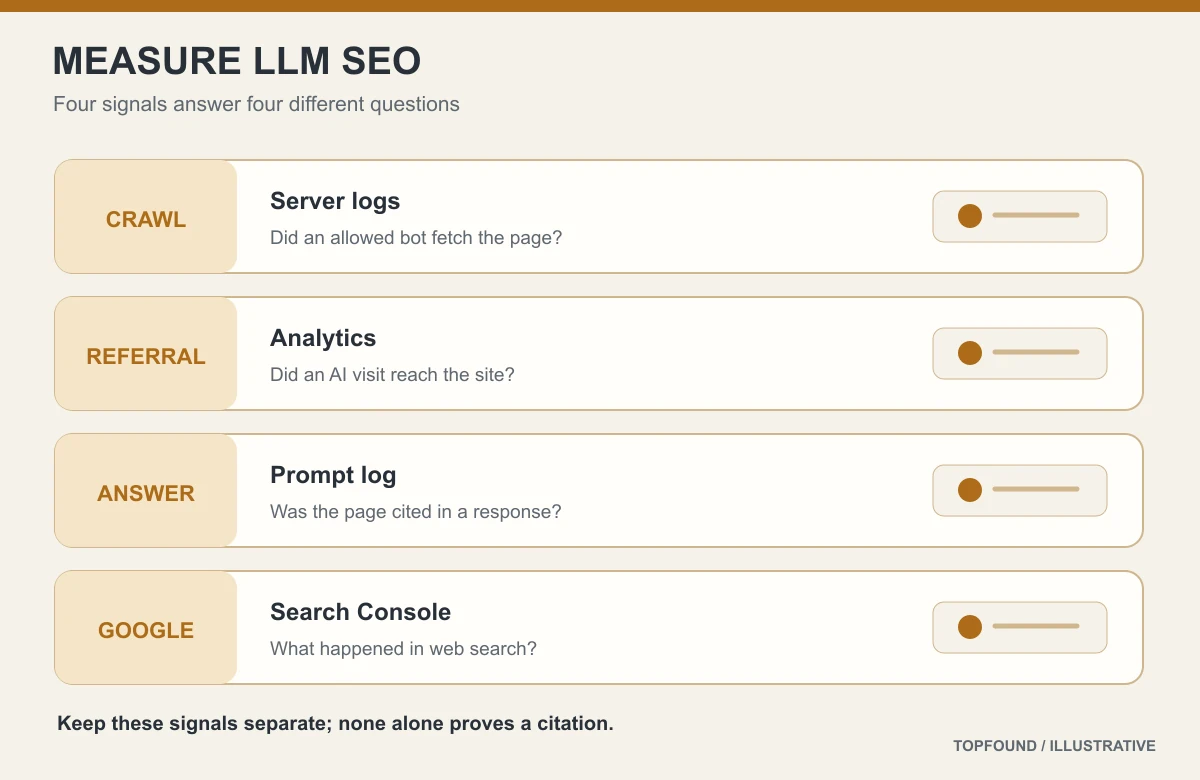
LLM SEO measurement layers
| Layer | What to record | Where |
|---|---|---|
| Crawl | Which AI bots fetch which pages, and how often | Server logs or bot analytics |
| Referral | Visits from AI assistant domains | Web analytics |
| Answer | Named? Described correctly? Cited? Dated. | Prompt log |
| Google AI features | Impressions and clicks (Web search type) | Search Console |
Sources: AI features and your website, Optimizing your website for generative AI features (fetched Oct 29, 2026).
Common LLM SEO mistakes
- Blocking a search crawler such as OAI-SearchBot or PerplexityBot while trying to block training.
- Allowing a bot in robots.txt but blocking it at the CDN or firewall.
- Hiding the key answer behind client-side JavaScript, tabs, or a login.
- Publishing one thin page per prompt variation instead of one strong page per topic.
- Relying on llms.txt or special markup as a shortcut; Google says it ignores them for Search.
- Buying or placing inauthentic mentions.
- Letting prices, features, and integrations go stale.
- Reporting a single “AI rank” instead of dated crawl, referral, and answer data.
Where managed help starts
Teams can run this guide themselves. Teams that want TopFound to audit crawler access, rewrite key pages, and run a dated prompt log across ChatGPT, Claude, Gemini, and Perplexity can start with a free AEO report at /aeo-report or the LLM visibility service at /services/llm-visibility-optimization. Public plans are on /pricing: Growth $797/month, Scale $1,297/month, and Custom scoped.
FAQ
What is LLM SEO?
LLM SEO is optimizing a site so the search and retrieval systems behind AI assistants such as ChatGPT, Claude, Gemini, and Perplexity can crawl it, understand it, and cite it in their answers.
Is LLM optimization the same as LLM SEO?
In marketing use, yes. LLM optimization and LLM SEO both mean making pages easy for AI assistants to retrieve and cite. In machine learning, “LLM optimization” can also mean tuning a model’s speed or cost, which is a different job.
What is LLMO?
LLMO is short for large language model optimization, another name for LLM SEO: allowing AI search crawlers, keeping pages indexable, and writing clear, evidence-backed answers that assistants can quote.
Is LLM SEO different from regular SEO?
Mostly not. Google says its AI features are rooted in core Search ranking and that optimizing for them is still SEO. The new parts are extra crawlers to allow and a higher premium on clear, quotable answers.
Which crawlers should I allow for LLM SEO?
For citations, allow the search crawlers: OAI-SearchBot (ChatGPT), Claude-SearchBot (Claude), PerplexityBot (Perplexity), and Googlebot (AI Overviews and AI Mode). Training crawlers such as GPTBot and ClaudeBot are separate choices.
Does blocking GPTBot remove my site from ChatGPT?
Not from ChatGPT search, according to OpenAI. GPTBot is for training and OAI-SearchBot is for search, and OpenAI says the settings are independent. Blocking OAI-SearchBot is what removes a site from ChatGPT search answers.
Do I need llms.txt for LLM SEO?
Not for Google: Google says Search ignores llms.txt and similar files. Other systems may read it, and it does no harm. Treat it as optional; crawler access and content quality matter more.
How long does LLM SEO take to work?
Crawler changes can register quickly; OpenAI and Perplexity say robots.txt changes take about 24 hours. Content changes depend on recrawling and on whether the page becomes the best source for a question, so there is no fixed timeline.
How do I measure LLM SEO?
Track three layers: AI crawler hits in logs, referral visits from assistant domains in analytics, and a dated prompt log of whether assistants name and cite you. Use Search Console for Google AI Overviews and AI Mode.
Where does TopFound fit?
TopFound (topfound.io) is a managed AEO / AI SEO agency. This guide is an explainer, not a case study. A soft next step is /aeo-report.
Open the doors, then give the engines something worth quoting
Use the GEO guide for the full system, the LLM visibility guide for tracking, and the citation guide for passage-level work. TopFound (topfound.io) does not promise citations or rankings.
Conclusion
LLM SEO comes down to four steps. Let each engine’s search crawler in, at robots.txt and at the edge. Write pages with direct, dated, self-contained answers and real evidence. Describe your brand the same way everywhere and earn genuine corroboration. Measure crawl, referral, and answer data separately, without pretending there is a single AI rank.
None of that needs a trick, and the vendors’ own documentation says as much. For the full system, continue to /blog/generative-engine-optimization; for tracking, /blog/llm-visibility; for paid placement in ChatGPT, /blog/chatgpt-ads.
Sources: Optimizing your website for generative AI features (fetched Oct 29, 2026), OpenAI: Overview of OpenAI crawlers (fetched Oct 29, 2026).