
The short answer
AI citation optimization is the disciplined process of improving the odds that answer engines cite your brand or URL when they respond to buyer questions. Practically, that means selecting the source classes models already use for your category, publishing answer-ready evidence those systems can extract, clarifying entities so the right company is credited, and measuring citations on a fixed prompt set separately from mentions, referrals, and classic rankings. Nothing guarantees a citation: Google’s AI-features guidance says Search-eligible, helpful content can be considered and appearance is not guaranteed, and chat engines choose sources per answer. This article owns the evidence-and-measurement process. Content workflow checklists live on /resources/ai-citation-optimization-content-workflow; commercial packaging lives on /services/ai-citation-optimization.
Key takeaways
- Demand notes (labeled tools, 2026-09-29 lock): Ahrefs Lite US Overview for “ai citation optimization” showed SV 80, KD 1, CPC $20. Google Trends US Past year average interest was 10 (episodic). GSC Last 28d: “ai citation optimization” 52 impressions + “ai citations optimization” 18 impressions, 0 clicks. The service page /services/ai-citation-optimization already had 129 impressions—this blog must not clone it. Tool and GSC readouts—not TopFound rankings.
- Citations ≠ mentions ≠ referrals. Log them as separate rows or you will optimize the wrong lever.
- Source selection beats random publishing: study which domains recur as citations when your brand is absent, then decide on-site vs off-site work.
- Answer-ready evidence (direct answer, proof, limits, dates) improves extractability; it does not coerce inclusion.
- Keep ChatGPT how-tos, AI Overviews workflows, tools buyer guides, and content-workflow resources on their existing URLs; this post owns the citation process lens.
What “AI citation optimization” means (and what it does not)
Buyers search “ai citation optimization” when they want a process: how to become a cited source in AI answers, not merely a mentioned brand name. The near-variant “ai citations optimization” shows the same job with plural wording. Adjacent questions—how to get cited in ChatGPT, why a company is missing from AI answers, how citations differ from mentions—often appear in the same research journey, but they already have dedicated TopFound resources. This article owns the end-to-end process lens: source selection, answer-ready evidence, entity clarity, and measurement.
Demand evidence for this lock (2026-09-29): Ahrefs Lite US Overview listed “ai citation optimization” at search volume 80, keyword difficulty 1, and CPC $20—the lowest actionable KD and highest CPC in the locked shortlist. Google Trends (US, Past year, Web Search) showed average interest 10 with episodic weekly readings. Google Search Console (Last 28 days UI period around Sep 6–Sep 26, 2026) showed “ai citation optimization” at 52 impressions and “ai citations optimization” at 18 impressions, both at 0 clicks. Separately, /services/ai-citation-optimization already recorded 129 impressions in the same GSC window—so this blog must teach process, not reproduce service-page packaging. These are labeled Ahrefs Lite / Trends / GSC figures. No OpenSEO metrics were used.
Cannibalization guardrails: content production steps stay on /resources/ai-citation-optimization-content-workflow; ChatGPT-specific tactics on /resources/how-to-get-cited-in-chatgpt; vocabulary on /resources/ai-citations-vs-brand-mentions-vs-referrals; absence diagnostics on /resources/why-your-company-is-missing-from-ai-answers; AI Overviews workflow on /blog/how-to-show-up-in-ai-overviews; tools category on /blog/answer-engine-optimization-tools. Soft CTA only to /services/ai-citation-optimization.
Sources: AI features and your website, Do I need SEO?.
The four-part AI citation optimization process
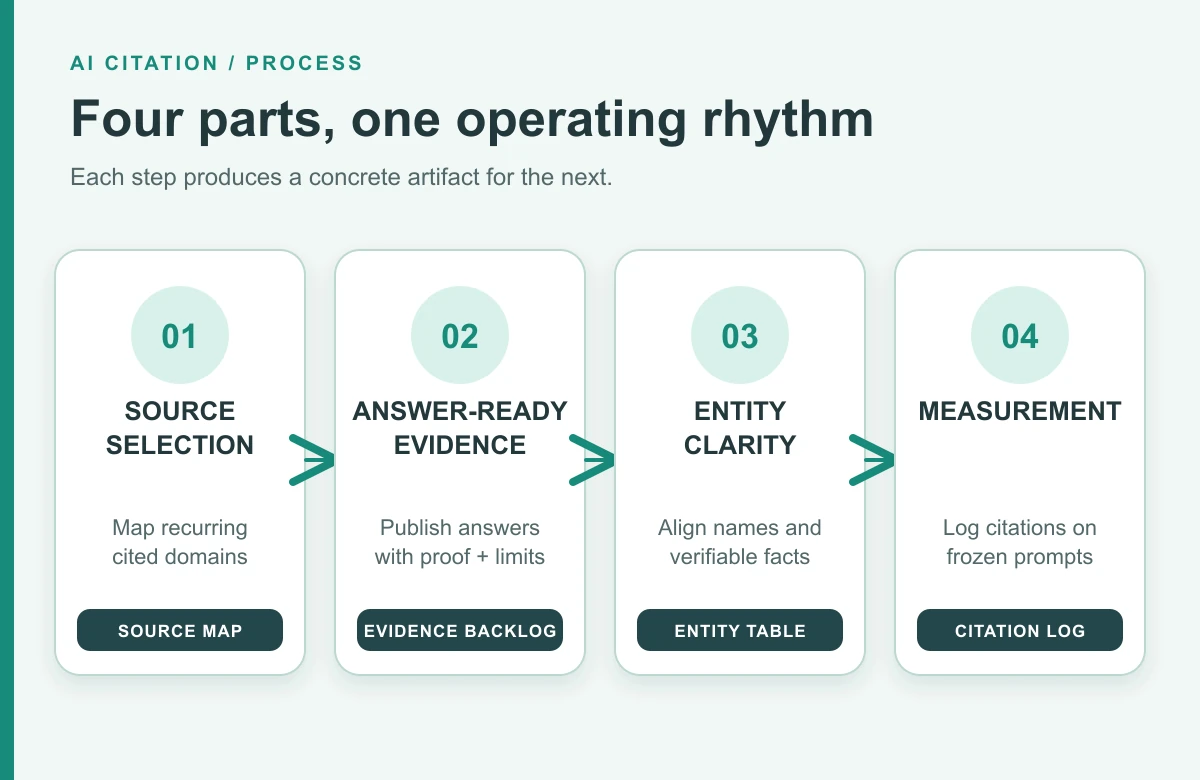
Treat citation optimization as a monthly operating rhythm with four parts. Part one—source selection—studies which domains already appear as citations for your priority prompts when your brand does not. Part two—answer-ready evidence—upgrades your own pages so a human or a summarizing model can extract a correct, scoped answer with proof and limits. Part three—entity clarity—removes avoidable confusion about who you are. Part four—measurement—logs citations on a frozen prompt set without blending them into mentions or classic ranks.
Run the parts in order for new programs. Teams often jump to content publishing without a source map, then wonder why review sites and competitor comparison posts keep winning the citation chips. Other teams buy tools without a measurement vocabulary and report “AI visibility” as one number. The process below keeps those failure modes visible.
Engines in scope for most B2B programs include ChatGPT, Google AI Overviews (and related AI Mode experiences where relevant), Perplexity, Gemini, Claude, Grok, and Copilot. You do not need every engine on day one. Start with the surfaces your buyers actually quote on sales calls, then expand the prompt set deliberately. If you need the buyer-side evaluation of managed retainers that ship this process, pair this guide with /blog/aeo-services.
Artifacts each part should produce
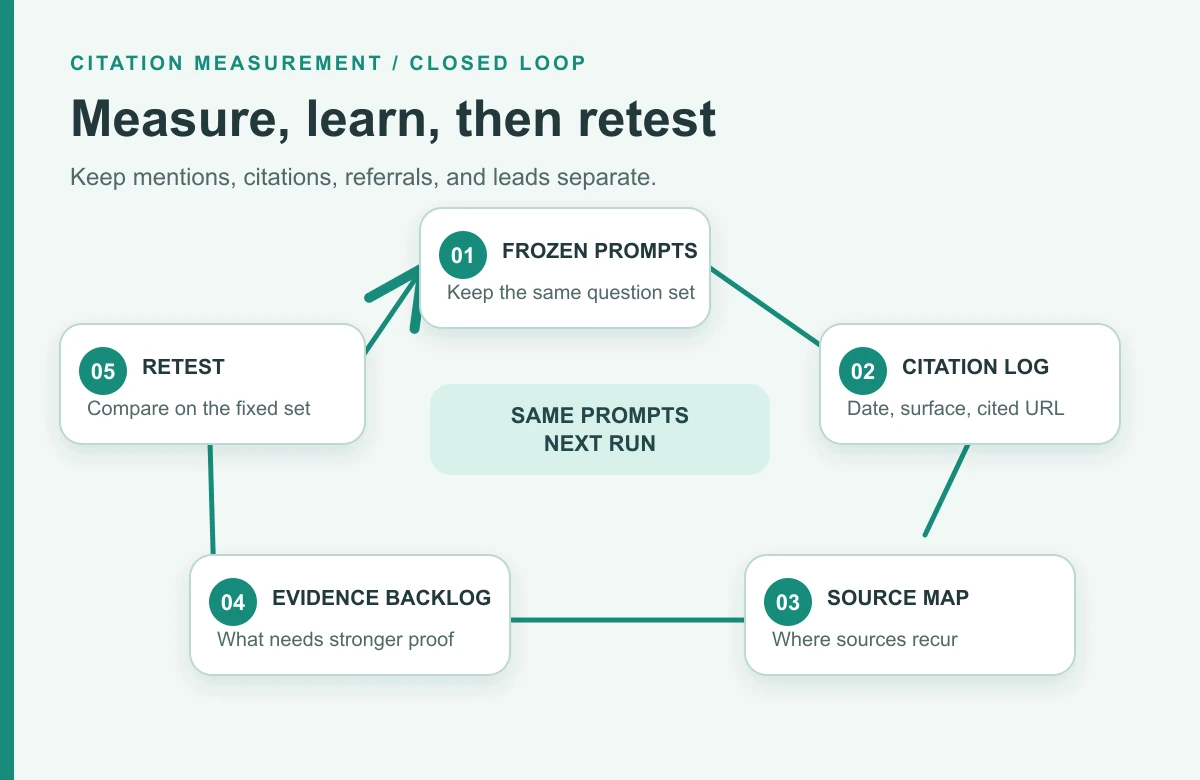
- Source map: recurring citation domains per prompt cluster.
- Evidence backlog: pages needing direct answers, proof, dates, limits.
- Entity table: canonical names, product strings, sameAs candidates.
- Citation log: date, engine, prompt, cited URL, mention-only flag.
Sources: Helpful, reliable, people-first content, Optimizing for generative AI features.
Source selection: study what models already cite
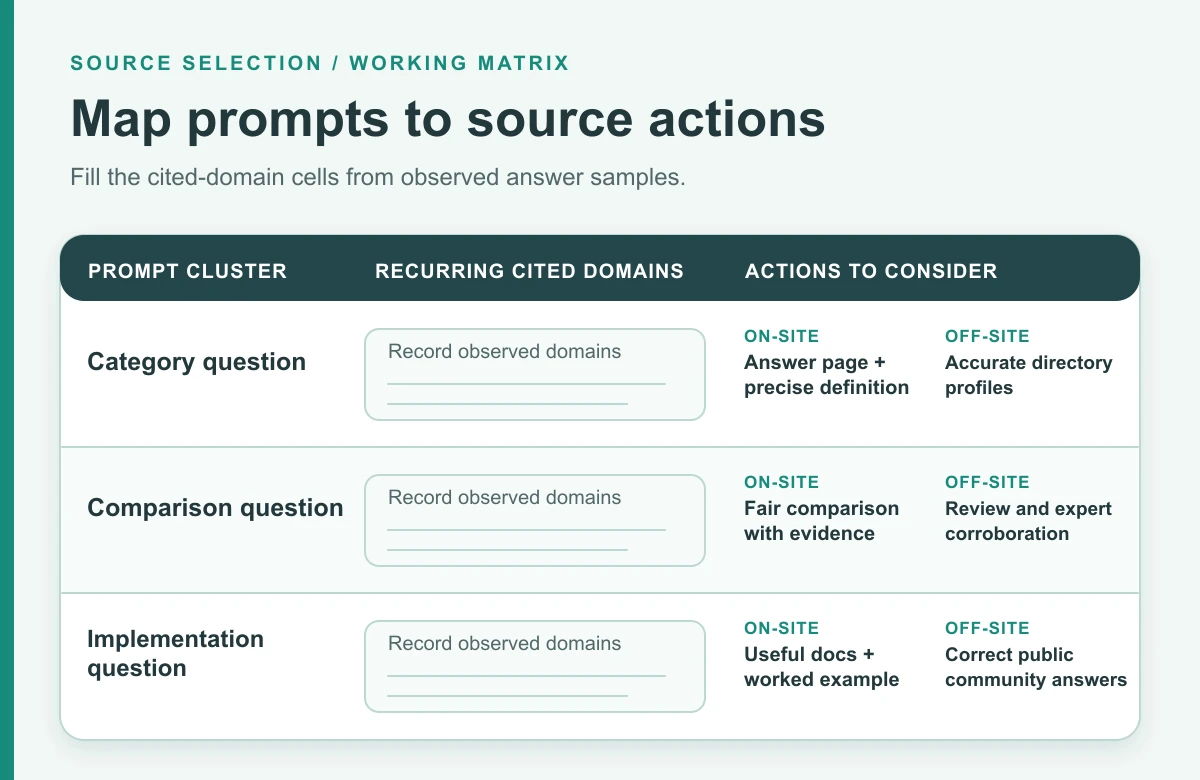
Source selection is the opposite of publishing into the void. For each high-priority prompt, record which domains appear as supporting links or named sources when your brand is absent. Rank domains by recurrence across the frozen set—not by a single flattering screenshot from one anonymous session. Recurrence tells you where corroboration energy belongs.
Common citation classes in B2B categories include official documentation, high-quality explainers, review and comparison platforms, analyst or trade press, academic or standards pages, and sometimes strong competitor education hubs. Your job is not to “be Wikipedia.” Your job is to decide, per gap, whether the fix is an on-site answer page that deserves to be cited, an earned mention on a domain that already wins citations, or both.
Be careful with vanity PR. A mention on a site that never appears in your answer samples may still help brand awareness, but it is a weak citation-optimization investment. Tie outreach to the source map. Prefer accurate, quotable facts on pages buyers and models already treat as corroborating sources.
Also separate “cited URL” from “mentioned brand.” A model can mention your product while citing a third-party review. That is a mention-plus-third-party-citation pattern, not a first-party citation win. Vocabulary details live on /resources/ai-citations-vs-brand-mentions-vs-referrals; this section only needs the distinction for prioritization.
Gap pattern → likely action
| Pattern in samples | Likely action | Avoid |
|---|---|---|
| Review platforms cited; you absent | Profile accuracy + earned reviews + on-site proof pages | Ignoring profiles while rewriting homepage hero only |
| Competitor docs cited for definitions | Publish clearer definitional answers with limits | Keyword stuffing “AI citation” into every H2 |
| Trade press cited for category claims | Pitch accurate expert explainers tied to gaps | Spray press releases unrelated to prompt map |
| Your URL mentioned but not linked/cited | Strengthen extractable evidence and corroboration | Assuming a mention equals a citation win |
Sources: AI features and your website, Helpful, reliable, people-first content.
Answer-ready evidence for AI citation optimization
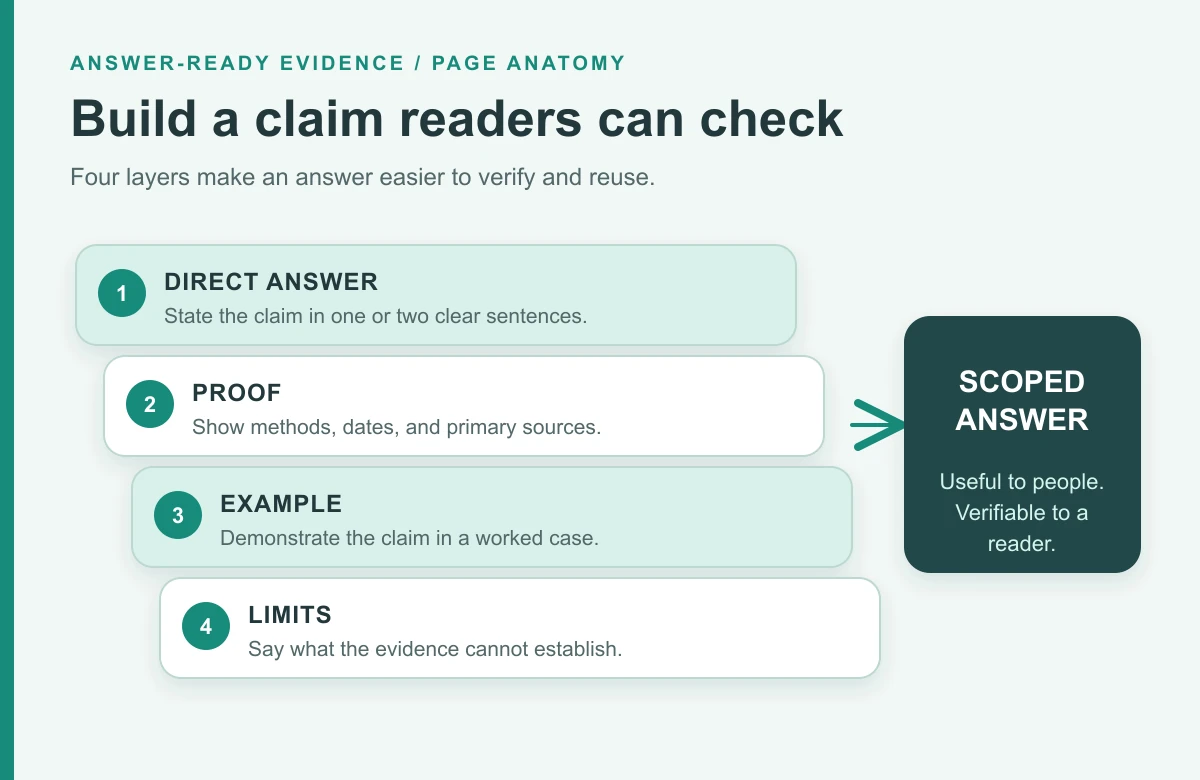
Answer-ready evidence is the on-site half of citation optimization. Lead with a direct answer in one or two sentences. Follow with proof: methods, definitions, dated statements, primary-source links near claims, and worked examples labeled as illustrative when numbers are not measured results. Close risky sections with visible limits so paraphrases do not invent guarantees.
This pattern helps humans skim and helps summarizing systems extract a scoped claim. It still does not guarantee inclusion. Google’s generative-AI optimization guidance and AI-features documentation both emphasize foundational helpful content and Search eligibility—not a proprietary “citation schema.” Structured data should match visible text; it is not a coercion mechanism.
Prioritize pages that map to prompts where you are already close: you rank in classic results, you are mentioned without citation, or competitors’ weaker explainers win because yours bury the answer. Do not boil the ocean. A small set of upgraded money-and-education URLs beats a hundred thin posts labeled for AI.
Content production checklists—briefs, outlines, review gates—belong on /resources/ai-citation-optimization-content-workflow. Keep this section focused on what “evidence” must contain for citation odds, not on the full editorial CMS workflow.
Sources: Optimizing for generative AI features, Intro to structured data, Helpful, reliable, people-first content.
Entity clarity so the right brand gets credited
Citation optimization fails quietly when models credit the wrong organization with a similar name, or when your product strings disagree across About, docs, app UI, and press. Entity clarity is the discipline of one canonical company story: legal/public name, product names, category descriptors, and consistent facts a third party could verify.
Build a simple entity table and treat it as release-blocking for major page launches. Align Organization/About copy with visible claims. If structured data exists, make it match the page. Seek accurate third-party corroboration where identity collisions show up in prompt samples—TopFound’s own entity-disambiguation thinking on /blog/what-is-topfound-entity-disambiguation applies to any brand with a collision risk.
Appoint an internal entity owner who can approve naming changes. Without that owner, SEO, product marketing, and PR diverge—and answer engines inherit the mess. Entity work is not vanity; it is how citations attach to the correct card in the knowledge sense of “who.”
Entity clarity mini-audit
- List canonical company and product strings in one table.
- Diff About, homepage, docs, app chrome, and social bios.
- Run a small identity prompt set; note wrong-entity citations.
- Fix on-site first; then pursue off-site corrections where recurrence is high.
Sources: Helpful, reliable, people-first content, Intro to structured data.
How to measure AI citation optimization without fooling yourself
Create a frozen prompt set before you look. For each run, record date, engine or surface, prompt, whether your brand was mentioned, whether a first-party URL was cited, which third-party URLs were cited, and any framing notes. Keep classic rankings in a separate system. Keep referrals and leads in analytics—not inside the citation cell.
Sample size honesty matters. A week of manual checks is a pilot. Expanding the prompt set only after a disappointing week invalidates comparisons. If you use software from the AEO tools category, treat it as instrumentation; the buyer guide for that category lives on /blog/answer-engine-optimization-tools.
Google Search Console includes some AI-feature traffic inside Web search performance reporting. That is useful context for overall Search, not a replacement for a citation log. Do not invent a proprietary “AI rank” by averaging unlike signals.
Absence diagnostics—why a company is missing from answers—remain on /resources/why-your-company-is-missing-from-ai-answers. How-to-show-up-in-AI-Overviews remains the Overviews workflow post. This section only defines the citation measurement slice of the broader process.
Signal → what it means → common misuse
| Signal | Means | Misuse |
|---|---|---|
| Mention | Brand/product named in the answer | Counting as a citation win |
| Citation | URL or source credited/linked as support | Averaging with classic rank positions |
| Referral | Visit attributable to an AI surface when measurable | Assuming every answer click is tracked |
| Lead | Qualified conversion after a visit | Blending into an “AI SEO score” |
Sources: AI features and your website, Do I need SEO?.
Worked example: one prompt cluster in three weeks
Scenario (illustrative only—not a TopFound client case study; no invented before/after citation percentages): A vertical SaaS team cares about the prompt cluster “how to choose [category] software for mid-market teams.” Sales hears ChatGPT and Perplexity named on calls. Informal checks show review platforms and two competitors’ comparison pages cited; the company’s own buyer guide is long but buries the answer.
Week 1 — Source selection: Freeze 20 prompts. Log citation domains. Confirm review platforms and competitor education hubs recur. Build a source map with on-site vs off-site actions.
Week 2 — Evidence + entity: Rewrite the buyer guide with a direct answer up top, a criteria table, an illustrative scoring example labeled illustrative, and a limits callout. Align product naming with About. Request eligibility checks on the URL.
Week 3 — Corroboration + measure: Fix review-profile inaccuracies tied to the map. Pitch one accurate expert quote to a trade outlet that already appears in samples. Re-run the frozen 20 prompts twice. Report mention rows and citation rows separately. Do not claim causation if a first-party citation appears in the window—note coincidence honestly.
Done definition
- Source map with recurrence counts.
- One upgraded answer-ready URL live.
- Entity strings matched across About and the guide.
- Two dated measurement passes on the frozen set.
TopFound context (soft CTA, not a service clone)
TopFound (topfound.io), founded by Rushik, offers managed AEO and AI SEO programs that include citation-oriented work across ChatGPT, Google AI Overviews, Perplexity, Gemini, Claude, Grok, and Copilot. Public Growth pricing starts at $797/mo and Scale at $1,297/mo. For qualified Growth and Scale clients, TopFound publishes a 90-day offer of 30% more qualified organic + AI traffic against a documented baseline, or work free until it lands while conditions are met. That is a traffic offer—not a guaranteed citation count.
Commercial packaging for citation-focused services lives on /services/ai-citation-optimization. Broader managed programs live on /services/aeo-services. This blog remains the process education layer so the service URL can keep commercial intent without competing with a how-to clone. Educational evaluation of AEO retainers lives on /blog/aeo-services.
Honest limits
You can do everything right and still be omitted from a given answer. Volatility across days and engines is normal.
Schema and machine-readable files do not guarantee citations. Google documents that you do not need special AI markup to appear in AI Overviews or AI Mode.
Optimizing only for one chat product while ignoring classic Search and other answer surfaces leaves demand on the table.
GSC impressions for citation-optimization queries with zero clicks, plus an already-impressioned service page, mean TopFound must differentiate educational process content from commercial service copy—exactly what this article attempts.
Never present illustrative examples as measured case results.
Sources: AI features and your website, Intro to structured data.
FAQ
What is AI citation optimization?
A process for improving the odds that AI systems cite your brand or URL: select the sources models already trust, publish answer-ready evidence, clarify entities, and measure citations separately from mentions and referrals. It does not guarantee citations.
How is this different from the content workflow resource?
/resources/ai-citation-optimization-content-workflow owns production workflow. This blog owns the evidence-led process across source selection, entities, and measurement.
Does FAQ schema make ChatGPT cite me?
No. Structured data can clarify content when it matches the page, but it does not coerce generative citations.
Should we optimize for AI Overviews and chat citations the same way?
Shared foundations—eligibility, helpful answers, entities—apply. Measurement and surface-specific tactics differ; keep the Overviews workflow on /blog/how-to-show-up-in-ai-overviews, SaaS Gemini/AIO playbook on /blog/gemini-ai-overviews-saas-playbook, Google AI Mode on /blog/google-ai-mode, Claude on /blog/claude-citation-eligibility, ChatGPT SEO on /blog/chatgpt-seo, Perplexity on /blog/perplexity-seo-for-saas, and ChatGPT citation tactics on /resources/how-to-get-cited-in-chatgpt.
Where do managed citation services live on TopFound?
On /services/ai-citation-optimization, with broader AEO programs on /services/aeo-services. This article stays educational with a soft CTA.
How do AI citation optimization and AEO services fit together?
AI citation optimization is the process (sources, evidence, entities, measurement). AEO services are the managed engagement that can ship that process. Evaluate retainers with /blog/aeo-services; keep this post as the process playbook.
How often should we re-measure citations?
Pick a cadence you can sustain—weekly for pilots, biweekly or monthly for steady state—and keep the prompt set frozen between comparisons.
Run the process, then decide on capacity
Use this process to select sources, ship evidence, clarify entities, and measure honestly. When you want managed help or a free baseline, use TopFound’s soft paths—without treating this article as a second service page.
Conclusion
AI citation optimization is a process problem: source selection, answer-ready evidence, entity clarity, and honest measurement. Ahrefs Lite shows approachable difficulty (KD 1) with high CPC ($20) on a smaller volume term (SV 80); Trends interest is episodic (avg 10); GSC shows impression demand without clicks—and a service page already collecting impressions. That mix justifies a distinct educational process article, not a service-page clone and not invented win metrics.
Run the four parts, keep related how-tos on their existing URLs (including /blog/chatgpt-seo, /blog/claude-citation-eligibility, /blog/gemini-ai-overviews-saas-playbook, /blog/google-ai-mode, and /blog/perplexity-seo-for-saas for engine wedges), place citations inside the wider LLM visibility map on /blog/llm-visibility, pair entity clarity with /blog/entity-seo-for-saas, and package stakeholder evidence with /blog/ai-visibility-report. Respect the hard limit: helpful, eligible content can be considered; nothing guarantees a citation. For evaluating managed AEO engagements that include citation work, see /blog/aeo-services. When you want managed capacity, use /services/ai-citation-optimization as the soft commercial next step.
Sources: AI features and your website, Helpful, reliable, people-first content.