
The short answer
FAQ SEO is writing a short set of real questions and direct answers on a page so it covers the follow-ups searchers ask. Google stopped showing FAQ rich results in May 2026, so the value now is the content itself: clear, self-contained answers that Google, AI Overviews, ChatGPT, and Perplexity can understand and quote.
Key takeaways
- Demand notes (labeled, 2026-10-16 lock): Ahrefs Lite US — “faq seo” SV 1.6K / KD 6; “llm citations” SV 250 / KD 0. Tool readouts, not a TopFound ranking or traffic forecast.
- Timeline from Google: August 2023, FAQ rich results limited to well-known government and health sites; May 7, 2026, the FAQ rich result no longer appears in Search; June 2026, the documentation was removed.
- FAQPage markup no longer produces a Google rich result. Google said in 2023 there was no need to remove unused structured data; it does not cause problems.
- Google’s generative AI guide says structured data is not required for AI features and that there is no need to chunk content into tiny pieces.
- Good FAQs still earn their place: they answer real follow-up questions in quotable sentences and give answer engines more to retrieve.
Who this FAQ SEO guide is for
This guide is for SaaS marketers, content leads, and developers who add FAQ sections to blog posts, product pages, and pricing pages, and who want to know whether that still helps in Google and in AI answers. A lot of older FAQ SEO advice is built around a rich result that Google no longer shows. This page explains what changed and what still works.
Page ownership: this URL owns FAQ SEO as a content practice. The broader question of schema and AI search is on /resources/structured-data-and-ai-search. Topic coverage and query fan-out are on /blog/semantic-seo. Passage-level citation work is on /blog/ai-citation-optimization.
TopFound uses FAQ sections on its own blog posts, including this one. We describe our editorial practice and Google’s published guidance; we do not report rankings or citation counts.
What is FAQ SEO?
FAQ SEO is the practice of adding a focused set of frequently asked questions and concise answers to a page so that the page answers the follow-up questions its readers have. Done well, it widens the set of queries a page is relevant for, keeps the reader on the page, and produces short passages that search engines and AI answer engines can reuse.
For several years FAQ SEO also meant FAQPage structured data, because Google showed expandable FAQ rich results under a listing. That incentive is gone. What remains is the part that always mattered most: picking real questions and answering them clearly.
FAQ schema in 2026: what happened to FAQ rich results
In August 2023 Google announced that FAQ rich results from FAQPage structured data would only be shown for well-known, authoritative government and health websites, and would no longer be shown regularly for other sites. In the same post Google said there was no need to proactively remove the markup: structured data that is not used does not cause problems for Search, but has no visible effect.
Google’s documentation changelog then records the end of the feature. On May 8, 2026, Google added a deprecation notice saying the FAQ rich result would no longer appear in Google Search starting May 7, 2026. In June 2026 Google removed the FAQ rich result documentation because the feature is no longer shown.
So FAQPage markup no longer earns a Google rich result for anyone. It is still a valid schema.org type, and other systems may read it, but no engine publicly documents that FAQPage markup earns AI citations. Google’s generative AI guide is explicit that structured data is not required for generative AI search and that there is no special schema.org markup to add.
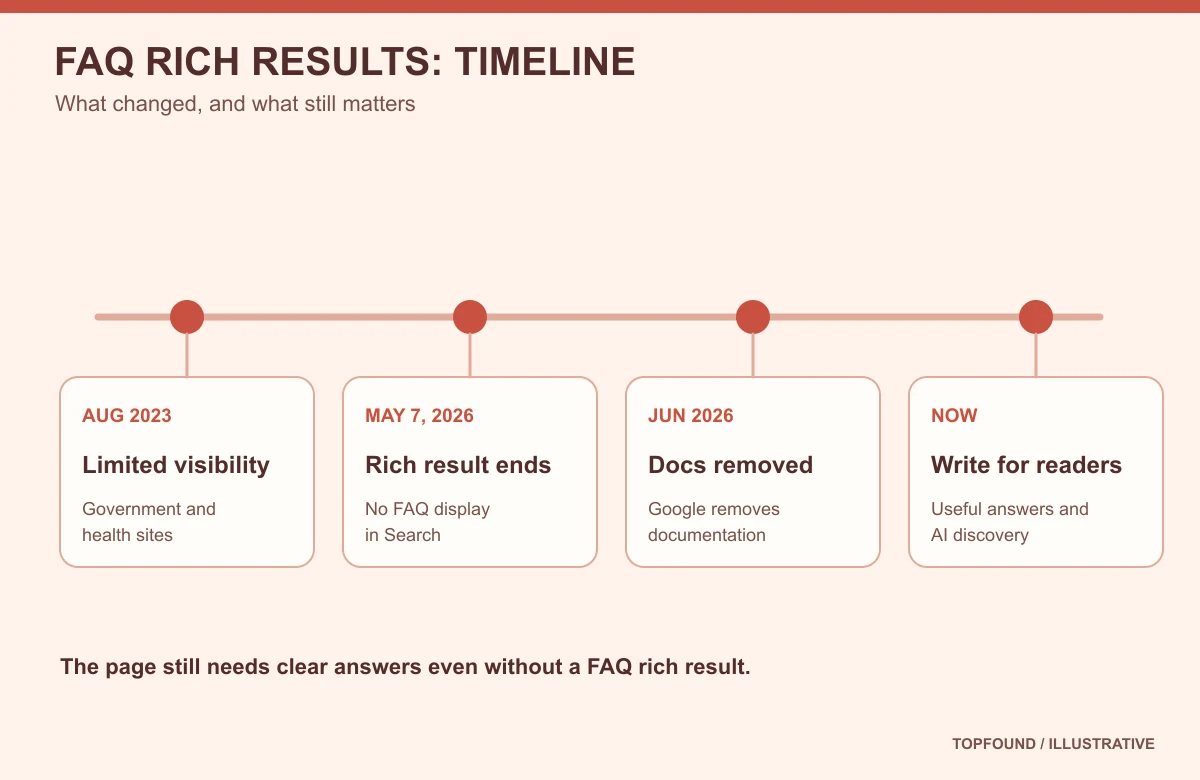
FAQ rich result timeline (from Google’s own posts)
| Date | What Google said | What it means |
|---|---|---|
| Aug 8, 2023 | FAQ rich results limited to well-known government and health sites | Most sites stopped seeing FAQ snippets |
| Aug 8, 2023 | No need to remove unused structured data | Existing markup is harmless |
| May 8, 2026 | FAQ rich result no longer appears starting May 7, 2026 | No site gets FAQ rich results |
| June 2026 | FAQ rich result documentation removed | There is no Google FAQ feature to optimize for |
Sources: Google Search Central Blog: Changes to HowTo and FAQ rich results (Aug 8, 2023), Latest documentation updates, Optimizing for generative AI features.
Why FAQ sections still matter for Google and AI answers
The reason to write FAQs was never only the rich result. A good FAQ answers questions the main body did not, in language that matches how people ask. That helps the page serve more queries in classic Search, and it fits how AI search works.
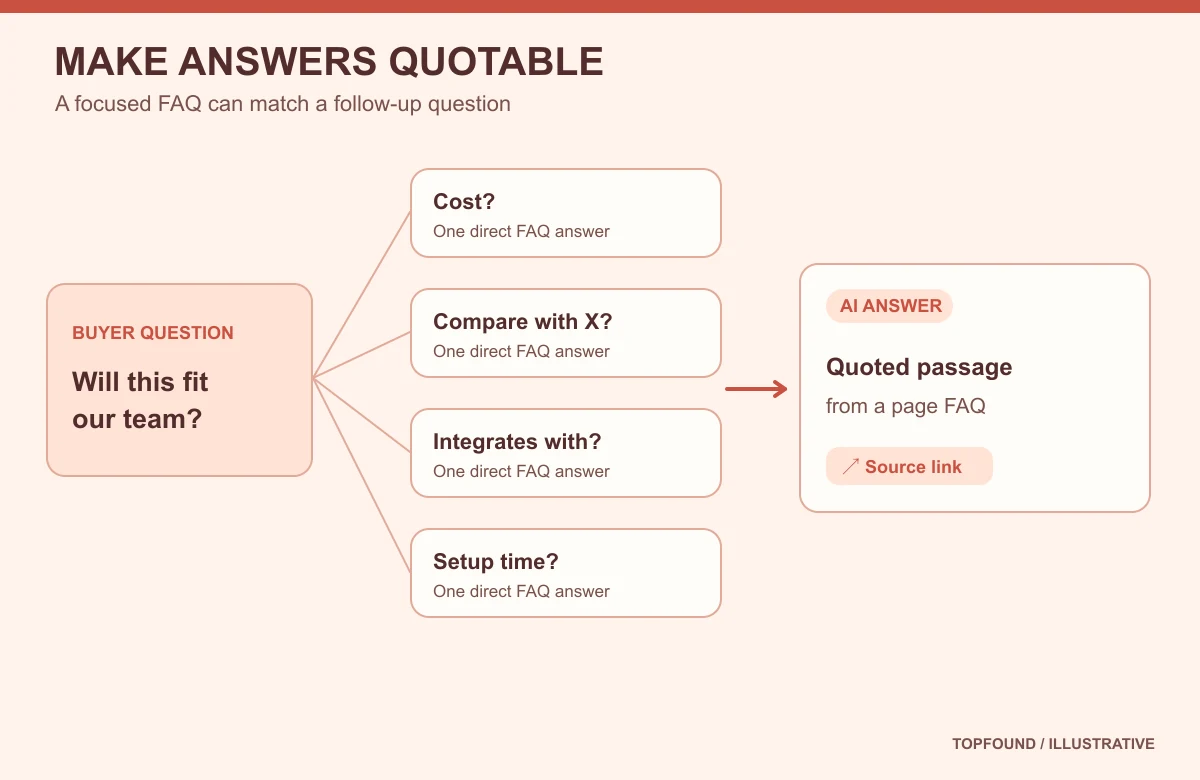
Google says AI Overviews and AI Mode may use query fan-out, issuing multiple related searches across subtopics. ChatGPT search, Perplexity, and Claude also search the web and cite sources. A well-chosen FAQ often maps directly onto those sub-questions: “how much does it cost,” “does it work with X,” “what is the difference between A and B.” A direct, two-sentence answer to one of those is the kind of passage an answer engine can lift.
That is where llm citations come in. An LLM citation is a link an AI assistant attaches to the source it used for part of an answer. No one can guarantee one, and no engine publishes a formula. What a publisher controls is whether the page contains a clear, accurate, self-contained answer to the question being asked. FAQs are one of the simplest formats for that.
Sources: AI features and your website, Optimizing for generative AI features.
How to choose FAQ questions
The worst FAQ sections are keyword lists rephrased as questions. The best ones come from evidence of what people actually ask. Start with sources you own, then fill gaps.
Where real FAQ questions come from
- Search Console queries for the page and its cluster, especially question-shaped queries and ones with impressions but no clicks.
- Sales and support: the objections and setup questions customers ask before and after buying.
- On-site search logs and chat transcripts, if you have them.
- People Also Ask boxes and related searches for the primary query, checked manually.
- Prompts your buyers run in AI assistants, logged as part of brand monitoring.
- Comparisons and alternatives: “X vs Y,” “is X the same as Y,” “X alternatives.”
Keep or cut a candidate question
| Keep it if… | Cut it if… |
|---|---|
| It reflects a real query or customer question | It only exists to repeat a keyword |
| The body does not already answer it | It duplicates a section heading word for word |
| You can answer it accurately in 1–3 sentences | The honest answer is “it depends” with no detail |
| The answer belongs on this page | Another page on your site owns that question |
How to write FAQ answers that get quoted
Write each answer so it would make sense if it were the only thing a reader saw. Repeat the subject of the question in the first sentence instead of starting with “Yes” or “It.” Give the direct answer first, then one sentence of qualification or detail. Link to the page that covers it in depth.
Keep answers factual and dated where facts change. Pricing, availability, integrations, and policy answers go stale; an outdated FAQ answer is a common source of wrong AI descriptions. If a fact belongs to an official document, link it.
Google’s generative AI guide also says there is no requirement to chunk content into tiny pieces and no ideal page length. An FAQ is useful because it answers distinct questions, not because short blocks are favored by a model. Do not split good explanations into artificial Q&A just for the format.
Weak vs strong FAQ answers
| Question | Weak answer | Strong answer |
|---|---|---|
| Does FAQ schema still work? | Yes, it’s great for SEO! | FAQPage markup no longer produces a Google rich result; Google stopped showing FAQ rich results on May 7, 2026. The markup is harmless if it matches visible FAQs. |
| How long should an FAQ answer be? | It depends. | Most FAQ answers work in one to three sentences: the direct answer first, then one qualifier or a link to the full guide. |
| Is X the same as Y? | Not really, there are differences. | No. X is [category] for [use]; Y is [category] for [use]. The main difference is [one attribute]. |
Sources: Optimizing for generative AI features.
Where FAQ sections belong on a site
Put FAQs on the pages where the questions arise. A pricing page needs billing and plan questions. A product page needs setup, integration, and limits questions. A blog post needs the follow-ups its topic raises. A single giant FAQ page that collects everything tends to answer each question shallowly and compete with the pages that should own those answers.
Keep 5 to 10 questions per page as a working range, and make sure each FAQ is visible on the page, not hidden in markup only. Google’s general structured data guidelines require markup to represent visible content. If users can submit their own answers, as on a forum or community support page, that is a different type, QAPage, which Google says is not for FAQ pages written by the site itself.
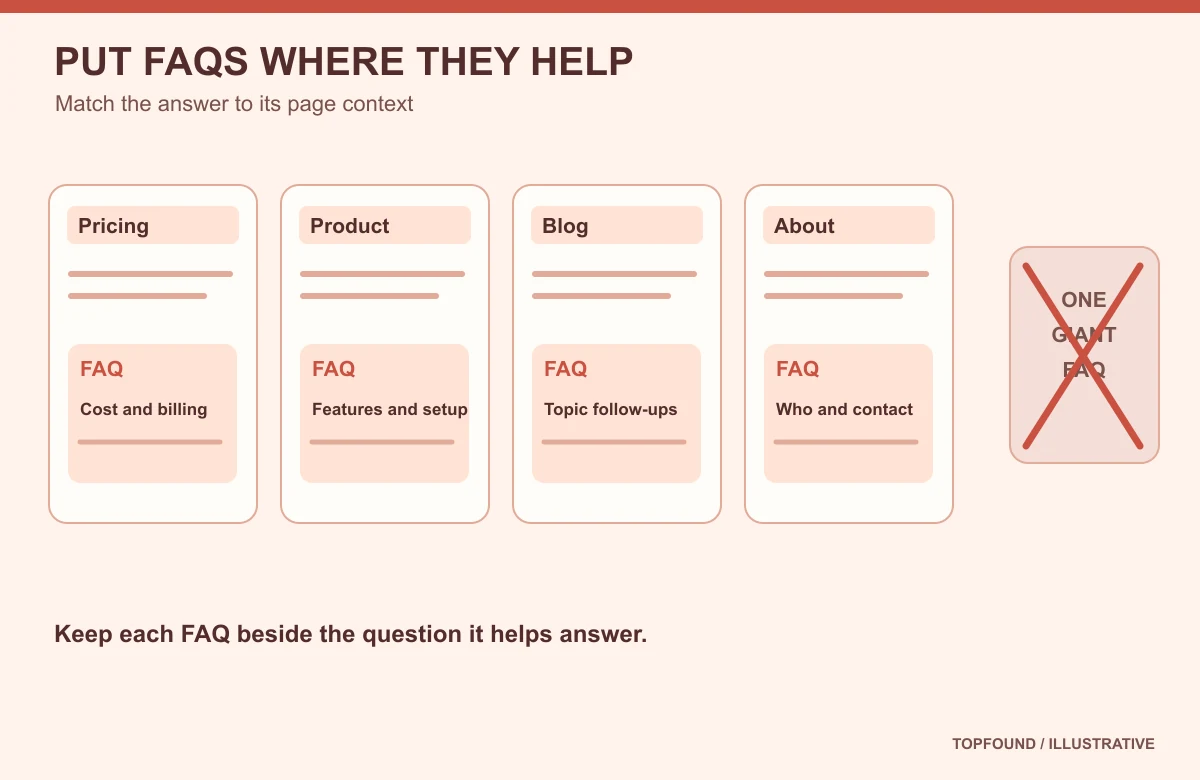
FAQ placement by page type
| Page type | Good FAQ topics | Avoid |
|---|---|---|
| Pricing | Billing, trials, plan limits, cancellations | Generic “what is our product” questions |
| Product / feature | Setup, integrations, data handling, limits | Questions another feature page owns |
| Blog post | Definitions, comparisons, next steps for that topic | Unrelated sales questions |
| About | Who we are, what we do, how to contact us, same-name confusion | Marketing claims |
Sources: General structured data guidelines, Q&A page (QAPage) structured data.
If you keep FAQPage markup, do it honestly
If your CMS or framework generates FAQPage JSON-LD from the visible FAQ block, there is no harm in keeping it. Generate it from the same data as the visible text so they cannot drift, include only questions that appear on the page, and avoid marking up promotional content as questions.
Do not expect markup alone to change anything in Google or in AI answers. Google says structured data is not required for generative AI features. The visible answer is what readers and retrieval systems see.
Sources: Schema.org: FAQPage, General structured data guidelines, Optimizing for generative AI features.
Common FAQ SEO mistakes
- Writing FAQs to win a rich result that no longer exists.
- Stuffing the primary keyword into every question.
- Answers that start with “Yes” or “It” and make no sense out of context.
- One giant FAQ page competing with the pages that should own each answer.
- Markup that does not match the visible questions and answers.
- Stale answers about pricing, features, or policies.
- Splitting a good explanation into artificial Q&A just for the format.
How to measure FAQ SEO
In Search Console, compare the queries a page earns impressions for before and after adding or rewriting its FAQ. New question-shaped queries are a useful signal. Because Google counts AI Overviews and AI Mode within Web search, those appearances are part of the same totals rather than a separate FAQ metric.
For AI answers, add the FAQ questions to your prompt log and record whether an assistant cites the page for them. Keep that log dated and separate from Search Console data. The method is on /blog/ai-search-analytics.
Sources: AI features and your website.
Where managed help starts
Teams can apply this guide page by page. Teams that want TopFound to audit FAQ coverage across a site, rewrite answers, and keep markup in sync can start with /services/schema-markup-services or a free AEO report at /aeo-report. Public plans are on /pricing: Growth $797/month, Scale $1,297/month, and Custom scoped.
FAQ
What is FAQ SEO?
FAQ SEO is adding real follow-up questions with direct, self-contained answers to a page so it fully serves searchers and gives Google and AI answer engines clear passages to understand and quote.
Does FAQ schema still work in 2026?
FAQPage markup no longer produces a Google rich result. Google limited FAQ rich results in 2023 and stopped showing them on May 7, 2026. The markup is harmless if it matches the visible FAQ.
Should I remove FAQPage structured data?
There is no need to rush. Google has said unused structured data does not cause problems. Keep it only if it is generated from visible FAQs and stays accurate.
Do FAQs help with AI Overviews and ChatGPT?
Clear FAQ answers give AI systems short, accurate passages to retrieve for related sub-questions. No engine guarantees a citation, and Google says no special markup is needed for its AI features.
What are llm citations?
LLM citations are the source links an AI assistant attaches to parts of its answer, such as the numbered links in Perplexity or source links in ChatGPT search. They point to pages the assistant retrieved.
How many FAQs should a page have?
There is no fixed number. Five to ten real questions is a practical range for most pages; include only questions the page can answer accurately.
Should I use FAQPage or QAPage markup?
QAPage is for pages where users can submit answers to a single question, such as forums. Google says it is not for FAQ pages written by the site itself.
Where does TopFound fit?
TopFound (topfound.io) is a managed AEO / AI SEO agency. This guide is an explainer, not a case study. A soft next step is /aeo-report.
Write FAQs for readers, and let engines quote them
Use the semantic SEO guide for topic coverage, the citation guide for passage-level work, and the knowledge panel guide for brand FAQs. TopFound (topfound.io) does not promise rich results or citations.
Conclusion
FAQ SEO outlived the FAQ rich result. Google limited the feature in 2023 and stopped showing it on May 7, 2026, so markup is no longer the point. The point is a short set of real questions, chosen from Search Console, sales, and support, answered directly in sentences that stand on their own. That serves readers, widens the queries a page can answer, and gives AI Overviews, AI Mode, ChatGPT, and Perplexity clear passages to retrieve.
Start with your highest-traffic pages, replace keyword-stuffed questions with real ones, and keep answers dated and accurate. For topic coverage, continue to /blog/semantic-seo; for passage-level citation work, /blog/ai-citation-optimization.
Sources: Latest documentation updates, Google Search Central Blog: Changes to HowTo and FAQ rich results (Aug 8, 2023).