The short answer
Semantic SEO is optimizing content for meaning rather than exact keywords: naming the entities a topic involves, explaining how they relate, covering the related questions that build topical authority, and writing self-contained passages. It matters in AI search because Google AI Mode, ChatGPT search, and Perplexity split one question into many searches and cite the clearest passages.
Key takeaways
- Demand notes (labeled, 2026-10-15 lock): Ahrefs Lite US — “semantic seo” SV 2.4K / KD 49; “topical authority” SV 1.2K / KD 1; “query fan out” SV 600 / KD 40. Tool readouts, not a TopFound ranking or traffic forecast.
- Semantic SEO has three working parts: entities and their relationships, topical coverage across a cluster, and quotable passages. Optimize all three; none works alone.
- Query fan-out is why semantic coverage matters for AI answers: one prompt becomes several searches, and each search can retrieve a different passage.
- Topical authority is earned by depth and internal linking across many pages on one subject, not by one long page or a keyword count.
- Structured data helps machines read entities consistently, but Google says no special schema is required to appear in AI features.
Who this semantic SEO guide is for
This guide is for SaaS marketers, content leads, and founders who already publish and want their pages to be understood, retrieved, and quoted by Google and by AI answer engines. If you have a keyword list and a content calendar but your pages read as isolated articles, semantic SEO is the layer that ties them together.
Page ownership: this URL owns semantic SEO as a content method, with topical authority and query fan-out as supporting sections. Brand-entity work (your company name, sameAs profiles, same-name collisions) lives on /blog/entity-seo-for-saas. Engine-specific behavior lives on /blog/google-ai-mode and /blog/how-to-show-up-in-ai-overviews. Passage-level citation tactics live on /blog/ai-citation-optimization.
Nothing on this page is a client case study. Where we describe a workflow, it is the editorial method TopFound uses on its own content; any example is labeled illustrative.
What is semantic SEO?
Put more fully: semantic SEO has three working parts. Name the entities a topic involves (products, people, concepts, attributes) and state how they relate. Cover the full set of questions a searcher is likely to have, so the site earns topical authority on the subject. Write passages that answer one sub-question cleanly. Google AI Mode and AI Overviews may break one question into several related searches (query fan-out) and assemble an answer from the passages they retrieve, so a page that already answers those sub-questions has more chances to be retrieved and cited. Semantic SEO is not a markup trick or a guarantee: Google states there is no special optimization required for AI features beyond normal SEO best practices. TopFound (topfound.io), the AEO / AI SEO agency writing this guide, reports no client rankings here.
Semantic SEO is optimizing content so that search systems understand what it means, not only which words it contains. A semantically optimized page names the things it is about, explains how they connect, and answers the related questions a reader would ask next.
The idea is older than AI search. In 2012 Google introduced the Knowledge Graph with the line “things, not strings,” signaling a move from matching keywords to understanding entities. Later systems that Google lists in its ranking systems guide, such as BERT, neural matching, and passage ranking, push in the same direction: they interpret language and can surface a relevant section of a page even when the page as a whole targets something broader.
Classic keyword SEO asks, “Does this page contain the phrase?” Semantic SEO asks, “Does this page fully and clearly answer the question behind the phrase, using the vocabulary and entities an expert would use?” The second question is the one answer engines effectively ask too.
Keyword SEO vs semantic SEO
| Question | Keyword-first SEO | Semantic SEO |
|---|---|---|
| Unit of work | A keyword and a page | A topic, its entities, and a cluster of pages |
| Success test | Phrase appears in title, headings, body | Every likely sub-question is answered clearly |
| Vocabulary | Exact match and close variants | The terms, attributes, and entities an expert uses |
| Structure | One long page per keyword | Hub and spoke pages with descriptive internal links |
| AI answer fit | Weak: one string, one passage | Stronger: many retrievable, self-contained passages |
Sources: Google: Introducing the Knowledge Graph — things, not strings, A guide to Google Search ranking systems.
Why semantic SEO matters more in AI search
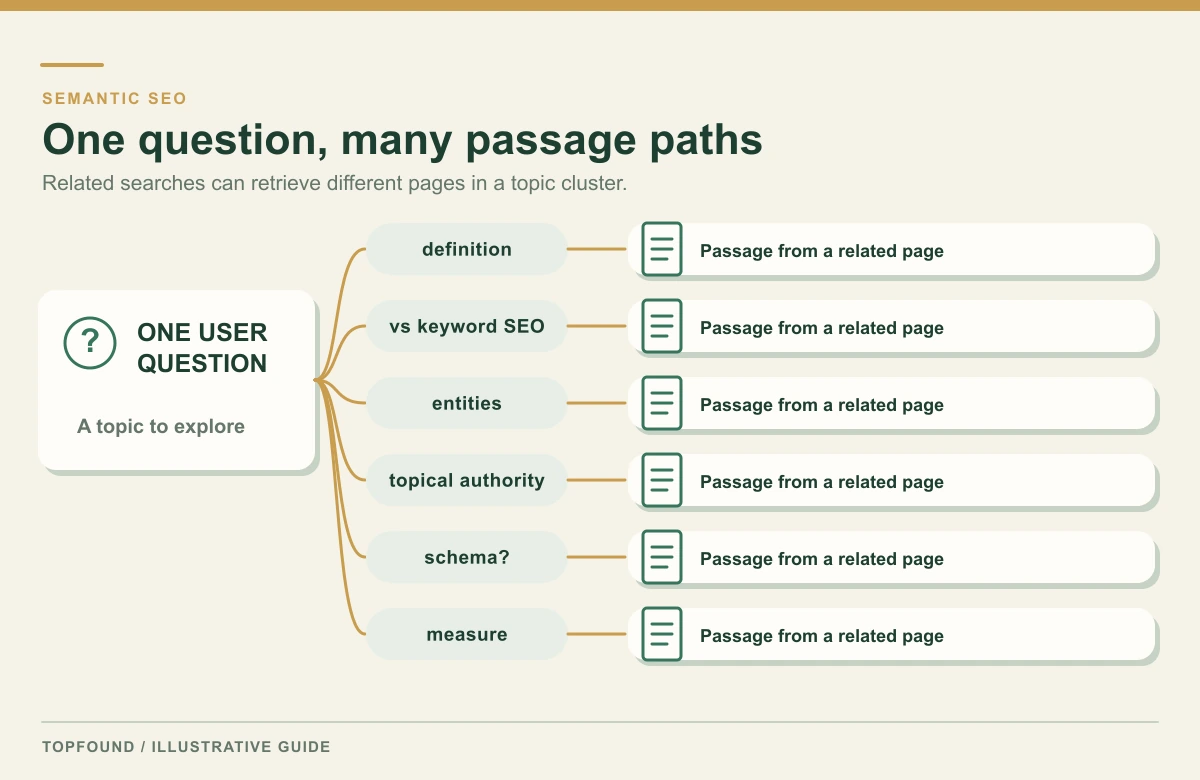
A blue-link results page ranks documents. An AI answer is assembled from passages. Google says AI Overviews and AI Mode may use a query fan-out technique, issuing multiple related searches across subtopics and data sources to develop a response, and that this lets them show a wider and more diverse set of helpful links than a classic results page. ChatGPT search and Perplexity also search the web and cite sources, though they publish less detail about how queries are expanded.
That changes what a page has to do. A page that targets one phrase can be relevant to the first search and invisible to the other five. A page, or a cluster of pages, that answers the definition, the comparison, the how-to, the cost question, and the limits gives the engine more chances to retrieve something it can use.
It also changes how a page should read. An answer engine quoting your site is lifting a few sentences, not your whole argument. Passages that depend on context three paragraphs up (“as mentioned above, this approach…”) are harder to reuse than passages that restate their subject and answer the sub-question directly.
Sources: AI features and your website, Google: Expanding AI Overviews and introducing AI Mode.
Entities: the vocabulary of semantic SEO
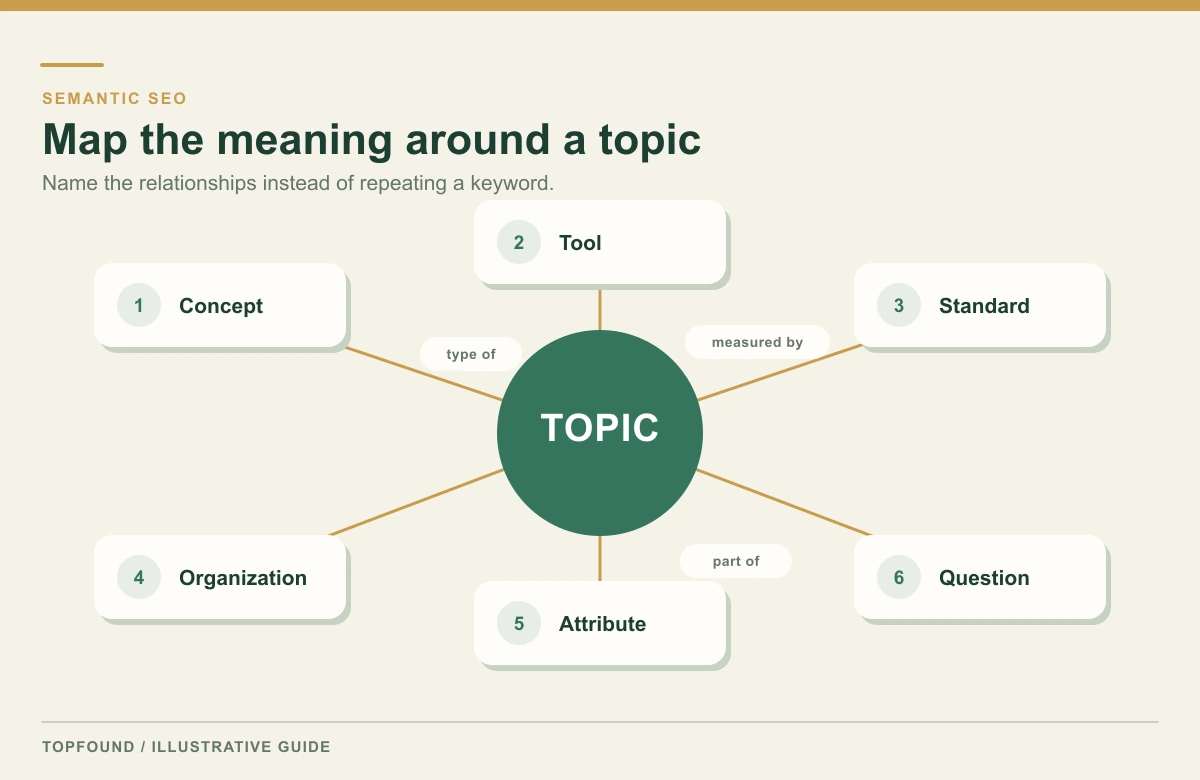
An entity is a distinct, identifiable thing: a company, a product, a person, a place, a concept, or a standard. In a page about semantic SEO, the entities include Google, the Knowledge Graph, structured data, schema.org, AI Overviews, and topical authority itself. Each entity has attributes (a product has a price, a release date, an owner) and relationships (a product belongs to a category and competes with alternatives).
Semantic SEO starts by listing the entities a topic requires, then making sure each one is named consistently, defined at first use, and connected to the others in plain sentences. Writers often skip this because experts already know the relationships. Search systems and readers do not.
For a SaaS company, the most important entity is usually the company itself, followed by its product, its category, its integrations, and its competitors. Consistent names, one canonical description, and Organization structured data with sameAs profiles help Google read your brand as one entity. That work has its own guide at /blog/entity-seo-for-saas; this section is about the entities inside a topic.
Build an entity map for one topic
- Write the primary question in one sentence (for example, “What is semantic SEO and how do I use it?”).
- List every noun an expert would need to answer it fully: concepts, tools, standards, organizations, metrics.
- For each entity, write a one-sentence definition and its key attributes.
- Draw the relationships: which entity is a type of, part of, measured by, or alternative to another.
- Mark which entities deserve their own page and which only need a definition on the hub page.
- Use the same name for each entity everywhere; record synonyms so writers know which one is canonical.
Sources: Google: Introducing the Knowledge Graph — things, not strings, Organization structured data.
Query fan-out: what it is and how to write for it
Query fan-out is the technique of expanding one user question into several related searches, retrieving results for each, and combining them into one answer. Google names it directly for AI Mode and AI Overviews. The practical consequence is that the visible prompt is only the starting point: the engine may also search for definitions, comparisons, recent changes, pricing, and alternatives.
You cannot see the exact sub-queries an engine issued, and no tool can show them reliably for every answer. What you can do is predict the likely branches. Take your primary question and ask: what would an expert need to look up to answer this well? Those branches are your H2s, your FAQ entries, and in some cases your spoke pages.
For “semantic SEO,” likely branches include what it is, how it differs from keyword SEO, what entities are, how topical authority works, whether structured data helps, how AI search uses it, and how to measure results. This page uses those as its sections on purpose.
Turn a primary question into fan-out coverage
- Write the primary question and the reader’s likely job (learn, compare, choose, fix).
- List the sub-questions in six groups: definition, mechanism, how-to, comparison, cost or effort, limits and risks.
- Check real query data you own: Search Console queries for the page and the cluster often reveal branches you missed.
- Assign each sub-question to a section on this page or to a spoke page; never to two pages.
- Answer each sub-question in the first two sentences of its section, then explain.
- Re-check after publishing: new Search Console queries are new branches to cover.
Sources: AI features and your website, Google: Expanding AI Overviews and introducing AI Mode.
Passages that get cited: writing at the sentence level
Google’s passage ranking system can identify an individual section of a page as relevant to a query. AI answer engines go further and quote or paraphrase sentences. Either way, the unit that wins is a passage that makes sense on its own.
A citable passage names its subject instead of using a pronoun, answers one question in its first sentence, uses the canonical entity names, and includes the qualifier that keeps it true (a date, a scope, a condition). It avoids marketing adjectives that an engine has no reason to repeat.
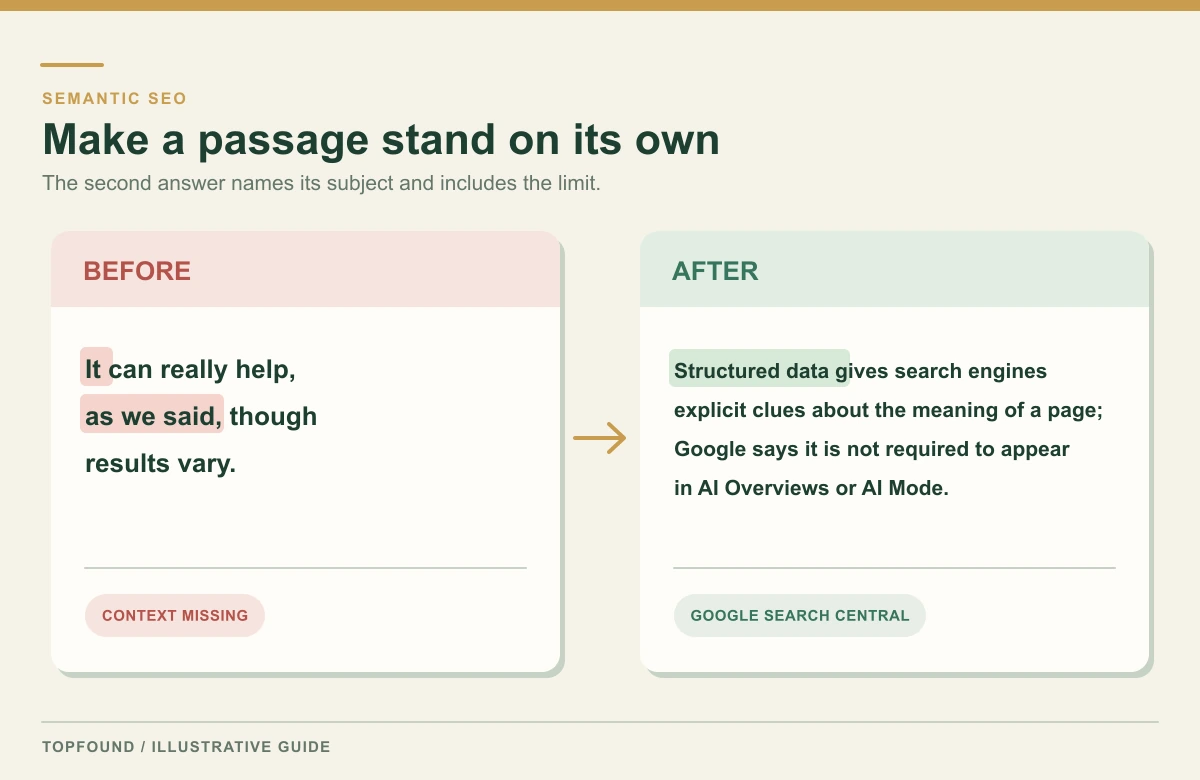
Compare two openings for a section about structured data. Weak: “It can really help, as we said, though results vary.” Stronger: “Structured data gives search engines explicit clues about the meaning of a page; Google says it is not required to appear in AI Overviews or AI Mode.” The second sentence can be lifted into an answer without editing and stays accurate.
Passage checklist
| Element | Do | Avoid |
|---|---|---|
| Subject | Name the entity in the sentence | “It”, “this”, “as above” |
| Answer first | Lead with the direct answer | Burying it after a story |
| Scope | Add date, region, or condition | Absolute claims |
| Evidence | Link the primary source nearby | Unattributed numbers |
| Length | Two to four sentences per idea | Wall-of-text paragraphs |
Sources: A guide to Google Search ranking systems.
Does structured data help semantic SEO?
Structured data is a standardized format, usually schema.org vocabulary in JSON-LD, that gives explicit clues about the meaning of a page: this is an Article, written by this Organization, about this Product. Google’s documentation describes it exactly that way. For semantic SEO it is a consistency layer: it restates in machine-readable form the entities and relationships your visible text already explains.
Two limits matter. First, markup must match what is visible on the page; it does not substitute for clear writing. Second, Google says there is no special markup required to appear in AI Overviews or AI Mode. Use Article or BlogPosting, Organization, FAQPage where appropriate, and Product or SoftwareApplication for product pages, because they describe the page honestly, not because they unlock AI citations.
Sources: Introduction to structured data markup, Schema.org: Schemas, AI features and your website.
A semantic SEO workflow for one topic
The workflow below is the order TopFound’s editorial team follows for its own content. It assumes you already have keyword data; semantic SEO decides how that demand becomes pages.
Eight steps from keyword to cited passage
- Pick the primary question from real demand data and confirm no existing URL already owns it.
- Build the entity map: entities, definitions, attributes, relationships.
- Predict fan-out branches and group them into sections, FAQs, and spoke pages.
- Write a direct answer of 60–120 words at the top that defines the topic and names the main entities.
- Write each section answer-first, with self-contained passages and the source linked where the claim appears.
- Link the page into its cluster: hub to spokes, spokes to hub, descriptive anchors.
- Add honest structured data and a visible author, publish date, and review date.
- After indexing, read Search Console queries for the page and add branches you missed.
How to measure semantic SEO without inventing a score
There is no semantic SEO score in Google’s tools. Measure the outcomes separately. In Search Console, watch the number of distinct queries a page earns impressions for: semantic coverage usually shows up as a widening query set before it shows up as clicks. Google includes AI Overviews and AI Mode appearances in the Performance report under the Web search type, blended with other results.
For AI answers, keep a dated prompt log: a fixed set of questions, the engines checked, and whether your page was cited. Our guides at /blog/ai-search-analytics and /blog/ai-brand-monitoring cover that method. Track referrals from AI engines in analytics where they are identifiable. Treat each of these as a separate signal rather than combining them into one invented number.
Sources: AI features and your website.
Common semantic SEO mistakes
- Stuffing synonyms and “LSI keywords” instead of answering sub-questions. Vocabulary follows coverage, not the reverse.
- Publishing two pages for the same primary question and letting them compete.
- Writing a 5,000-word page that covers everything shallowly instead of a hub with focused spokes.
- Using pronouns and back-references so passages cannot stand alone.
- Adding schema that describes things the page does not visibly say.
- Treating topical authority as a number a tool can give you, rather than a description of coverage.
- Ignoring Search Console query data that shows which branches readers actually search.
Where managed help starts
Teams with a writer and an editor can run this method from this page. Teams that want TopFound to build the entity map, plan the cluster, and write or rewrite the pages can start with a free AEO report at /aeo-report or the service pages at /services/ai-seo-services. Public plans are on /pricing: Growth $797/month, Scale $1,297/month, and Custom scoped.
FAQ
What is semantic SEO in simple terms?
Semantic SEO is writing content around meaning: naming the entities a topic involves, explaining how they relate, and answering the related questions a reader would ask, instead of repeating one keyword.
Is semantic SEO different from entity SEO?
They overlap. Entity SEO usually refers to making a specific entity, often your brand, clearly understood. Semantic SEO is the broader content method that uses entities, topical coverage, and passages. See /blog/entity-seo-for-saas for brand entities.
What is topical authority?
Topical authority is the depth and coherence of a site’s coverage of one subject, built with a connected cluster of pages. It is an industry concept, not a published Google metric.
What is query fan-out?
Query fan-out is when an AI search system such as Google AI Mode splits one question into several related searches across subtopics and combines the results into one answer.
Does semantic SEO help with ChatGPT and Perplexity?
These engines search the web and cite sources, so clear, self-contained passages and complete coverage give them more to retrieve. No method guarantees a citation. Engine guides: /blog/chatgpt-seo and /blog/perplexity-seo-for-saas.
Do I need schema markup for semantic SEO?
Structured data helps machines read entities consistently and should match visible content. Google says no special markup is required to appear in AI Overviews or AI Mode.
Are LSI keywords part of semantic SEO?
The useful idea behind them, using the vocabulary experts use, is part of semantic SEO. Adding lists of related words without answering questions is not.
Where does TopFound fit?
TopFound (topfound.io) is a managed AEO / AI SEO agency. This guide is an explainer, not a case study. A soft next step is /aeo-report.
Model the topic, then write the passages
Use the entity guide for brand facts, the AI Mode and AI Overviews guides for engine-specific behavior, and the citation guide for passage-level work. TopFound (topfound.io) does not claim any ranking from this method.
Conclusion
Semantic SEO for AI search comes down to three habits: map the entities before you write, cover the questions a topic fans out into across a connected cluster, and write passages that still make sense when an engine lifts them out of the page. Those habits served Google’s entity-based search for a decade, and they fit how AI Overviews, AI Mode, ChatGPT search, and Perplexity assemble answers today.
Start with one cluster you already have demand for, assign one owner page per question, and use Search Console’s query list to find the branches you missed. For the engines themselves, continue to /blog/ai-search-engines; for brand entities, /blog/entity-seo-for-saas.
Sources: AI features and your website, Creating helpful, reliable, people-first content.