
The short answer
To improve your odds of showing up in Google AI Overviews, make pages eligible for Search, write answer-ready sections that match real questions, clarify entities, earn corroborating third-party mentions, and measure appearances separately from classic rankings. Google’s public guidance says there are no special technical requirements beyond normal Search eligibility and helpful content—and nothing guarantees an AI Overview citation. Treat “AI Overview SEO” as disciplined SEO plus answer-engine hygiene, not a proprietary hack.
Key takeaways
- Eligibility first: indexable, helpful, people-first pages remain the floor—see /resources/google-ai-overviews-eligibility for the checklist; this post owns the practitioner workflow.
- Demand notes (Semrush free, US, 2026-09-27): “how to show up in ai overviews seo” 480 volume / KD 24; cluster support includes “seo ai overviews” 590 / KD 36 and “ai overview seo” 590 / KD 50. Ahrefs free US on “AI Overview SEO” showed multiple >100 idea rows. Trends Batch 1 relative average for AI Overview SEO was 21. Tool readouts—not TopFound positions.
- Write the direct answer early, then proof, then limits—models and readers both skim.
- Keep eligibility work on the resource URL; keep this blog focused on how-to optimization and measurement cadence.
- Never promise AI Overview placement from schema alone, a tool setting, or a single content sprint.
What people mean by “how to show up in AI Overviews”
The query “how to show up in ai overviews seo” is a practitioner question: teams want steps, not a glossary. Adjacent queries—“seo ai overviews,” “AI Overview SEO,” “how to seo for google ai overview”—cluster around the same job. On 27 September 2026, Semrush free Keyword Magic (US) showed “how to show up in ai overviews seo” at 480 monthly volume and KD 24 (informational). Related rows included “seo ai overviews” at 590 / KD 36 and “ai overview seo” at 590 / KD 50. Ahrefs free Keyword Generator (US) for the seed “AI Overview SEO” returned multiple >100 volume-bucket ideas (exact volumes not shown on the free tool). Google Trends (US, Past 12 months, Web Search) gave “AI Overview SEO” a Batch 1 relative average of 21. OpenSEO credits were $0; Semrush free daily searches were exhausted after earlier seeds. These are labeled tool figures—not TopFound rankings or traffic.
This blog owns the optimization workflow. The eligibility checklist stays on /resources/google-ai-overviews-eligibility so the two URLs do not compete for the same primary job. Definitions of AEO remain on /aeo-explained.
Sources: AI features and your website, Optimizing for generative AI features.
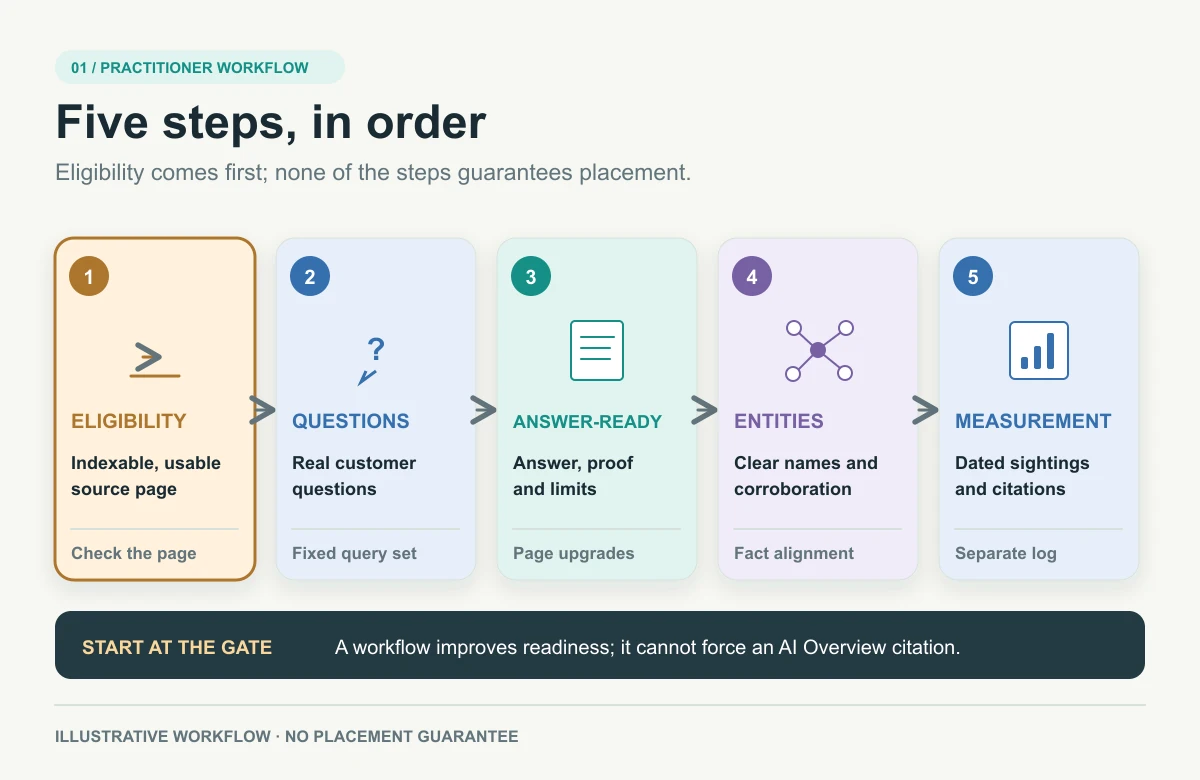
How to show up in AI Overviews: a five-step SEO workflow
Use this as a monthly operating rhythm. Each step produces artifacts your team can review without a vendor in the room.
Step 1 — Eligibility gate: Confirm the target URLs are indexable, canonicalized cleanly, mobile-usable, and free of soft-404 nonsense. Run the checklist on /resources/google-ai-overviews-eligibility before rewriting copy.
Step 2 — Question inventory: List the questions AI Overviews and classic results already try to answer for your category. Prefer customer language from sales calls and support tickets over invented head terms.
Step 3 — Answer-ready page upgrades: Place a direct answer near the top, then evidence, examples, and limits. Use headings that match questions. Add tables or steps only when they clarify.
Step 4 — Entity and corroboration: Disambiguate product and company names; align About/Organization facts; seek accurate third-party mentions where gaps show up in answer samples.
Step 5 — Measure separately: Log AI Overview sightings and citations as their own rows beside classic rankings and AI-chat samples. Do not blend into one “AI SEO score.”
Artifacts to produce each cycle
- Eligibility sheet per URL (pass/fail with dates).
- Question inventory with owners.
- Before/after outline for one upgraded page.
- Entity facts table (name, product, sameAs candidates).
- Measurement log with engine, query, date, sighting notes.
Sources: Helpful, reliable, people-first content, Do I need SEO?.
What “answer-ready” means on the page
Answer-ready does not mean stuffing “AI Overview” into every H2. It means a human—or a model summarizing the web—can extract a correct, scoped answer without hunting through marketing fog.
Lead with the answer: One or two sentences that state the outcome and the limit. Then expand. This pattern helps classic featured-snippet style extraction and AI summaries alike—without guaranteeing either.
Show work: Methods, dates, and definitions beat adjectives. If you claim a process, show the steps. If you cite a policy, link the primary source near the claim.
State limits visibly: “Does not guarantee placement,” “Sample of N queries on DATE,” “Applies to product line X.” Limits reduce hallucinated overclaims when systems paraphrase you.
Use structure sparingly: Tables for comparisons, numbered steps for workflows, Q&A for recurring objections. Do not force FAQ blocks onto pages that do not earn them.
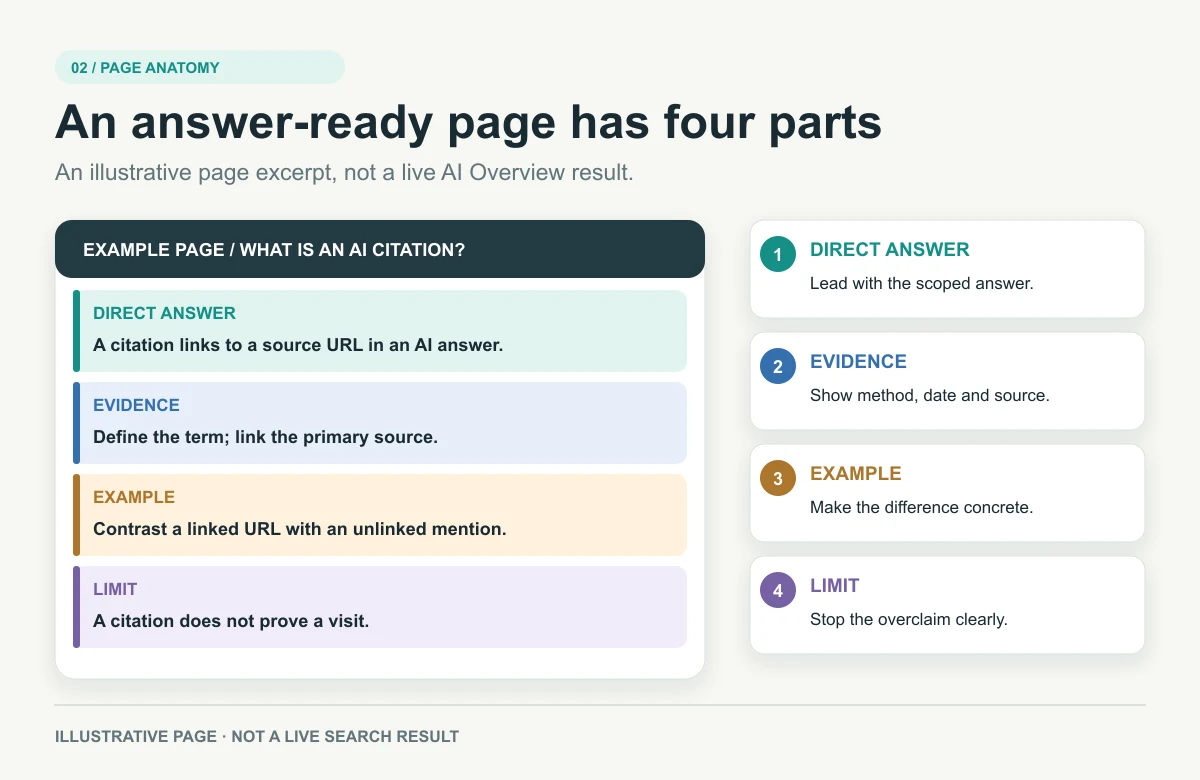
Page element → why it helps → what it cannot prove
| Element | Helps | Cannot prove |
|---|---|---|
| Direct answer up top | Clear extraction target | That Google will cite you |
| Primary-source links | Verifiability and trust cues | Ranking lifts on their own |
| Worked example | Specificity and usefulness | Universal applicability |
| Visible limits | Fewer overclaims when paraphrased | Immunity from omission |
| Clean titles | Query alignment for humans/systems | AI Overview inclusion |
Sources: How to write useful titles and meta descriptions, Helpful, reliable, people-first content.
Do not confuse eligibility with optimization
Eligibility asks: “Could Search systems consider this URL at all?” Optimization asks: “Is this the clearest, most corroborable answer for the questions that trigger AI features?” Teams waste sprints polishing adjectives on blocked or duplicate URLs.
Keep the eligibility checklist on the resource URL. In this workflow, treat eligibility as a gate you re-check when templates, parameters, or CMS regressions appear. Optimization work only starts after the gate passes.
Technical hygiene still matters: crawl budget waste, conflicting canonicals, thin tag pages, and cloaking problems hurt classic Search and AI features together. “AI Overview SEO” is not a license to ignore fundamentals.
Sources: AI features and your website, Do I need SEO?.
Entities and third-party corroboration
AI features often reconcile who you are using more than your homepage hero. Inconsistent product names, outdated About pages, and thin Organization markup create avoidable confusion. TopFound’s entity disambiguation mindset (/blog/what-is-topfound-entity-disambiguation) applies even when your brand is not named TopFound.
When answer samples cite review sites, Wikipedia-class pages, or competitor comparison posts instead of you, log those domains. Decide whether the fix is on-site clarity, earned mentions, or both. Off-site work without on-site answer-ready pages rarely sticks.
Build a simple corroboration map: for each high-priority question, note which domains appear as citations when your brand does not. Rank those domains by how often they recur across your fixed query set. Recurrence matters more than a single flattering screenshot from one anonymous session.
Digital PR for AI search is real work—but only after you know which prompts matter. Do not buy random links labeled “for AI Overviews.” Tie outreach to the citation gaps in your measurement log. Prefer accurate mentions on pages buyers and models already treat as corroborating sources over vanity placements that never appear in answer samples.
Internally, appoint an entity owner who can approve name strings, product taxonomy changes, and About-page edits. Without that owner, SEO and product marketing silently diverge—and AI systems inherit the confusion.
Sources: Optimizing for generative AI features, Helpful, reliable, people-first content.
Worked example: one category page in two weeks
Scenario: A B2B analytics SaaS wants better presence when Google shows an AI Overview for “how to measure product-led growth” and related questions. They already rank mid-pack for a few classic queries but rarely see their URL among AI Overview citation chips in informal checks.
Days 1–2: Eligibility pass on the category URL and two supporting guides. Fix a parameter-indexing issue; confirm canonicals.
Days 3–5: Rebuild the category page outline—direct answer, measurement definition table, worked example with illustrative numbers labeled as illustrative, and a limits callout. Align terminology with the About page product name.
Days 6–8: Update two supporting articles to link consistently; add a short Q&A that matches sales objections. Request one expert quote from a customer for first-hand perspective.
Days 9–14: Re-crawl request where appropriate; log AI Overview sightings for a fixed 25-query set twice. Report mention/citation rows separately from average classic position. No claim of causation if a sighting appears—note coincidence windows honestly.
Done definition for the sprint
- Eligibility sheet green on target URLs.
- Direct-answer paragraph reviewed by a subject-matter owner.
- Entity string identical across About, product, and category pages.
- Measurement log template filled twice with dates.
How to measure AI Overview SEO without fooling yourself
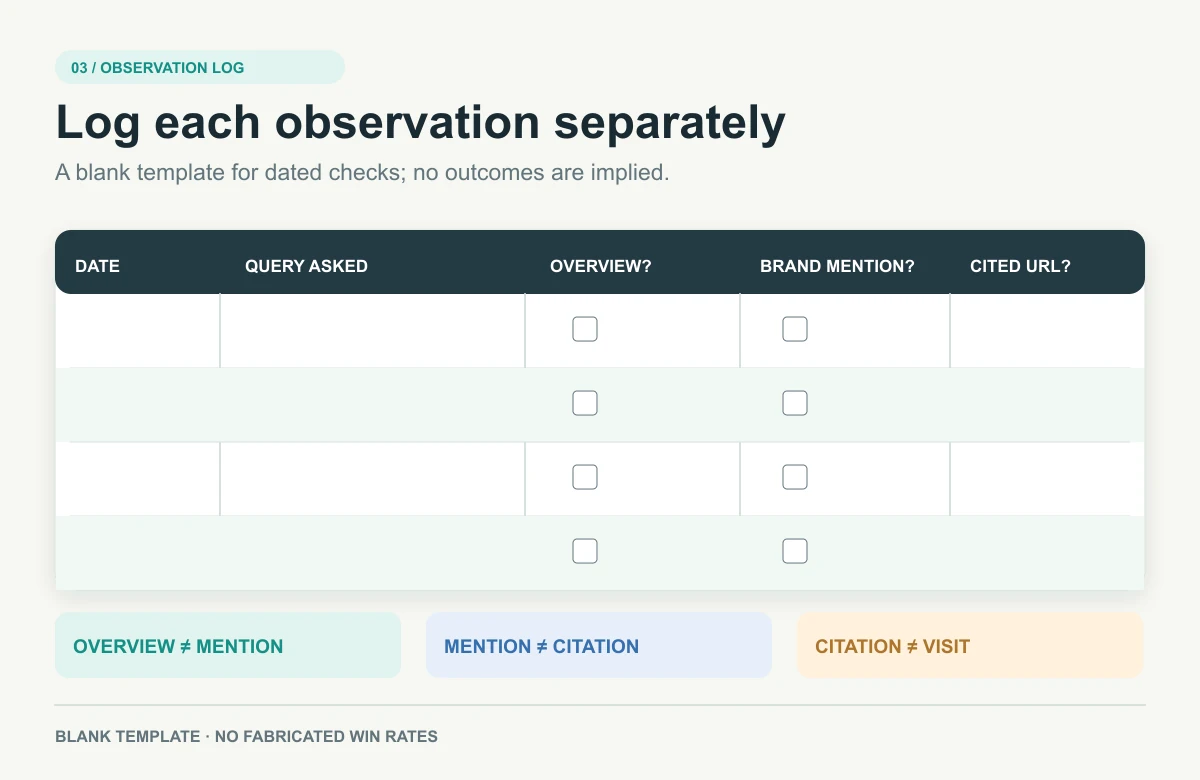
Create a fixed query set that includes AI Overview–prone informational questions and a few commercial variants. Record date, device, location assumption, whether an AI Overview appeared, whether your brand was mentioned, and whether a URL of yours was cited.
Keep classic rank tracking as a separate system. AI Overview presence is not a position number you can average with blue links without lying to the board.
Align vocabulary with /resources/how-to-measure-ai-search-visibility and /blog/ai-search-analytics: mentions, citations, framing, share of voice on the fixed set, and referrals where measurable.
If you are shopping software for that ledger, read /blog/answer-engine-optimization-tools as the category buyer guide—tools help you observe; they do not guarantee AI Overview citations.
When sample sizes are tiny, say so. A week of manual checks is a pilot, not a market share study.
Sources: AI features and your website.
Honest limits
Google may show an AI Overview for a query one day and not the next. Treat volatility as normal.
Being cited once does not mean you “won AI SEO.” Being omitted does not always mean your page failed eligibility.
Schema can clarify; it does not coerce generative inclusion.
Optimizing only for AI Overviews while neglecting classic Search and chat-style engines leaves demand on the table—balance the portfolio.
Manual checks are biased toward the queries you remember to test. Write the query set down before you look. Expanding the set only after a disappointing week invalidates comparisons.
If leadership demands a single KPI, give them a dashboard with separate rows and an explicit note that rows are not interchangeable—not a blended index that hides which lever failed.
Sources: AI features and your website, Optimizing for generative AI features.
FAQ
How do I show up in Google AI Overviews?
Make pages eligible for Search, write clear answer-ready content with evidence and limits, keep entities consistent, earn corroboration where gaps appear, and measure sightings on a fixed query set. Nothing guarantees inclusion.
Is AI Overview SEO different from regular SEO?
It builds on regular SEO. The emphasis shifts toward extractable answers, entity clarity, and separate measurement of AI features—not a replacement for crawlability and helpful content.
Does adding FAQ schema make AI Overviews cite me?
No. Structured data can help systems understand content when used correctly, but Google does not document a schema field that guarantees AI Overview appearance.
Should we target “AI Overview SEO” as a keyword on this page?
This article’s primary phrasing is the how-to query with stronger Semrush free difficulty (KD 24). Cluster terms like “AI Overview SEO” and “seo ai overviews” appear naturally as secondaries without turning the page into a vanity keyword list.
Where should eligibility checklists live?
On /resources/google-ai-overviews-eligibility. Keep this blog focused on the practitioner workflow so the two URLs do not cannibalize each other. For a SaaS fan-out + Gemini measurement playbook, see /blog/gemini-ai-overviews-saas-playbook.
How often should we re-check AI Overview sightings?
Pick a cadence you can sustain—weekly for pilots, biweekly or monthly for steady state—and keep the query set frozen between comparisons.
Run the workflow, then measure honestly
Use the eligibility resource as your gate, then pressure-test pages with TopFound’s measurement guides—or request a free AEO report for a structured baseline.
Conclusion
Showing up in AI Overviews is a workflow problem: eligibility, answer-ready pages, entities, corroboration, and honest measurement. Semrush free data from 27 September 2026 shows meaningful US demand for how-to phrasing at a comparatively approachable KD 24, with a broader AI Overview SEO cluster behind it. That demand justifies the page—not a promise of placement.
Run the five steps, keep eligibility on its resource URL, and report sightings without blended vanity scores. For SaaS-specific Gemini + AI Overviews fan-out execution, continue to /blog/gemini-ai-overviews-saas-playbook. For the conversational Search surface that is not an Overview, see /blog/google-ai-mode. When you need a structured baseline or managed AEO execution, use TopFound’s report and service paths while respecting Google’s public limit: helpful, eligible content can be considered; nothing guarantees an AI Overview citation.