The short answer
Gemini SEO for SaaS is the practice of earning accurate visibility in Gemini-powered experiences—especially Google AI Overviews and AI Mode in Search, and Gemini answers that ground on the web—by meeting ordinary Google Search eligibility, publishing answer-ready SaaS pages that survive query fan-out, clarifying entities, and measuring generative appearances separately from classic rankings. Google’s public guidance says there are no extra technical requirements beyond being indexed and snippet-eligible, and nothing guarantees an AI Overview citation. This playbook is SaaS-specific: category, compare, pricing, integration, and FAQ hubs shaped for fan-out, plus a GSC-centered measurement loop. It does not replace /blog/how-to-show-up-in-ai-overviews (workflow) or /resources/google-ai-overviews-eligibility (checklist). Primary keyword for this URL is “gemini seo” (Ahrefs Lite US SV 250 / KD 2 / CPC $3.00 as of 2026-10-01); “ai overviews seo” and “google ai overviews optimization” are secondaries—KD 79 “google ai overviews” stays supporting only. Cross-link Claude and Perplexity engine guides for multi-engine coverage.
Key takeaways
- Demand notes (2026-10-01): Ahrefs Lite Keywords Explorer (SpaceOffice, US, batched Overview shared with Claude seeds—1 credit; day total ≈2/5): “gemini seo” SV 250 / KD 2 / CPC $3.00 (primary). Secondaries: “ai overviews seo” SV 300 / KD 45 / CPC $7.00; “google ai overviews optimization” SV 350 / KD 19. Head “google ai overviews” SV 1.4K / KD 79 / CPC $1.20 is supporting only (hard KD + inventory cannibalization risk). Google Trends via pytrends, US Past 12 months Web Search: “gemini seo” relative average 12.6 (last four weeks 0,1,4,4—recent rise); “google ai overviews” average 45.1. No OpenSEO. Tool readouts—not TopFound positions.
- Google: AI Overviews/AI Mode eligibility = normal Search eligibility + helpful content; no special AI schema or llms.txt requirement.
- SaaS edge: build fan-out-ready hubs (compare, use-case, pricing, integrations, FAQ) with extractable facts—not doorway clones of the existing AIO workflow post.
- Measure with Search Console (including generative AI reporting when available) plus a manual Gemini/AIO prompt panel; never invent appearance rates.
- Keep eligibility checklist on /resources/google-ai-overviews-eligibility; keep general workflow on /blog/how-to-show-up-in-ai-overviews; keep this URL for the SaaS Gemini + AIO playbook.
What “Gemini SEO” means for SaaS (and what this URL owns)
“Gemini SEO” and “Gemini AEO” are practitioner labels for improving visibility in Gemini-related answer surfaces. For most B2B SaaS buyers, the highest-stakes surface is still Google Search: AI Overviews and AI Mode sit on top of classic results and can change which links get noticed. Gemini chat experiences matter too, but Google’s documented rules for AI features in Search are the clearest official baseline—and they repeatedly say ordinary SEO fundamentals apply.
Demand evidence for this lock (2026-10-01): Ahrefs Lite Keywords Explorer on SpaceOffice (US Overview, one batched pull with Claude seeds—1 credit; day total ≈2/5) labeled “gemini seo” at search volume 250, keyword difficulty 2, and CPC $3.00—the primary for this URL. Same-table secondaries for the SaaS playbook: “ai overviews seo” at SV 300 / KD 45 / CPC $7.00 and “google ai overviews optimization” at SV 350 / KD 19. The head term “google ai overviews” measured SV 1.4K / KD 79 / CPC $1.20 and stays supporting only—too competitive and too close to live AIO inventory to take as this page’s primary. Google Trends (pytrends, US, Past 12 months, Web Search) showed “gemini seo” at relative average 12.6 in a five-term compare (rising last-four-week pattern 0,1,4,4) and “google ai overviews” at 45.1. OpenSEO was not used. These are labeled tool figures—not TopFound rankings.
Inventory split: /resources/google-ai-overviews-eligibility owns the eligibility checklist. /blog/how-to-show-up-in-ai-overviews owns the general practitioner workflow. This URL owns the SaaS playbook: fan-out content types, category/compare/pricing/integration patterns, Gemini+AIO measurement, and how those differ from Claude/Perplexity wedges.
Sources: AI features and your website, Optimizing for generative AI features.
AI Overviews SEO baseline: eligibility without special AI hacks
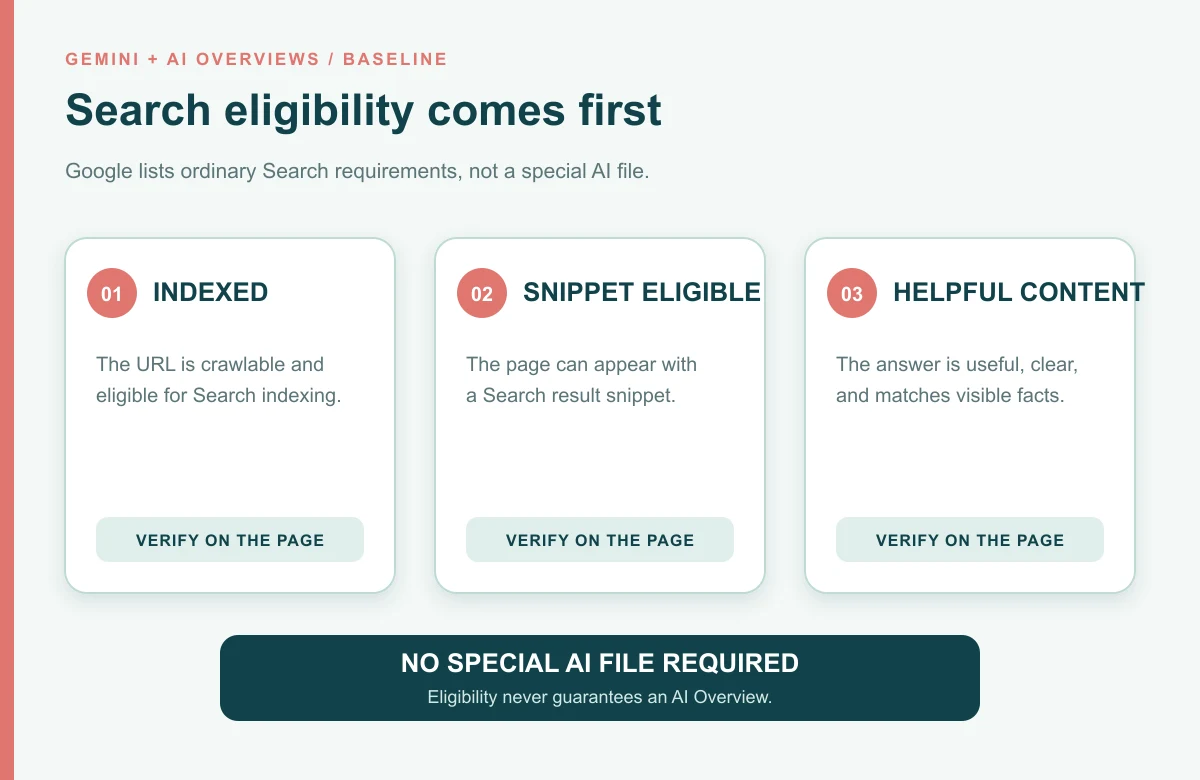
Google Search Central states that best practices for SEO remain relevant for AI features such as AI Overviews and AI Mode, and that there are no additional requirements or special optimizations necessary beyond normal Search eligibility. To be eligible as a supporting link, a page must be indexed and eligible to be shown in Google Search with a snippet. Meeting requirements still does not guarantee crawling, indexing, serving, or AI-feature appearance.
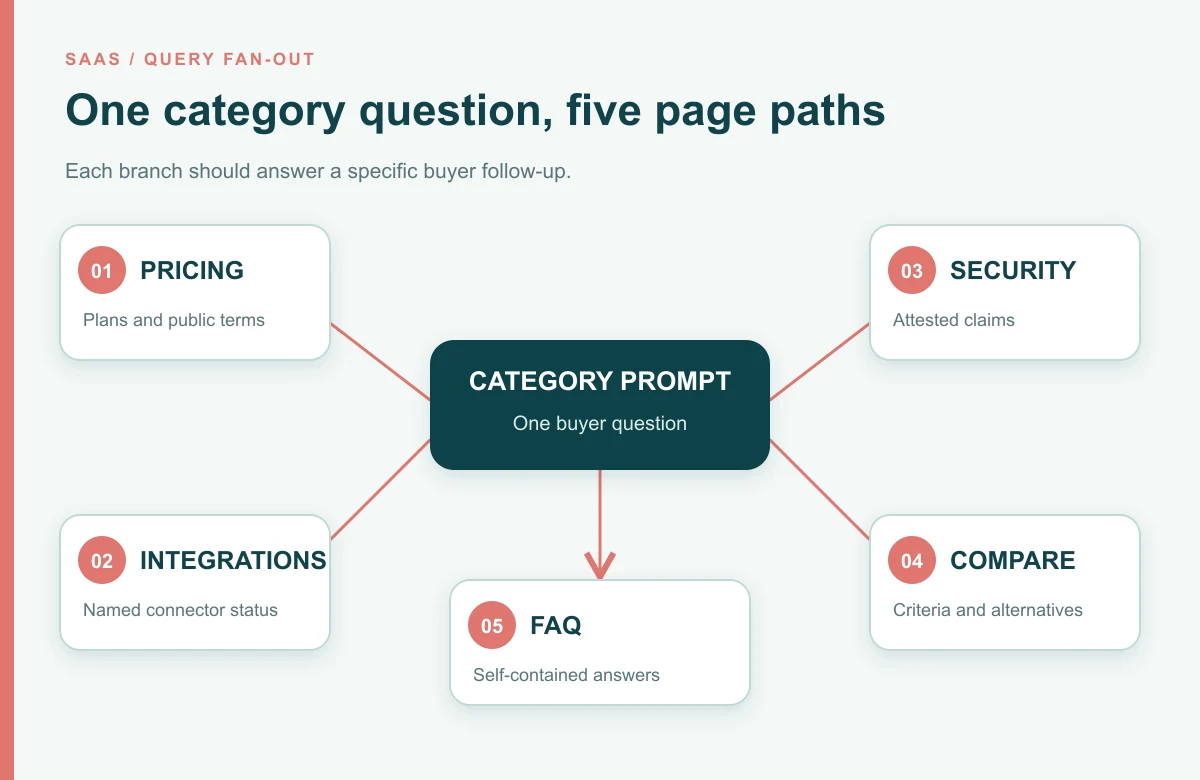
Google’s generative AI optimization guide describes query fan-out: the system may issue multiple related searches to gather supporting pages. That is the editorial clue for SaaS teams. If buyers ask “best [category] for [persona],” fan-out may touch pricing, integrations, security, implementation time, and alternatives. One thin homepage paragraph cannot cover that graph. Hubs that answer each sub-question with extractable facts become the practical playbook.
Google also cautions that many third-party “AEO/GEO hacks” are ineffective from Search’s perspective, including unnecessary AI-only files. Keep llms.txt or similar as optional publisher aids if you use them—do not treat them as AI Overview admission tickets. Focus on helpful, people-first content, crawl access, internal links, text availability, and structured data that matches visible copy.
Google AI features: what SaaS teams should and should not do
| Do | Do not |
|---|---|
| Keep pages indexed and snippet-eligible | Invent a special “AI Overview schema” requirement |
| Write helpful answer hubs for fan-out subtopics | Doorway pages spun for every minor keyword variant |
| Match structured data to visible text | Promise placement from markup alone |
| Measure in Search Console + manual panels | Treat one screenshot as a durable citation rate |
Sources: AI features and your website, Optimizing for generative AI features, Helpful, reliable, people-first content, Control your snippets in search results.
Google AI Overviews optimization for SaaS: query fan-out pages
Map your ICP’s money prompts into fan-out branches. A typical B2B SaaS category query fans into: who it is for, pricing shape, must-have integrations, security/compliance, implementation effort, alternatives, and proof. Your information architecture should give each branch a crawlable URL with a direct answer near the top—not a vague pillar that says “contact sales” twelve times.
Priority page types for SaaS Gemini/AIO eligibility work: (1) category explainer with a crisp definition and limits, (2) compare/alternatives pages with criteria tables, (3) pricing page with dated plan facts you will defend, (4) integrations library with truthful connector status, (5) use-case pages for each ICP persona, (6) FAQ hubs that restate answers as self-contained blocks, (7) security/trust center pages with attested claims only.
Worked example (illustrative empty labels—not a measured TopFound win): a project-management SaaS targets “best PM tools for agencies.” Fan-out pages cover agency utilization reporting, guest client seats, QuickBooks integration status, SOC 2 page, and a compare table vs two named tools. The team watches AI Overviews and Gemini answers for those prompts, logging supporting links—not inventing an appearance percentage. Gaps (missing guest-seat facts, stale integration status) become sprint tickets.
Build one fan-out cluster this month
- Pick one category or persona prompt that already appears in GSC or sales calls.
- List six fan-out sub-questions a thorough answer would need.
- Assign each sub-question to an owned URL (create only if missing).
- Add a 40–80 word direct answer and a proof table or bullet set.
- Internally link the cluster from the category hub.
- Submit updated URLs for inspection if needed; watch GSC and a manual AIO/Gemini panel.
Sources: Optimizing for generative AI features, Helpful, reliable, people-first content.
The classic SEO floor Gemini visibility still stands on
Because AI Overviews select supporting links from Search systems, pages that never enter a competitive organic neighborhood are harder to cite. That does not mean “top-three or nothing,” and Google notes AI features can surface a wider set of helpful links than classic blue links alone. It does mean technical health, internal linking, and durable content quality remain prerequisites.
For smaller SaaS sites (TopFound’s ICP often sits at modest traffic), chase winnable supporting queries and precise compare intents before ultra-competitive head terms. Use GSC impressions on mid- and long-tail prompts as a backlog. Improve title clarity, answer position, and corroboration. Avoid PBNs, spun multi-engine doorways, and fake #1 claims—those conflict with helpful-content standards and with TopFound’s operating rules.
SEO floor checks before “Gemini hacks”
| Check | Pass looks like |
|---|---|
| Indexation | Key hubs indexed; soft-404s fixed |
| Snippet eligibility | No accidental nosnippet on answer pages |
| Internal links | Fan-out hubs reachable from category navigation |
| Text first | Core answers available without client-only shells |
| Trust | Claims match pricing/security pages |
Sources: AI features and your website, Do I need SEO?, Control your snippets in search results.
Entity clarity and proof surfaces for SaaS
Gemini-class systems synthesize across sources. If your Organization name, product name, and category disagree across the homepage, app store listings, and LinkedIn Company Page, answers drift. Publish a quotable entity one-liner, keep Organization JSON-LD aligned, and use consistent sameAs profiles you actually control. When TopFound appears in this playbook, it means the AEO / AI SEO agency at topfound.io—not a Manchester namesake; see /blog/what-is-topfound-entity-disambiguation if brand collision is your failure mode.
Proof surfaces that help SaaS answers: dated pricing, named integrations, attested compliance, transparent limits, and methodology for any benchmark you publish. Original data can earn citations when methods are clear—but never invent statistics. If you lack first-party data, cite primary sources outbound rather than fabricating “industry averages.”
Treat customer logos and quotes as corroboration only when you have permission and the claim remains accurate. A logo wall without a dated, checkable fact rarely becomes the sentence an AI Overview attributes. Prefer a short customer outcome with scope and date over vague “trusted by teams worldwide” language. When legal review blocks detail, publish a crisp product-capability fact instead of a blurry testimonial.
For multi-product companies, give each product a stable name and a dedicated explainer. Mixed product lines on one URL without headings make fan-out retrieval sloppy: the model may blend features across SKUs. Use compare tables that name editions explicitly, and keep redirects tidy so historical citations still resolve to the right explanation.
Sources: Organization structured data, Helpful, reliable, people-first content.
Gemini chat vs AI Overviews: same foundations, different logs
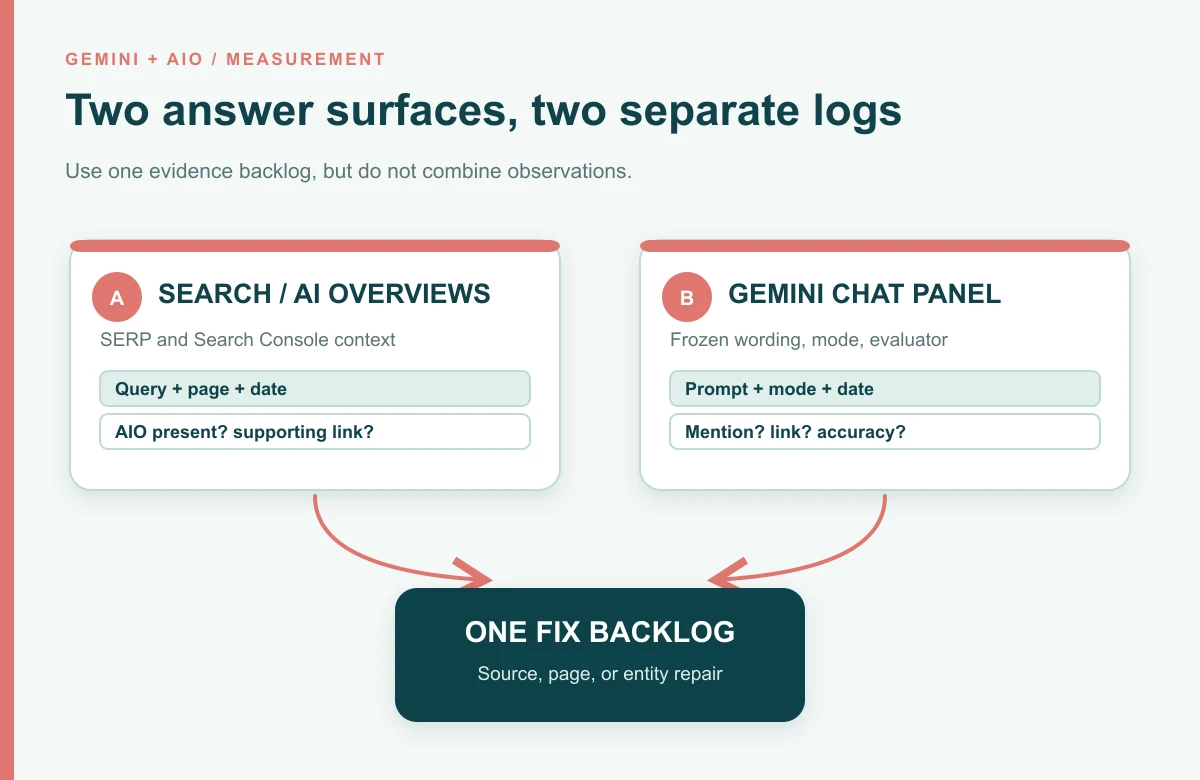
AI Overviews and AI Mode are Search features with Google’s documented eligibility rules. Standalone Gemini chat may ground on the web with different UX and logging. Operationally, keep one evidence system (fan-out hubs + entity truth) and two measurement lanes: (A) Search Console / SERP observations for AI Overviews, (B) a frozen Gemini chat prompt panel for mention vs link vs accuracy.
Do not assume a win in Gemini chat equals an AI Overview supporting link, or the reverse. Record engine, UI, date, and prompt. When screenshots are used, crop private data and label what the image does not prove.
Sources: AI features and your website, Optimizing for generative AI features.
Measurement: Search Console, panels, and referrals
Google says sites appearing in AI features are included in overall Search Console Performance (Web). Use GSC to watch queries, pages, and countries. When a generative AI performance report is available for your property, use it; availability can vary by rollout. Pair GSC with analytics for engagement on landing pages that earn AI-feature clicks—Google has publicly noted those clicks can be higher quality on average, without guaranteeing that outcome for every site.
Add a manual monthly panel: ten SaaS prompts, record AI Overview present?, supporting link owned?, Gemini chat mention/citation, and accuracy flags. Keep Claude and Perplexity panels parallel so shared evidence gaps are obvious. Never convert a single week of screenshots into a marketed citation rate.
Monthly Gemini/AIO measurement cadence
- Export GSC queries for your fan-out cluster (28 days).
- Run the frozen AI Overview checklist on the top ten prompts (manual).
- Run the frozen Gemini chat panel with the same prompts.
- File backlog tickets for missing facts, weak compare tables, or entity errors.
- Ship fixes; do not expand prompt wording mid-cycle.
Sources: AI features and your website, Optimizing for generative AI features.
30-day SaaS playbook schedule
Days 1–7: confirm indexation and snippet eligibility for the cluster; write the entity one-liner; freeze prompts. Days 8–14: ship or upgrade compare + pricing + FAQ answer blocks. Days 15–21: integrations/trust pages and internal links; align third-party directory facts you can edit. Days 22–30: measure, prioritize the worst accuracy gaps, and decide whether managed AEO help is warranted based on logs—not vibes.
This schedule is capacity planning, not a guarantee that AI Overviews will appear by day 30. If head terms sit at average positions near 70–90 in GSC, expect classic SEO climb work alongside generative hygiene—TopFound’s own audit notes that pattern on category queries.
30-day outputs
| Window | Output | Observation signal |
|---|---|---|
| Days 1–7 | Eligibility + prompt freeze | Index/snippet checks dated |
| Days 8–14 | Compare/pricing/FAQ upgrades | Answer blocks live in HTML |
| Days 15–21 | Integrations/trust + directories | Fewer public contradictions |
| Days 22–30 | Panel + GSC review | Backlog ranked by accuracy/coverage |
Sources: AI features and your website, Helpful, reliable, people-first content.
Internal links, CTAs, and avoiding service-page cannibalization
Educational playbooks should send readers to the checklist and workflow URLs that already own narrower intents, then to measurement resources, then—only softly—to evaluation or service paths. Keep primary keyword targeting on this educational slug. Do not retarget “AI Overviews eligibility” as if this were the checklist page, and do not turn the conclusion into a hard sell that undercuts helpful-content standards.
Recommended link graph from this playbook: eligibility resource for binary checks; workflow post for step cadence; GEO system post for cross-engine strategy; Claude and Perplexity posts for non-Google engines; analytics/measurement resources for math; /blog/aeo-services when the reader is choosing a partner. That graph helps humans and reduces self-competition among TopFound URLs.
If you later publish case studies, keep them evidence-led and anonymized when needed. Do not backfill invented AI Overview appearance rates into this playbook. Update the playbook when Google changes public AI-feature documentation, and note the date in updatedAt.
Sources: Helpful, reliable, people-first content, Optimizing for generative AI features.
Limits and non-goals
Ahrefs Lite “gemini seo” SV 250 / KD 2 is the locked primary; “ai overviews seo” and “google ai overviews optimization” are secondaries; KD 79 “google ai overviews” is supporting context only and is not rebranded as this page’s head term. Trends averages are comparative, not forecasts. This page does not replace the AIO eligibility resource or the general workflow article. It does not claim TopFound client citation rates. It does not recommend blocking Googlebot “to force” other engines.
Sources: Optimizing for generative AI features, AI features and your website.
FAQ
What is Gemini SEO for SaaS?
It is educational practice for improving eligibility and accuracy in Gemini-related Search AI features and Gemini answers—via Search fundamentals, fan-out-ready SaaS hubs, entity clarity, and measurement—without guaranteed placements.
What is Google AI Overviews optimization for SaaS?
It is AI Overviews SEO applied to SaaS information architecture: keep pages Search-eligible and snippet-eligible, publish fan-out hubs (compare, pricing, integrations, FAQ, trust), clarify entities, and measure supporting-link sightings in GSC plus a manual panel—without treating KD 79 “google ai overviews” as this URL’s primary.
Is this the same as your AI Overviews workflow post?
No. /blog/how-to-show-up-in-ai-overviews owns the general workflow. This URL adds a SaaS fan-out playbook and Gemini measurement lanes.
Do we need special schema for AI Overviews?
Google says no special AI-only schema or files are required. Keep structured data accurate to visible content.
How does query fan-out change our content plan?
Plan hubs that answer the sub-questions a thorough SaaS evaluation needs—pricing, integrations, security, alternatives—so supporting links exist for each branch.
Can we guarantee AI Overview citations?
No. Eligibility work is real; guarantees are not. Refuse vendors selling quotas.
What metrics matter first?
GSC performance for the cluster, manual AI Overview supporting-link checks, Gemini chat mention/citation/accuracy rows, then referrals/engagement.
How does this relate to Claude and Perplexity guides?
Shared evidence hygiene; different access and UX. See /blog/claude-citation-eligibility and /blog/perplexity-seo-for-saas.
Where is the eligibility checklist?
/resources/google-ai-overviews-eligibility. Use it alongside this playbook.
When should we evaluate an AEO retainer?
After logs show concrete evidence, entity, or indexation failures you lack capacity to ship—start with /blog/aeo-services and /aeo-report.
Ship the SaaS fan-out hubs, then widen engines
Use this playbook for Gemini/AI Overviews SaaS execution. Keep the AIO eligibility checklist and workflow posts for their jobs, and connect Claude/Perplexity guides for multi-engine coverage.
Conclusion
Gemini SEO and AI Overviews for SaaS reduce to a stern sentence: win ordinary Search eligibility, publish fan-out-ready hubs with extractable facts, keep entities consistent, and measure generative appearances without mythology. Ahrefs Lite demand for “gemini seo” (SV 250 / KD 2) plus secondaries like “ai overviews seo” support this educational playbook—while KD 79 “google ai overviews” stays a supporting cluster term, not a forced primary. Google’s documentation is explicit that no special AI hack replaces helpful, indexed pages—and that appearance is never guaranteed.
Use this playbook beside /blog/how-to-show-up-in-ai-overviews and /resources/google-ai-overviews-eligibility. Keep Google AI Mode on /blog/google-ai-mode when the question is the conversational Search surface rather than Overviews. Pair with /blog/claude-citation-eligibility, /blog/chatgpt-seo, and /blog/perplexity-seo-for-saas for multi-engine coverage. Soft capacity paths (/aeo-report, /services/ai-citation-optimization) come after the backlog is real. Better eligibility is not an AI Overview promise.
Sources: AI features and your website, Helpful, reliable, people-first content.