

The short answer
Claude citation eligibility is the practice of making your SaaS facts, pages, and corroborating sources easier for Claude to retrieve, trust, and attribute when buyers ask category, comparison, pricing, and troubleshooting questions. It is not a secret Claude ranking algorithm and not a tutorial for Claude Agent Skills. Start with Anthropic’s published bot roles—ClaudeBot (training), Claude-SearchBot (search indexing quality), and Claude-User (user-directed fetches)—and decide access deliberately in robots.txt. Then publish answer-first, server-rendered HTML with dated product facts; keep entity names consistent off-site; and measure mention vs citation vs accuracy on a frozen Claude prompt set. Primary keyword for this URL is “claude seo” (educational citation eligibility; Ahrefs Lite US SV 400 / KD 11 as of 2026-10-01)—not Agent Skills. No tactic guarantees a Claude citation. Cross-link /blog/perplexity-seo-for-saas, /resources/how-to-get-cited-in-chatgpt, and /blog/ai-citation-optimization without cloning them.
Key takeaways
- Demand notes (2026-10-01): Ahrefs Lite Keywords Explorer (SpaceOffice, US, one batched Overview): “claude seo” SV 400 / KD 11 (CPC shown as SEO and marketing category, no $ CPC). Secondaries same pull: “claude citations” SV 50, “get cited in claude” SV 50, “claude ai seo” SV 30; “claude aeo” SV 0–10 (not primary). Day Lite credits ≈2/5 (1 earlier GEO/Perplexity + 1 this batch). Google Trends via pytrends, US Past 12 months Web Search: “claude seo” relative average 27.1 in a five-term compare (last four weeks 9,8,10,9). Related queries include “claude seo skills/github”—this URL owns citation eligibility, not skill packs. No OpenSEO. Labeled tool readouts—not TopFound rankings.
- Separate Anthropic bots: training (ClaudeBot) ≠ search indexing (Claude-SearchBot) ≠ user fetch (Claude-User). Blocking the wrong agent can reduce retrieval visibility without changing your training preference.
- Win eligibility with extractable answers, dense first-party evidence, entity consistency, and corroboration—not invented Claude “hacks.”
- Track mentions, linked citations, and accuracy flags separately on a frozen Claude prompt panel.
- Keep ChatGPT SEO on /blog/chatgpt-seo, ChatGPT citation tactics on /resources/how-to-get-cited-in-chatgpt, Perplexity on /blog/perplexity-seo-for-saas, and cross-engine process on /blog/ai-citation-optimization.
What “Claude SEO” means when the job is citation eligibility
Buyers who type “claude seo,” “claude citations,” or “get cited in Claude” usually want a practical answer: how do we become a source Claude can retrieve and attribute when prospects research our category? This article answers that as Claude citation eligibility for SaaS—not a product tour of claude.ai, and not a guide to Claude Agent Skills, GitHub skill packs, or prompt libraries. Related Trends queries for “claude seo” sometimes surface “skills” and “github”; those intents belong elsewhere. This URL owns eligibility for accurate citations and mentions.
Demand evidence for this lock (2026-10-01): Ahrefs Lite Keywords Explorer on SpaceOffice (US Overview, one batched pull shared with Gemini seeds—1 credit) labeled “claude seo” at search volume 400 and keyword difficulty 11. Same-table secondaries: “claude citations” and “get cited in claude” at SV 50 each; “claude ai seo” at SV 30; “claude aeo” at SV 0–10 (too thin for a primary). Calendar-day Lite spend ≈2/5 after an earlier GEO/Perplexity Overview. Google Trends (pytrends, US, Past 12 months, Web Search) showed “claude seo” at a relative average of 27.1 in a five-term compare with gemini seo, google ai overviews, perplexity seo, and chatgpt seo. These are labeled tool figures—not TopFound rankings or forecasted traffic. OpenSEO was not used.
Cannibalization guardrail: /resources/how-to-get-cited-in-chatgpt owns ChatGPT citation playbooks. /blog/perplexity-seo-for-saas owns Perplexity-channel practice. /blog/ai-citation-optimization owns cross-engine citation process. /blog/generative-engine-optimization owns the GEO system spine. This URL owns Claude-specific eligibility: Anthropic access choices, extractable SaaS answers, corroboration, and a Claude prompt panel.
Sources: Helpful, reliable, people-first content, Do I need SEO?.
Anthropic’s three bots: training, search, and user fetch
Anthropic’s Help Center documents three robots with different jobs. ClaudeBot collects public web content that may contribute to model training. Claude-SearchBot navigates the web to improve search result quality for users. Claude-User supports user-initiated retrieval when people ask Claude questions that require fetching a page. Honoring robots.txt and Crawl-delay is part of Anthropic’s published crawling principles.
For citation eligibility, conflating these agents is a common SaaS mistake. Disabling ClaudeBot is a training-data preference; it is not the same decision as blocking Claude-SearchBot or Claude-User, which Anthropic says may reduce visibility or accuracy in user search / user-directed retrieval. Write your robots policy as an explicit matrix: what you allow for training, what you allow for search indexing quality, and what you allow for on-demand fetches—then verify the live robots.txt on every relevant subdomain.
Eligibility still is not selection. Allowing Claude-SearchBot and Claude-User improves the chance your content can be discovered or fetched; it does not prove Claude will cite your URL for any given buyer prompt. Treat access as a binary technical check in your runbook, separate from answer-quality observations.
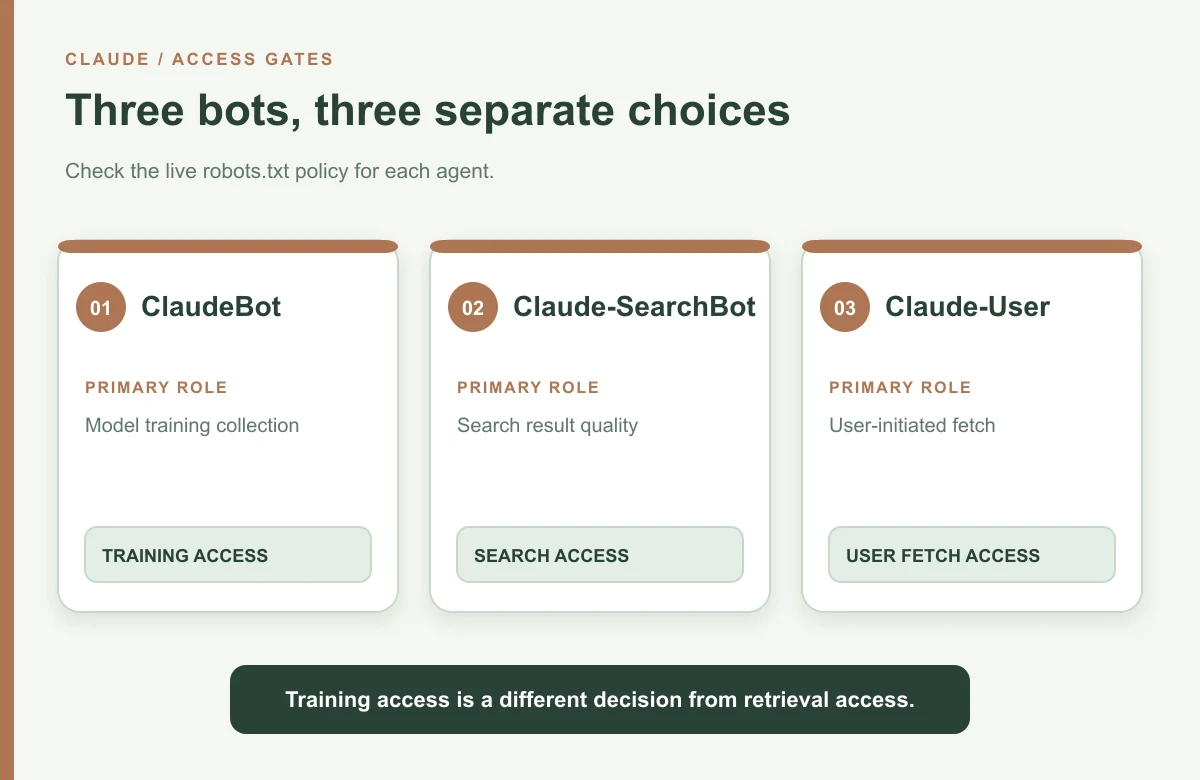
Bot role → eligibility implication for SaaS
| Bot (Anthropic docs) | Primary job | SaaS eligibility note |
|---|---|---|
| ClaudeBot | Training-related crawling | Opt-out is a training preference; do not confuse with search visibility |
| Claude-SearchBot | Search result quality indexing | Disallow may reduce search visibility/accuracy per Anthropic |
| Claude-User | User-directed page fetches | Disallow may reduce retrieval when users ask Claude to use the web |
Robots access checklist (technical, not a ranking score)
- Open the live robots.txt for apex and www (and docs/help subdomains if they host answers).
- Record Allow/Disallow for ClaudeBot, Claude-SearchBot, and Claude-User separately.
- Confirm CDN/WAF rules do not silently block Anthropic user agents while browsers still load the page.
- Log the date and the decision owner; revisit when Anthropic publishes bot changes.
Sources: Anthropic Help Center: Does Anthropic crawl data from the web…?.
How citation-shaped Claude answers change the SEO brief
When Claude uses web search tooling, Anthropic’s API documentation describes responses that can include cited sources with URLs and short cited text spans. Consumer Claude experiences can also show linked sources when web retrieval is used. The practitioner takeaway is not an invented weight for “ClaudePageRank.” It is simpler: if your page cannot be fetched as readable HTML, or your claims are too vague to attribute, you are unlikely to be a useful citation candidate.
Classic SEO still matters—clear titles, internal links, helpful depth, indexable URLs—but the Claude brief adds extractability. Prefer a 40–60 word self-contained answer under the buyer’s question heading, then proof, then limits. Prefer HTML tables for plans, limits, and comparisons. Prefer dated version notes over evergreen vagueness. Prefer outbound links to primary standards and docs your claims depend on.
Do not promise that schema alone, an llms.txt file, or a single blog sprint forces Claude citations. Google’s generative guidance is still the safest public baseline for people-first content; Claude-specific work sits on top as access policy plus extractable evidence.
Classic SEO focus → Claude eligibility emphasis
| Classic SEO focus | Claude eligibility emphasis |
|---|---|
| Rank for queries | Be fetchable and attributable in Claude answers |
| Snippet-worthy titles | Self-contained answer blocks under question headings |
| Backlink acquisition | Corroborating third-party descriptions of the same facts |
| Traffic as primary KPI | Mention vs citation vs accuracy on a frozen Claude prompt set |
Sources: Anthropic Docs: Web search tool, AI features and your website, Optimizing for generative AI features, Helpful, reliable, people-first content.
SaaS evidence density Claude can quote without guessing
Claude citations need concrete claims. Soft SaaS marketing copy—“the leading platform for modern teams”—gives retrieval systems little to attribute. Replace fluff with extractable facts: what the product does, who it is for, plan names and public prices if you publish them, integration names, compliance attestations you actually hold, implementation timelines you will defend, and dated changelog highlights.
Build a fact sheet page or llm-info style surface that restates the same entities your homepage and pricing page use. Keep spelling identical: product name, legal entity, founder or executive names you choose to publish, and category phrases. Then make sure G2/Capterra/directory blurbs and partner listings do not contradict those facts. Contradictions push models toward third-party pages that look more consistent than your own.
Worked example (illustrative empty labels only—not a TopFound case result): a B2B analytics SaaS publishes (1) a pricing page with plan names and a last-updated date, (2) a compare page vs two named alternatives with a criteria table, (3) a “limits” section stating API rate caps, and (4) a public security page listing attested frameworks. On a frozen Claude prompt set about “best analytics tools for Series A SaaS,” the team logs whether answers mention the brand, link an owned URL, or cite a third-party review instead. Gaps become a backlog: missing compare table, stale price, conflicting directory category. No sample here invents a citation rate.
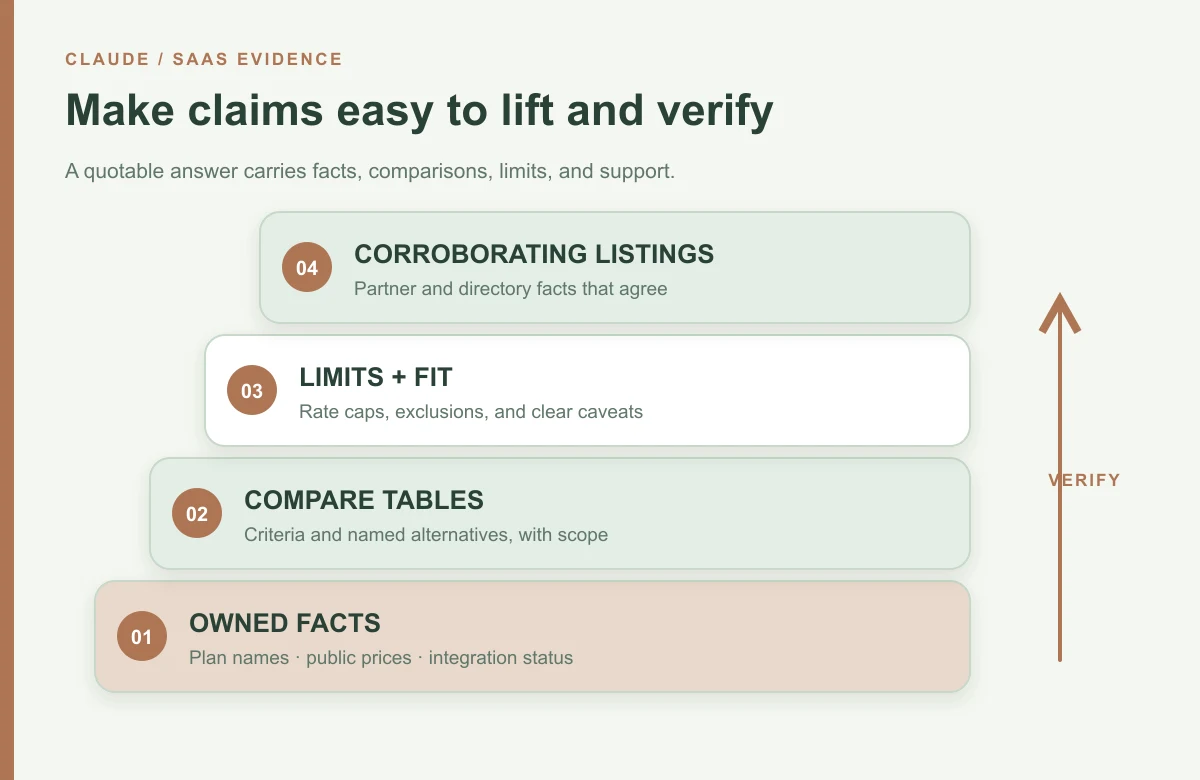
Evidence sprint for one SaaS category prompt
- Pick one money prompt (category, alternative, or pricing).
- List the five facts an accurate answer must include.
- Locate each fact on an owned URL as visible HTML (not only in a PDF or screenshot).
- Add or fix a 40–60 word answer block under a question-style heading.
- Check one third-party page for contradictory category or pricing language.
- Re-run the frozen Claude prompt and log mention / citation / accuracy—not vanity screenshots alone.
Sources: Helpful, reliable, people-first content, Organization structured data.
Structure and HTML: make passages liftable
Answer engines prefer passages that remain true without the surrounding essay. Lead sections with the direct answer. Use question-shaped H2/H3s that match how buyers ask Claude. Keep key claims in the initial HTML response—client-only rendering that leaves empty shells in text-mode fetches is a common eligibility failure for modern SaaS front ends.
Use real tables for plans and feature matrices. Use ordered lists for procedures. Put caveats in the same section as the claim so a short citation does not misrepresent you. Update visible dates when facts change. Organization and Article/FAQ structured data can help machines map entities when markup matches visible text; Anthropic does not publish a schema field that forces Claude citations, and Google’s AI-feature guidance likewise rejects the idea of special AI-only files as a requirement for Google AI features.
Sources: AI features and your website, Optimizing for generative AI features, Organization structured data.
Measure Claude with a frozen prompt panel
Create eight to twelve prompts your ICP actually asks: category shortlists, “best for [persona],” alternatives, pricing, integrations, and troubleshooting. Freeze wording, mode (for example web search on/off if the product exposes it), date, and evaluator. For each run, record: brand mentioned? owned URL cited? competitor cited? factual error? Then separate referral analytics (if any Claude referrers appear) from answer observations. DataFast or analytics with zero Claude referrals does not prove Claude never mentions you—clicks and answers are different events.
Refuse vendors who sell guaranteed Claude citation quotas. Improve eligibility, ship evidence fixes from the backlog, and re-run the same panel monthly. Pair Claude logs with Perplexity and ChatGPT panels so you learn whether failures are engine-specific or shared evidence problems.
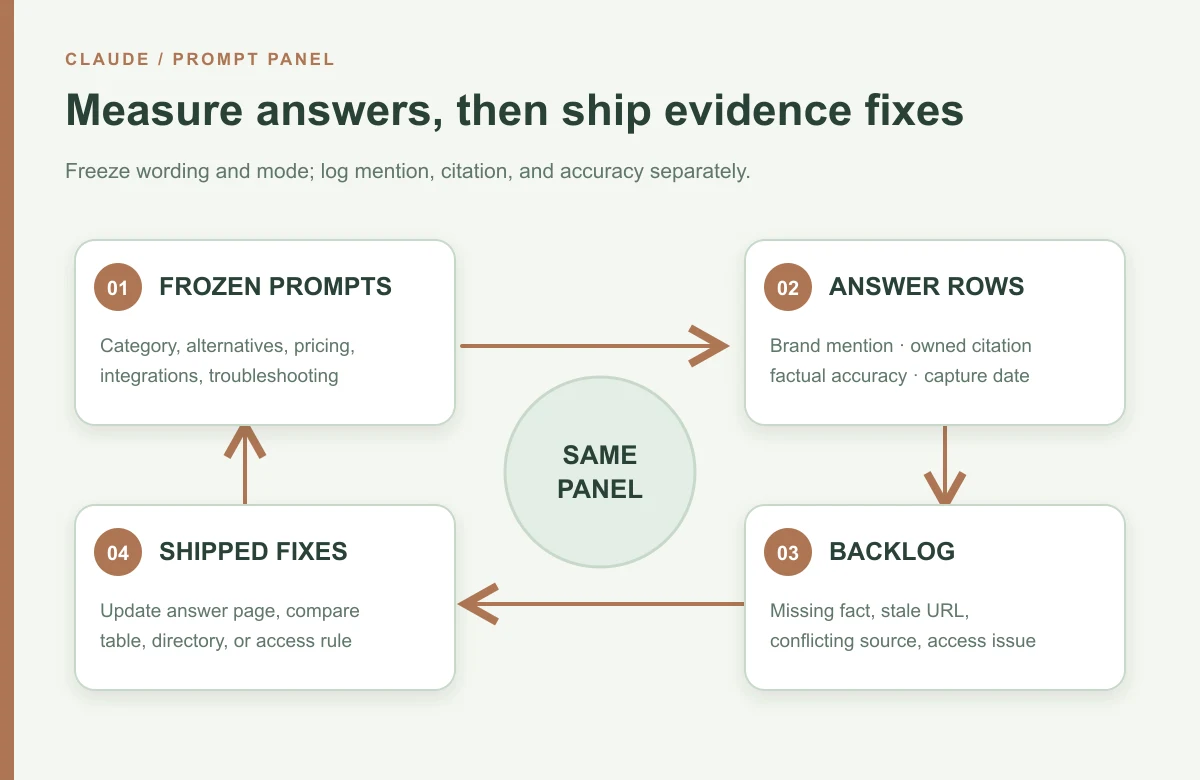
Log columns for a Claude panel
| Column | Why it exists |
|---|---|
| Prompt + date + mode | Makes runs comparable |
| Mention (Y/N) | Brand named without requiring a link |
| Owned citation (URL) | Linked source you control |
| Third-party citation | Who else is teaching the category |
| Accuracy flag | Wrong price, wrong category, wrong entity |
| Next fix | Page or corroboration task—not a vanity rewrite |
Sources: Anthropic Help Center: Does Anthropic crawl data from the web…?, AI features and your website.
Corroboration: why Claude may prefer someone else’s page
Even with perfect robots access, Claude may attribute a category claim to a review site, documentation hub, or newsletter that states the same fact more clearly—or that many other sources repeat. Corroboration work is not link spam. It is making the public record consistent: partner listings, integration directories, help-center mirrors, founder interviews, and honest customer stories that use the same product name and category language.
Prioritize third-party pages that already rank or get cited for your buyer prompts. Ask for factual corrections when a directory lists the wrong category, dead pricing, or a confused entity (a common failure mode when brand names collide). Publish primary sources others can cite—benchmarks with methodology, public changelogs, and security pages—so Claude and human writers have something stronger than a homepage slogan.
For SaaS teams under roughly 10k monthly visits, corroboration often beats another thin blog post. One corrected G2 category, one accurate “alternatives” mention, and one quotable compare table on your own domain usually move the prompt panel more than five undifferentiated thought-leadership essays. Log which third-party URLs Claude cites today; those URLs are your real competitors for attribution.
Corroboration mini-audit (one afternoon)
- From your last Claude panel, list every third-party URL cited for your category prompts.
- Check each for wrong price, wrong category, or wrong company identity.
- File correction requests or update your owned pages so the accurate fact is easier to lift.
- Add one primary-source page (methodology, limits, or security) that others can cite.
- Re-run only the prompts that failed accuracy or owned-citation checks.
Sources: Helpful, reliable, people-first content, Anthropic Help Center: Does Anthropic crawl data from the web…?.
A 30-day Claude eligibility workflow for a SaaS marketing team
Week 1 is access and inventory. Export your robots decisions for Anthropic bots, confirm HTML rendering of the ten URLs most likely to answer buyer prompts, and build the frozen Claude panel. Do not expand the panel mid-month or you will lose comparability.
Week 2 is evidence. For the three highest-value prompts, ship answer blocks, tables, and dated facts. Align the homepage one-liner, pricing page, and llm-info or about page so the entity string is identical. Fix any soft-404 or login wall that hides the answer from a text fetch.
Week 3 is corroboration and internal links. Connect the new answer pages from category and compare hubs. Correct the worst third-party mismatch you can influence. Add outbound citations to primary standards your claims rely on.
Week 4 is measurement and editorial honesty. Re-run the panel, update the backlog, and publish only claims you can defend. If Claude still prefers a competitor’s documentation, study their extractability—passage clarity, tables, dates—before assuming a mysterious penalty. Keep Google-aligned helpful-content standards in view so Claude work does not drift into doorway pages.
30-day workflow outputs
| Week | Shipped output | Success signal (observation only) |
|---|---|---|
| 1 | Bot matrix + frozen 8–12 prompts | Access checks documented with dates |
| 2 | Three answer-ready owned URLs | Facts visible in HTML; dates present |
| 3 | Corroboration fixes + internal links | Fewer contradictory public descriptions |
| 4 | Panel re-run + backlog | Clearer mention/citation/accuracy rows—not a promised lift |
Sources: Anthropic Help Center: Does Anthropic crawl data from the web…?, Helpful, reliable, people-first content, Optimizing for generative AI features.
Entity clarity when Claude confuses similar brand names
If your brand name collides with another company, Claude may retrieve the wrong entity even when your pages are strong. Publish a short disambiguation sentence on the homepage and about page: legal name, what you sell, who you serve, and the canonical website. Keep Organization structured data consistent with that sentence. Use the same wording in LinkedIn Company Page about text and other sameAs profiles you control.
TopFound (topfound.io) is an Answer Engine Optimization (AEO) / AI SEO agency—not the Manchester-area TopFound namesake. TopFound’s own inventory includes entity-disambiguation education (/blog/what-is-topfound-entity-disambiguation and the homepage entity module) because AI answers amplify namesakes. The pattern generalizes: do not bury the disambiguation in a footer. Put a quotable 40–60 word definition where both humans and fetchers see it. Then test brand prompts (“What is [Brand]?”) separately from category prompts so you can tell entity failure from category competition.
Sources: Organization structured data, Helpful, reliable, people-first content.
Limits, non-goals, and honest expectations
Ahrefs Lite volumes above are labeled tool readouts for topic lock—not traffic forecasts or ranking claims. Trends relative averages are comparative interest only. “Claude seo skills” intent is explicitly out of scope. Training opt-outs via ClaudeBot are privacy/policy choices—not a citation strategy. Appearance in any single Claude answer is not a durable rate.
This guide is educational. Soft next steps for capacity live on /aeo-report, /blog/aeo-services, and /services/ai-citation-optimization after your logs show concrete evidence or access failures.
Sources: Anthropic Help Center: Does Anthropic crawl data from the web…?, Optimizing for generative AI features.
FAQ
What is Claude citation eligibility?
It is the practice of improving your odds that Claude can retrieve and accurately attribute your pages—through deliberate Anthropic bot access, extractable evidence, entity consistency, corroboration, and frozen-prompt measurement—without promising citations.
How do we get cited in Claude?
Treat “get cited in Claude” as eligibility work: allow the right Anthropic bots, publish extractable SaaS facts as HTML, keep entity strings consistent off-site, corroborate claims on third-party pages, and measure mention vs owned citation on a frozen Claude prompt panel. No vendor can guarantee Claude citations.
Is Claude SEO the same as Claude Agent Skills?
No. Skills/GitHub intents are different. This article targets citation eligibility for brand and product answers.
Should we block ClaudeBot to force better citations?
No. ClaudeBot is documented as training-related. Search and user-fetch visibility are separate agents. Make an explicit policy; do not use training blocks as a hack.
How is this different from the ChatGPT citation resource?
/resources/how-to-get-cited-in-chatgpt owns ChatGPT access and observation patterns. This URL owns Anthropic bot roles and Claude-specific SaaS eligibility.
How does this relate to Perplexity SEO?
Both are engine wedges. Perplexity emphasizes citation-forward SaaS evidence on /blog/perplexity-seo-for-saas. Claude emphasizes Anthropic access gates plus extractability. Share evidence hygiene; do not merge the URLs.
Does schema or llms.txt guarantee Claude citations?
No. Accurate Organization markup and machine-readable summaries can clarify entities; they do not compel selection.
What should we measure first?
On a frozen Claude prompt set: mentions, owned URL citations, third-party citations, and accuracy errors—then ship evidence fixes.
Can anyone guarantee Claude citations?
No. Refuse quota promises. Eligibility work is real; guarantees are not.
Where next after this guide?
Pair with /blog/gemini-ai-overviews-saas-playbook for Google-side engines, /blog/generative-engine-optimization for the GEO system, and measurement resources for analytics depth.
Improve Claude eligibility, then widen the engine set
Use this guide for Claude-specific access and extractability. Connect it to Perplexity, ChatGPT, and cross-engine citation process pages, and choose capacity only after prompt logs show where you fail.
Conclusion
Claude SEO, practiced as citation eligibility for SaaS, is disciplined access plus extractable truth: configure Anthropic’s bots intentionally, publish answer-first HTML with dated facts, keep entities consistent off-site, and measure mention versus citation on a frozen prompt panel. Ahrefs Lite demand for “claude seo” (SV 400 / KD 11) plus Trends interest supports this educational engine page—without treating tool metrics as traffic promises or citation guarantees.
Connect this Claude wedge to /blog/chatgpt-seo, /blog/perplexity-seo-for-saas, /resources/how-to-get-cited-in-chatgpt, /blog/ai-citation-optimization, and /blog/gemini-ai-overviews-saas-playbook. Softly evaluate help via /aeo-report or /services/ai-citation-optimization only after logs show where access or evidence fails. Better eligibility is not a citation guarantee.
Sources: Anthropic Help Center: Does Anthropic crawl data from the web…?, Helpful, reliable, people-first content.