

The short answer
Generative engine optimization (GEO) is the practice of making a brand accurately discoverable, synthesizable, and citable inside generative answers and generative search experiences—ChatGPT, Google AI Overviews / AI Mode, Perplexity, Gemini, Claude, Grok, Copilot, and similar surfaces—without treating GEO as a replacement for crawlable SEO or as a synonym for every AEO deliverable. For SaaS teams, GEO is best run as a system: (1) product-fact and entity integrity, (2) synthesis-ready owned pages, (3) corroboration in the wider web corpus, (4) technical eligibility for crawl and retrieval, and (5) measurement of mentions, citations, accuracy, and referrals as separate rows. This article owns deep GEO practice for the primary query “generative engine optimization.” The comparison decision tree stays on /blog/geo-vs-aeo-vs-seo-for-saas. Cross-engine AI search implementation stays on /blog/ai-search-optimization-playbook. Managed packaging stays on /services/generative-engine-optimization and /blog/aeo-services—not here. No scheme, schema field, or vendor pitch guarantees generative rankings or citations.
Key takeaways
- Demand notes (labeled tools, 2026-10-01 lock): Ahrefs Lite US Overview for “generative engine optimization” showed SV 7,200, KD 65, CPC $11.00. Google Trends US Past 12 months Web Search relative average was 52 versus compared candidates. Tool and Trends readouts—not TopFound rankings or traffic forecasts. Ahrefs credits for the lock day: 1/5 (one batched Overview); no further Ahrefs spend for this draft.
- GEO is a generative-answer visibility discipline; AEO names cross-engine answer readiness; SEO remains the eligibility foundation Google describes for AI features. Deep practice lives here; vs-explainer lives on /blog/geo-vs-aeo-vs-seo-for-saas.
- Run GEO as five coupled loops—facts/entities, synthesis-ready content, corroboration, technical eligibility, and honest measurement—not as a one-off “GEO content pack.”
- Separate mentions, citations, accuracy corrections, and referrals. Celebrating a name-drop as a GEO win hides citation-quality and product-fact work.
- Engine-specific depth (for example Perplexity) belongs in channel guides such as /blog/perplexity-seo-for-saas; keep this URL as the GEO system spine.
What buyers mean by generative engine optimization
People search “generative engine optimization” when they need a durable definition and a workable method for showing up accurately inside generative answers—not another slide that only rearranges GEO, AEO, and SEO logos. The buyer is usually a SaaS marketing, growth, or demand-gen lead who has heard that ChatGPT, AI Overviews, Perplexity, and peer engines influence shortlists, and who needs to know what to change on owned pages, in the corroborating web, and in measurement. GEO, in that practical sense, is the discipline of improving eligibility and fidelity for generative synthesis and citation—without inventing guaranteed placements.
Demand evidence for this lock (2026-10-01): Ahrefs Lite US Overview listed “generative engine optimization” at search volume 7,200, keyword difficulty 65, and CPC $11.00 (SpaceOffice Lite, Google/US, one batched Overview pull). Google Trends (US, Past 12 months, Web Search) showed a relative average of 52 for GEO among the compared candidates in the lock set. These are labeled Ahrefs Lite / Trends figures—not TopFound rankings, not predicted traffic, and not proof any vendor owns the SERP. OpenSEO was not used. Ahrefs credits for the lock day: 1/5 confirmed; this drafting pass spends no further Ahrefs credits.
Cannibalization guardrail: /blog/geo-vs-aeo-vs-seo-for-saas owns the vs-explainer and investment decision tree. /blog/ai-search-optimization-playbook owns the cross-surface SaaS optimization playbook. /blog/ai-search-visibility-framework owns visibility-state language. /blog/aeo-services and /services/generative-engine-optimization own evaluation and commercial packaging. /blog/perplexity-seo-for-saas owns Perplexity-channel practice. /blog/claude-citation-eligibility owns Claude eligibility. /blog/gemini-ai-overviews-saas-playbook owns the SaaS Gemini/AI Overviews playbook. This URL owns generative engine optimization as a deep how-to / system for generative engines.
Sources: AI features and your website, Do I need SEO?.
Generative engine optimization defined (practitioner version)
Generative engine optimization is the set of practices that help generative systems retrieve, understand, synthesize, and—when appropriate—cite your brand accurately for prompts that matter to buyers. Those systems include chat products with browsing or tool use, AI Overviews and AI Mode experiences that draw from Search-eligible content, and citation-forward answer engines. The optimization target is not a classic blue-link position alone; it is answer inclusion, framing fidelity, and citation quality across generative surfaces.
GEO does not repeal SEO. Google’s documentation on AI features and generative AI optimization emphasizes that helpful, people-first, Search-eligible content remains foundational, and that appearance in AI features is not guaranteed. Crawlability, clear titles, trustworthy presentation, and useful pages still matter. GEO builds on that eligibility layer by shaping extractable facts, entity clarity, corroboration, and measurement for generative synthesis—not by promising a secret markup that forces inclusion.
GEO also should not collapse into “whatever an agency labeled GEO this quarter.” Many scopes that matter for SaaS look like answer-engine readiness plus content designed for synthesis. When you need a clean comparison of GEO vs AEO vs SEO investment decisions, use /blog/geo-vs-aeo-vs-seo-for-saas. When you need the operating system for generative engines themselves, stay on this page.
GEO term → practical meaning → common misuse
| Term | Practical meaning | Common misuse |
|---|---|---|
| Generative engine optimization | Improve accurate inclusion/citation in generative answers | Rebranding all SEO as GEO |
| Synthesis readiness | Facts structured so models can quote without distortion | Keyword stuffing into AI-looking prose |
| Corroboration | Consistent third-party and owned evidence | Buying links as a “GEO package” |
| Citation eligibility | Pages and sources worth retrieving and attributing | Guaranteed citation quotas |
Sources: AI features and your website, Optimizing for generative AI features, Helpful, reliable, people-first content.
The five-loop generative engine optimization system for SaaS
Treat generative engine optimization as five coupled loops rather than a single content sprint. Loop 1 — product-fact and entity integrity: one reconciled source of truth for pricing tiers, limits, integrations, company identity, and product aliases. Loop 2 — synthesis-ready owned pages: comparison, alternatives, category, identity, and troubleshooting URLs written so answers can extract accurate claims. Loop 3 — corroboration: reviews, partner pages, docs mirrors, and publisher coverage that do not contradict owned facts. Loop 4 — technical eligibility: crawl, indexation, structured identity where appropriate, and access patterns that keep pages retrievable. Loop 5 — measurement: frozen prompt sets with separate rows for mentions, citations, accuracy issues, and referrals.
These loops map to owners. Product marketing owns facts. Content and SEO own synthesis-ready pages. Comms and partnerships influence corroboration. Engineering and SEO own eligibility. Analytics and growth own measurement hygiene. GEO fails when one team “writes GEO blogs” while pricing pages contradict docs and third-party reviews describe a sunset feature.
The system is deliberately compatible with the AI search optimization playbook’s layers and the visibility framework’s four panels. GEO here zooms into generative-engine practice; those companion URLs remain the broader playbook and visibility map. For Perplexity-specific citation patterns, continue to /blog/perplexity-seo-for-saas after you understand the spine.
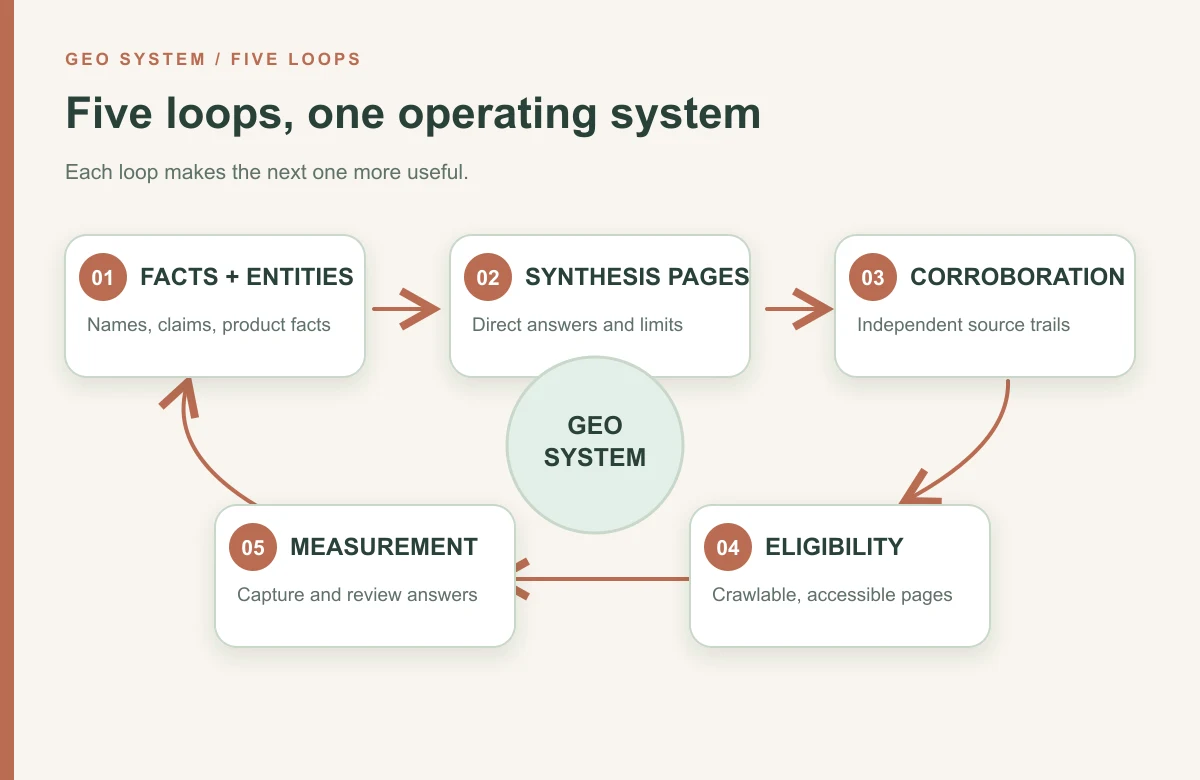
Loop → primary job → typical SaaS owners
| Loop | Primary job | Typical owners |
|---|---|---|
| Facts / entities | Reconcile product truth and identity | PMM + legal + SEO |
| Synthesis-ready pages | Ship extractable answers for buying prompts | Content + SEO |
| Corroboration | Align third-party descriptions | Comms + partnerships |
| Technical eligibility | Keep pages crawlable and clear | Eng + SEO |
| Measurement | Track mentions/citations/accuracy/referrals separately | Growth + analytics |
Sources: Optimizing for generative AI features, Helpful, reliable, people-first content.
Loop 1 — Product facts and entity integrity
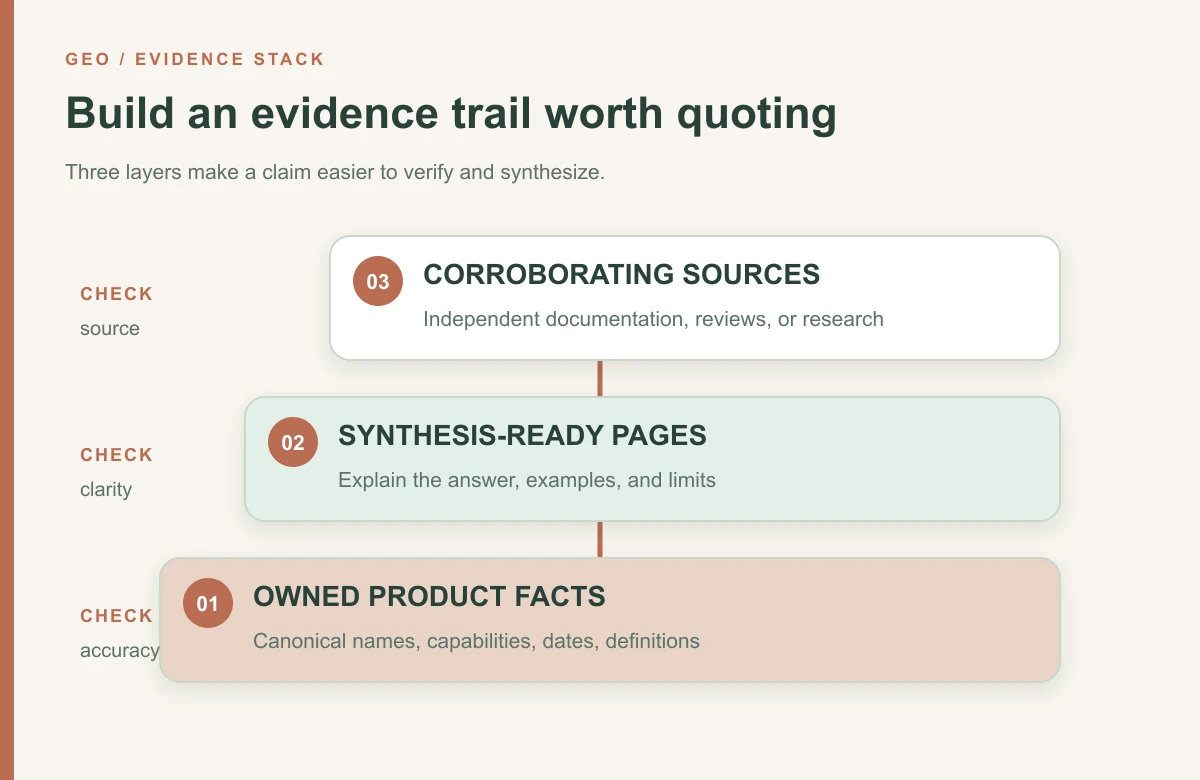
Generative systems synthesize. If your pricing page, docs, About page, and G2 profile disagree, the answer will often pick one fragment and present it as truth. GEO starts with a product-facts table: official name and aliases, category phrasing, plan names, hard limits, supported regions, key integrations, and “what we are not.” Update dates matter. A stale “last updated” signal next to changed pricing invites mis-citation.
Entity integrity means the company and product are distinguishable from similarly named tools and from prior acquisitions. Clear Organization facts, consistent NAP-like identity fields where relevant, and disambiguating About copy reduce wrong-entity answers. Structured data can support clarity when it matches visible content; it does not compel generative inclusion. See also /blog/what-is-topfound-entity-disambiguation for the entity-focused companion.
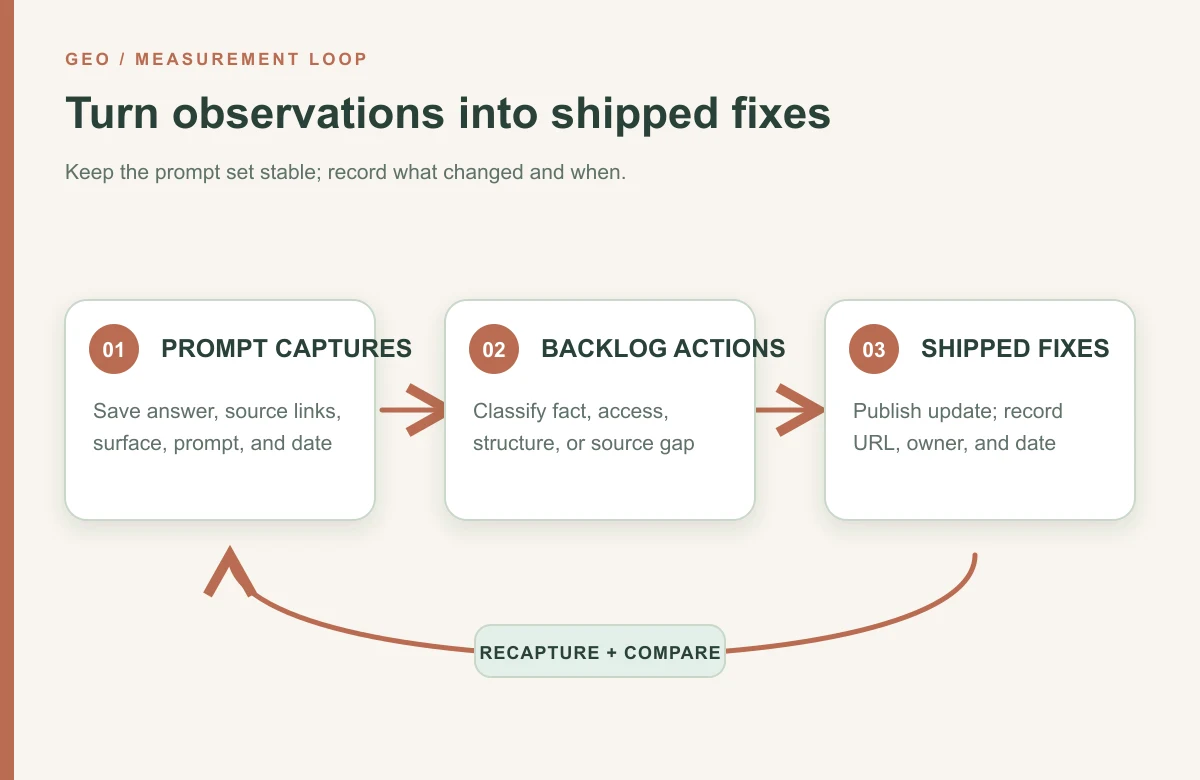
Run a monthly facts reconciliation: export claims that appear in generative answers on your frozen prompt set, compare them to the product-facts table, and file corrections as backlog items—not as one-off Slack screenshots.
Fact integrity sprint (first two weeks)
- Build a single product-facts table with owners and last-verified dates.
- Diff pricing, docs, About, and top review profiles for contradictions.
- Publish extractable “limits and non-goals” sections on key commercial pages.
- Log generative misstatements against the table; do not invent win rates.
Sources: Organization structured data, Helpful, reliable, people-first content.
Loop 2 — Synthesis-ready content for generative engines
Synthesis-ready content is not “write like a chatbot.” It is content that answers buying questions with scannable claims, definitions up front, explicit comparisons, dated evidence, and clear limits. Generative engines favor passages that can be quoted without reconstructing missing context. Lead with the direct answer, then support it. Use tables for plan differences. Name competitors fairly on alternatives pages instead of forcing readers (and models) to invent the shortlist.
Prioritize URL types that map to prompt classes: identity (“what is [brand]”), category (“best X for Y”), comparison (“[brand] vs [peer]”), alternatives, pricing/limits, integration and troubleshooting docs. Each should expose extractable facts near the top. Avoid burying critical limits in PDFs that are hard to retrieve or in interactive widgets that never render text to crawlers.
This loop connects to citation-quality work on /blog/ai-citation-optimization and to the content workflow resource at /resources/ai-citation-optimization-content-workflow. Keep those URLs for citation process depth; keep this section focused on how synthesis-ready pages feed generative engine optimization as a system.
Prompt class → page type → extractable element
| Prompt class | Page type | Extractable element |
|---|---|---|
| Identity | About / product overview | One-sentence definition + category |
| Category / shortlist | Category guide | Who it is for / not for |
| Comparison | Vs page | Fair criteria table with limits |
| Pricing / packaging | Pricing + docs | Plan names, hard caps, exclusions |
| Troubleshooting | Docs | Steps with prerequisites and errors |
Sources: Helpful, reliable, people-first content, How to write useful titles and meta descriptions.
Loop 3 — Corroboration outside your domain
Generative answers often blend owned pages with reviews, documentation mirrors, community threads, and publisher explainers. If those sourcesdisagree with your product-facts table, GEO work includes outreach and updates—not only on-site polish. Prioritize high-trust profiles that already describe you incorrectly, partner integration pages with outdated screenshots, and ranking listicles that still ship last year’s packaging.
Corroboration is not a euphemism for buying links. It is consistency of public evidence. When a review site lists a feature you deprecated, file an update. When a partner page names the wrong SKU, fix the joint listing. When a reputable guide omits a hard limit that changes buyer fit, offer a factual correction—not a promotional rewrite.
Track corroboration as a backlog with source URL, claim, desired accurate claim, and owner. Measure whether generative answers still quote the stale source after updates. Do not claim that one corrected listing caused a citation lift unless you have controlled before/after evidence on a frozen prompt set.
Corroboration triage
- From prompt captures, list third-party URLs that appear beside or instead of you.
- Flag factual conflicts with the product-facts table.
- Assign owners (partner, review, PR) with a due date.
- Re-check the same prompts after the source updates—not random new prompts only.
Sources: Helpful, reliable, people-first content.
Loop 4 — Technical eligibility for generative retrieval
If a page cannot be crawled or usefully rendered, it is a weak candidate for generative retrieval that depends on web evidence. Technical eligibility for GEO reuses SEO fundamentals: allow crawling where you want discovery, avoid accidental noindex on commercial explainers, ensure primary claims exist in HTML text, keep titles and headings descriptive, and maintain stable URLs when facts change (update content rather than endlessly forking near-duplicate pages).
Optional artifacts such as llms.txt can help some agents discover preferred pages, but they are not a ranking switch. Treat them as navigation hints for machine readers—see /blog/what-is-llms-txt—while keeping the real work on helpful pages and facts. Organization and other structured data should mirror visible truths; mismatched schema is noise.
Google’s AI-features guidance remains the north star for Search-tied generative experiences: same foundational practices as Search; no special AI-only guarantee markup. Other engines choose sources per answer. Eligibility work improves readiness; it does not sell quotas.
Sources: AI features and your website, Do I need SEO?, Organization structured data.
Loop 5 — Measuring generative engine optimization outcomes
GEO measurement fails when teams invent a single “AI score.” Use a frozen prompt set across the engines that matter to your buyers. For each capture, record engine/surface, locale, date, prompt class, inclusion (mentioned or not), citation (linked/attributed or not), accuracy flags, and competitor co-occurrence. Separately track referrals you can attribute in analytics. Definitions deepen on /resources/how-to-measure-ai-search-visibility and /resources/ai-citations-vs-brand-mentions-vs-referrals; this loop only insists on separation of rows.
Cadence beats drama. Weekly: ship one synthesis-ready fix or corroboration update tied to observed errors. Monthly: re-run the frozen set, prioritize the worst prompt classes, and refuse to move goalposts mid-month. Quarterly: refresh the prompt set intentionally and document why prompts were added or retired.
Never report invented traffic lifts or citation guarantees in GEO dashboards. KD 65 on Ahrefs Lite for the head term describes competition to rank content about generative engine optimization—not the difficulty of earning a ChatGPT mention. Trends relative average 52 describes comparative interest, not forecasted sessions for this URL.
Metric row → what it answers → what it is not
| Row | Answers | Not |
|---|---|---|
| Inclusion / mention | Were you named? | A ranking position |
| Citation quality | Linked + accurate + current? | Any name-drop win |
| Competitive share | Vs peers on a frozen set? | Universal AI ownership |
| Referrals / leads | Visits or pipeline you can attribute? | Proof a single blog caused it |
Sources: AI features and your website, Optimizing for generative AI features.
Worked example: a 60-day SaaS GEO implementation sprint
Scenario (illustrative only—not a TopFound client case; invents no real citation rates or traffic): A B2B analytics SaaS hears buyers repeating competitor names from ChatGPT comparison prompts and sees intermittent Perplexity citations to an outdated partner page. Leadership asks for “GEO.” The team refuses a vanity package and runs the five loops.
Weeks 1–2: product-facts table; fix pricing/docs contradictions; clarify About identity. Weeks 3–4: ship two synthesis-ready comparison pages and a limits section on pricing. Weeks 5–6: correct the partner page and two review profiles. Weeks 7–8: freeze a 40-prompt set across ChatGPT, Perplexity, and AI Overviews; log inclusion, citation, and accuracy separately; put three recurring misstatements into the backlog.
Decision at day 60: they do not claim “we own GEO.” They show fewer accuracy errors on the frozen set, one new owned URL appearing as a citation on a subset of comparison prompts (anecdotal, dated), and a clear next month backlog. Capacity questions—if any—route to /blog/aeo-services or /services/generative-engine-optimization only after the system is running.
Sprint done definition
- Product-facts table live with owners.
- At least two synthesis-ready commercial URLs shipped.
- Top conflicting third-party claims filed or fixed.
- Frozen prompt log with separate mention/citation/accuracy rows.
- No guaranteed-citation language in the readout.
How GEO relates to AEO and SEO without becoming the comparison post
SEO remains the eligibility layer: crawlable, helpful pages that can rank in classic results and remain candidates for Search-tied AI features. AEO (answer engine optimization) names the cross-engine job of answer readiness and citation quality across chat and AI search surfaces. GEO emphasizes generative-answer visibility and synthesis fidelity. Overlap is large; acronym battles are unproductive.
Use /blog/geo-vs-aeo-vs-seo-for-saas when stakeholders need a decision tree for where to invest first and how to evaluate “GEO agency” pitches that are really AEO scopes. Use this article when the decision is already “we need generative engine optimization practice” and the team needs the system. Use /blog/ai-search-optimization-playbook when you want the broader five-layer SaaS playbook spanning surfaces. Use /aeo-explained for the AEO category overview.
Sources: AI features and your website, Do I need SEO?.
How TopFound fits (soft CTA)
TopFound helps brands improve AI-answer and organic visibility through managed AEO / AI SEO / GEO-oriented work. Public Growth and Scale plans start at $797/mo and $1,297/mo. This article does not reproduce plan matrices or invent case metrics. Soft paths after the educational layer: free baseline via /aeo-report; managed GEO packaging via /services/generative-engine-optimization; broader AEO via /services/aeo-services; citation-focused packaging via /services/ai-citation-optimization.
Next educational steps: /blog/perplexity-seo-for-saas for a channel wedge, /blog/ai-citation-optimization for citation process depth, and /resources/how-to-measure-ai-search-visibility for instrumentation.
Honest limits of generative engine optimization
No GEO checklist guarantees inclusion in ChatGPT, AI Overviews, Perplexity, or any peer engine. Google states appearance in AI features is not guaranteed; chat engines choose sources per answer.
Ahrefs Lite SV 7,200 / KD 65 / CPC $11.00 for “generative engine optimization” describes demand and ranking difficulty for content about the topic—not the difficulty of becoming cited inside generative answers.
Trends relative average 52 is comparative interest among locked candidates—not a traffic forecast for this URL.
Schema, llms.txt, and monitoring logins are readiness aids at best. They are not placement switches.
A 60-day sprint can improve factual consistency and readiness; it cannot honestly promise a fixed citation quota or revenue lift.
Sources: AI features and your website, Optimizing for generative AI features.
FAQ
What is generative engine optimization?
Generative engine optimization (GEO) is the practice of improving accurate discoverability, synthesis, and citation of your brand inside generative answers and generative search experiences—built on SEO eligibility and overlapping heavily with AEO answer readiness.
How is GEO different from AEO and SEO?
SEO is the crawlable helpful-content foundation. AEO focuses on cross-engine answer readiness and citations. GEO emphasizes generative-answer visibility and synthesis fidelity. For a decision tree, see /blog/geo-vs-aeo-vs-seo-for-saas; this page owns deep GEO practice.
Is this a TopFound GEO services landing page?
No. Managed packaging lives on /services/generative-engine-optimization and evaluation guidance on /blog/aeo-services. This URL is an educational implementation guide.
Does generative engine optimization replace SEO?
No. Google’s AI-features guidance still depends on Search-eligible, helpful content. GEO builds on that foundation rather than replacing it.
How should SaaS teams start GEO in the first month?
Reconcile product facts and entities, ship synthesis-ready pages for top buying prompt classes, triage contradictory third-party sources, confirm technical eligibility, and start a frozen prompt log with separate mention/citation/accuracy rows.
Where should Perplexity-specific tactics live?
In the channel guide /blog/perplexity-seo-for-saas. For Claude, use /blog/claude-citation-eligibility; for Gemini and Google AI Overviews SaaS execution, use /blog/gemini-ai-overviews-saas-playbook. Keep this article as the GEO system spine and cross-link engine guides.
Can you guarantee generative citations or AI Overview placement?
No. Eligibility and readiness can improve; placements are not sold as quotas. Refuse vendors who guarantee citation counts.
How does this GEO system relate to AI citation optimization?
This article owns the five-loop generative engine optimization system. /blog/ai-citation-optimization deepens citation-quality process across engines. /blog/perplexity-seo-for-saas specializes the channel wedge. Cross-link them; do not collapse all three into one page.
How does this relate to the AI search optimization playbook?
The playbook (/blog/ai-search-optimization-playbook) covers cross-surface SaaS optimization layers. This GEO article zooms into generative-engine system practice and should cross-link—not duplicate—that playbook.
Build the GEO system, then specialize by engine
Use this guide as the generative engine optimization spine. Keep the comparison post for acronym decisions, run channel guides when one engine matters most, and choose capacity only after the system is clear.
Conclusion
Generative engine optimization is a practical system for SaaS teams: reconcile facts and entities, publish synthesis-ready pages, align corroborating sources, keep technical eligibility healthy, and measure mentions, citations, accuracy, and referrals as separate rows. Ahrefs Lite demand for “generative engine optimization” (SV 7,200, KD 65, CPC $11.00) and Trends relative average 52 justify a durable educational head—without cloning the GEO vs AEO vs SEO comparison or inventing win metrics.
Keep /blog/geo-vs-aeo-vs-seo-for-saas as the vs-explainer, /blog/ai-search-optimization-playbook as the broader playbook, /blog/ai-citation-optimization for citation-process depth, /blog/perplexity-seo-for-saas as the Perplexity channel wedge, /blog/claude-citation-eligibility for Claude, and /blog/gemini-ai-overviews-saas-playbook for Gemini/AI Overviews SaaS. Softly evaluate capacity via /services/generative-engine-optimization or /aeo-report (and retainer fit via /blog/aeo-services) only after the system is clear. Remember Google’s limit: helpful eligibility is not a generative placement guarantee—and remember TopFound’s editorial limit: no fabricated rankings, traffic lifts, or citation quotas.
Sources: AI features and your website, Helpful, reliable, people-first content.