
The short answer
AI visibility is whether, where, and how a brand appears when people get answers from AI systems such as ChatGPT, Perplexity, Gemini, and Google AI Overviews. A practical framework checks four things: where and when you appear, whether the answer includes you, whether the citation is linked and accurate, and your share of answers versus competitors.
Key takeaways
- Demand note (labeled, 2026-10-31 refresh): Ahrefs Lite US, 2026-10-31 — “ai visibility” SV 4.3K / KD 30; “ai visibility tools” 1.7K / KD 0. Earlier lock (2026-09-30): “ai search visibility” SV 2.8K / KD 0. Tool readouts, not TopFound rankings or a traffic forecast.
- AI visibility ≠ rankings ≠ traffic. A brand can rank in Google and still be absent from ChatGPT or AI Overviews on the same topic.
- Separate inclusion (mentioned) from citation quality (linked + accurate) or you will celebrate the wrong wins.
- Competitive share of answers is a prioritization lens on a frozen prompt set, not a universal vanity KPI.
- First-party AI visibility data now exists for some surfaces: Search Console’s Generative AI performance report (Google AI Overviews and AI Mode impressions) and Bing Webmaster Tools’ AI Performance report (citations in Microsoft Copilot and Bing AI summaries).
- This URL owns the AI visibility definition and framework. LLM-specific checks live on /blog/llm-visibility, stakeholder reports on /blog/ai-visibility-report, Google-only tracking on /blog/ai-overview-tracking, and tool buying on the tools guides.
What is AI visibility? (And what it is not)
AI visibility is whether, where, and how your brand shows up when people get answers from AI systems, such as ChatGPT, Perplexity, Gemini, Claude, and Google AI Overviews or AI Mode. People also call it AI search visibility or brand visibility in AI search. Buyers search for it when they need a definition they can operationalize: does our brand show up in AI answers, on which surfaces, and in what form? The phrase is often used loosely to mean “AI SEO,” “AEO,” “being cited in ChatGPT,” or “a dashboard login.” Those are related jobs with different owners. Visibility is the state you observe. Optimization is the work that tries to change that state. Measurement is how you instrument the observation without inventing a blended score.
Demand evidence, labeled: Ahrefs Lite US on 2026-10-31 showed “ai visibility” at search volume 4.3K and keyword difficulty 30, the broader term this page now targets. The original 2026-09-30 lock recorded “ai search visibility” at 2.8K, KD 0. Google Search Console for topfound.io (Sep 30–Oct 27, 2026) showed “ai search analytics” at 962 impressions, so this framework must not become another analytics or measurement article. These are tool and GSC readouts, not TopFound rankings.
Cannibalization guardrail: /blog/llm-visibility owns LLM visibility (the assistant-by-assistant check). /blog/ai-visibility-report owns the recurring stakeholder report. /blog/ai-overview-tracking owns Google AI Overview tracking. /resources/how-to-measure-ai-search-visibility owns measurement methods, sampling, and row definitions. /blog/ai-search-analytics owns the analytics-platform category. /blog/ai-search-optimization-playbook owns SaaS implementation. /blog/aeo-agency-vs-ai-visibility-tools owns monitor-versus-execute buying. /services/ai-visibility-recovery and /services/ai-search-analytics own commercial packaging. This URL owns definition + framework only.
Sources: AI features and your website (checked Oct 30, 2026), Do I need SEO?.
The four-part AI visibility framework
Use four questions as the framework spine. First: where and when does the brand appear—which engines and surfaces (ChatGPT, Google AI Overviews / AI Mode, Perplexity, Gemini, Claude, Grok, Copilot, classic Google results), which locales, and which prompt classes (category, comparison, alternative, troubleshooting, identity)? Second: answer inclusion—was the brand named at all? Third: citation quality—was a URL linked or clearly sourced, was the page current, and was the framing accurate? Fourth: competitive share of answers—on the same frozen prompt set, how often do named competitors appear relative to you?
These questions deliberately separate states that teams often blend. A brand can be “visible” as a named mention with a wrong pricing claim. Another brand can be invisible as a name but cited via a partner review domain. A third can dominate classic rankings while remaining absent from generative answers. The framework forces those distinctions into language leadership can use without requiring them to become analysts on day one. When you are ready to change the map—not just describe it—use the companion /blog/ai-search-optimization-playbook.
Google’s AI-features documentation reminds practitioners that AI Overviews and AI Mode draw from Search-eligible content and that appearance is not guaranteed. Chat engines choose sources per answer. Visibility frameworks describe observation; they do not authorize guarantees.
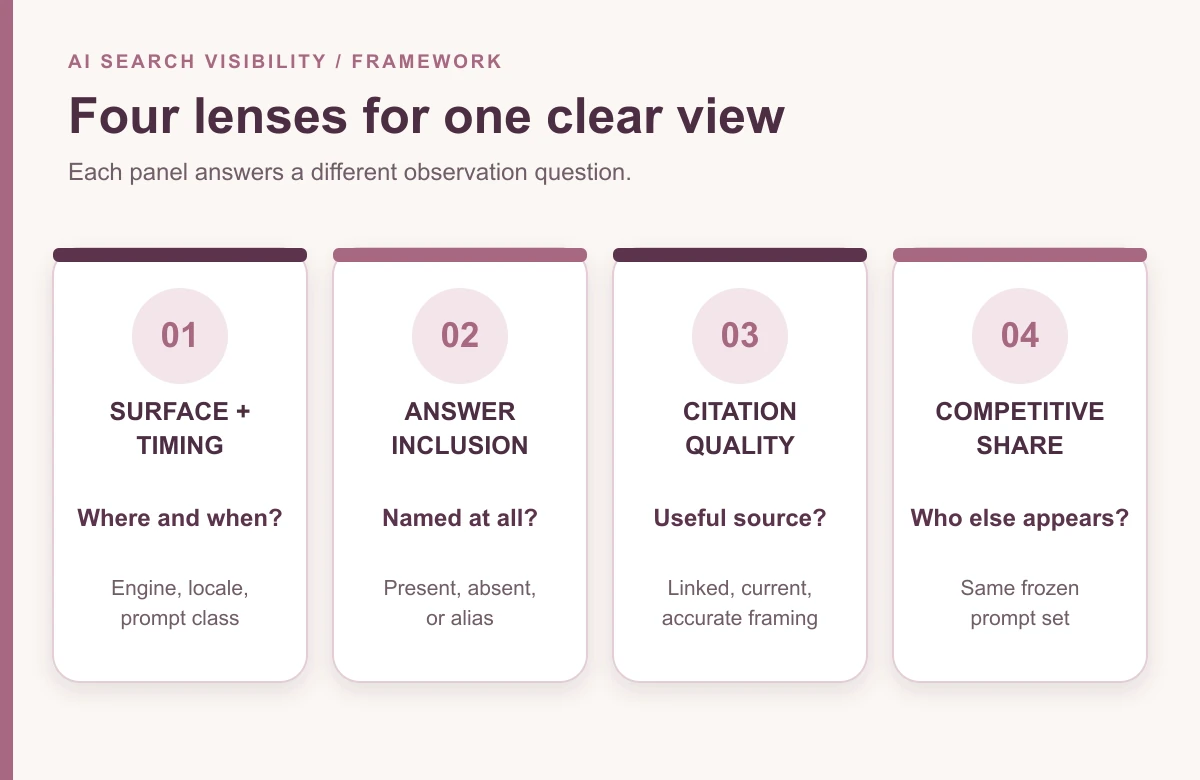
Framework question → state you are describing → common mistake
| Question | State | Common mistake |
|---|---|---|
| Where / when? | Surface + prompt-class presence | Checking one engine once |
| Included? | Mention / answer inclusion | Treating absences as permanent |
| Cited well? | Link + accuracy + freshness | Celebrating any name-drop |
| Vs competitors? | Share on a frozen set | Inventing a universal AI score |
Sources: AI features and your website (checked Oct 30, 2026), Helpful, reliable, people-first content.
Part 1 — Where and when the brand appears
Visibility always has a surface and a time. “We are visible in AI search” is incomplete until you name the engine, the interface mode (for example browsing on vs off where it matters), the locale, and the date of observation. A brand that appears in Perplexity for comparison prompts may still be absent from Google AI Overviews for the same query family. Classic organic visibility remains part of the map—especially because Search eligibility is still foundational for Google’s AI features—but it is not a substitute for answer-surface checks.
Organize presence by prompt class as well as by engine. Category prompts reveal shortlist behavior. Comparison prompts reveal competitive framing. Identity prompts (“what is [brand]”) reveal entity clarity. Troubleshooting prompts reveal whether docs are retrieved. Pricing prompts reveal whether commercial facts stay accurate when synthesized. When you later optimize, those classes tell you which URL types to ship first—see the companion playbook.
Timing matters because generative answers are volatile. A single screenshot in Slack is an anecdote. A dated series on a frozen set is visibility evidence. You do not need a perfect tool on day one; you need consistent fields. When you are ready for instrumentation depth, escalate to /resources/how-to-measure-ai-search-visibility rather than expanding this framework article into a methods encyclopedia.
Minimum “where/when” capture fields
- Engine / surface name and locale.
- Exact prompt text (frozen set preferred).
- Capture date and whether the brand appeared.
- Prompt class tag (category, comparison, identity, etc.).
Sources: AI features and your website (checked Oct 30, 2026), Do I need SEO?.
Part 2 — Answer inclusion (were you in the answer at all?)
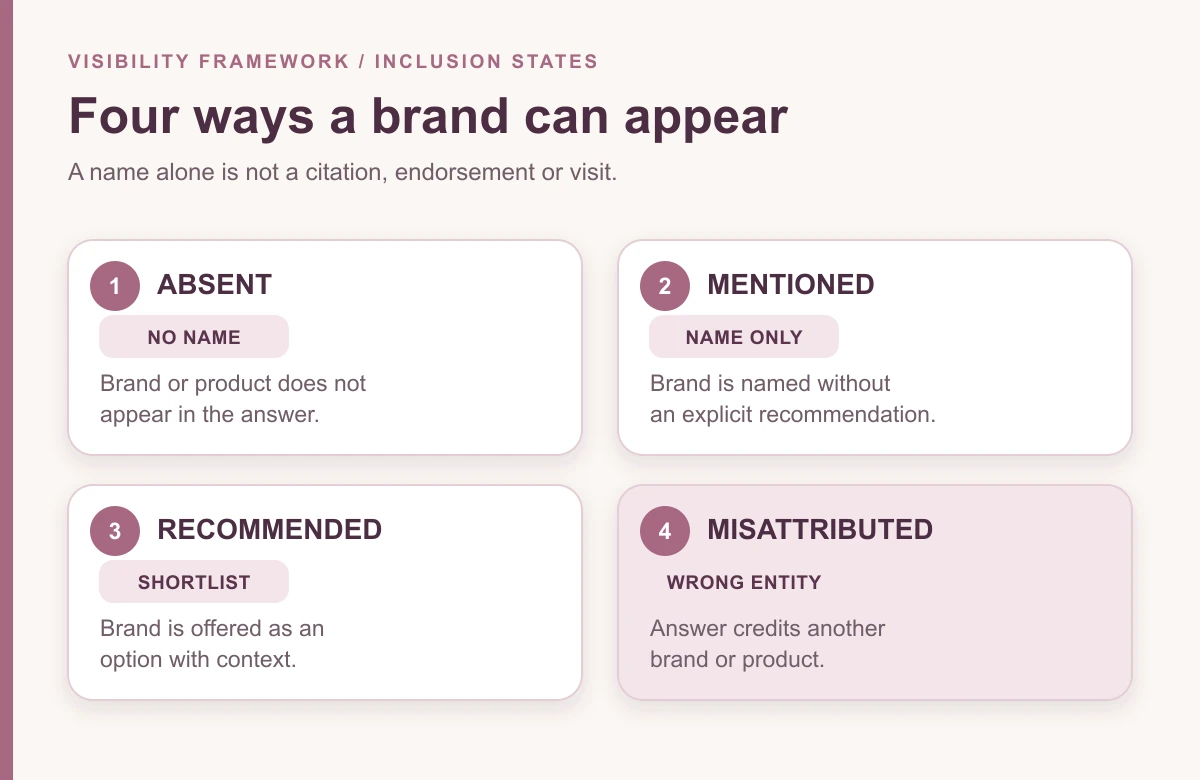
Answer inclusion is the binary-ish state: did the generated or AI-assisted answer name your brand, product, or clear alias? Inclusion is not a ranking position. It is closer to presence in a shortlist. Teams that only track classic SERP positions miss this layer entirely—and then wonder why sales hears competitor names from ChatGPT.
Inclusion has nuance. Soft inclusion (“tools like X include…”) differs from hard recommendation. Incorrect inclusion (wrong category, wrong pricing tier) can be worse than polite absence because it trains buyers on false facts. Track inclusion separately from sentiment/framing so you can prioritize corrections.
Absence is also informative. If you are absent while three peers appear, you have a visibility gap on that prompt class. If everyone is absent and the answer cites only publishers, your gap may be corroboration rather than on-site polish. The framework names the state; the playbook sequences the response.
Sources: Helpful, reliable, people-first content.
Part 3 — Citation quality (linked, accurate, current)
Citation quality asks whether inclusion came with a usable source and truthful framing. A linked citation to your current docs is different from a name-drop. A link to an outdated pricing page is a visibility problem disguised as a win. A citation to a third-party review that misstates your limits is a corroboration and entity problem.
Separate citations from mentions from referrals. Mentions are names. Citations are sourced links (or clear attribution). Referrals are visits you can attribute in analytics. Collapsing them into one “AI visibility” number creates fake progress. Definitions and edge cases belong in /resources/ai-citations-vs-brand-mentions-vs-referrals; this framework only insists that citation quality is its own panel.
Accuracy and freshness are part of quality. If answers still describe a sunset feature, your visible pages or the third-party corpus are stale relative to the product. Visibility work then includes updating extractable facts—not buying another monitoring seat alone.
Citation quality checklist (framework lens)
| Check | Good signal | Repair hint |
|---|---|---|
| Linked source? | Owned or trusted URL present | Answer-ready pages + corroboration |
| Correct entity? | Right company/product named | Entity disambiguation / About clarity |
| Current facts? | Matches live pricing/docs | Reconcile product-facts table |
| Fair frame? | Limits stated without distortion | Rewrite extractable limits sections |
Sources: AI features and your website (checked Oct 30, 2026), How to write useful titles and meta descriptions.
Part 4 — Competitive share of answers
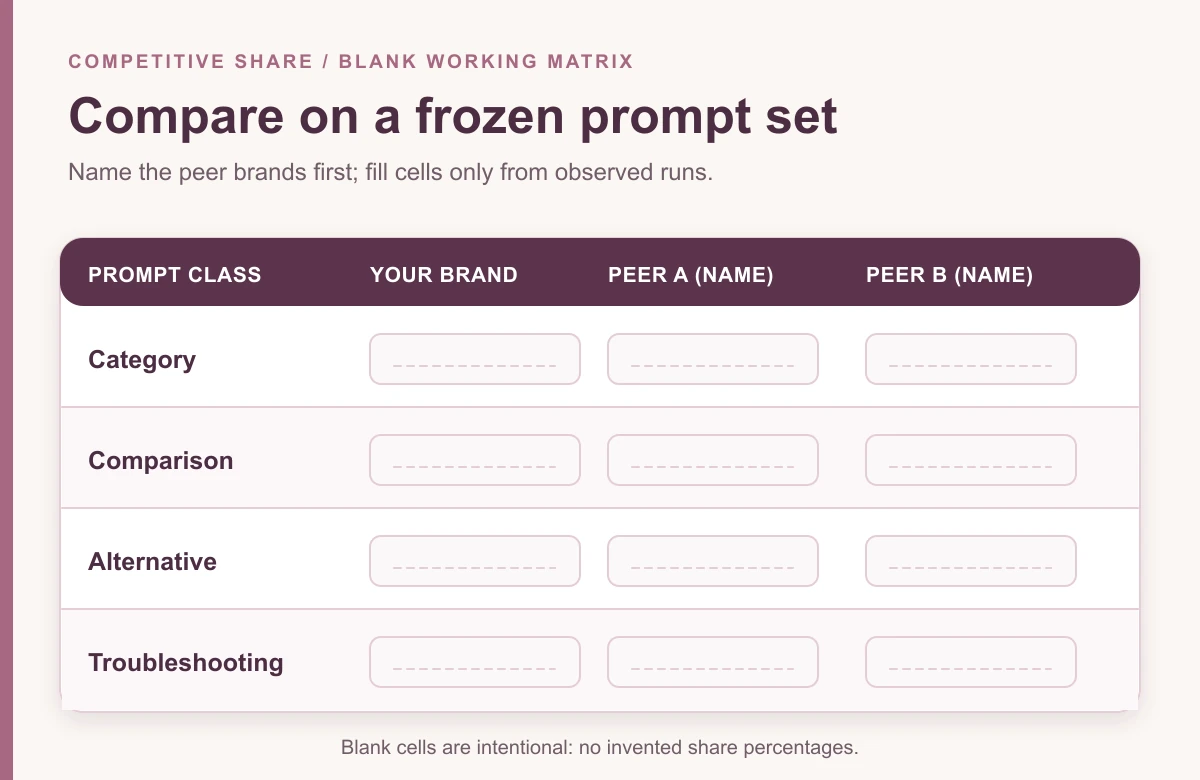
Competitive share of answers, sometimes called competitive share of AI answers, is a relative view on a frozen prompt set: how often do you appear versus named competitors? It is useful for prioritization—“we lose comparison prompts to A and B”—not as a single board KPI that hides engine differences. Compute share only on the prompts you actually re-run. Do not extrapolate a 40-prompt sample into “we own AI search.”
Share moves for reasons outside your control: competitor launches, model updates, publisher articles, review-site refreshes. Treat shifts as hypotheses to investigate, not as automatic proof that last week’s blog caused a lift. When you act, use the optimization playbook’s cadence rather than rewriting the framework.
If leadership wants tooling to automate share tracking, that is an analytics-category purchase—evaluate with /blog/ai-search-analytics and the monitor-versus-agency guide—not a reason to expand this definition article into a vendor scorecard.
Where first-party AI visibility data exists
Most AI visibility evidence is still sampled: you run prompts and record what you see. Two search engines now publish first-party data. Google’s Search Console has a Generative AI performance report, rolled out to all sites by August 31, 2026, that shows impressions in AI Overviews and AI Mode by page, country, device, and date. Bing Webmaster Tools added an AI Performance report in public preview on February 10, 2026, showing how often your pages are cited in Microsoft Copilot and Bing’s AI summaries, with the grounding queries behind those citations.
Use those reports for the Google and Microsoft parts of Part 1 and Part 3, and keep a dated prompt log for ChatGPT, Claude, Perplexity, and Gemini. Google’s generative AI guide adds a useful caution: no third-party tool has access to its internal ranking or AI systems, so treat any tool’s Google visibility figure as a sample, not ground truth.
Sources: Search Console Help: Generative AI performance report (Search) (fetched Oct 30, 2026), Bing Webmaster Blog: Introducing AI Performance in Bing Webmaster Tools (Feb 10, 2026), Optimizing your website for generative AI features (fetched Oct 31, 2026).
Where AI visibility tools fit
AI visibility tools automate the observation half of this framework: they run prompt sets on a schedule and record mentions, citations, and competitor appearances. They are useful when someone on your team will act on what they find. They do not change the map by themselves, and their numbers depend on which engines, locations, and prompts they sample, so ask vendors how data is collected and whether you can export raw rows.
This page doesn’t rank vendors. For categories, verified examples, and a buyer checklist, use /blog/answer-engine-optimization-tools and /blog/ai-seo-tools. To decide between buying software and hiring execution help, use /blog/aeo-agency-vs-ai-visibility-tools.
Sources: Optimizing your website for generative AI features (fetched Oct 31, 2026).
How the framework connects to optimization and measurement
Think in three URLs. This framework tells you what visibility means and which states to talk about. The optimization playbook (/blog/ai-search-optimization-playbook) tells you how to ship foundations, signals, tests, and cadence. The measurement resource (/resources/how-to-measure-ai-search-visibility) tells you how to instrument rows rigorously—sample design, analytics joins, and reporting hygiene.
Teams get stuck when they buy a dashboard before agreeing on the framework language, or when they publish content without a visibility map. Agree on the four questions first. Then measure. Then optimize. If capacity is the bottleneck after the map is clear, consider managed paths such as /services/aeo-services or /services/ai-visibility-recovery—softly, after the educational layer.
AEO and GEO vocabulary still apply. Answer-engine visibility and generative-engine visibility are surface families inside Part 1. You do not need to rename the company strategy every quarter; you need consistent states and owners.
Sources: Optimizing your website for generative AI features (fetched Oct 31, 2026), Helpful, reliable, people-first content.
Worked example: applying the framework in a leadership review
Scenario (illustrative only—not a TopFound client case; invents no real citation rates or traffic): A SaaS CMO asks, “Are we visible in AI search?” The marketing lead refuses a yes/no. Instead they present the four panels for a frozen 40-prompt set across ChatGPT, Perplexity, and Google AI Overviews for two weeks of captures.
Where/when: strong presence on identity prompts in Perplexity; weak on comparison prompts in ChatGPT; intermittent AI Overview cards for category queries. Inclusion: named on 12 of 40 prompts. Citation quality: only 5 of those 12 included an owned URL; two citations pointed at outdated pricing. Competitive share: Competitor A appeared on 22 prompts; Competitor B on 18; the brand on 12.
Decision: the team does not buy a new tool that week. They schedule answer-ready comparison pages and a pricing-fact reconciliation (optimization playbook), keep the prompt set frozen, and assign measurement ownership using the resource guide’s row definitions. The framework turned a vague executive question into an actionable map—without inventing a composite AI score.
Leadership-ready framework readout
- State engines, dates, and prompt-set size up front.
- Report inclusion, citation quality, and competitor co-occurrence as separate rows.
- Name one optimization backlog theme, not ten scattered ideas.
- Refuse guaranteed citation language in the same meeting.
How TopFound fits (soft CTA)
TopFound helps brands improve AI-answer and organic visibility through managed AEO / AI SEO work. Public Growth and Scale plans start at $797/mo and $1,297/mo. This article does not reproduce plan matrices or invent case metrics. Soft paths: free baseline via /aeo-report; recovery-oriented packaging via /services/ai-visibility-recovery; broader AEO via /services/aeo-services.
Next educational steps: run /blog/ai-search-optimization-playbook for implementation, and keep /resources/how-to-measure-ai-search-visibility for measurement depth.
Honest limits of an AI visibility framework
A framework does not create visibility. It only structures observation. Shipping still happens in the optimization layer.
KD 30 on Ahrefs Lite for “ai visibility” describes the difficulty of ranking content about the topic, not the difficulty of becoming visible inside AI answers themselves.
Search volume shows interest in the term; it is not a traffic forecast for this URL.
First-party reports cover Google and Microsoft surfaces only; chat assistants still need sampled prompt logs.
No schema field or monitoring login guarantees inclusion. Google’s guidance remains: helpful, eligible content can be considered; appearance is not guaranteed.
Sources: AI features and your website (checked Oct 30, 2026), Optimizing your website for generative AI features (fetched Oct 31, 2026).
FAQ
What is AI visibility?
AI visibility is whether, where, and how a brand appears in answers from AI systems such as ChatGPT, Perplexity, Gemini, and Google AI Overviews: where you appear, whether you are included, how well you are cited, and your share versus competitors.
Is AI visibility the same as AI search visibility?
Yes, the terms are used interchangeably. Both cover AI chat assistants and AI features inside search engines, not only classic blue-link rankings.
How is AI visibility different from LLM visibility?
AI visibility is the umbrella across every AI surface, including Google AI Overviews and AI Mode. LLM visibility focuses on chat assistants such as ChatGPT, Claude, Gemini, and Perplexity. See /blog/llm-visibility.
How is AI visibility different from AI search optimization?
Visibility is the map of where and how you appear. Optimization is the work that tries to change the map. See /blog/ai-search-optimization-playbook for implementation.
How do I check AI visibility in Google and Bing?
Use Search Console’s Generative AI performance report for AI Overviews and AI Mode impressions, and Bing Webmaster Tools’ AI Performance report for Copilot and Bing AI citations. Use a dated prompt log for chat assistants.
Do I need AI visibility tools?
Only if someone will act on the data. Tools automate sampled prompt checks; they don’t fix gaps. Compare categories on /blog/answer-engine-optimization-tools before buying.
Can anyone guarantee AI visibility?
No. Google says appearance in AI features isn’t guaranteed, and chat assistants choose sources per answer. Frameworks and playbooks improve readiness; they do not sell placements.
Where does TopFound fit?
TopFound (topfound.io) is a managed AEO / AI SEO agency. This guide is an explainer, not a case study. A soft next step is /aeo-report.
Map AI visibility, then optimize and measure
Use this framework to define what AI visibility means for your brand. Then run the optimization playbook and the measurement resource, without collapsing all three into one page.
Conclusion
AI visibility comes down to four questions: where and when you appear, whether answers include you, whether citations are linked and accurate, and how that compares to competitors on a frozen prompt set. Use first-party reports from Search Console and Bing where they exist, and a dated prompt log everywhere else, without cloning the measurement resource or inventing win metrics.
Use this framework to stop answering “are we visible?” with a shrug or a single screenshot. Then measure honestly and optimize on a cadence. Package stakeholder readouts with /blog/ai-visibility-report. Define LLM visibility on /blog/llm-visibility and compute competitive share with /blog/ai-share-of-voice. Continue to /blog/ai-search-optimization-playbook for AI search optimization implementation, /resources/how-to-measure-ai-search-visibility for methods, and /blog/ai-citation-optimization when citation quality is the bottleneck. Keep Google’s limit in view: eligibility is not a placement guarantee—and keep this URL as the map, not a second dashboard manual.
Sources: AI features and your website (checked Oct 30, 2026), Helpful, reliable, people-first content.