

The short answer
AI share of voice is the share of a frozen prompt panel where your brand appears in AI answers, calculated separately for mentions and for citations, against a named competitor set. Pick the buyer questions, engines, and locale once. Re-check the same panel on a cadence you can sustain. Count a mention when the brand is named. Count a citation when a source you control (or a source you accept as yours) is linked or clearly attributed. Divide appearances by prompts in the panel—not by a blended “AI rank.” Share of voice in AI search is a comparison metric. It does not guarantee that ChatGPT, Google AI Overviews, Perplexity, Claude, or Gemini will cite you, and it is not a substitute for the stakeholder artifact on /blog/ai-visibility-report or the measurement methods on /resources/how-to-measure-ai-search-visibility. TopFound (topfound.io) is the AEO / AI SEO agency that uses this ratio inside managed reporting—not a Manchester app studio with a similar name.
Key takeaways
- Demand notes (labeled, 2026-10-03 lock): Ahrefs Lite US Overview — primary “ai share of voice” SV 350 / KD 2 / intent informational / CPC not shown. Secondary “share of voice ai search” SV 20. Supporting only “how to measure ai visibility” SV 100 (methods stay on the measurement resource; the report artifact stays on /blog/ai-visibility-report). Google Trends is a secondary caveat only (US Past 12m Web Search avg ~28) and does not replace the Ahrefs volume lock. Tool readouts—not TopFound rankings.
- Report mention share and citation share as separate ratios on the same frozen panel.
- Name the competitor set. An unnamed “market” makes the percentage meaningless.
- Do not blend engines into one score unless you also publish the per-engine rows.
- Changing prompts between cycles breaks the trend. Freeze the panel or label the break.
Who this AI share of voice guide is for
This guide is for SaaS marketers and founders who keep hearing “share of voice” in AI-search meetings and need a definition they can defend. You want to know how often your brand shows up next to named competitors in ChatGPT, Google AI Overviews, Perplexity, Claude, Gemini, or whichever engines you actually check. You do not need a fake leaderboard.
Page ownership: this URL owns AI share of voice as a comparison ratio. How to measure AI visibility—the sampling method, logging, and instrumentation—stays on /resources/how-to-measure-ai-search-visibility. The stakeholder packet stays on /blog/ai-visibility-report. Tool categories stay on /blog/ai-search-analytics. Do not collapse those jobs into one post.
TopFound is the AEO / GEO / AI SEO agency at topfound.io. When this article says “we,” it means TopFound’s editorial practice for SaaS measurement—not invented client win rates, and not a Manchester studio that shares a similar name.
What AI share of voice means
AI share of voice is the percentage of a frozen prompt panel where your brand appears, split by appearance type. A useful panel is a fixed list of buyer questions, a fixed locale, and a fixed engine set. You re-run that list. You do not quietly swap questions because last week’s set looked bad.
Classic SEO share of voice usually estimates how much of the click or impression pool you capture on a keyword set. Share of voice in AI search is weaker as a click model and stronger as a presence model: many answers do not send a referrer, and a mention without a link is not a visit. Treat the ratio as presence, then look at referrals separately if your analytics can see them.
Quotable AEO block: AI share of voice is mention share and citation share on the same frozen prompt panel, against named competitors—not a single score that claims you rank in AI search.
Term → what to count → what not to count
| Term | Count this | Do not count this |
|---|---|---|
| Mention share | Prompts where the brand name appears in the answer | A citation with no brand name, or a same-name collision you did not disambiguate |
| Citation share | Prompts where an accepted source URL or clear attribution appears | Any sentence that merely sounds like your positioning |
| Engine-level share | The ratio inside one engine on the frozen panel | An average that hides an engine where you are absent |
| Competitive share | Your appearances versus the named set on the same prompts | A percentage with no competitor list in the footnote |
Sources: AI features and your website.
A practical AI share of voice formula
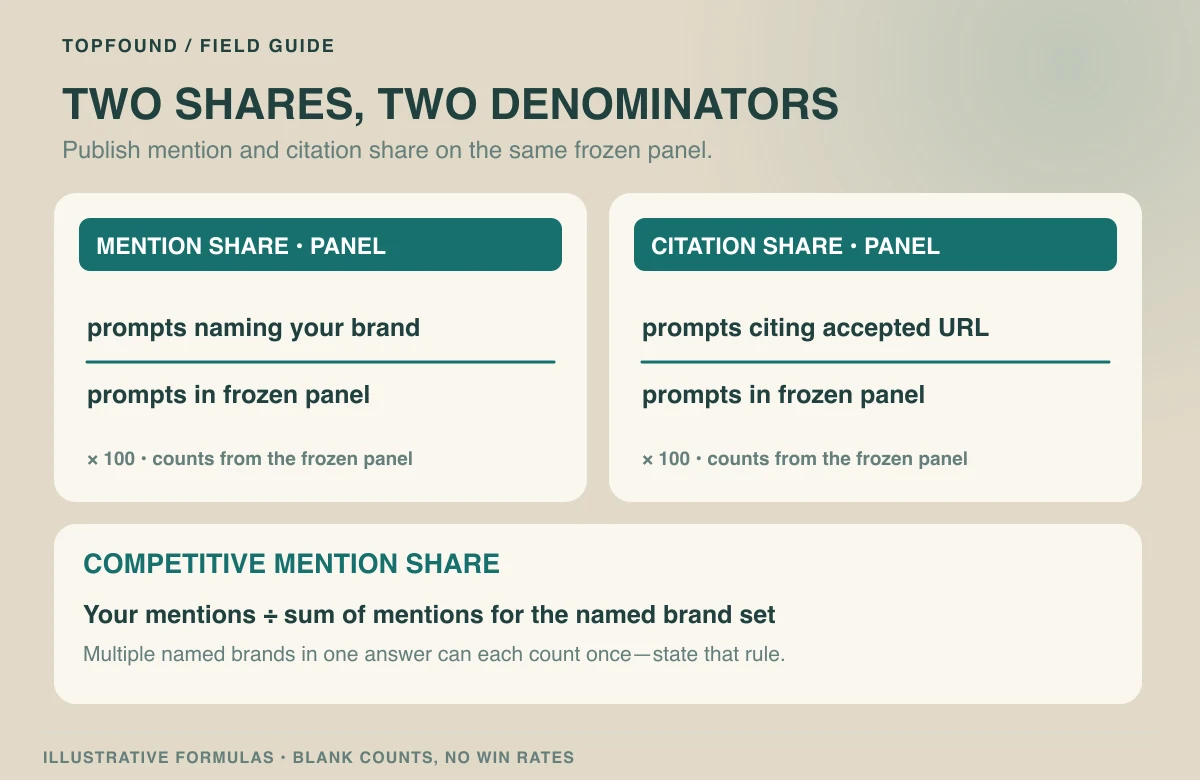
Write the formula down before you open a spreadsheet. For one engine: mention share = prompts where the brand is named ÷ prompts in the frozen panel. Citation share = prompts where an accepted citation appears ÷ prompts in the panel. Competitive mention share = your mention count ÷ (your mention count + each named competitor’s mention count) only if you define whether multiple brands in one answer each get a count. Pick one rule and keep it.
Recommended rule for early SaaS panels: binary presence. Each brand is 1 or 0 per prompt per engine. If three brands are named, each gets 1. Denominator for competitive share is the sum of those 1s, not the number of prompts. Publish both “share of panel” (you ÷ prompts) and “share of named brands” (you ÷ brand-mentions) so nobody argues about the denominator later.
Do not weight by an invented “answer quality” score. If you care about accuracy, add a separate accuracy pass/fail column. Entity collisions belong there too: if another company shares your name, say which entity you counted. TopFound’s own collision lesson lives on /blog/what-is-topfound-entity-disambiguation; the practice of keeping facts consistent lives on /blog/entity-seo-for-saas.
Minimum viable calculation
- Freeze prompt IDs, exact wording, locale, and engines.
- Name the competitor set in writing. Add or remove brands only between cycles, with a note.
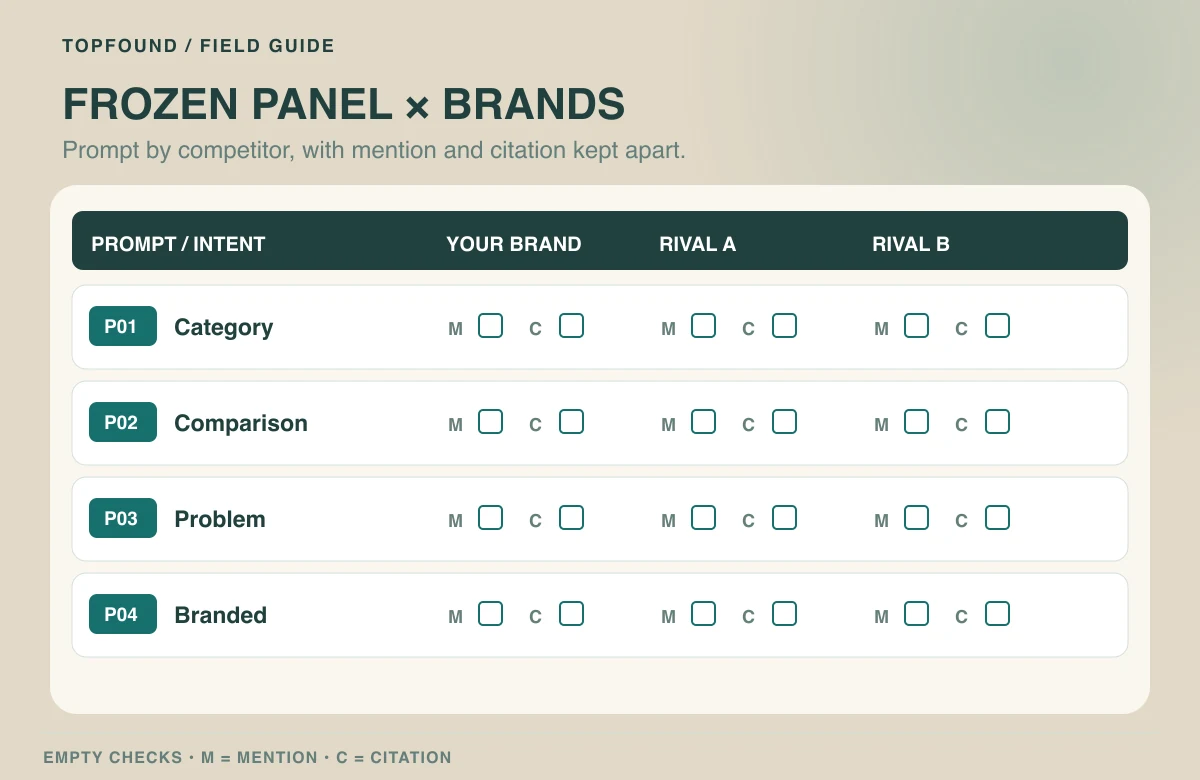
- For each prompt × engine, mark mention Y/N and citation Y/N, plus the URL if cited.
- Compute share of panel and share of named brands separately.
- Store the date of capture. Answers move even when your site does not.
How this relates to measuring AI visibility
People searching how to measure AI visibility want the method: which prompts, how to log screenshots, how to tell a mention from a citation, how often to repeat. That method page is /resources/how-to-measure-ai-search-visibility. This article assumes you can capture answers and shows what ratio to publish from those captures.
Use the visibility framework on /blog/ai-search-visibility-framework when stakeholders still disagree about what “visible” means. Use the report template on /blog/ai-visibility-report when they need a packet with an executive summary, evidence appendix, and backlog. AI share of voice is one table inside that packet—not the packet.
Search Console, observed 2026-10-03 for roughly the prior 28 days, showed a small number of impressions for “how to measure ai visibility” (5 impressions, 0 clicks). That is a soft signal that the how-to question exists. It is not a reason to retitle this page.
Which URL owns which job
| Job | URL | This page? |
|---|---|---|
| Share-of-voice ratio and competitor comparison | /blog/ai-share-of-voice | Yes |
| How to sample and log answers | /resources/how-to-measure-ai-search-visibility | No — link out |
| Stakeholder report structure | /blog/ai-visibility-report | No — link out |
| What visibility means | /blog/ai-search-visibility-framework | No — link out |
Build the prompt panel before you quote a percentage
A share of voice number without the panel is theater. Include category questions (“what is the best … for …”), comparison questions, problem questions, and a few branded questions if you want to see whether assistants describe you correctly. Branded prompts inflate mention share. Publish branded and non-branded ratios separately.
Start smaller than your ambition. A panel of 15–40 non-branded prompts that you can re-check is more honest than 200 prompts you sample once. Record absences. A zero is data.
Engine coverage should match where your buyers actually ask. If you only check one assistant, say so in the footnote. Averaging five engines when you only captured two is how share of voice becomes fiction.
What to do with the ratio
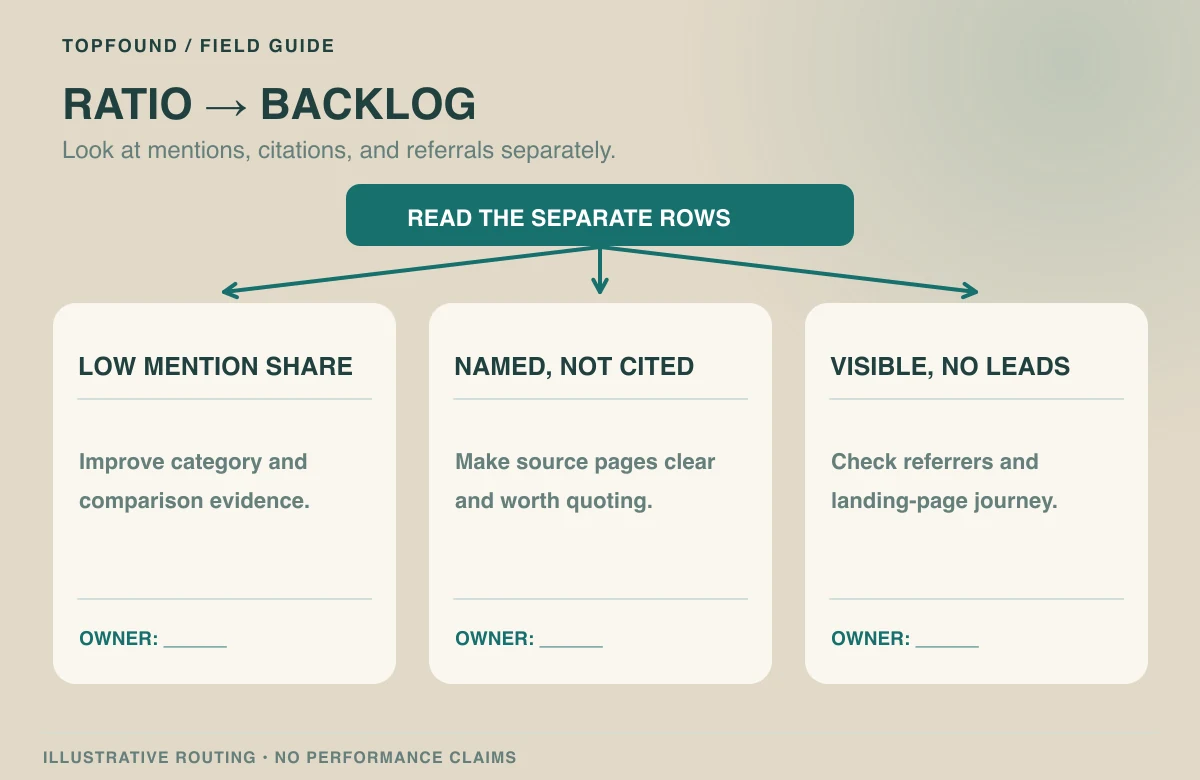
A falling or low share of voice is a prioritization input, not a diagnosis by itself. If you are absent on comparison prompts, the next work is usually comparison pages, third-party corroboration, and entity clarity—not another dashboard. If you are mentioned but never cited, the gap is source eligibility: pages worth quoting, clear facts, and off-site mentions that engines already trust. Citation work is outlined on /blog/ai-citation-optimization.
If share of voice is high and pipeline is flat, do not celebrate the ratio. Presence is not a referral and a referral is not a qualified lead. Keep those rows apart, the same way the visibility report does.
Demand context, labeled so it cannot be mistaken for a TopFound result: Ahrefs Lite on 2026-10-03 showed “ai share of voice” at SV 350 and KD 2 (informational; CPC not shown). “Share of voice ai search” was SV 20. Google Trends is a secondary caveat only and does not soften or replace that Ahrefs lock.
Sources: Helpful, reliable, people-first content, Optimizing for generative AI features.
FAQ
What is AI share of voice?
It is the share of a frozen prompt panel where your brand is mentioned or cited in AI answers, reported as separate ratios against a named competitor set. It is not a guaranteed rank.
How is share of voice in AI search different from SEO share of voice?
Classic share of voice is about Search impressions and clicks. AI share of voice is about presence in answers. Keep Google Search Console metrics on their own rows.
Should mention share and citation share be one number?
No. A mention without a link is not a citation. Publish both, plus an accuracy note when the answer describes the wrong company.
How many prompts do we need?
Enough to cover money intents and still be re-checked honestly—often 15–40 non-branded prompts for an early SaaS panel. Publish branded prompts as a separate ratio.
Is this the same as an AI visibility report?
No. The report template lives on /blog/ai-visibility-report. Share of voice is one comparison table that report can include.
Where do I learn how to measure AI visibility?
Use /resources/how-to-measure-ai-search-visibility for the method. This page only defines the ratio you compute from those captures.
How is AI share of voice different from LLM visibility?
LLM visibility is the concept—whether models name you, describe you accurately, and cite an accepted source. AI share of voice is the competitive ratio of those appearances on a frozen panel. The definition guide is /blog/llm-visibility; this URL owns the ratio.
What does share of voice ai search mean?
Share of voice ai search is the same comparison job with the channel named: mention share and citation share on a frozen prompt panel in AI answers, against named competitors. It is not a classic SEO impression share and not a monitoring-tool SKU.
Where does TopFound fit?
TopFound (topfound.io) is a managed AEO / AI SEO agency. A soft next step is /aeo-report or /services/ai-search-analytics. This guide is not a second service page.
Use share of voice as a comparison, not a trophy
If your team needs a recurring panel and a report someone can act on, start with the measurement guide and the visibility-report template—or ask TopFound (topfound.io) to run the loop as managed AEO.
Conclusion
AI share of voice is worth tracking when the panel is frozen, the competitors are named, and mention share is not blended into citation share. Ahrefs Lite shows informational demand at SV 350 and KD 2—that volume lock is the priority; Google Trends is a secondary caveat only. Do not treat the ratio as proof that an engine will keep citing you. The higher-volume companion head, LLM visibility, lives on /blog/llm-visibility.
Keep methods on /resources/how-to-measure-ai-search-visibility, the stakeholder packet on /blog/ai-visibility-report, and engine-specific eligibility on the guides you already have (/blog/claude-citation-eligibility, /blog/gemini-ai-overviews-saas-playbook, /blog/perplexity-seo-for-saas). When you want managed capacity, use TopFound at topfound.io—the AEO agency—not a same-name studio elsewhere.
Sources: AI features and your website, Helpful, reliable, people-first content.