The short answer
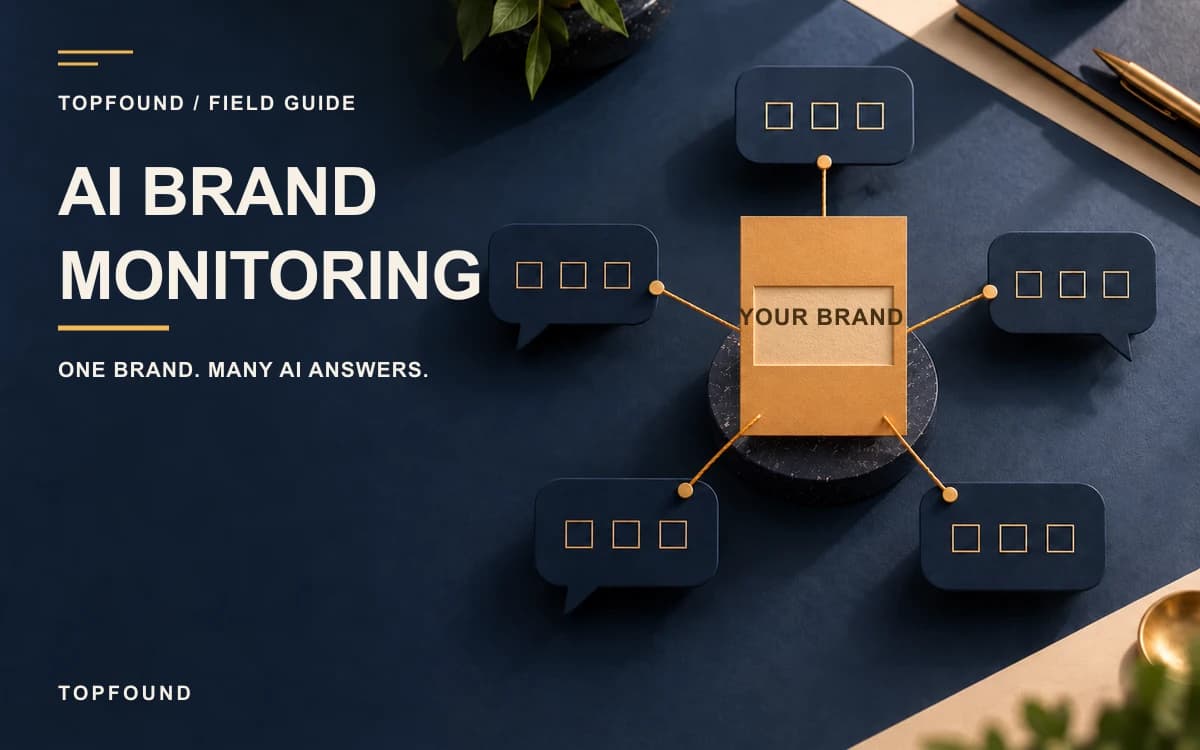
AI brand monitoring is the practice of regularly checking what AI assistants—ChatGPT, Google AI Overviews and AI Mode, Gemini, Perplexity, Claude, and Microsoft Copilot—say about your brand, and logging five separate facts for each answer: was the brand mentioned, was it described accurately, what was the framing or sentiment, which source URLs were cited, and was it the right entity rather than a same-name company. It differs from classic brand monitoring, which tracks social posts, news, and web pages that mention you. Start with a frozen prompt set and a dated log; add a tracking tool when the manual log is too slow. No monitoring changes an answer by itself: fixes come from accurate public pages and consistent facts. This guide does not claim any brand’s mention rate. TopFound (topfound.io) is the AEO / AI SEO agency—not a Manchester company with a similar name.
Key takeaways
- Demand notes (labeled, 2026-10-05 lock): Ahrefs Lite US Overview — primary “ai brand monitoring” SV 1,500 / KD 21 / CPC $0.80 / intent informational + commercial. Tool readout, not a TopFound ranking or traffic forecast.
- Log five rows per answer: mention, description accuracy, sentiment or framing, cited source, and entity correctness. Do not merge them into one score.
- AI brand monitoring watches answers. Classic brand monitoring watches posts and pages. Tools such as Google Alerts and Mention were built for the second job.
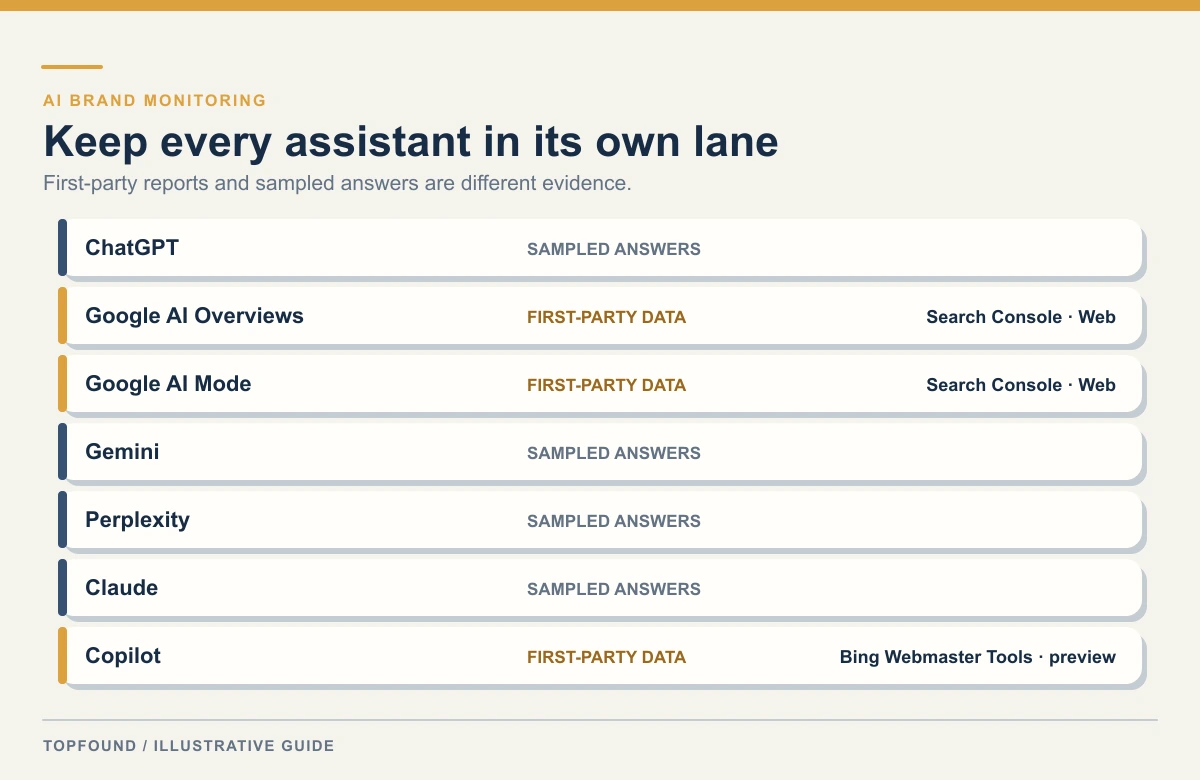
- Engine-owned data is thin but real: Search Console includes AI Overviews and AI Mode under Web, and Bing Webmaster Tools reports Copilot citations in public preview. Everything else is sampled answers.
- An inaccurate description is a page and entity problem. Fix the public facts, then re-check.
Who this AI brand monitoring guide is for
This guide is for SaaS marketers, founders, and PR or brand leads who have noticed buyers asking AI assistants about their category and want to know what those assistants say. You may have a social listening tool already. It will not tell you how ChatGPT described your pricing yesterday.
Page ownership: this URL owns AI brand monitoring as the ongoing practice of checking how assistants mention, describe, frame, and cite one brand. The competitor ratio on a frozen prompt panel is /blog/ai-share-of-voice. The stakeholder artifact that rolls this up is /blog/ai-visibility-report. The cross-engine concept is /blog/llm-visibility. Metric definitions live on /resources/ai-citations-vs-brand-mentions-vs-referrals.
TopFound is the AEO / GEO / AI SEO agency at topfound.io. This article does not present client screenshots, mention rates, or sentiment scores. When it says “we,” it means editorial practice.
What AI brand monitoring means
Quotable definition: AI brand monitoring is a recurring, dated check of what AI assistants say about a brand, recorded as separate facts—mention, description accuracy, sentiment or framing, cited sources, and entity correctness—so a team can see what changed and fix what is wrong.
The word “monitoring” matters. One screenshot is an anecdote. Monitoring means the same prompts, run on a schedule, with the date, engine, and mode recorded each time, including the runs where the brand is absent.
It is not the same as AI share of voice. Share of voice divides your mentions by everyone’s mentions on a panel. Brand monitoring asks a narrower question about you: are you there, are you right, and what is the source? You need the second before the first means anything.
Sources: AI features and your website.
Five signals to track in AI brand monitoring
Record each signal in its own column. A mention with a wrong description is not a win. A citation to a stale third-party review is not the same as a citation to your pricing page.
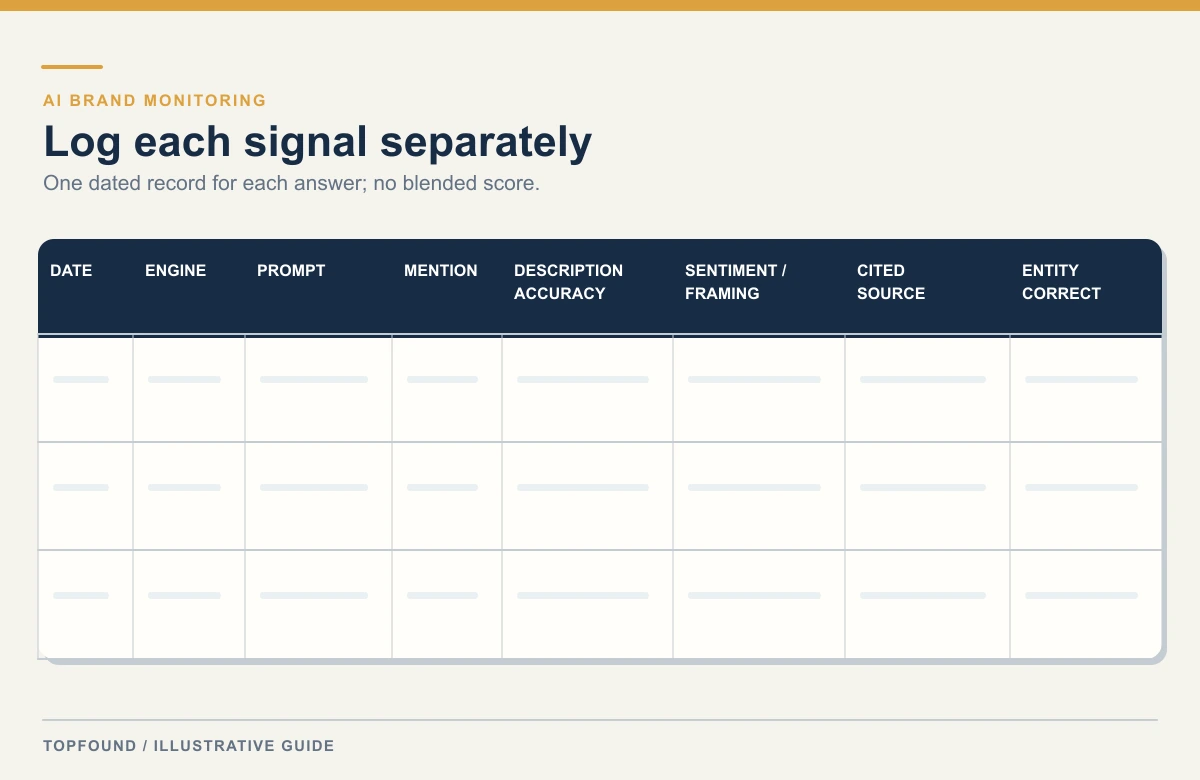
AI brand monitoring log columns
| Signal | What to record | Common mistake |
|---|---|---|
| Mention | Brand named yes or no; position in the list if there is one | Counting branded prompts with non-branded ones |
| Description accuracy | Category, product, audience, pricing model, and limits versus your public facts | Treating any mention as positive |
| Sentiment or framing | Recommended, neutral, cautioned against; the exact phrase used | Using an automated score without reading the answer |
| Cited source | Each URL linked as a source, and whose site it is | Calling a mention a citation |
| Entity correctness | Right company, not a same-name brand or old product name | Missing that the answer describes someone else |
Which AI assistants to include in AI brand monitoring
Pick the assistants your buyers use and record each separately: ChatGPT, Google AI Overviews, Google AI Mode, Gemini, Perplexity, Claude, and Microsoft Copilot. Each has its own retrieval and its own answer, so one engine tells you nothing certain about another.
Two engines give site owners first-party data. Google includes AI Overviews and AI Mode appearances in the Search Console Performance report under the Web search type, so you see them blended with other Search traffic rather than separately. Bing Webmaster Tools’ AI Performance report, in public preview since February 10, 2026, shows citation counts, cited pages, and grounding queries for Copilot and Bing AI summaries; Microsoft notes the data is a sample. For ChatGPT, OpenAI says search referral URLs include utm_source=chatgpt.com, which shows visits, not mentions.
Access comes before monitoring makes sense. If a crawler is blocked, the engine may not retrieve your current pages. OpenAI documents OAI-SearchBot for ChatGPT search, Anthropic documents Claude-SearchBot alongside ClaudeBot and Claude-User, and Perplexity documents PerplexityBot and Perplexity-User. Check robots.txt against the engines you monitor. Engine guides: /blog/chatgpt-seo, /blog/google-ai-mode, /blog/gemini-ai-overviews-saas-playbook, /blog/perplexity-seo-for-saas, /blog/claude-citation-eligibility.
Sources: AI features and your website, Microsoft Bing Blog: AI Performance in Bing Webmaster Tools (public preview, Feb 10, 2026), OpenAI Help Center: Publishers and developers FAQ, OpenAI: Overview of OpenAI crawlers, Anthropic / Claude Support: Does Anthropic crawl data from the web?, Perplexity docs: Perplexity crawlers.
AI brand monitoring vs classic brand monitoring
Classic brand monitoring tracks content that mentions you: social posts, news, blogs, forums, and web pages. Google Alerts emails you when new web content matches a query. Mention describes itself as social listening and media monitoring across social media and the web. Brand24 describes itself as a social listening tool and now also lists an AI Visibility product on its site.
AI brand monitoring tracks generated answers, which are not published pages and cannot be found by a web alert. The two still connect: the reviews, forum threads, and articles that classic monitoring surfaces are often the kind of third-party pages assistants retrieve and cite. Use classic monitoring to find the sources, and AI brand monitoring to see what the answers do with them.
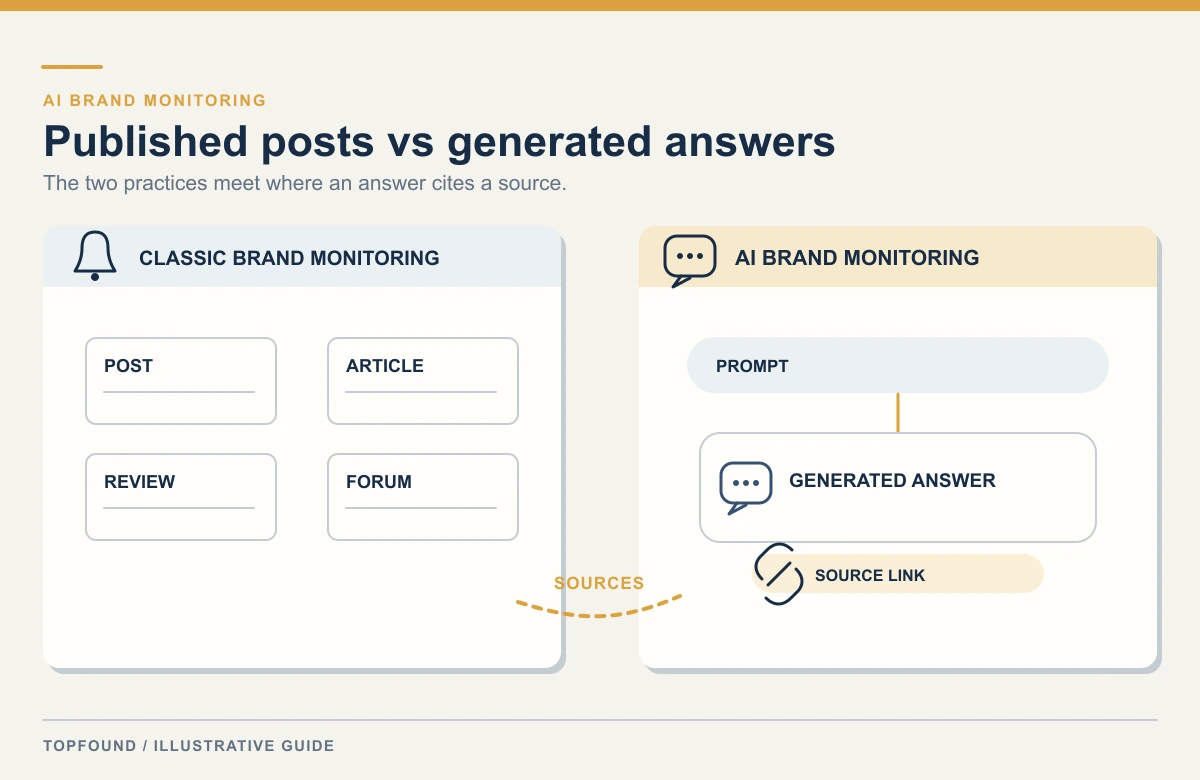
Classic vs AI brand monitoring
| Classic brand monitoring | AI brand monitoring | |
|---|---|---|
| What is watched | Published posts, articles, pages | Generated answers to prompts |
| Unit of record | A URL or post that mentions you | A dated prompt, engine, and answer |
| Typical question | Who is talking about us? | What does the assistant say about us, and from which source? |
| Examples | Google Alerts, Mention, Brand24 | Ahrefs Brand Radar, Semrush AI Visibility Toolkit, Surfer AI Tracker, Peec AI, or a manual log |
Sources: Google Alerts, Mention, Brand24.
AI brand monitoring tools and the manual log
Several products now describe AI brand monitoring features on their public sites (checked 2026-10-05; not a ranking, not tested by TopFound): Ahrefs Brand Radar tracks mentions and citations across AI Overviews, AI Mode, ChatGPT, Perplexity, Gemini, and Copilot. Semrush’s AI Visibility Toolkit covers AI mentions, brand perception and sentiment against competitors, and daily prompt tracking. Surfer’s AI Tracker monitors how Gemini, ChatGPT, AI Overviews, AI Mode, and Perplexity talk about a brand. Peec AI tracks visibility, position, sentiment, and cited sources.
A spreadsheet works for 15 to 40 prompts if someone re-runs them on schedule. Move to a tool when the manual log is late, not before. The category guide is /blog/ai-seo-tools; the tracker buyer checklist is /blog/answer-engine-optimization-tools. This guide does not list prices because they change often.
AI brand monitoring loop
- Write 15–40 non-branded buyer prompts plus a separate branded set (“what is [brand]”, “[brand] pricing”).
- Choose the engines and modes. Record country, account state, and date with every run.
- Log the five signals per answer. Log absences too.
- Flag wrong descriptions and wrong entities first; they do the most damage.
- Trace each wrong fact to a source: your own page, a directory, a review, or nothing visible.
- Fix the public fact, then re-run the same prompts on the next cycle.
Sources: Ahrefs Brand Radar, Semrush Knowledge Base: AI Visibility Toolkit, Surfer AI Tracker, Peec AI.
When AI brand monitoring finds a wrong description
An assistant that describes the wrong product, an old price, or a same-name company is telling you the public evidence is inconsistent or thin. Align the facts on your homepage, about page, pricing, and product pages first. Organization structured data with your name, logo, URL, and sameAs profiles helps Search read the entity consistently; it does not force an answer to change.
Then check the third-party pages that cite you. You cannot order them to change, but you can request corrections and publish clearer first-party pages. The entity practice is /blog/entity-seo-for-saas. A worked same-name example is /blog/what-is-topfound-entity-disambiguation, which uses TopFound (topfound.io) and an unrelated Manchester company with a similar name as the teaching case.
Sources: Organization structured data.
Where managed help starts
Informational readers can run the loop above from this page. Teams that want the monitoring, the fixes, and the reporting handled can start at /services/ai-search-analytics or /services/entity-optimization.
TopFound’s public list prices are on /pricing: Growth $797/month, Scale $1,297/month, and Custom scoped. This article does not invent tool prices.
FAQ
What is AI brand monitoring?
AI brand monitoring is the recurring check of what AI assistants such as ChatGPT, Google AI Overviews and AI Mode, Gemini, Perplexity, Claude, and Copilot say about a brand, logged as separate facts: mention, description accuracy, sentiment, cited source, and entity correctness.
How is AI brand monitoring different from social listening?
Social listening tracks published posts and pages that mention you. AI brand monitoring tracks generated answers to prompts, which a web alert cannot see. Use both: classic monitoring finds the sources that assistants may cite.
How do I monitor my brand in ChatGPT?
Run a fixed set of prompts on a schedule, record the date and the answer, and log mention, accuracy, sentiment, and cited URLs separately. Make sure OAI-SearchBot is not blocked. For visits, OpenAI says ChatGPT search referrals include utm_source=chatgpt.com. See /blog/chatgpt-seo.
Can Google Search Console show AI Overview mentions?
Google includes AI Overviews and AI Mode appearances in the Search Console Performance report under the Web search type, blended with other Search data. It does not show what the answer said about your brand.
What are AI brand monitoring tools?
Products such as Ahrefs Brand Radar, Semrush AI Visibility Toolkit, Surfer AI Tracker, and Peec AI describe tracking brand mentions, sentiment, or citations in AI answers. Compare them on engine coverage, raw exports, and how they separate mentions from citations. See /blog/answer-engine-optimization-tools.
Is AI brand monitoring the same as AI share of voice?
No. Brand monitoring checks what assistants say about you. Share of voice compares your mentions with competitors on a frozen panel. See /blog/ai-share-of-voice.
What should we do when an AI assistant describes us wrongly?
Trace the wrong fact to a source, fix your own pages first, keep names and facts consistent everywhere you control, and re-run the same prompts. See /blog/entity-seo-for-saas.
Where does TopFound fit?
TopFound (topfound.io) is a managed AEO / AI SEO agency. This page is an explainer, not a case study. A soft next step is /aeo-report. Public plans are on /pricing (Growth $797/month, Scale $1,297/month, Custom scoped).
Monitor the answers, then fix the facts
Use share of voice for competitor ratios, the visibility report for stakeholders, and the entity guides when assistants describe the wrong company. TopFound (topfound.io) does not publish a mention rate for any brand here.
Conclusion
AI brand monitoring is the priority head for this page because Ahrefs Lite, United States, 2026-10-05, shows SV 1,500, KD 21, CPC $0.80, with informational and commercial intent, and no live TopFound URL owned the practice of watching how assistants describe one brand. KD 21 is a tool score, not a forecast.
Freeze the prompts, log five signals separately, fix wrong facts at the source, and re-run. For competitor ratios use /blog/ai-share-of-voice; for the stakeholder brief use /blog/ai-visibility-report. When you want managed work from the agency at topfound.io, use /services/ai-search-analytics or /aeo-report.
Sources: AI features and your website, Microsoft Bing Blog: AI Performance in Bing Webmaster Tools (public preview, Feb 10, 2026).