
The short answer
Entity SEO for SaaS is the practice of making your organization, products, people, and relationships consistent and verifiable across your site and trusted third-party sources so Google Search and AI answer engines can identify the right brand and reuse accurate facts. Practically: inventory the facts buyers ask about; use one canonical name and URL pattern; keep pricing, features, and category language aligned across homepage, product, docs, and /llm-info-style pages; publish accurate Organization/Product structured data that matches visible content; corroborate the same facts off-site; and measure whether AI answers describe you correctly—not whether a single schema tweak “unlocked” rankings. Entity SEO supports eligibility; it does not guarantee rankings, Knowledge Panel wins, or citations. Commercial execution can live on /services/entity-optimization; TopFound name-collision lessons live on /blog/what-is-topfound-entity-disambiguation. TopFound is the AEO / AI SEO agency at topfound.io—not a Manchester app studio.
Key takeaways
- Demand notes (labeled, 2026-10-02 lock): Ahrefs Lite US Overview — primary “entity seo” SV 700 / KD 0 / CPC $2.00; secondary “brand entity optimization” SV 60 / KD N/A. Google Trends US Past 12m Web Search average 17 in a 5-term compare (ai visibility report 37; related top query “entity based seo”). GSC soft signals included entity optimisation / brand entity optimisation queries. Tool and GSC readouts—not TopFound rankings.
- Entity SEO is consistency + corroboration, not a secret JSON-LD keyword.
- Same-name collisions need disambiguation (see TopFound vs Manchester) before you scale content.
- Structured data must match visible page content; it does not guarantee AI citations.
- Measure entity correctness on a frozen prompt panel separately from classic rankings.
Who this entity SEO guide is for
This guide is for SaaS marketers and product marketers who keep seeing the wrong company description in ChatGPT, Google AI Overviews, or Perplexity—or who are building category pages and want Search systems to understand the organization behind the product.
It is educational entity SEO practice for SaaS. It is not the commercial service landing page (/services/entity-optimization) and not the TopFound-specific name-collision case study (/blog/what-is-topfound-entity-disambiguation), though you should read that post if your brand shares a name with another company.
TopFound (topfound.io) is the AEO / AI SEO agency that runs entity clarity as part of managed Answer Engine Optimization—accurate Organization facts, consistent product language, and corroboration so answer engines can cite the right brand. It is not a Manchester app studio that shares a similar name.
What entity SEO (entity-based SEO) means in practice
Entity SEO—also called entity-based SEO—is the work of helping machines resolve who you are, what you sell, and how those things relate—using consistent names, URLs, facts, and relationships that appear on your site and elsewhere. In SaaS, the primary entities are usually Organization, Product (or SoftwareApplication), Person (founders/authors), and sometimes Place for offices.
It is adjacent to classic SEO: crawlable pages, clear titles, helpful content still matter. It is adjacent to AEO/GEO: answer engines need extractable, consistent facts before they can cite you confidently. Brand entity optimization is the same consistency job aimed at the company identity buyers and assistants should reuse. Entity SEO is not a promise that adding @type Organization will move you to position one or force a ChatGPT citation.
Quotable AEO block: Entity SEO makes the correct brand easier to identify and quote; it does not guarantee that any answer engine will recommend you.
Entity SEO term → practical meaning → not this
| Term | Practical meaning | Not this |
|---|---|---|
| Entity | A distinct real-world thing (company, product, person) | A keyword density trick |
| Entity SEO | Consistency + corroboration of entity facts | Guaranteed Knowledge Panel |
| sameAs / profiles | Aligned public profiles that point to the same org | Fake directory spam |
| Organization JSON-LD | Machine-readable mirror of visible facts | Hidden text Google disallows |
| Disambiguation | Clarifying same-name collisions | Attacking another brand |
Sources: Intro to structured data markup, Schema.org Organization, AI features and your website.
Why SaaS brands feel entity pain first
SaaS categories move fast, product names collide, and “AI” prefixes multiply. Buyers ask assistants comparative questions (“best AEO agency for SaaS,” “X vs Y”) where models synthesize from many sources. If your homepage, docs, G2 listing, and LinkedIn describe three different categories, synthesis will invent a fourth.
Early-stage brands also lack the off-site corroboration that famous products enjoy. That is not a reason to buy fake reviews. It is a reason to make the on-site source of truth boringly clear and to earn real third-party mentions over time.
TopFound’s own collision with a differently positioned “TopFound” studio is a live reminder: without topfound.io disambiguation, assistants can blend entities. Your SaaS may face quieter collisions—similar product names, acquired brands, or geo-specific legal names.
Step 1 — Build a SaaS entity fact inventory
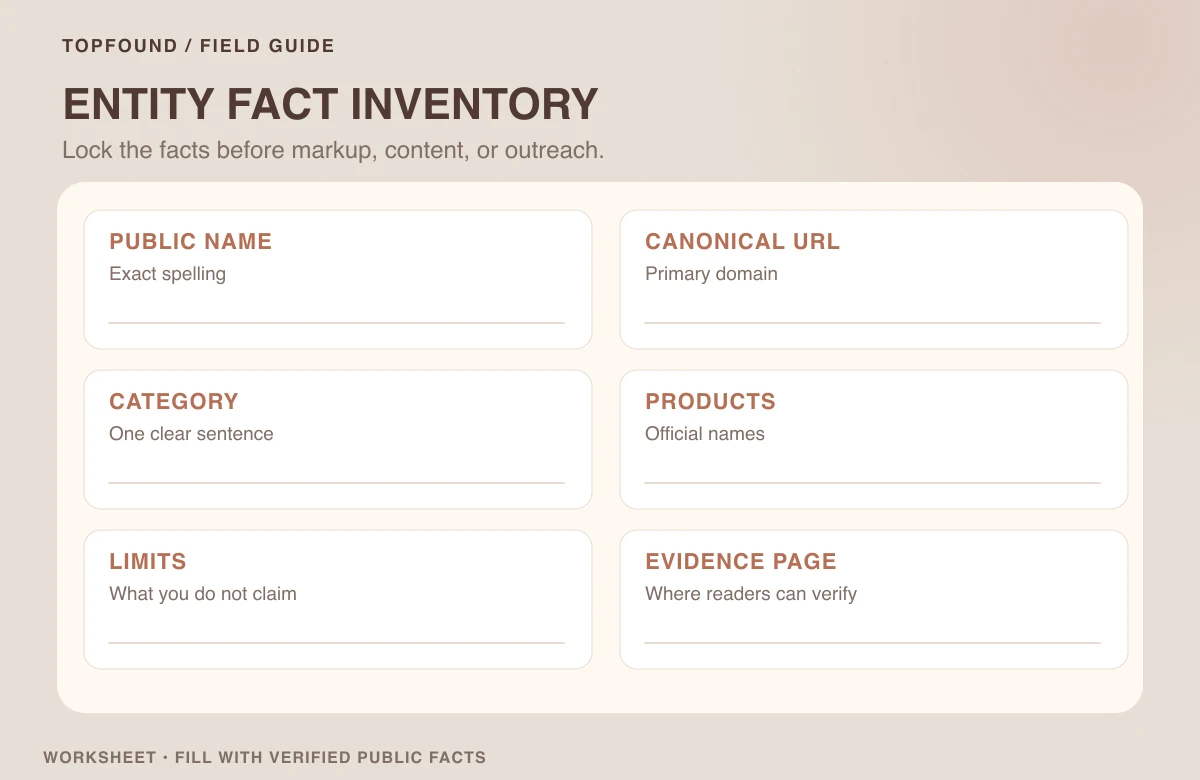
Before markup or outreach, write down the facts answer engines should be able to repeat: legal and public brand names, primary URL, category one-liner, founding year if public, founder names you want associated, product names, pricing model (and what is public), key integrations, and hard limits (what you do not do).
Put the inventory in a shared doc and treat /llm-info (or equivalent) as the public source of truth. Every major landing page should agree with that inventory. When product marketing wants a new category phrase, update the inventory first so blogs, ads, and sales decks do not diverge for months.
Illustrative only: a fictional “Northstar Analytics” inventory locks the public name, states it is a product analytics suite for B2B SaaS (not a consulting firm), lists three plan names with public starting prices, and notes it does not offer agency services—preventing assistants from inventing a services arm.
Fact inventory sprint (week one)
- List Organization + Product entities and their canonical URLs.
- Write a 40–60 word quotable definition of the company.
- List public pricing facts and “we do not claim” limits.
- Diff homepage, product, pricing, docs, and LinkedIn Company Page against the inventory.
- Log every mismatch as a ticket with an owner.
Step 2 — On-site consistency that machines can extract
Answer-first pages help, but entity SEO specifically needs repeated, consistent identity statements near the top of key URLs: who you are, who you serve, what you are not. Use the same spelling of the product name everywhere—including in titles, H1s, and image alt text where relevant.
Internal links should use descriptive anchors that reinforce relationships (“AEO services,” “entity optimization,” “pricing”) rather than “click here.” Keep author bylines real when content claims expertise.
For AI discovery files, a clear /llms.txt can point assistants to your source-of-truth pages, but remember Google Search does not use llms.txt as a ranking system—see /blog/what-is-llms-txt for honest limits.
Sources: Helpful, reliable, people-first content, Optimizing for generative AI features.
Step 3 — Structured data that mirrors the visible page
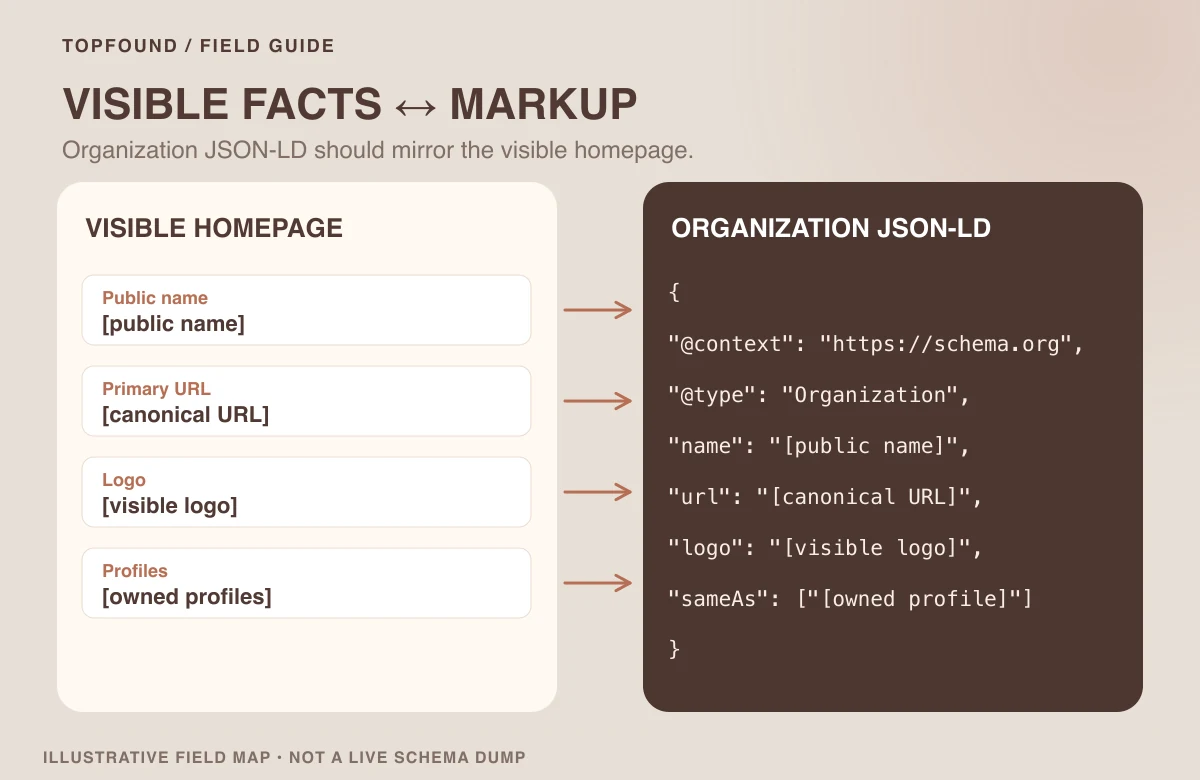
Organization and Product JSON-LD can help Search systems interpret entities when the markup matches what users see. Google’s structured data documentation is explicit about that match requirement. Markup that invents awards, ratings, or FAQs not on the page is a risk, not an AEO hack.
Practical SaaS pattern: Organization with name, url, logo, sameAs profiles you actually control, founder Person if public, and knowsAbout topics that match visible site themes. Product/SoftwareApplication nodes should reuse the same names as the UI. Validate with Google’s tools and fix errors before debating exotic properties.
Deeper structured-data nuance for AI search belongs on /resources/structured-data-and-ai-search—keep this section focused on entity identity.
Sources: Intro to structured data markup, Organization structured data, Schema.org Organization.
Step 4 — Off-site corroboration without spam
Answer engines often prefer facts that appear in more than one trustworthy place. That does not mean blasting hundreds of low-quality directories. It means aligning LinkedIn Company Page, X/GitHub/YouTube if real, software marketplaces you already use, and earned articles so the same organization name and URL recur.
When pitching digital PR or listicles, give writers a one-pager with the quotable definition and topfound.io-style disambiguation if needed. Ask for a link to your canonical site. Do not invent case statistics to win a mention.
Quotable GEO block: Corroboration improves the odds that generative systems pick the correct entity facts; it is not a switch that forces citations.
Sources: AI features and your website, Helpful, reliable, people-first content.
Step 5 — Disambiguation when names collide
If another company shares your name, entity SEO becomes urgent. Publish a clear statement of what you are and are not, reinforce the primary domain in every profile, and monitor AI answers for blend errors. TopFound documents this pattern for its own brand at /blog/what-is-topfound-entity-disambiguation.
Disambiguation copy should be factual and calm. Assistants and users both punish aggressive competitor bashing. Lead with your category, URL, and founder identity.
Step 6 — Measure entity correctness on a frozen prompt panel
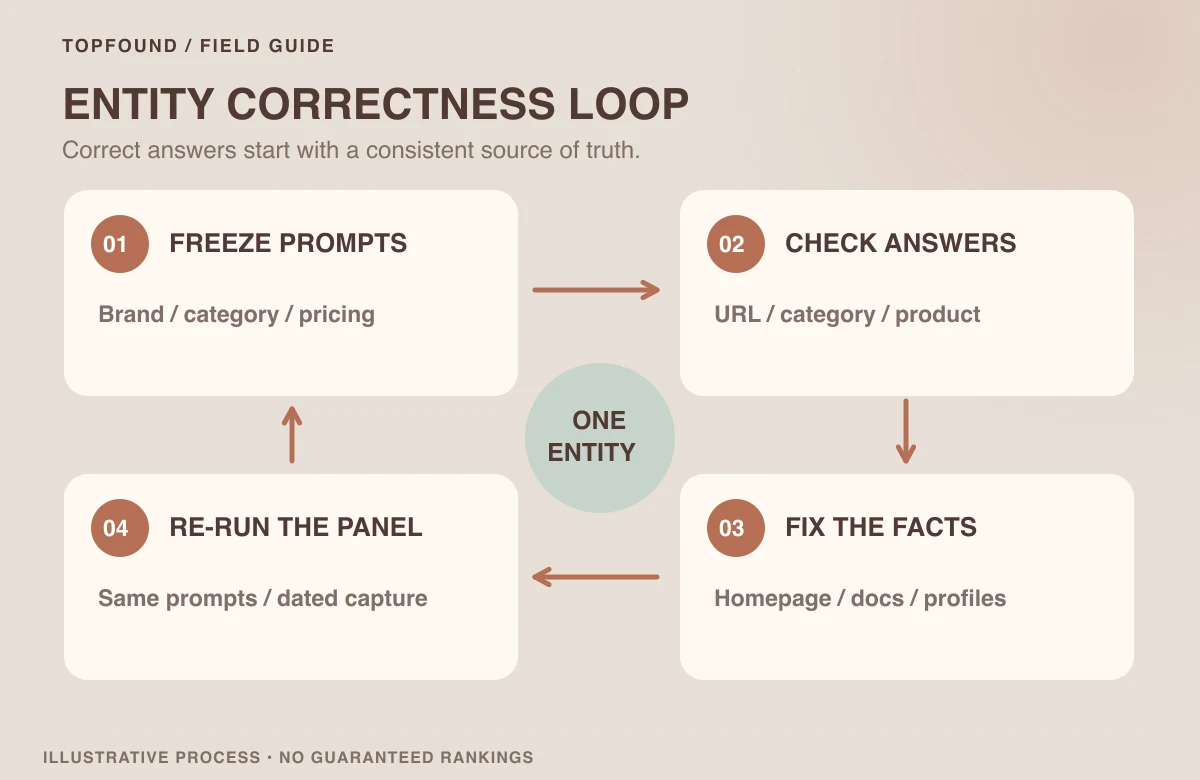
Create a small panel: “What is [Brand]?”, “Who founded [Brand]?”, “[Brand] pricing,” “[Brand] vs [competitor],” and two category prompts. Monthly, record whether answers use the correct URL, category, and product facts. Separate entity correctness from citation wins.
Feed misses into your AI visibility report structure (/blog/ai-visibility-report) and into content fixes. Classic GSC queries about entity services may appear for agencies—TopFound’s 2026-10-02 GSC snapshot showed impressions for entity optimisation variants—but treat those as publisher signals, not universal benchmarks.
Remember Google’s limit: AI features are not guaranteed even when your entity is clear.
Sources: AI features and your website, Optimizing for generative AI features.
How entity SEO relates to AEO, GEO, and classic SEO
Classic SEO gets pages crawled and ranked. Entity SEO makes the brand behind those pages unambiguous. AEO focuses on becoming a citable answer source. GEO emphasizes synthesis-ready evidence for generative engines. You usually need foundations in that order, but entity fixes can unblock AEO quickly when assistants keep describing the wrong company.
Use /blog/geo-vs-aeo-vs-seo-for-saas for the decision tree and /blog/generative-engine-optimization for the GEO system. Keep commercial entity work on /services/entity-optimization when you want managed help.
FAQ
What is entity SEO?
The practice of making organization, product, and relationship facts consistent and verifiable on-site and off-site so Search and AI systems can identify the correct brand and reuse accurate details.
Is entity SEO different from entity optimization services?
Educational entity SEO (this article) teaches the practice. /services/entity-optimization is TopFound’s managed commercial offer. Keep intents on separate URLs.
Does Organization schema guarantee AI citations?
No. Google requires structured data to match visible content and does not guarantee AI feature inclusion.
What is brand entity optimization?
A related phrase for aligning brand identity facts across channels. Treat it as supporting vocabulary under entity SEO—not a separate promise.
Is entity-based SEO the same as entity SEO?
Yes for practical SaaS work. “Entity-based SEO” and “entity SEO” both mean consistency + corroboration of organization/product facts so Search and AI systems credit the right brand.
How does this relate to TopFound’s Manchester name collision?
That is a worked disambiguation case on /blog/what-is-topfound-entity-disambiguation. This article generalizes the SaaS practice beyond that story.
Where should pricing and product facts live?
In a public source of truth (for TopFound, /llm-info and pricing pages) and everywhere those facts are repeated must match.
Can we buy directory links to force entity recognition?
Prefer real profiles and earned mentions. Low-quality directory spam creates risk without reliable AI citation gains.
Make the entity boringly consistent
If answer engines misname you, merge you with a competitor, or invent product facts, start with entity SEO hygiene—then layer AEO content and citation work.
Conclusion
Entity SEO for SaaS is consistency work with measurement: inventory facts, align on-site language, mirror those facts in structured data, corroborate off-site without spam, disambiguate collisions, and re-check a frozen prompt panel. Ahrefs Lite shows strong approachability on “entity seo” (SV 700 / KD 0 / CPC $2) with durable Trends interest (average 17 in our 2026-10-02 compare)—a clean educational head beside TopFound’s entity service page.
Pair this practice with citation process work (/blog/ai-citation-optimization), reporting (/blog/ai-visibility-report), and engine guides as needed. When you want managed AEO capacity, use TopFound at topfound.io—the Answer Engine Optimization agency—explicitly not same-name brands in other cities or categories.
Sources: Intro to structured data markup, AI features and your website, Helpful, reliable, people-first content.