The short answer
SaaS SEO is the work of earning organic search traffic and AI-answer visibility for a software product. For B2B SaaS it centres on pages that match buying intent, such as use cases, comparisons, integrations, and pricing, plus crawlable server-rendered pages, helpful content, and measurement tied to sign-ups and pipeline.
Key takeaways
- Demand note (labeled, 2026-10-31 lock): Ahrefs Lite US, 2026-10-31 — “saas seo” SV 2.4K / KD 21; “b2b saas seo” 1.1K / KD 9; “seo for startups” 1.4K / KD 9. Tool readouts, not a TopFound traffic forecast.
- Build pages around buying intent first: use cases, comparisons and alternatives, integrations, and pricing usually sit closer to a trial than a generic blog post.
- Google renders JavaScript, but its documentation still calls server-side rendering or pre-rendering a great idea because not every bot can run JavaScript.
- robots.txt is not a way to keep a page out of Google. Use noindex or a login for app screens and staging, and keep marketing pages crawlable.
- SoftwareApplication rich results need a name, a price in offers, and a rating or review that follows Google’s review snippet guidelines. Never invent ratings.
- Measure SaaS SEO against sign-ups and pipeline, not visits alone, and add AI answer referrals and Search Console’s Generative AI report as separate rows.
Who this guide is for
This guide is for founders, marketing leads, and growth teams at B2B software companies who want organic search to produce trials and pipeline, not just visits. It covers which pages a SaaS site needs, the technical problems specific to JavaScript apps and product subdomains, how AI answers change the picture, and how to measure the result.
Platform statements come from Google, OpenAI, and Search Console documentation fetched October 30–31, 2026 and linked below. We don’t quote third-party benchmarks for SaaS conversion rates or traffic, because published figures vary widely and are rarely comparable. Use your own analytics instead.
Page ownership: this URL owns the SaaS SEO overview. The AI-search half lives on /blog/ai-seo. Entity and knowledge-graph work lives on /blog/entity-seo-for-saas. Deciding between SEO, AEO, and GEO budgets lives on /blog/geo-vs-aeo-vs-seo-for-saas. Running AI search as a weekly program lives on /blog/ai-search-optimization-playbook.
What is SaaS SEO?
SaaS SEO is search engine optimization for software-as-a-service companies. The fundamentals are the same as any SEO: crawlable pages, helpful content, a clear site structure, and earned authority. What makes SaaS different is the product. Buyers research a category for weeks, compare alternatives, check integrations and pricing, and often involve several people. The site has to serve each of those moments, and the app itself, usually a JavaScript application on its own subdomain, adds technical traps that a brochure site doesn’t have.
B2B SaaS SEO narrows that further. Search volumes for business software terms are often small, but each sign-up can be worth a lot, so intent matters more than raw traffic.
SaaS SEO vs ecommerce and local SEO
| SaaS SEO | Ecommerce SEO | Local SEO | |
|---|---|---|---|
| Core pages | Use cases, comparisons, integrations, pricing, docs | Category and product pages | Location and service pages, business profile |
| Buying cycle | Weeks to months, several people | Minutes to days | Often same day |
| Conversion | Trial, demo, sign-up | Purchase | Call, visit, booking |
| Technical traps | JS rendering, app and docs subdomains, staging | Facets, duplicate variants | Inconsistent business details |
Sources: SEO Starter Guide (fetched Oct 31, 2026).
The pages a SaaS SEO strategy needs
Most SaaS sites start with a homepage, a pricing page, and a blog, then wonder why the blog brings readers who never sign up. A better order is to build the pages buyers look for when they are close to choosing, then add educational content that feeds them.
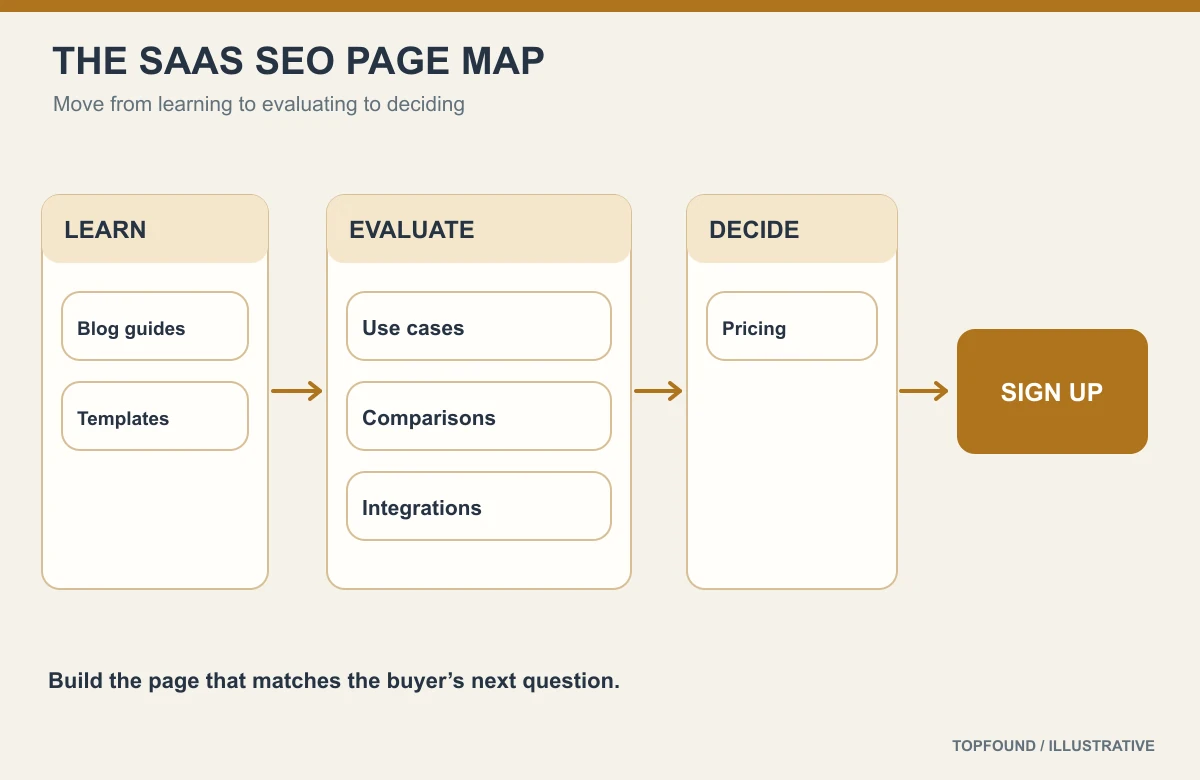
Each page type below answers a different question. Write each for one main intent, link related pages with descriptive anchor text, as Google’s starter guide recommends, and avoid creating thin variations just to target more phrasings.
SaaS SEO page types by buying stage
| Page type | Buyer question | Stage | Notes |
|---|---|---|---|
| Category or use-case page | What tool solves this job? | Problem aware | One page per real use case, with product proof |
| Comparison and alternatives | How does X compare with Y? | Evaluating | Fair, dated, sourced; no disparagement |
| Integration pages | Does it work with my stack? | Evaluating | Only for integrations that exist, with setup detail |
| Pricing page | What will it cost? | Deciding | Plans and limits as plain HTML text |
| Docs and help center | How do I do this in the product? | Using | Often ranks for long-tail; keep crawlable |
| Templates and free tools | Can I try something now? | Problem aware | Must be genuinely useful, not doorway pages |
| Blog guides | How do I solve this problem? | Learning | Link to the use-case and pricing pages |
Sources: SEO Starter Guide (fetched Oct 31, 2026), Spam policies (fetched Oct 31, 2026).
Keyword research for SaaS
Start with your customers rather than a keyword tool. Sales call notes, support tickets, onboarding surveys, and churn reasons tell you the words buyers really use, the tools they compare you with, and the integrations they need. Then use a keyword tool to size those topics and find adjacent phrasing. Record every volume with its tool, market, and date, because readouts differ between tools and change over time.
A good SaaS SEO strategy prioritizes by intent first, then by volume, then by difficulty. A use-case or comparison term with modest volume can produce more trials than a broad informational term with ten times the searches. For TopFound’s own blog, we pick the higher-volume term when two candidates fit equally well, use keyword difficulty only as a tie-break, and check that no existing page already owns the term.
Be careful with programmatic pages. Generating thousands of near-identical integration or location pages is exactly what Google’s spam policy describes as scaled content abuse, whether the pages are written by people, templates, or AI. Programmatic pages are fine when each one has unique, useful content, such as real setup steps for a real integration.
SaaS keyword research in five steps
- Collect buyer language from sales calls, support tickets, and reviews.
- List the jobs your product does, the tools you replace, and the integrations you support.
- Size each topic in a keyword tool and label every volume with source and date.
- Map each topic to one page type and one URL; merge duplicates.
- Order by intent, then volume, then difficulty, and check for existing pages first.
Sources: Spam policies (fetched Oct 31, 2026), Guidance on using generative AI content on your website (fetched Oct 31, 2026).
Technical SEO for SaaS: JavaScript, apps, and subdomains
Most SaaS marketing sites are built with JavaScript frameworks, and that is fine for Google if you follow its rules. Google’s JavaScript SEO basics describe three phases, crawling, rendering, and indexing, and explain that Google renders pages with a headless Chromium before indexing them. The same page still calls server-side rendering or pre-rendering a great idea, because it makes sites faster for users and crawlers and because not all bots can run JavaScript. That last point matters for AI search crawlers too. Google’s generative AI guide makes the same point from the other side: Google can process content in JavaScript as long as it isn’t blocked, but SEO on JavaScript-framework sites is generally more complex, so follow the JavaScript best practices.
Google lists several JavaScript traps that are common on SaaS sites. Use the History API for routing instead of URL fragments, and make links real <a href> elements. Return meaningful HTTP status codes, and avoid soft 404s in single-page apps by sending a real 404 or adding noindex for missing content. If the original HTML contains a noindex tag, Google may skip rendering, so JavaScript can’t remove it later. Set canonical URLs in the HTML and keep them consistent.
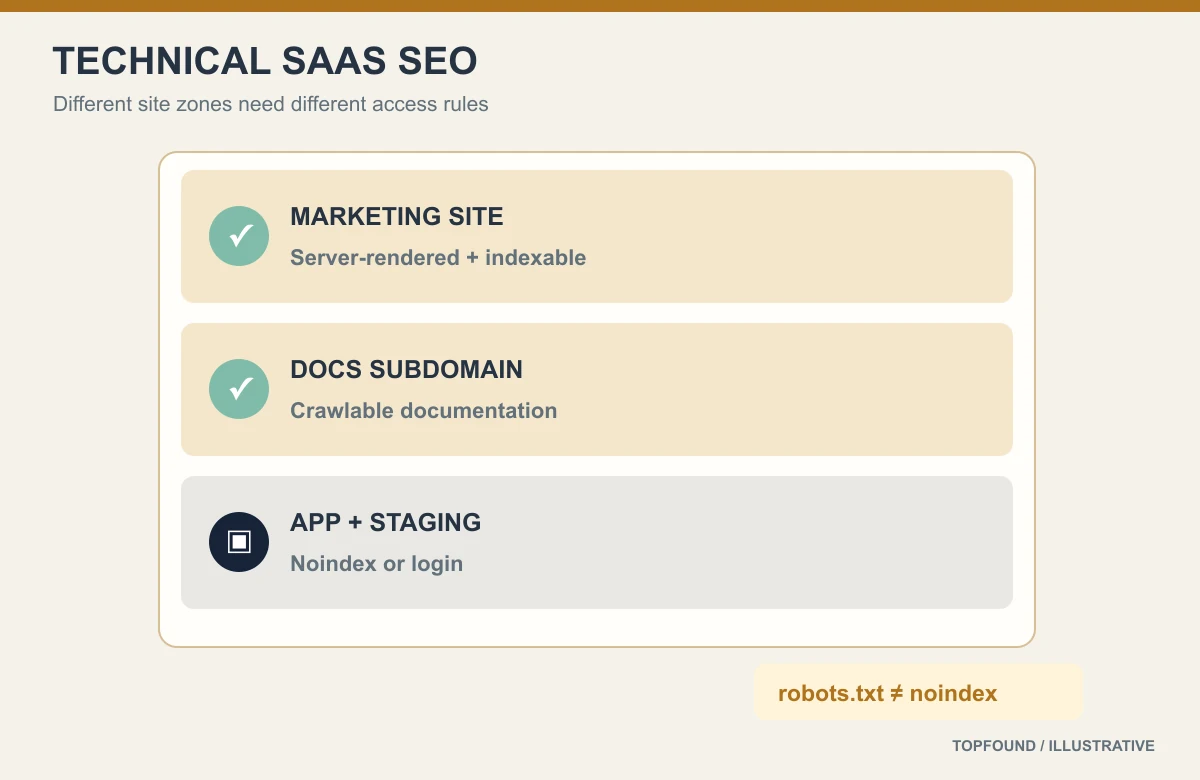
A large part of technical SEO for SaaS is keeping the product and the marketing site apart. Logged-in app screens, staging environments, and preview deployments shouldn’t appear in search. Google is explicit that robots.txt is not a mechanism for keeping a page out of Google: a blocked URL can still be indexed if other pages link to it. Use noindex or password protection instead, and keep robots.txt for managing crawl. Docs and help centers on a subdomain should usually stay crawlable, since they answer many long-tail questions.
Technical SaaS SEO checklist
- Server-render or pre-render marketing pages, pricing, and docs.
- Use History API routing and real <a href> links.
- Return real 404 and 301 status codes; remove soft 404s.
- Put noindex or a login on app screens, staging, and previews; don’t rely on robots.txt.
- Keep canonical tags in the HTML and consistent with internal links and sitemaps.
- Keep docs and help pages crawlable and linked from the main site.
- Allow AI search crawlers such as OAI-SearchBot; decide training crawlers separately.
- Submit an XML sitemap and check indexing in Search Console.
Sources: Understand JavaScript SEO basics (fetched Oct 31, 2026), Optimizing your website for generative AI features (fetched Oct 31, 2026), Introduction to robots.txt (fetched Oct 31, 2026), OpenAI: Overview of OpenAI crawlers (fetched Oct 30, 2026).
Content that earns SaaS sign-ups
SaaS content works best when it shows the product doing the job. A guide that walks through the real workflow, with your own screenshots, settings, and limits, is harder to copy than a generic article and gives both readers and AI systems something specific to quote.
If your team uses AI to draft, follow Google’s guidance: AI can help with research and structure, but every claim, title, meta description, and piece of structured data needs a human fact check, and generating many pages without added value can count as scaled content abuse. Keep a short editorial standard that says who checks what.
Comparison pages deserve extra care. Compare on criteria buyers care about, date the comparison, link to sources, and describe competitors fairly. Pages that disparage competitors or rely on invented numbers tend to lose trust with readers and reviewers.
Sources: Guidance on using generative AI content on your website (fetched Oct 31, 2026).
Structured data for SaaS
Structured data helps Google understand a page but doesn’t guarantee a rich result. Two types matter most for SaaS. Organization markup on the homepage describes the company. SoftwareApplication markup, or its WebApplication subtype, describes the product.
Google’s SoftwareApplication documentation lists three required properties: name, offers.price (set to 0 if the app is free), and either aggregateRating or review. It recommends applicationCategory, such as BusinessApplication, and operatingSystem. Ratings must follow Google’s review snippet guidelines, so only mark up genuine reviews that appear on the page. Inventing or self-awarding ratings breaks the guidelines and the trust of anyone who checks.
SoftwareApplication properties (Google docs, Oct 31, 2026)
| Property | Status | SaaS note |
|---|---|---|
| name | Required | Product name as shown on the page |
| offers.price | Required | Use 0 for a free plan; match the pricing page |
| aggregateRating or review | Required | Genuine reviews only, per review snippet guidelines |
| applicationCategory | Recommended | For example BusinessApplication |
| operatingSystem | Recommended | For web apps, list what you support |
Sources: Software App (SoftwareApplication) structured data (fetched Oct 31, 2026).
SaaS SEO for AI answers
Buyers now ask ChatGPT, Perplexity, and Google’s AI Mode for software shortlists. Google says its AI features use the normal Search index and need no extra technical requirements beyond normal Search eligibility and Search Console’s Search generative AI setting, which is on by default. Its guide also says unique, non-commodity content is likely to influence AI search presence more than anything else in the long run. So the SaaS SEO work above is also the foundation for AI answers. OpenAI documents OAI-SearchBot as the crawler that surfaces sites in ChatGPT search, separate from its training crawler GPTBot.
What helps most is clarity: a direct description of what the product does and for whom near the top of key pages, current pricing and limits, honest comparison pages, and a consistent description across your site, docs, and profiles. Our /blog/ai-seo guide covers the AI side in depth, /blog/entity-seo-for-saas covers entity clarity, and /blog/perplexity-seo-for-saas covers Perplexity.
Sources: AI features and your website (fetched Oct 30, 2026), Optimizing your website for generative AI features (fetched Oct 31, 2026), OpenAI: Overview of OpenAI crawlers (fetched Oct 30, 2026).
SEO for startups: what to do in the first 90 days
Early-stage SaaS companies rarely have the domain authority to win broad terms quickly, so the first months should focus on foundations and on terms close to the product.
First 90 days of startup SaaS SEO
- Weeks 1–2: fix rendering, indexing, sitemaps, and app or staging leaks; set up Search Console and analytics with sign-up events.
- Weeks 3–6: publish the homepage, pricing, and your top three use-case pages with clear direct answers.
- Weeks 5–8: add comparison or alternatives pages for the tools buyers actually mention, written fairly.
- Weeks 7–10: add integration pages for real integrations and link docs from the main site.
- Weeks 9–12: start a blog around the problems your best customers had before they found you, linking back to use-case pages.
How to measure SaaS SEO
Traffic is an input, not the goal. Track organic sessions by page type, sign-ups or demo requests from organic visits, and, where your CRM allows, the pipeline and revenue those sign-ups become. Search Console shows queries, clicks, impressions, and indexing; its Generative AI performance report shows impressions in AI Overviews and AI Mode by page. Referrals from chatgpt.com, perplexity.ai, and claude.ai show AI answer visits, though not every AI mention sends a click.
Report these as separate rows rather than one blended score. A page can gain impressions without sign-ups, or win AI citations without much Google traffic, and each needs a different fix. Our /blog/ai-search-analytics guide covers AI referral tracking in detail.
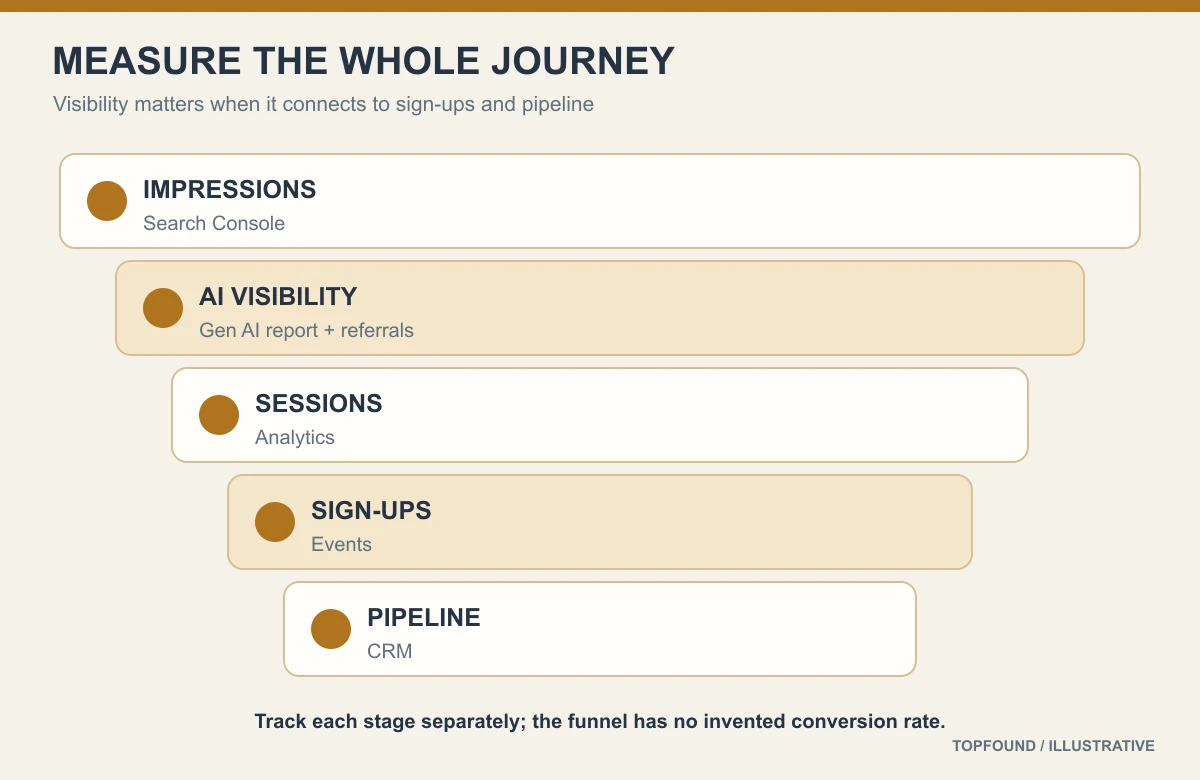
SaaS SEO metrics by stage
| Stage | Metric | Source |
|---|---|---|
| Visibility | Impressions, average position | Search Console |
| AI visibility | AI Overviews and AI Mode impressions; AI referrals | Search Console Generative AI report; analytics |
| Engagement | Organic sessions by page type | Analytics |
| Conversion | Trials, sign-ups, demo requests | Analytics events |
| Revenue | Pipeline and closed revenue from organic | CRM |
Sources: Search Console Help: Generative AI performance report (Search) (fetched Oct 30, 2026).
Common SaaS SEO mistakes
- Shipping a client-side-only marketing site that some bots can’t read.
- Letting app screens, staging, or preview URLs get indexed.
- Using robots.txt to hide pages instead of noindex or a login.
- Publishing hundreds of thin integration or location pages.
- Writing comparison pages that disparage competitors or use invented numbers.
- Marking up ratings that aren’t genuine or aren’t on the page.
- Hiding pricing and plan limits inside images or scripts.
- Reporting traffic without sign-ups and pipeline.
Where managed help starts
Teams can run this guide in-house. SaaS teams that want TopFound to audit their site for Google and AI search, rebuild key pages, and measure sign-ups from organic and AI answers can start with a free AEO report at /aeo-report or see AI SEO services at /services/ai-seo-services. Public plans are on /pricing: Growth $797/month, Scale $1,297/month, and Custom scoped.
FAQ
What is SaaS SEO?
SaaS SEO is search engine optimization for software companies: building pages that match how buyers research and compare software, keeping them crawlable, and measuring results by trials, sign-ups, and pipeline.
How is B2B SaaS SEO different from regular SEO?
The fundamentals are the same, but B2B SaaS has long buying cycles, several decision makers, low-volume high-value terms, and JavaScript apps and subdomains that add technical traps.
Which pages matter most for SaaS SEO?
Use-case, comparison, integration, and pricing pages usually sit closest to a sign-up. Blog guides and docs support them and capture earlier research.
Does Google index JavaScript SaaS sites?
Yes, Google renders JavaScript, but its docs still recommend server-side rendering or pre-rendering because it is faster and not all bots can run JavaScript.
Should I block my app with robots.txt?
Not to keep it out of Google. Google says robots.txt isn’t a mechanism for that; use noindex or password protection for app screens and staging.
What schema should a SaaS site use?
Organization on the homepage and SoftwareApplication or WebApplication for the product. SoftwareApplication rich results need name, offers.price, and a genuine rating or review.
How long does SaaS SEO take?
There is no reliable fixed timeline. Technical fixes take effect after Google recrawls the affected pages; competitive terms take longer and depend on content, intent match, and authority.
Where does TopFound fit?
TopFound (topfound.io) is a managed AEO / AI SEO agency. This guide is an explainer, not a case study. A soft next step is /aeo-report.
Build the pages buyers search for, then make sure crawlers can read them
Use the AI SEO guide for the AI-search half, the entity guide to make your product unambiguous, and the SEO vs AEO vs GEO guide to decide what to fund first. TopFound (topfound.io) does not promise rankings or AI citations.
Conclusion
SaaS SEO comes down to three things: build the pages buyers look for when choosing software, make sure every crawler, including AI search crawlers, can read them, and measure success in sign-ups and pipeline. Google’s documentation covers the technical rules clearly, from JavaScript rendering to robots.txt and SoftwareApplication markup.
For the AI-search half, continue to /blog/ai-seo. To make your product unambiguous to search engines, /blog/entity-seo-for-saas. To decide how to split budget between SEO, AEO, and GEO, /blog/geo-vs-aeo-vs-seo-for-saas.
Sources: Understand JavaScript SEO basics (fetched Oct 31, 2026), AI features and your website (fetched Oct 30, 2026).