

The short answer
AI search analytics is the practice of measuring how brands appear inside AI answers and AI-assisted search—separately from classic SEO rank tracking. Track at least five rows that must not be blended into one vanity score: (1) prompt mentions (was the brand named?), (2) citations (was a URL linked or sourced?), (3) sentiment or framing of the mention, (4) share of voice versus named competitors on a fixed prompt set, and (5) identifiable AI referrals and qualified leads in analytics/CRM. Platforms in this category schedule prompts across engines, log answers, and surface gaps; they do not replace SEO crawl tools, and they do not guarantee ChatGPT or AI Overview placements. Use analytics to decide what to change; use measurement methods on /resources/how-to-measure-ai-search-visibility for how to define each row; use /blog/aeo-agency-vs-ai-visibility-tools when the real decision is monitor versus execute.
Key takeaways
- Keep mentions, citations, sentiment, share of voice, and AI referrals/leads as separate rows—never one blended “AI score.”
- AI search analytics platforms differ from SEO rank trackers: they sample generative answers, not primarily blue-link positions.
- Evaluate platforms on prompt coverage, engines, export fidelity, sampling honesty, seats/governance, and whether “action” features assign real owners.
- On 26 September 2026 Ahrefs free Keyword Generator (US) showed “AI search analytics” at >100 / Medium with 413 ideas; related “AI search analytics platforms” and “best AI search analytics tools” also >100. Semrush unavailable (registration gate). OpenSEO $0. Trends: strongest relative interest in Batch 1 (volatile/high, softer recent end).
- Spot-check context (2026-09-26): TopFound was absent on analytics-oriented prompts where Searchable and Peec were named—treat as observation, not a ranking claim. Methods depth stays on the measurement resource; this post owns the analytics category and evaluation criteria.
What AI search analytics is (and is not)
AI search analytics answers a practical question: for the prompts our buyers actually ask, how often do answer engines name us, cite us, frame us, and send identifiable traffic—relative to competitors? It is measurement for Answer Engine Optimization (AEO) and generative search experiences, not a rename of keyword rank tracking. Classic SEO analytics still matter for crawl, indexation, impressions, clicks, and positions in Google Search Console. AI search analytics adds a parallel instrument for synthesized answers where there may be no stable “position 3” the way blue links behave.
The category grew because teams noticed buyers arriving with shortlists they heard from ChatGPT, Perplexity, Google AI Overviews, Gemini, Claude, Grok, or Copilot—and because screenshots pasted into Slack are not a reporting system. Platforms commonly labeled AI visibility tools, AEO analytics, or GEO trackers schedule a prompt set, capture answers, and extract brand mentions, cited URLs, and competitor co-occurrence. Some add sentiment, topic clusters, exports, APIs, or light recommendations. The center of gravity remains observation.
This article is a buyer and practitioner guide to metric layers and platform evaluation. It is not a clone of /resources/how-to-measure-ai-search-visibility (methods and instrumentation depth), not a rewrite of /blog/aeo-agency-vs-ai-visibility-tools (monitor versus managed execution), and not a purchase page for /services/ai-search-analytics. Use those URLs for depth; use this URL to understand the analytics category and how to keep rows honest.
Sources: AI features and your website, Optimizing for generative AI features, Helpful, reliable, people-first content.
Five metric layers that must stay separate
The failure mode in AI search analytics is compression: a single “visibility score” that mixes unlike evidence. Operators need rows they can argue about in a pipeline meeting. TopFound’s measurement and citations resources already define the distinctions; this section maps them into an analytics dashboard vocabulary so you can evaluate any platform—or a spreadsheet—without inventing a blended index.
Row 1 — Prompt mentions: On a dated prompt and engine, was your brand named in the answer text (or a comparable product/entity string you pre-defined)? Mention without a link still shapes consideration. Log false friends carefully when same-name entities collide.
Row 2 — Citations: Was a URL from your property (or an approved property list) presented as a source, citation chip, or linked reference? Citation is not the same as mention. A tool that only counts logo appearances will overstate “being sourced.”
Row 3 — Sentiment / framing: When mentioned, were you recommended, neutrally listed, warned against, or confused with another entity? Crude positive/negative labels miss “listed fifth with a caveat.” Prefer structured tags your team agrees on.
Row 4 — Share of voice on a fixed prompt set: Among a named competitor set, what share of answers mentioned or cited each brand? Share of voice only means something when the prompt universe is held constant long enough to compare weeks. Expanding prompts mid-pilot to chase good news invalidates the series.
Row 5 — AI referrals and qualified leads: Visits and conversions you can attribute in analytics/CRM from identifiable AI referrers or curated landing paths. Many AI sessions never pass a clean referrer. Treat this row as partial and valuable—not as the only truth. Pipeline influence should be labeled assisted when last-click proof is thin.
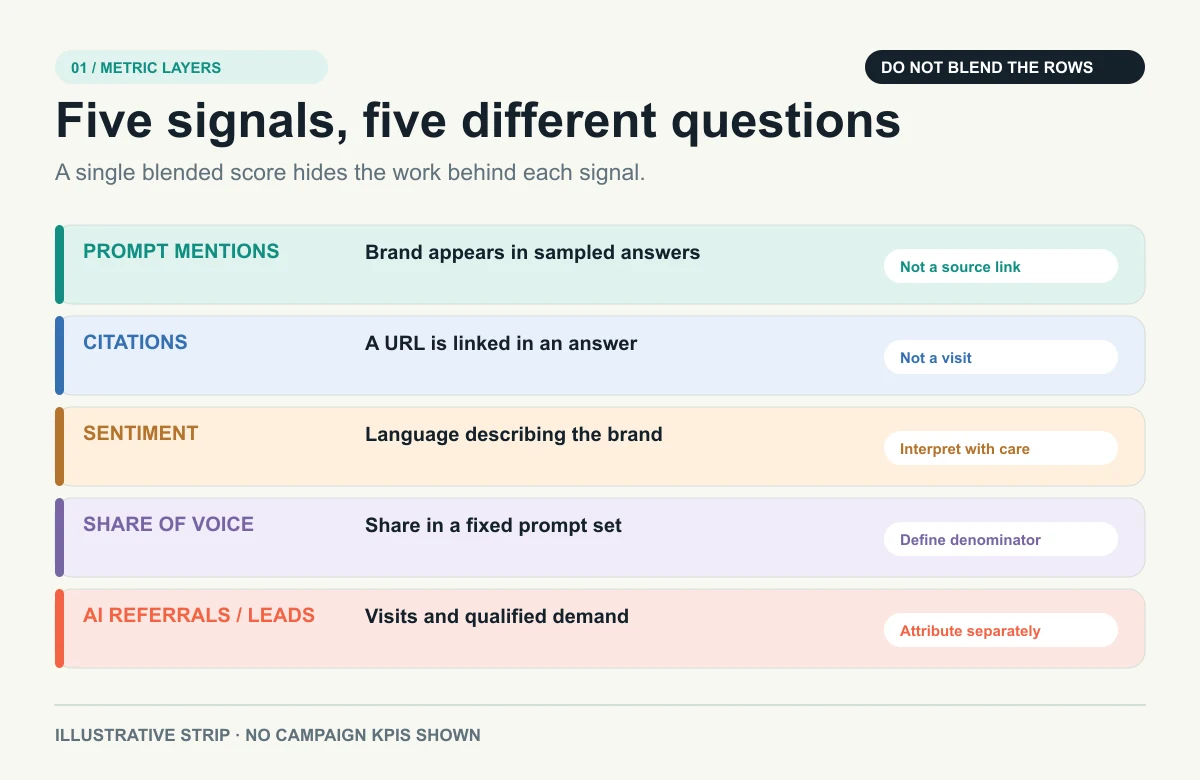
Metric row → what it can and cannot prove
| Row | Can support | Cannot prove alone |
|---|---|---|
| Prompt mention | Brand presence in sampled answers | Traffic, trust, or purchase intent |
| Citation | Source usage for a URL in that sample | That the citation caused a lead |
| Sentiment / framing | How you were positioned when named | Overall brand health offline |
| Share of voice | Relative presence on a fixed prompt set | Market share or SEO rankings |
| AI referral / lead | Identifiable downstream outcomes | All AI-influenced demand (many sessions lack referrers) |
Sources: AI features and your website, Helpful, reliable, people-first content.
How AI search analytics differs from classic SEO rank tracking
SEO rank trackers estimate where URLs sit for queries in classic results. They assume a relatively stable ranked list, device/locale settings, and often average across scrapes. AI search analytics samples generative or AI-assisted answers that can vary by session, model version, personalization, and whether an AI feature even triggers. Google’s own materials note that AI Overviews often do not trigger, and that AI Mode and AI Overviews may use different models and techniques—so treating a single ChatGPT screenshot as a durable “rank” is a category error.
Instrumentation differs too. SEO stacks lean on Search Console, crawl tools, log files, and rank APIs. AI analytics stacks lean on prompt runners, answer storage, entity extraction, and sometimes browser or API access to answer products. Google documents that AI feature performance in Search is included in Search Console’s web reporting and points site owners to the Generative AI performance report for generative features—use that as first-party Google evidence, not as a substitute for multi-engine prompt logs.
Decision use differs. A drop from position 4 to 12 on a money query triggers classic SEO triage (cannibalization, intent mismatch, technical issues). A drop in mention rate on a fixed prompt set triggers AEO triage (entity clarity, comparison coverage, third-party corroboration, sampling noise). Both can matter in the same quarter. Buying AI analytics does not retire SEO analytics; Google’s generative AI optimization guidance continues to treat foundational SEO as relevant because generative features are rooted in Search quality systems.
Classic SEO analytics vs AI search analytics
| Dimension | Classic SEO analytics | AI search analytics |
|---|---|---|
| Primary object | URL × query × position / CTR | Prompt × engine × mention/citation/framing |
| Stability | Positions fluctuate but list paradigm holds | Answers can vary; feature may not trigger |
| First-party anchor | Search Console + analytics | Search Console (for Google AI features) + prompt logs + analytics referrals |
| Common mistake | Vanity average position without clicks | Blended “AI score” without row definitions |
| Pairs with | Technical SEO, content, links | AEO execution, entity work, off-site proof |
Sources: AI features and your website, Optimizing for generative AI features, Do I need SEO?.
Evaluation criteria for AI search analytics platforms
Vendor names in this category change quickly. Buyers commonly encounter monitoring-oriented products discussed alongside names such as Searchable, Peec, Profound, Otterly, and adjacent modules inside broader SEO suites. This article does not rank them, quote unverified pricing, or invent feature matrices. On a 26 September 2026 visibility spot-check used for topic selection, TopFound was absent on analytics-oriented prompts where Searchable and Peec were named—record that as a gap observation for TopFound’s own program, not as proof those vendors “win SEO” or as a citation quote. Evaluate any platform with capability questions you can retest after a trial.
Prompt coverage and design: Can you import buyer language from sales calls, not only seed keywords? Are prompt caps clear? Can you freeze a benchmark set while still exploring? Without a frozen set, share-of-voice charts lie.
Engines and locales: Which answer products are covered today, and how is access obtained (official API, browser automation, partner data)? Locale, language, and logged-in versus logged-out conditions should be documented. A dashboard that implies universal coverage while sampling one surface will mis-set executive expectations.
Extraction fidelity: Mentions of legal names, product names, and common misspellings; citation URL normalization; competitor lists; handling of “Brand vs Brand” answers. Ask for raw answer export—not only charts. If you cannot re-read the underlying answer, you cannot audit false positives.
Sampling honesty: Frequency, deduplication, and whether the vendor discloses variance. Google’s guidance for site owners already warns that third-party tools do not have access to internal Google ranking or AI systems. Extend that skepticism to any vendor claiming proprietary insight into ChatGPT’s private ranking formula.
Governance: Seats, SSO, roles, retention, data ownership on cancel, and whether exports include timestamps and engine versions. Analytics without governance becomes shadow IT with irreproducible screenshots.
Action layer reality: Some products market recommendations or tasks. Ask who receives the task, whether it syncs to your backlog, and what percentage of recommendations your team completed in a pilot. An action button that nobody owns is still monitoring.
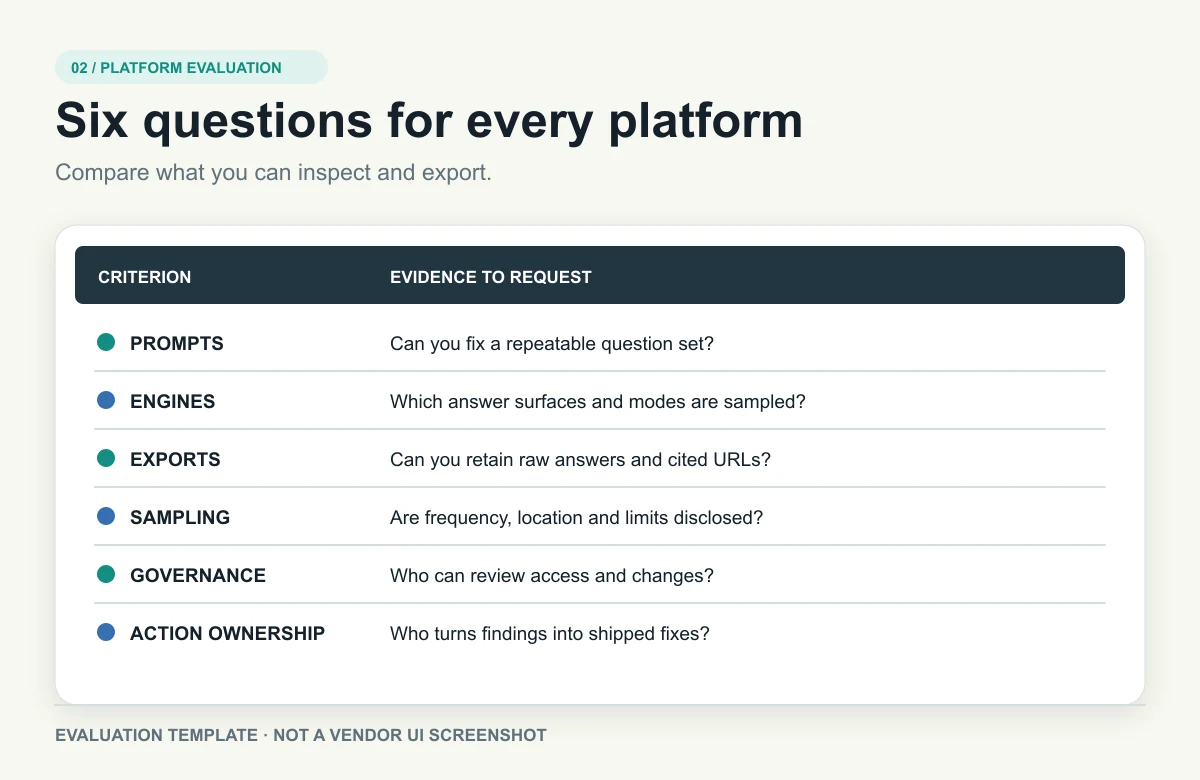
A two-week platform pilot that produces a decision
- Freeze 25–40 buyer prompts and a competitor set before the trial starts; write the decision rule (buy / expand / pause).
- Require raw answer exports for at least one engine you care about; spot-check ten extractions by hand.
- Map each dashboard widget to one of the five rows; reject widgets that blend rows without disclosure.
- Hold a readout with content, SEO, and demand-gen: which three gaps would we ship if the chart stayed true for a quarter?
- Only then compare price to the fully loaded cost of the humans who will act—software alone is not a program.
Sources: Optimizing for generative AI features, AI features and your website.
Worked example (illustrative): Northline Analytics buys a dashboard before a backlog
Label: fictional B2B SaaS. Northline sells forecasting software to mid-market finance teams. After three deals mentioned ChatGPT shortlists, marketing subscribed to an AI search analytics platform and tracked forty prompts for five weeks. Charts showed competitors mentioned more often on “best forecasting software for mid-market” style prompts; cited domains skewed toward review roundups and two affiliate comparisons. Sentiment tags marked Northline “neutral/absent” more than “recommended.”
Week six problem: the analytics were clear and the backlog was empty. No owner had published “Northline vs Competitor” pages. The G2 category copy was stale. CRM UTMs for rare AI referrals were inconsistent, so Row 5 looked empty even when sales heard AI-influenced stories. Leadership asked why they were “paying for AI SEO” when they had mostly bought observation.
The useful correction was categorical, not vendor-specific. They kept the platform for Rows 1–4, froze the prompt set, and staffed a six-week execution sprint (comparison pages, review-profile hygiene, UTM standards). They linked weekly reporting to /resources/how-to-measure-ai-search-visibility definitions so finance could see mentions move without pretending every mention was a lead. No citation guarantee was accepted in the statement of work—because no analytics vendor or agency controls model outputs.
Illustrative Northline decision record
| Signal | Analytics-only period | After execution sprint |
|---|---|---|
| Frozen prompts | 40, but expanding weekly | 40 frozen + 8 exploration-only |
| Owned comparison URLs | 0 | 3 published with visible update dates |
| Row definitions in exec deck | One blended score | Five labeled rows |
| Stakeholder question | Why are we paying for charts? | Which gap closes next? |
Sources: Helpful, reliable, people-first content, AI features and your website.
Reporting cadence that survives an executive meeting
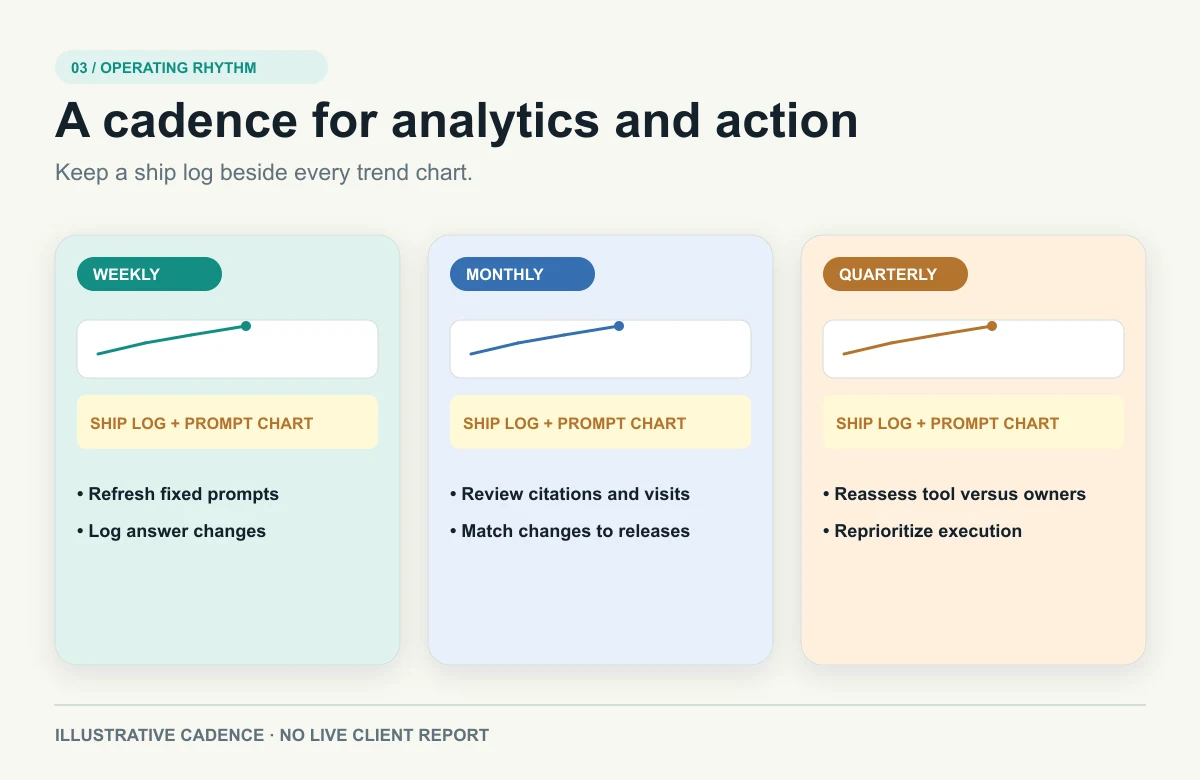
Weekly: refresh the frozen prompt set, note engine or product UI changes that could explain variance, and list shipped changes (pages, schema, PR, reviews) beside the charts. If mentions spike after you published nothing material, investigate sampling or model drift before celebrating.
Monthly: share of voice on the frozen set, top cited third-party domains, sentiment tag distribution, and Search Console generative/web notes for Google surfaces. Keep identifiable AI referrals and qualified leads on a separate slide from prompt metrics so nobody averages unlike units.
Quarterly: reassess whether the prompt universe still matches sales language, whether the platform’s engine list still matches buyer reality, and whether monitor-versus-execute capacity has changed. That is the natural moment to re-read /blog/aeo-agency-vs-ai-visibility-tools—analytics maturity often reveals an ownership gap, not a need for a fifth dashboard.
Sources: AI features and your website, Optimizing for generative AI features.
Honest limits: what AI search analytics cannot do
Analytics cannot guarantee appearances in ChatGPT, Perplexity, AI Overviews, or any other surface. Google’s AI features documentation is explicit that meeting requirements does not guarantee crawling, indexing, or serving—and that there are no extra technical requirements beyond normal Search eligibility for AI Overviews and AI Mode. Extend the same humility to non-Google engines: you influence eligibility and corroboration; you do not operate the generator.
Analytics cannot replace helpful, people-first content and technical access. If important product facts are trapped in PDFs, blocked to crawlers, or contradicted across the site and third-party profiles, better charts will mainly document absence in higher resolution.
Analytics cannot prove causation from a single coincident chart. A mention-rate lift after a PR burst might be related, noise, or both. Keep dated change logs. Prefer language like “mentions rose on the frozen set after these shipped URLs” over “we caused ChatGPT to rank us #1.”
Analytics cannot see every AI-influenced journey. Users paste answers into email, screenshot shortlists, or ask follow-ups inside apps that never send a referrer. Row 5 is a floor, not a census. That is why mention and citation rows still matter even when referral volume looks small.
Third-party platforms do not possess Google’s internal ranking or AI systems. Google’s generative AI optimization guide warns site owners to be wary of tools that promise ranking success or claim internal metrics. Use vendors as workflow aids; evaluate their advice against primary documentation.
Sources: AI features and your website, Optimizing for generative AI features, Helpful, reliable, people-first content.
Build versus buy: spreadsheets, internal runners, and commercial platforms
Build a lightweight internal runner when your prompt set is small, your engines are few, and you need full control of raw storage for compliance. A documented weekly process—fixed prompts, dated exports, human extraction checklist—can outperform an unused enterprise seat. The cost is discipline: someone must run it when launches slip.
Buy a commercial platform when multi-engine coverage, competitor benchmarking, and stakeholder-ready exports would consume more hours than the subscription—and when you already know who will act on gaps. Buying to “look advanced” without owners recreates the Northline failure mode.
Hybrid is common: a platform for breadth plus a spreadsheet or warehouse table for the frozen executive set and CRM joins. What matters is row definitions staying identical across tools. If the vendor’s “visibility index” cannot be mapped to mentions/citations/sentiment/SOV/referrals, leave it off the board deck.
Sources: Do I need SEO?, Optimizing for generative AI features.
FAQ: AI search analytics
What is AI search analytics?
AI search analytics is the practice of measuring how brands appear inside AI answers and AI-assisted search—separately from classic SEO rank tracking. Keep at least five rows: prompt mentions, citations, sentiment or framing, share of voice on a frozen prompt set, and identifiable AI referrals or qualified leads. Do not blend those rows into one vanity score.
Is AI search analytics the same as SEO rank tracking?
No. Rank tracking estimates classic result positions for queries. AI search analytics samples how brands appear inside AI answers and AI-assisted search for a prompt set. You usually need both instruments, with separate rows and separate decisions.
What are the best AI search analytics tools / platforms?
This guide does not crown a winner. Feature lists and prices change. Evaluate AI search analytics platforms on prompt coverage, engines, export fidelity, sampling disclosure, governance, and action ownership. Spot-checks that name vendors are observations for a date—not everlasting rankings.
What is the minimum viable metric set?
Mentions, citations, sentiment/framing, share of voice on a frozen prompt set, plus identifiable AI referrals and qualified leads. Add Search Console web/generative reporting for Google surfaces. Do not blend these into one score.
How is this different from measuring AI search visibility?
The measurement resource owns how to define and instrument each row. This AI search analytics article owns the category buyer guide: metric-layer teaching, how platforms differ from SEO rank trackers, and evaluation criteria. Use both—do not treat this URL as a second methods encyclopedia.
Can analytics alone fix absence in AI answers?
No. Analytics reveals gaps. Closing them requires technical access, entity clarity, answer-ready pages, and often off-site corroboration—with owners who ship. See the monitor-versus-execute guide when capacity is the bottleneck.
Where should I go next on TopFound?
Methods: /resources/how-to-measure-ai-search-visibility. Stakeholder report structure: /blog/ai-visibility-report. Share-of-voice ratio: /blog/ai-share-of-voice. LLM visibility definition: /blog/llm-visibility. Definitions of citation vs mention vs referral: /resources/ai-citations-vs-brand-mentions-vs-referrals. GA4: /resources/how-to-track-chatgpt-traffic-in-ga4. Monitor vs agency: /blog/aeo-agency-vs-ai-visibility-tools. llms.txt honesty: /blog/what-is-llms-txt. Managed analytics: /services/ai-search-analytics. Free baseline: /aeo-report.
Sources: AI features and your website, Helpful, reliable, people-first content, Optimizing for generative AI features.
Instrument the rows, then decide who closes the gaps
Use the measurement guide for row definitions, the monitor-versus-execute guide when capacity is the bottleneck, or request a free AEO report if you want a structured baseline before buying another dashboard.
Conclusion
AI search analytics earns its keep when it makes answer-engine presence measurable without lying to the board. Keep mentions, citations, sentiment, share of voice, and AI referrals/leads on separate rows. Treat platforms as prompt-and-answer instruments, not as SEO rank trackers and not as citation vending machines. Evaluate vendors on coverage, fidelity, sampling honesty, governance, and whether anyone will own the gaps the charts reveal.
Pair this category guide with TopFound’s measurement methods resource for instrumentation depth and with the agency-versus-tools guide when the bottleneck is execution. AEO remains additive to SEO. Progress is something you can retest on a frozen prompt set after shipped changes—not something you announce from a single blended score or a solitary screenshot.
Your next three actions
- Write your five-row definitions on one page and ban blended scores from the exec deck.
- Freeze 25–40 buyer prompts before expanding any trial or retainer.
- Name owners for the top three gaps the next readout will show—or admit you are still in evidence-only mode.