The short answer
An AI visibility tool monitors how often brands appear, get mentioned, or get cited across answer engines for a prompt set. An AEO agency diagnoses why gaps exist and executes the work—technical SEO, entity clarity, answer-ready content, off-site corroboration, and measurement design—so those gaps can close. Buy software when you have people who will act on the data. Hire managed AEO when you need judgment and delivery, not another dashboard. Many teams do both: a tool for continuous measurement plus an agency (or strong in-house owners) for implementation. Neither a subscription nor a retainer guarantees ChatGPT citations.
Key takeaways
- Tools answer “where do we show up?” Agencies answer “what should we change, and who will ship it?”
- Vendor names in this category change quickly; evaluate capabilities (prompt coverage, engines, exports, seats, action layers) rather than memorizing a permanent ranking.
- A monitoring pilot is often the right first spend if leadership still disputes whether AI answers matter for your buyers.
- If citation analysis keeps pointing at review platforms, comparison pages, and PR you never staff, adding a fourth dashboard will not finish the work.
- AEO remains additive to SEO. Measure mentions, citations, referrals, and leads as separate rows—never as one blended “AI score.”
Start with the job to be done
Buyers often arrive with a shopping question framed as a category question: “Should we get Profound, Peec, Otterly, Searchable… or hire an AEO agency?” Those options are not substitutes. One class of product watches answer engines. The other class of partner changes the pages, entities, and third-party proof those engines might retrieve. Confusing them creates a familiar failure mode: a beautiful weekly chart of absence, and still no one to write the comparison page.
This article is a decision guide, not a product review scorecard and not a clone of TopFound’s service pages. It will not crown a “best tool” or “best agency.” Public pricing and feature matrices for monitoring vendors change; where this guide mentions vendor names, treat them as examples of the monitoring category, not as an endorsement ranking. For how to vet a managed partner specifically, keep /resources/how-to-choose-an-aeo-agency as the deeper buyer checklist. For definitions of AEO itself, keep /aeo-explained.
Google’s guidance for AI Overviews and AI Mode is blunt in a useful way: there are no additional technical requirements beyond normal Search eligibility and helpful content, and nothing guarantees appearance. That limit applies equally to software dashboards and agency retainers. Your purchase should buy clarity and capacity—not a promised citation quota.
Sources: AI features and your website, Do I need SEO?.
What AI visibility tools actually do
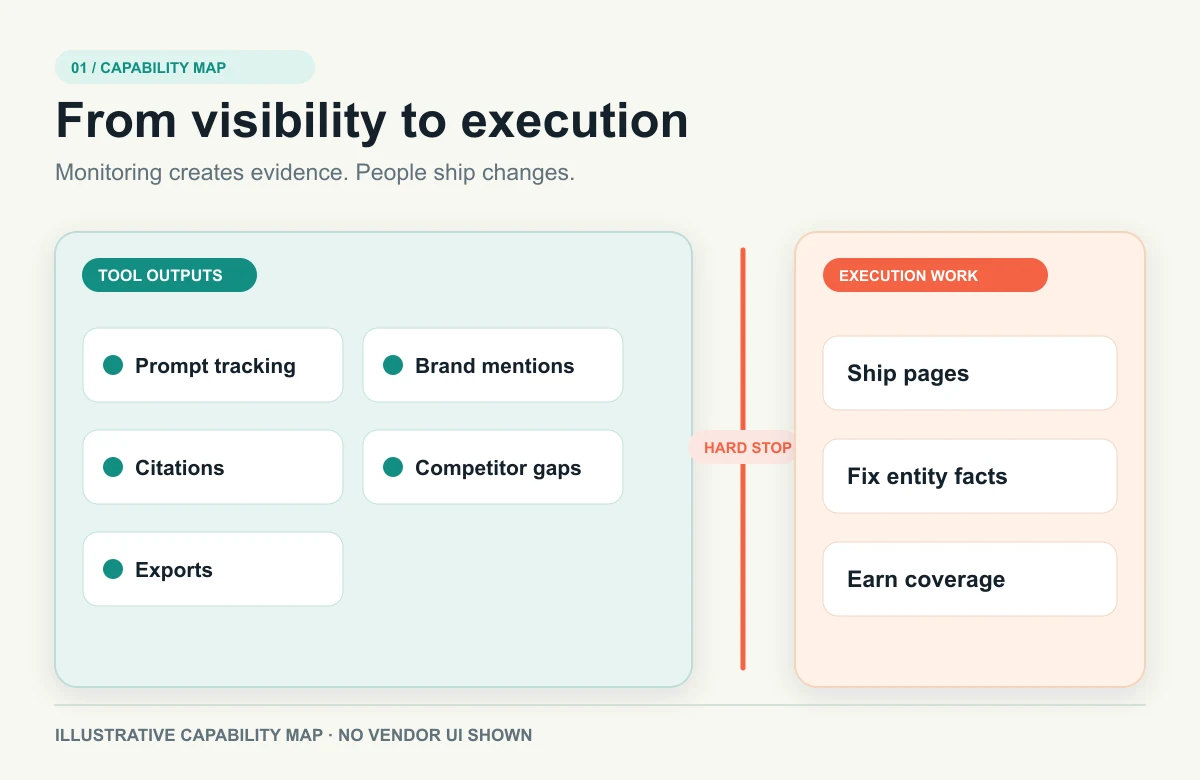
AI visibility tools—sometimes labeled AEO platforms, GEO trackers, or AI search analytics—typically run a prompt set across one or more answer products on a schedule. They record whether your brand was mentioned, whether a URL was cited, how you compared with competitors, and which third-party domains appear as sources. Some add sentiment, position-in-answer estimates, topic clustering, exports, APIs, or light recommendations. A few market an “action layer”; even then, the product’s center of gravity is measurement.
Examples buyers commonly evaluate in 2026 include Profound, Peec, Otterly, Searchable, and adjacent suites from broader SEO platforms. Exact plan names, prompt caps, engine lists, white-label options, and prices are UNKNOWN in this article unless you verify them on the vendor’s current pricing page—do that before procurement. Third-party blog comparisons often quote entry prices; those figures go stale and should not be treated as TopFound research metrics.
A good tool reduces manual copy-paste from ChatGPT and Perplexity into spreadsheets. It does not update your G2 profile, resolve a same-name entity collision, ship schema that matches visible copy, earn a trade-press mention, or decide which gap is worth this quarter’s engineering time. If your internal team already owns content, technical SEO, and digital PR, software can be enough. If those owners do not exist, the dashboard becomes a recurring reminder of unfinished work.
Sources: AI features and your website, OpenAI: Publishers and developers FAQ.
What a managed AEO agency actually does
A managed AEO agency sells diagnosis, prioritization, and execution across the surfaces that influence answers: crawlable technical foundations, entity clarity, answer-ready content, structured data that matches the page, off-site corroboration, and a measurement system stakeholders trust. Many agencies use a visibility tool inside the engagement. The tool is an instrument; the offer is the work.
In practical scopes you will see audits, prompt-universe design, on-page and content sprints, entity and schema fixes, comparison or alternatives pages, digital PR or review-platform programs, and monthly reporting that separates mentions, citations, referrals, and leads. Strong partners refuse guaranteed citation counts because they do not control model outputs. Weak partners sell “AI SEO” as a rename of last year’s blog package with a new slide.
TopFound’s own positioning is human-managed AEO and AI SEO at topfound.io: programs that aim to help brands get cited and recommended across major answer surfaces while still ranking on Google. That is one managed option among many. Use public plans on /pricing and the chooser guide to compare fit; do not treat this blog paragraph as a contract or a superiority claim.
Tool vs agency at a glance
| Dimension | AI visibility tool | Managed AEO agency |
|---|---|---|
| Primary output | Measurement and insights | Diagnosis plus shipped changes |
| Internal capacity needed | High—someone must act | Low to moderate—review and approve |
| Time to first clarity | Often days for a baseline | Weeks for audit + roadmap |
| Fails when | No owners for content, tech, PR | Scope is monitoring-only theater |
| Pairs well with | In-house SEO / content / PR | A tool for continuous tracking |
Sources: Helpful, reliable, people-first content, Optimizing for generative AI features.
When a monitoring tool is the right first buy
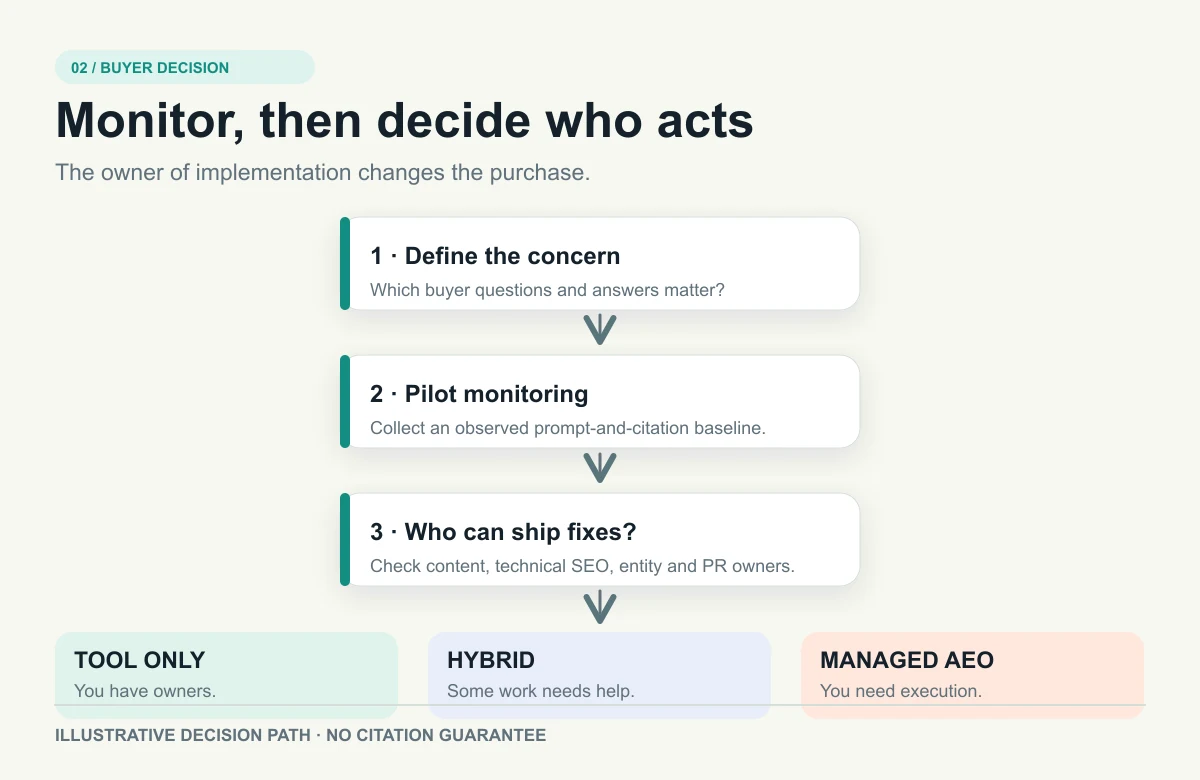
Buy software first when the debate is still “does AI search matter for us?” A four-week prompt pilot with a modest prompt set can show whether competitors appear in answers your sales team already hears on calls. That evidence is often more persuasive than a slide about industry trends—especially when you keep the method small and reproducible.
Buy software first when you already have owners. If a content lead can ship comparison pages, a developer can fix rendering and robots issues, and someone maintains review profiles, the tool’s gap list becomes a backlog instead of a museum exhibit. Agency dollars may be better spent later on specialized PR or a surge project.
Buy software first when procurement needs a low-commitment experiment. Tool subscriptions are usually easier to trial than retainers. Just define success before the trial: number of prompts, engines, competitors, and the decision you will make at the end (hire help, staff an owner, or pause). A trial without a decision rule mostly produces screenshots.
A tight two-week monitoring pilot
- Pick 25–40 real buyer prompts from sales calls and site search—not vanity definition queries alone.
- Choose two or three engines your buyers actually use; do not chase every logo on a vendor homepage.
- Log mentions, citations, cited domains, and competitor names with dates.
- Hold a 45-minute readout: what would we change if this chart stayed true for a quarter?
- Only then decide tool-only, agency assist, or hybrid—write the decision down.
Sources: AI features and your website.
When managed AEO is the better spend
Hire managed help when the dashboard already exists and the backlog does not move. The most common pattern: citation source analysis shows review platforms you have not updated, comparison URLs you have not written, and community threads nobody owns. Precision without owners is still absence.
Hire managed help when the problem is cross-functional. Entity collisions, schema-plus-content consistency, technical crawl issues, and digital PR rarely sit in one job description—see /blog/what-is-topfound-entity-disambiguation for a same-name collision teaching case. An agency earns its fee by sequencing those workstreams and reporting honestly when a lever is outside its control.
Hire managed help when leadership wants outcomes tied to pipeline language, not only visibility charts. That still does not mean guaranteed citations. It means a partner who will define mention vs citation vs referral vs qualified lead the way TopFound’s measurement guide does—and who will say which rows moved.
Sources: Helpful, reliable, people-first content, AI features and your website.
The hybrid model most serious teams end up with
In practice, mature programs look hybrid. A tool (or a documented in-house prompt pipeline) runs continuously. Humans—agency, in-house, or both—own the changes. Reporting stacks the surfaces: Google Search Console for web performance, analytics for identifiable AI referrals, and the visibility tool for prompt-level mentions and citations. Blending those into one vanity index hides the truth.
Google’s AI features documentation notes that AI Overviews and AI Mode performance rolls into Search Console’s web search reporting rather than a separate magic channel. That is another reason not to let a third-party “AI score” replace first-party analytics. Use each instrument for the question it can answer.
Hybrid also reduces category confusion in procurement. Finance can understand a software line item and a services line item. Marketing can explain why both appear on the same roadmap without pretending they are duplicates.
Sources: AI features and your website, Do I need SEO?.
Worked example (illustrative): ContourHQ’s monitoring pilot vs execution gap
Label: fictional SaaS. ContourHQ sells workflow software to mid-market operations teams. After sales reported buyers mentioning ChatGPT shortlists, marketing bought a visibility tool and tracked 30 prompts for six weeks. Result pattern: competitors appeared on “best workflow software for ops” prompts; ContourHQ appeared rarely; cited domains skewed toward G2-style roundups and two affiliate comparison blogs.
Week seven readout: the team had excellent charts and zero shipped pages. No one owned “ContourHQ vs Competitor” content. The G2 profile was outdated. PR had no pitch calendar. Leadership’s question—“why are we paying for AI SEO?”—was really “why is nothing changing?” They paused expansion of prompt volume and hired a managed AEO sprint focused on three comparison pages, review-profile cleanup, and a monthly citation log tied to CRM UTM hygiene.
Three months later (still illustrative, not a TopFound case metric): mention rate on the tracked set improved on some prompts and not others; two referral visits from cited pages were observed in analytics; pipeline influence remained carefully labeled assisted, not last-click proof. The tool subscription stayed. The difference was ownership. ContourHQ did not need a fifth dashboard. It needed people who could close the gaps the first dashboard revealed.
Illustrative ContourHQ decision record
| Signal | Tool-only period | After execution sprint |
|---|---|---|
| Prompt coverage | 30 prompts tracked | Same 30, plus 10 comparison prompts |
| Owned comparison URLs | 0 published | 3 published with update dates |
| Review profile hygiene | Stale category and screenshots | Updated; still not a ranking claim |
| Stakeholder question | Why are we paying for charts? | Which gap do we close next? |
Sources: Helpful, reliable, people-first content, OpenAI: Publishers and developers FAQ.
Questions that expose category confusion in sales calls
Whether you are evaluating software or an agency, ask questions that force the vendor to show artifacts. For tools: Which engines are covered today? How are prompts sampled? Can I export raw answers? Who owns the data if I cancel? What does the product explicitly not do? For agencies: Show a redacted baseline and a sample report. Who does the work? What is out of scope? How do you define mention vs citation vs referral? Will you refuse a citation guarantee on the record?
Watch for red flags that mix the categories. A tool vendor promising they will “make you rank in ChatGPT” without an execution team. An agency whose only deliverable is screenshots from a tool you could have bought yourself. A proposal that prices monitoring and execution as one opaque blob so you cannot tell what capacity you purchased.
Keep TopFound’s chooser resource nearby for agency-specific diligence, and the measurement guide for metric definitions. This article’s job is to stop you from buying the wrong category—not to replace those deeper pages.
Can a tool replace an AEO agency?
Only if you already have people who will interpret gaps and ship technical, content, entity, and off-site work. Otherwise the tool reports the problem with higher resolution.
Can an agency replace a tool?
Sometimes, with a documented manual or semi-automated prompt pipeline. Many agencies still use commercial tools because continuous multi-engine tracking is tedious to maintain by hand. Ask what instrument they use and whether you retain access to the data.
Sources: AI features and your website, Helpful, reliable, people-first content.
Cost and capacity without fake benchmarks
Public internet posts often quote tool entry prices from tens to hundreds of dollars per month and agency retainers in much higher annual bands. Those figures are not verified here and are marked UNKNOWN as TopFound research claims. What you can evaluate without invented benchmarks is capacity math: hours available to act on gaps, number of properties or brands, and whether off-site work is included.
A cheap tool with no owners can be more expensive than a retainer that ships. An expensive enterprise monitoring suite can be bargains for a team that already executes weekly. Put the annual software cost next to the fully loaded cost of the human time required to respond. That comparison is usually more honest than a feature matrix alone.
For TopFound’s own commercial terms, use /pricing and a discovery call—not blog approximations. Service-page keywords stay on service pages so this educational post does not cannibalize purchase intent URLs.
Sources: Do I need SEO?.
Measure like an operator, not like a press release
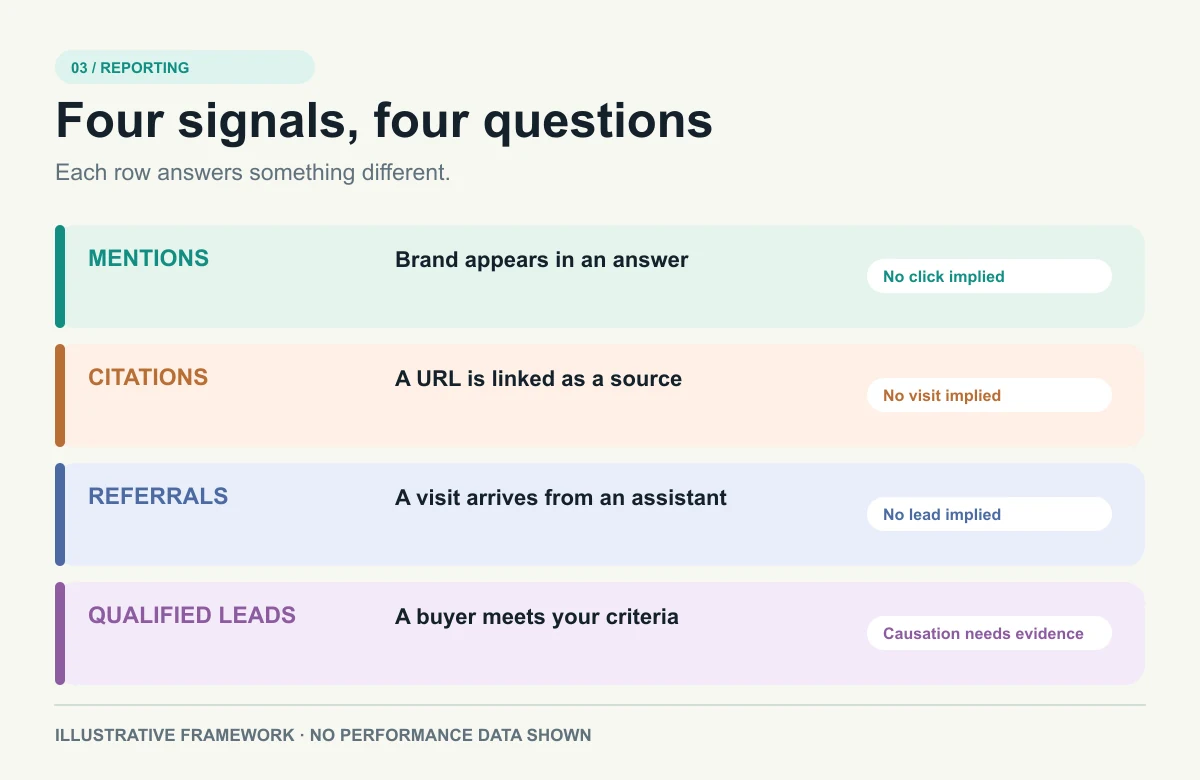
Whether tool-only or hybrid, report four separate ideas: brand mention in an answer, citation/link to a URL, referral visit you can see in analytics, and qualified lead or pipeline stage. TopFound’s measurement resource exists so teams stop compressing those into one “AI visibility” boast. Add Search Console web performance as its own row; Google documents that AI feature clicks are part of web search reporting, not a parallel universe.
When leadership asks for proof, show dated prompt logs and shipped changes beside the charts. A spike in mentions after you published nothing should make you suspicious of sampling noise. A flat chart after you shipped three comparison pages might still be early—or might mean the wrong prompts. Either way, the narrative should be falsifiable.
AEO is additive to SEO. Technical excellence and helpful content remain the floor. Tools and agencies are how you observe and accelerate work on top of that floor—not how you bypass it.
Sources: AI features and your website, Optimizing for generative AI features, Helpful, reliable, people-first content.
FAQ: agency vs AI visibility tools
Is Profound an AEO agency?
Profound is widely discussed as an AI visibility / AEO measurement platform, not as a substitute for a managed execution team. Always verify current product scope on the vendor’s site. If you need people to ship content, entity fixes, and PR, you still need owners—internal or agency.
Where do Peec, Otterly, and Searchable fit?
They sit in the monitoring / analytics category buyers compare when they want scheduled prompts, citations, and competitor views. Features and pricing change; evaluate exports, engines, seats, and whether any “action” features actually assign work your team will do.
Should we pause SEO if we buy AEO tools or an agency?
No. Google’s public materials continue to emphasize foundational SEO and helpful content for AI features in Search. Treat AEO as additive. Pausing crawlability, content quality, or measurement of classic search usually creates new gaps.
Will either option guarantee citations in ChatGPT?
No responsible vendor can guarantee that. Engines control retrieval and generation. Buy clarity, capacity, and honest measurement—then judge progress from dated logs.
What should I read next on TopFound?
Chooser guide: /resources/how-to-choose-an-aeo-agency. Measurement: /resources/how-to-measure-ai-search-visibility. Stakeholder report template: /blog/ai-visibility-report. Missing from answers: /resources/why-your-company-is-missing-from-ai-answers. Entity collisions: /blog/what-is-topfound-entity-disambiguation. Entity SEO practice: /blog/entity-seo-for-saas. Managed offer: /services/aeo-services or /answer-engine-optimization-agency. Definitions: /aeo-explained. Company identity: /about and /llm-info.
Sources: AI features and your website, Helpful, reliable, people-first content, OpenAI: Publishers and developers FAQ.
Decide the job, then pick the capacity
Use TopFound’s agency chooser and measurement guides to pressure-test vendors—or start with a free AEO report if you want a structured baseline.
Conclusion
AI visibility tools and AEO agencies solve adjacent problems. Software tells you where answers mention or cite brands across a prompt set. Managed AEO decides which gaps matter and ships the technical, content, entity, and authority work that might change those answers over time. Most capable teams eventually need measurement and execution; the mistake is buying one while needing the other.
Choose with artifacts: a prompt pilot, an owner map, a sample report, and a clear refusal of citation guarantees. Keep service purchase intent on service pages, keep definitional intent on /aeo-explained, and use this guide when the real question is monitor versus execute. For the educational LLM visibility map and the share-of-voice ratio, see /blog/llm-visibility and /blog/ai-share-of-voice. AEO stays additive to SEO—and progress stays something you can retest, not something you announce from a single screenshot.
Your next three actions
- Write down whether your bottleneck is evidence, owners, or both.
- Run a bounded prompt pilot or demand a redacted baseline from any agency on your shortlist.
- Separate tool and services line items in the plan so finance and marketing argue about capacity—not category labels.