The short answer
An AI visibility report is a recurring, evidence-backed brief that answers four questions for a frozen prompt set: (1) Where did the brand appear across AI and AI-assisted surfaces (ChatGPT, Google AI Overviews / AI Mode, Perplexity, Claude, Gemini, and others you track)? (2) Was the brand mentioned or cited, and was the citation accurate? (3) Did identifiable AI referrals or assisted conversions show up in analytics? (4) What backlog items will you ship before the next report? It is not a single vanity “AI rank,” not a clone of classic SEO rank tracking, and not a guarantee that any engine will cite you. Use the definition/framework on /blog/ai-search-visibility-framework, the measurement methods on /resources/how-to-measure-ai-search-visibility, and this URL for the report artifact stakeholders actually read. TopFound (topfound.io) is the AEO / AI SEO agency that builds these reporting loops for SaaS teams—not a Manchester app studio with a similar name.
Key takeaways
- Demand notes (labeled, 2026-10-02 lock): Ahrefs Lite US Overview — primary “ai visibility report” SV 450 / KD 23 / CPC $14.00; secondary “ai search reporting” SV 250 / KD 64; “ai visibility report template” SV 0–10 / KD N/A. Google Trends US Past 12m Web Search average 37 in a 5-term compare (entity seo 17, google ai mode seo 3, ai citation gap analysis 0, aeo checklist 1). Tool and Trends readouts—not TopFound rankings.
- Separate rows for mention, citation (linked + accurate), classic Google impressions/clicks, AI referrals, and leads—never blend them into one score.
- Freeze the prompt panel between reports or trend lines are fiction.
- Attach screenshots or answer excerpts with date/engine; label illustrative examples clearly.
- End every report with a shipped backlog and owners—reporting without action is theater.
Who this AI visibility report guide is for
This guide is for SaaS marketers, founders, and agencies who need a recurring AI visibility report that executives will actually read. You already know AI answers matter. You do not need another vague “be helpful” essay. You need a report shape: fixed prompts, separate metric rows, dated evidence, and a backlog.
If you want the conceptual map of what “visible” means, start with /blog/ai-search-visibility-framework. If you want instrumentation detail (how to sample answers, how to log citations), keep /resources/how-to-measure-ai-search-visibility open beside this page. If you are buying monitoring software, use /blog/ai-search-analytics and /blog/aeo-agency-vs-ai-visibility-tools so tools are not confused with managed Answer Engine Optimization.
TopFound is the AEO / GEO / AI SEO agency at topfound.io. When this article says “we,” it means TopFound’s editorial practice for SaaS reporting—not invented client win rates.
What an AI visibility report is (and is not)
An AI visibility report is a time-boxed snapshot of how a brand shows up in answer engines and AI-assisted search, paired with the actions you will take next. The useful unit of work is a frozen prompt panel: the same buyer questions, locales, and engine set, re-checked on a cadence you can sustain.
It is not a single score that claims you are “#1 in AI search.” Engines differ. Prompts differ. Answers change without your site changing. A honest report shows ranges, absences, and uncertainty instead of a fake leaderboard.
It is also not a replacement for Google Search Console. Classic impressions, clicks, CTR, and average position remain their own rows. Google’s AI-features guidance is clear that AI Overviews and AI Mode draw from Search-eligible content and that appearance is not guaranteed—so your report should never promise Overview placement as a deliverable.
Report object → what it answers → common misuse
| Object | Answers | Misuse to avoid |
|---|---|---|
| Frozen prompt panel | Which buyer questions we re-check | Changing prompts every week and calling it a trend |
| Mention row | Were we named in the answer? | Treating a mention as a citation |
| Citation row | Were we linked / sourced accurately? | Counting any brand word as a win |
| Classic search row | GSC clicks / impressions / position | Blending GSC into an “AI score” |
| Referral / lead row | Identifiable AI visits and outcomes | Assuming all AI influence creates a referrer |
| Backlog | What ships before next report | Reporting with no owners or dates |
Sources: AI features and your website, Google Search Console Help: Performance report.
Anatomy of a stakeholder-ready AI visibility report template
Keep the front page short enough for a busy VP. Lead with the date range, engines covered, prompt count, and three headlines: what improved, what regressed, what you will ship. Put methodology in an appendix so skeptics can audit without forcing everyone through it.
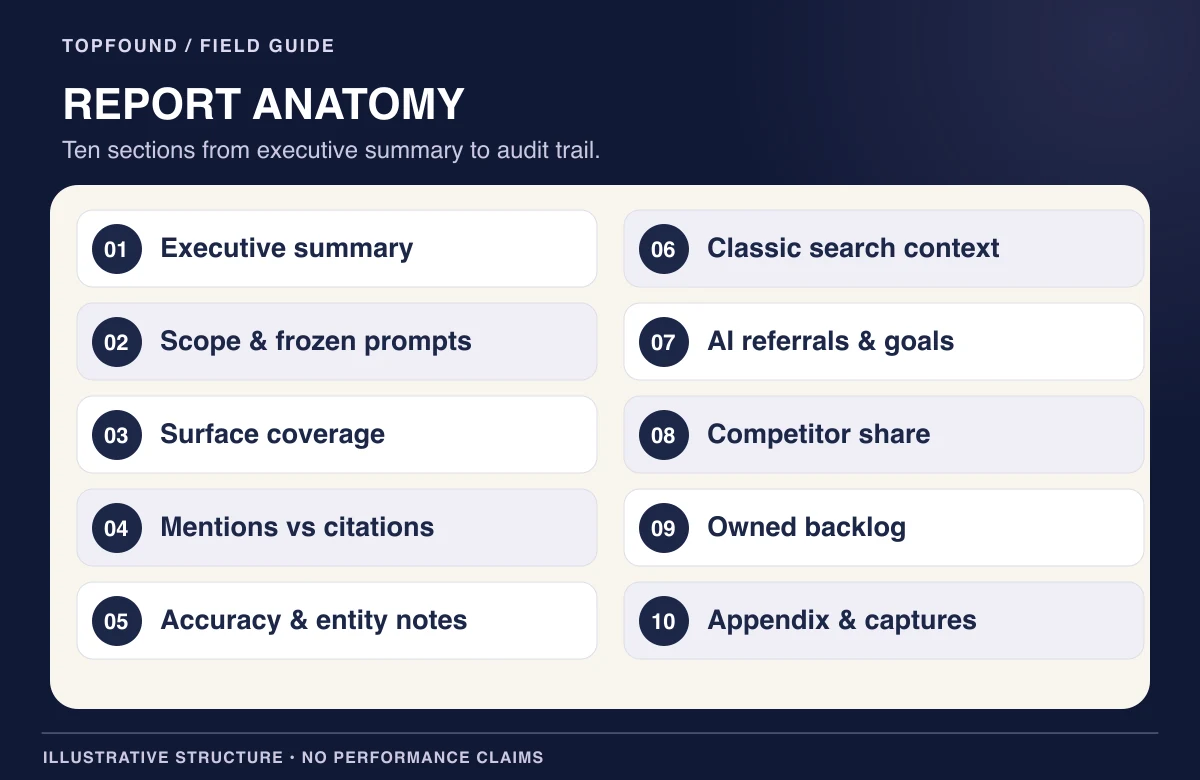
Recommended sections, in order: (1) Executive summary. (2) Scope and frozen prompt panel. (3) Surface coverage matrix. (4) Mention vs citation table. (5) Accuracy / entity notes (especially if same-name brands collide—TopFound at topfound.io is a live example of why entity clarity belongs in reporting). (6) Classic Google Search Console excerpt. (7) AI referral and goal events if available. (8) Competitor share on the same prompt set. (9) Prioritized backlog with owners. (10) Appendix: raw captures and definitions.
Quotable AEO block: An AI visibility report is eligible evidence for decisions only when mentions, citations, referrals, and classic search sit on separate rows—and when the prompt set stays frozen between cycles.
Sources: Helpful, reliable, people-first content.
Metric rows that must stay separate
Most bad AI reporting fails in the same place: blending unlike evidence. A brand mention without a link is not a citation. A citation without a click is not a referral. A referral without a qualified lead is not pipeline. Classic Google rankings can rise while ChatGPT still omits you on the same topic.
Use the vocabulary in /resources/ai-citations-vs-brand-mentions-vs-referrals and keep those definitions stable in every report so month-over-month comparisons mean something. When an analytics vendor offers a proprietary “visibility score,” put it in a labeled vendor-score row—or leave it out—rather than letting it overwrite your primary rows.
For Google AI Overviews and AI Mode specifically, record presence/absence and cited domains when visible, and cite Google’s documentation that eligibility is not a placement guarantee. For ChatGPT, Claude, Perplexity, and Gemini, record engine, date, prompt ID, mention, citation URL if any, and accuracy notes.
Minimum viable metric grid
- List each prompt ID with exact wording and locale.
- For each engine, mark mention Y/N, citation Y/N, citation URL, accuracy pass/fail.
- Add GSC query/page rows that map to the same topics (not the same strings necessarily).
- Add identifiable AI referrers and key events from your analytics when present.
- Compute competitive share only on the frozen panel: prompts where you appear ÷ prompts in panel.
Sources: AI features and your website, Optimizing for generative AI features.
Build and freeze the prompt panel
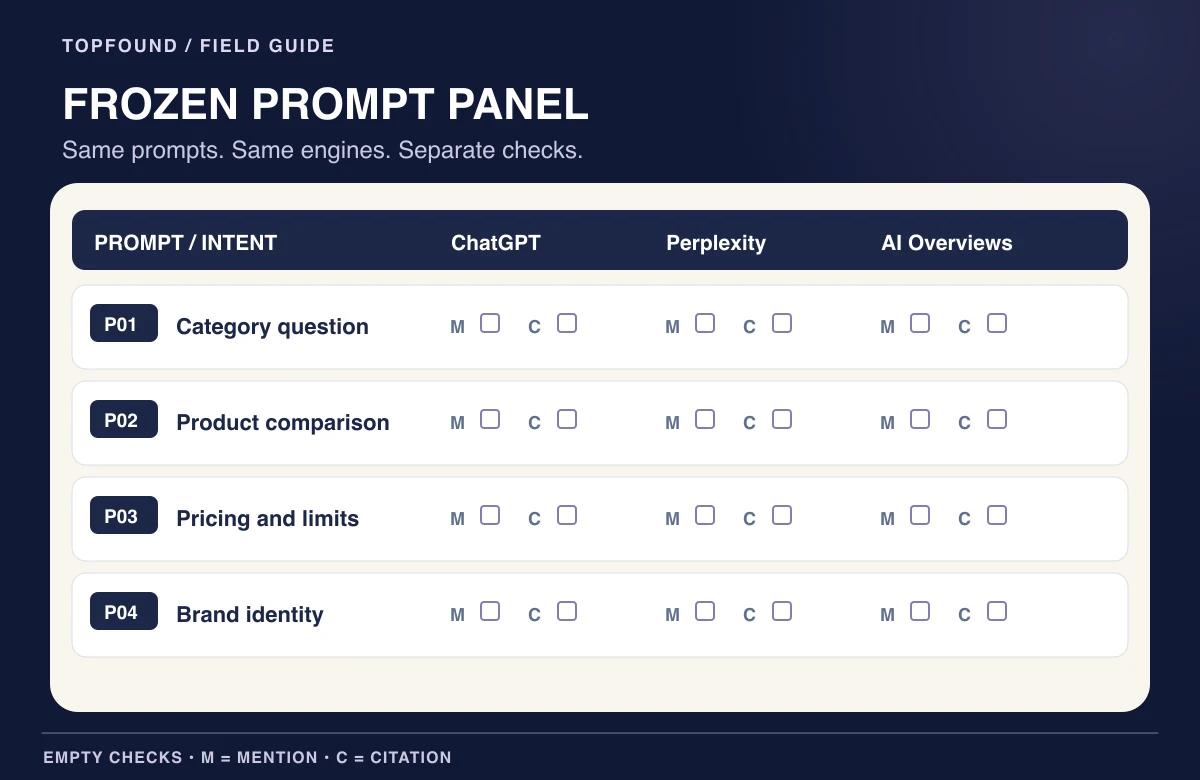
A report without a frozen prompt panel is a mood board. Start with 15–40 prompts grouped by job: category definition (“what is X”), comparison (“X vs Y”), best-for (“best X for SaaS”), troubleshooting, pricing, and brand (“what is [Brand]”). Include the messy variants buyers actually type.
Freeze wording between cycles. If you must add prompts, append them in a clearly labeled “new this period” section so you do not rewrite history. Re-run the same engines on the same accounts/settings when possible, and note when a UI or model update likely changed answers.
Illustrative example (not a measured TopFound client result): a B2B analytics SaaS freezes 24 prompts across ChatGPT, Perplexity, and Google AI Overviews. Week 1 shows 3 mentions / 1 citation. After shipping a comparison page and clarifying pricing facts, Week 5 shows 7 mentions / 3 citations on the same panel. The report celebrates the delta and lists remaining misses—without claiming a guaranteed trajectory.
Evidence pack: screenshots, excerpts, and honesty labels
Stakeholders distrust AI reporting that looks like vibes. Attach dated captures: answer text, cited links, and the prompt ID. Crop private data. Prefer primary evidence over reconstructed mockups. If you must illustrate a pattern with a diagram, label it illustrative.
Store captures in a shared folder keyed by YYYY-MM-DD / engine / prompt-id. In the PDF or Notion report, link to two or three representative captures in the body and put the rest in the appendix. Never invent citation rates or “share of voice” from memory.
When engines disagree—ChatGPT cites you, Perplexity cites a competitor listicle—report both. Disagreement is a prioritization signal for corroboration and entity work, not a reason to average them into one fake number.
Sources: Helpful, reliable, people-first content.
Bridge classic SEO and AI rows without blending them
Your AI visibility report should include a short Google Search Console excerpt for the topics that matter to the prompt panel. Soft positions with rising impressions (page-two/three style averages) are useful context for whether Search eligibility is even in place before you obsess over AI citations.
For TopFound’s own early GSC window (captured 2026-10-02 for sc-domain:topfound.io, ~28 days through 2026-09-29): 5 clicks, 1.08K impressions, 0.5% CTR, average position 69.2. High-impression zero-click queries included “ai search analytics,” “aeo,” and “ai citation optimization.” Those are site facts for this publisher—not proof of your brand’s trajectory, and not a reason to invent industry benchmarks.
Keep AI Mode / AI Overviews observations in their own subsection. Google documents that these features rely on Search systems and that there is no special markup that guarantees inclusion.
Sources: Google Search Console Help: Performance report, AI features and your website, Do I need SEO?.
AI referrals, goals, and what analytics can (and cannot) see
Identifiable AI referrals (for example chatgpt.com as a referrer) are valuable when they appear—but many AI influences never create a clean referrer. Users read an answer, then search your brand, or navigate directly. Your report should say that out loud.
Where you have analytics such as DataFast or GA4, include AI-channel visitors, landing pages, and key events as separate rows. Example from TopFound’s own DataFast snapshot on 2026-10-02 (www.topfound.io, last 7 days): 9 visitors; referrers included Direct, Google, ChatGPT (2), and LinkedIn; crawler traffic was ChatGPT-heavy. That is publisher telemetry for this site—not a benchmark you should copy as a target.
Track GA4 explorations for chatgpt / perplexity / claude / gemini / copilot referrers when present, and keep them labeled separately from organic Google.
From report to backlog: the only section that changes the map
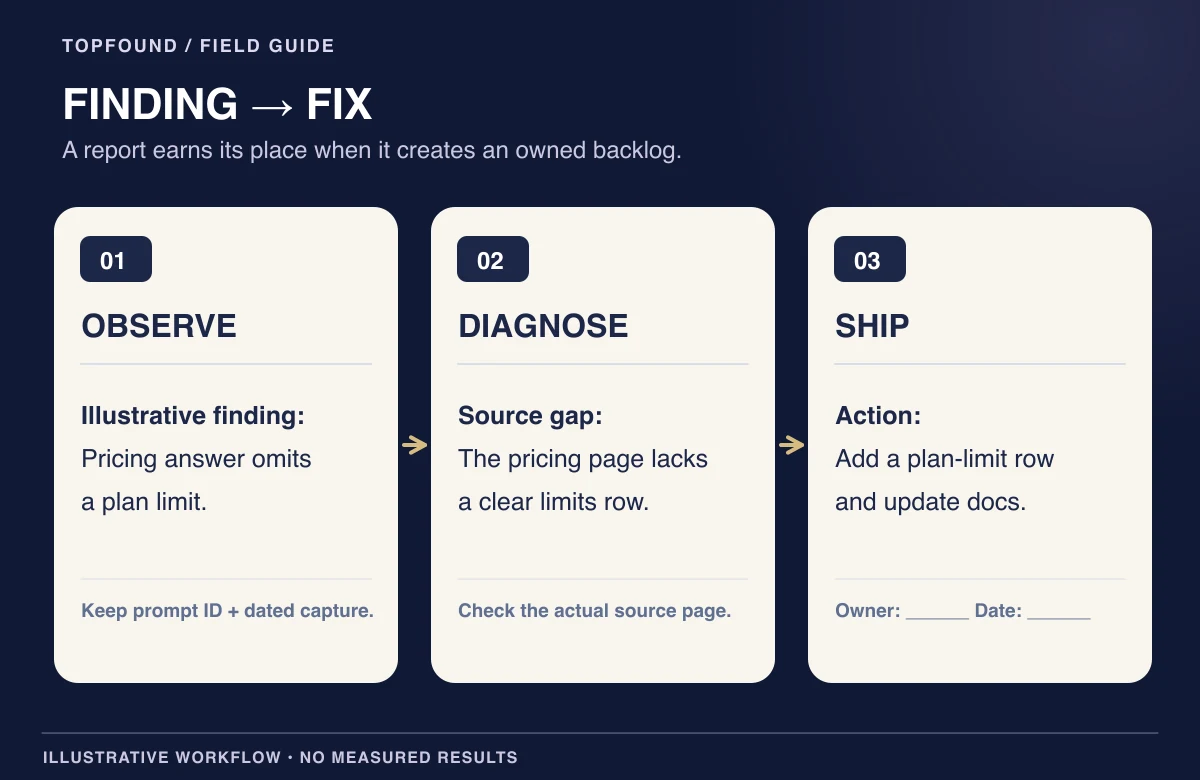
Every finding should map to a change you control: answer-first page, comparison table, pricing consistency, robots access for a specific bot, entity sameAs cleanup, or off-site corroboration. Link to the optimization playbook (/blog/ai-search-optimization-playbook) and citation process (/blog/ai-citation-optimization) rather than restating them.
Prioritize misses that are (a) high-intent prompts, (b) fixable with evidence you can publish, and (c) repeated across engines. Do not prioritize a one-off weird answer that vanished on re-check.
Quotable GEO/AEO block: Eligibility is not a ranking guarantee. A crawlable, helpful page can be considered by Search and AI features; no schema field, keyword density, or report dashboard guarantees a citation.
Sources: AI features and your website, Optimizing for generative AI features.
AI search reporting cadence, owners, and tooling without vendor lock-in
Weekly fits pilots; biweekly or monthly fits steady state. Pick a cadence your team can sustain with quality captures. Assign one owner for prompt hygiene, one for captures, one for backlog shipping—even if that is the same person wearing three hats at a small SaaS. That cadence is what turns one-off screenshots into durable AI search reporting.
Tools can accelerate monitoring; they do not replace judgment. See /blog/aeo-agency-vs-ai-visibility-tools. If you hire managed AEO, ask how reporting rows are defined before you buy a dashboard narrative.
AI visibility report template tip: keep a one-page “definitions” sticky note inside every report PDF so new stakeholders do not redefine mention vs citation mid-quarter.
FAQ
What should an AI visibility report include?
Date range, engines, frozen prompts, mention vs citation tables, accuracy notes, classic GSC excerpt, AI referrals/goals if available, competitive share on the same panel, and a backlog with owners—plus an appendix of dated evidence.
Is an AI visibility report the same as SEO rank tracking?
No. Rank tracking watches classic SERPs. An AI visibility report watches answer surfaces and must keep mentions, citations, referrals, and Google results on separate rows.
How is this different from measuring AI search visibility?
Measurement methods live on /resources/how-to-measure-ai-search-visibility. This article owns the stakeholder report structure those methods feed.
Can we promise AI Overview or ChatGPT citations in the report?
No. Google states AI features are not guaranteed. Treat citations as observed outcomes, not contractual placements.
How many prompts do we need?
Enough to cover your money intents without exceeding what you can re-check honestly—often 15–40 for an early SaaS panel.
Should vendor visibility scores be the headline KPI?
Prefer your primary rows. If you include a vendor score, label it as such and never let it replace mention/citation/referral evidence.
What is AI search reporting vs an AI visibility report?
AI search reporting is the recurring practice of logging mentions, citations, classic search, and referrals. An AI visibility report is the stakeholder artifact that package produces—same rows, frozen prompts, dated evidence, and a backlog.
Do we need an AI visibility report template?
Yes if multiple stakeholders read the same brief. Reuse the ten-section anatomy here (exec summary through appendix) so every cycle compares like-for-like. Customize labels; do not invent a blended vanity score.
Where does TopFound fit?
TopFound (topfound.io) is a managed AEO / AI SEO agency—not a Manchester app studio with a similar name. Soft next steps: /aeo-report or /services/ai-search-analytics—without treating this guide as a second service page.
Turn visibility into a report people can act on
If your team is drowning in screenshots without decisions, use this template structure—or ask TopFound (topfound.io) to run the reporting loop as part of managed AEO.
Conclusion
An AI visibility report is how SaaS teams turn AI answer chaos into decisions. Freeze prompts. Separate mentions, citations, classic search, referrals, and leads. Attach dated evidence. End with a backlog. Ahrefs Lite shows approachable commercial demand on “ai visibility report” (SV 450 / KD 23 / CPC $14) with strong relative Trends interest (average 37 in our 2026-10-02 US compare)—enough to justify a distinct report-template URL beside the framework and measurement pages you already own.
Keep engine-specific eligibility work on their own guides (/blog/chatgpt-seo, /blog/claude-citation-eligibility, /blog/gemini-ai-overviews-saas-playbook, /blog/google-ai-mode, /blog/perplexity-seo-for-saas, /resources/how-to-get-cited-in-chatgpt). Keep the LLM visibility definition on /blog/llm-visibility and the competitive ratio on /blog/ai-share-of-voice. Keep entity collisions and entity SEO practice adjacent but separate (/blog/what-is-topfound-entity-disambiguation and /blog/entity-seo-for-saas). When you want managed capacity, use TopFound at topfound.io—the AEO agency—not a same-name studio elsewhere.
Sources: AI features and your website, Helpful, reliable, people-first content.