

The short answer
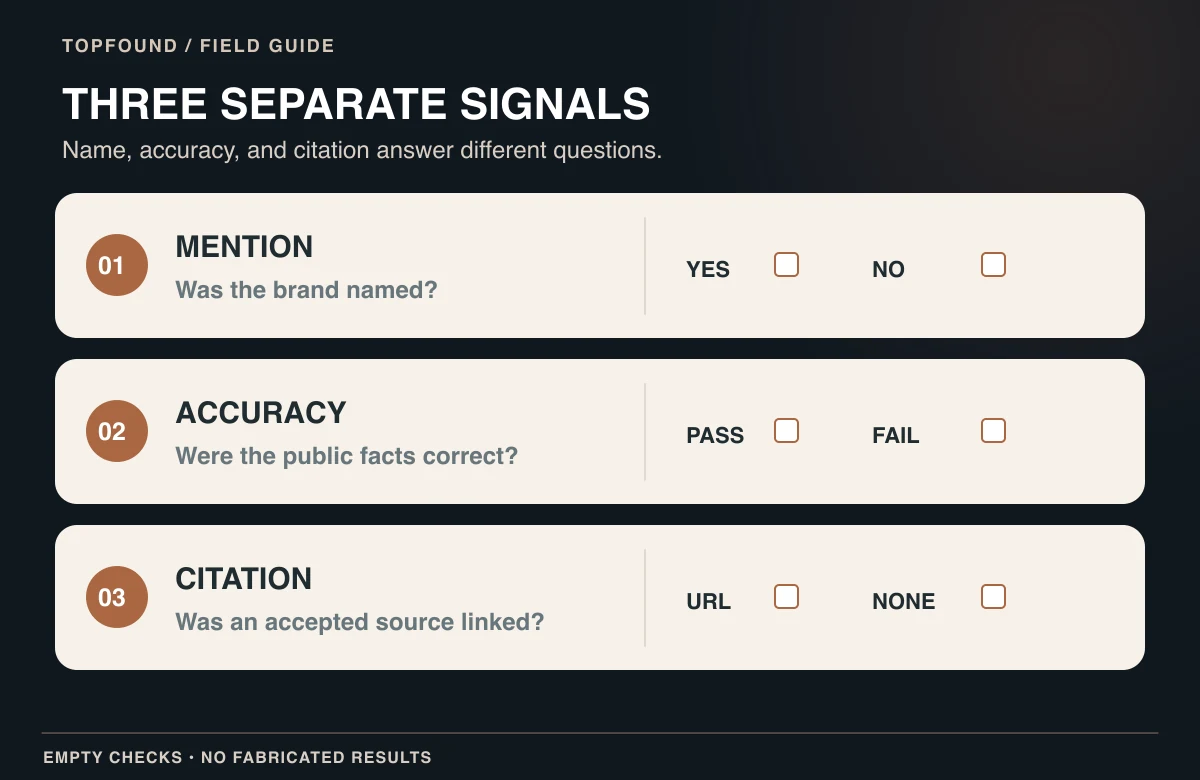
LLM visibility is the degree to which large language models name your brand, describe it accurately, and cite a source you accept when buyers ask category, comparison, and problem questions. Check the assistants your buyers actually use—commonly ChatGPT, Claude, Gemini, Perplexity, and Google’s AI Overviews or AI Mode—on a frozen prompt set. Record three separate facts per prompt: mentioned or not, accurate or not, cited or not. Prompt tracking is how you repeat that check. ChatGPT citations are one engine’s citation row, not the whole of LLM visibility. Classic Google rankings stay in Search Console. None of this is a guarantee that any model will recommend you. The educational definition lives on this URL. Managed execution lives on /services/llm-visibility-optimization. The comparison ratio lives on /blog/ai-share-of-voice. TopFound (topfound.io) is the AEO / AI SEO agency—not a Manchester app studio with a similar name.
Key takeaways
- Demand notes (labeled, 2026-10-03 lock): Ahrefs Lite US Overview — primary “llm visibility” SV 1,200 / KD 42 / CPC $7.00 / intent informational + commercial. Same-pull secondaries that are not already live primaries: “prompt tracking” SV 200 / KD 14 / CPC $4.50 (informational + branded); “chatgpt citations” SV 100 / KD 32 / CPC $1.00 (informational + branded). Tool readouts—not TopFound rankings. KD 42 means the head term is competitive; it is still the priority keyword for this URL.
- Score mention, accuracy, and citation as separate rows. A wrong description is not a win.
- Prompt tracking is the operating loop: same questions, same engines, dated captures.
- ChatGPT citations do not stand in for Claude, Gemini, Perplexity, or Google AI features.
- This page explains LLM visibility. /services/llm-visibility-optimization is the commercial offer. /blog/ai-share-of-voice owns the share-of-voice ratio.
Who this LLM visibility guide is for
This guide is for SaaS marketers and founders who need a plain definition of LLM visibility they can hand to a team. Buyers are asking assistants for tools, alternatives, and “what should we use.” You need to know whether those answers name you, whether they get the product right, and whether they cite a page you control or trust.
Page ownership: this URL owns the educational meaning of LLM visibility. The commercial service is /services/llm-visibility-optimization. Share of voice math is /blog/ai-share-of-voice. The stakeholder packet is /blog/ai-visibility-report. Sampling methods are /resources/how-to-measure-ai-search-visibility. ChatGPT SEO is /blog/chatgpt-seo; ChatGPT-specific citation tactics are /resources/how-to-get-cited-in-chatgpt. Engine guides stay on their own URLs (/blog/chatgpt-seo, /blog/claude-citation-eligibility, /blog/gemini-ai-overviews-saas-playbook, /blog/google-ai-mode, /blog/perplexity-seo-for-saas). Do not collapse those jobs into one post.
TopFound is the AEO / GEO / AI SEO agency at topfound.io. When this article says “we,” it means TopFound’s editorial practice—not invented client win rates, and not a Manchester studio that shares a similar name.
What LLM visibility means
LLM visibility is an observation about model answers, not a rank you can look up. A buyer types a question. An assistant replies with brands, claims, and sometimes links. You are visible on that prompt when the reply names the right company. You are usefully visible when the description matches the product you actually sell. You are cited when the reply attributes a source you accept—usually a URL on your domain, sometimes a third-party page that describes you fairly.
Two mechanisms sit under that observation, and they are not the same work. Models carry background associations from material they were trained on: consistent public facts make the right entity easier to resolve. Many assistants also retrieve live pages while answering. Retrieval is why a clear, current page can show up in an answer even when older training material is thin—and why a stale or contradictory page can be quoted against you. You cannot see the training mix. You can see the answer in front of you and the URL it cites.
Quotable AEO block: LLM visibility means a model names the correct brand, describes it accurately, and cites an accepted source on the questions buyers ask. It does not mean you rank first, and it does not mean any assistant owes you a mention.
LLM visibility fact → what you record → common mix-up
| Fact | Record | Mix-up to avoid |
|---|---|---|
| Mention | The right brand name appears in the answer | Counting a same-name company as you |
| Accuracy | Category, product, and limits match your public facts | Treating any mention as a win |
| Citation | An accepted URL or attribution appears | Calling a mention a citation |
| Absence | The prompt was checked and you were not named | Only logging the prompts you won |
Sources: AI features and your website, Helpful, reliable, people-first content.
LLM visibility versus classic SEO visibility
Classic SEO visibility is still Search Console: impressions, clicks, CTR, and average position on queries and pages. LLM visibility does not replace that report. A page can earn Google clicks and still be missing from ChatGPT. An assistant can name you without sending a referrer you can see in analytics. Keep the rows apart.
Google’s documentation on AI features says AI Overviews and AI Mode draw on Search-eligible content and that showing up is not guaranteed. So the SEO foundations—crawlable pages, helpful content, consistent facts—still matter for Google’s AI surfaces. They are necessary eligibility work, not a placement you can buy.
Do not fold LLM visibility into a single “AI rank.” Engines differ. Prompts differ. Answers change when you did not ship anything. A honest read shows mentions, misses, and wrong facts. The framework for what “visible” means across AI search is /blog/ai-search-visibility-framework. This page is specifically about large language model answers.
Sources: AI features and your website, Google Search Console Help: Performance report, Optimizing for generative AI features.
Prompt tracking: how you repeat an LLM visibility check
Prompt tracking is the practice of saving a fixed list of buyer questions and re-running them in the same assistants on a cadence you can sustain. It is the operational form of LLM visibility. Without it, every screenshot is a one-off and nobody can tell a real change from a new prompt.
Ahrefs Lite, in the same 2026-10-03 Overview, showed “prompt tracking” at SV 200, KD 14, CPC $4.50, with informational and branded intent. Branded intent means some searchers want a product by that name. This article does not review prompt-tracking vendors and does not invent their prices. The category of monitoring tools is /blog/ai-search-analytics and /blog/aeo-agency-vs-ai-visibility-tools. Use those pages when the question is software. Use this section when the question is the habit: which prompts, which engines, what you write down.
Minimum fields per capture: date, engine, prompt ID, exact wording, locale, mention yes/no, accuracy pass/fail, citation URL if any, and competitors named. Freeze the list between cycles. If you add prompts, label the break so the trend is not fiction. Fifteen to forty non-branded prompts is enough for an early SaaS panel if you will actually re-check them. Branded prompts (“what is [you]”) belong in a separate slice so they do not inflate visibility.
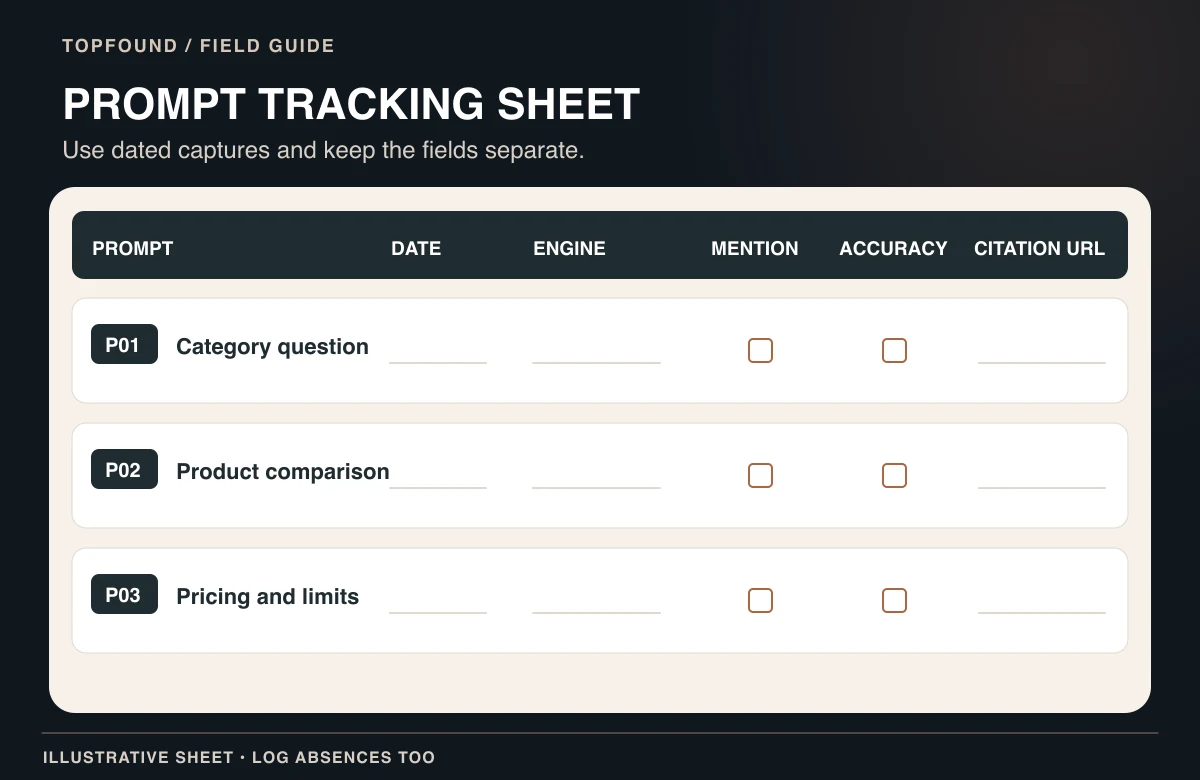
Prompt tracking loop
- Write the buyer questions once. Include category, comparison, problem, and a separate branded set.
- Pick the engines you will re-check. Say so if you only cover one.
- Log mention, accuracy, and citation URL. Log absences.
- Re-run on a weekly or monthly cadence you can staff.
- Turn misses into a backlog: pages, fact fixes, or third-party corroboration—not another unlabeled screenshot.
ChatGPT citations are one row inside LLM visibility
ChatGPT citations are the sources ChatGPT shows when it answers. They matter, and they are not the full definition of LLM visibility. A mention in ChatGPT with no link is still a mention. A citation in Perplexity does not tell you what Claude said. A Google AI Overview is a different surface again, with its own eligibility notes in Google’s docs.
Ahrefs Lite showed “chatgpt citations” at SV 100, KD 32, CPC $1.00, informational and branded. The how-to for earning those citations on ChatGPT specifically is /resources/how-to-get-cited-in-chatgpt. Keep that URL as the ChatGPT tactic page. This guide only places that tactic in the wider map: citations are one of three rows, on one of several engines.
When you report ChatGPT citations, store the prompt, the date, and the URL. Do not convert a handful of screenshots into a percentage of “the model.” If you need a competitive percentage, compute it on the frozen panel and publish it as share of voice on /blog/ai-share-of-voice—mention share and citation share kept separate.
Sources: Optimizing for generative AI features.
What to fix when models skip you or describe you wrong
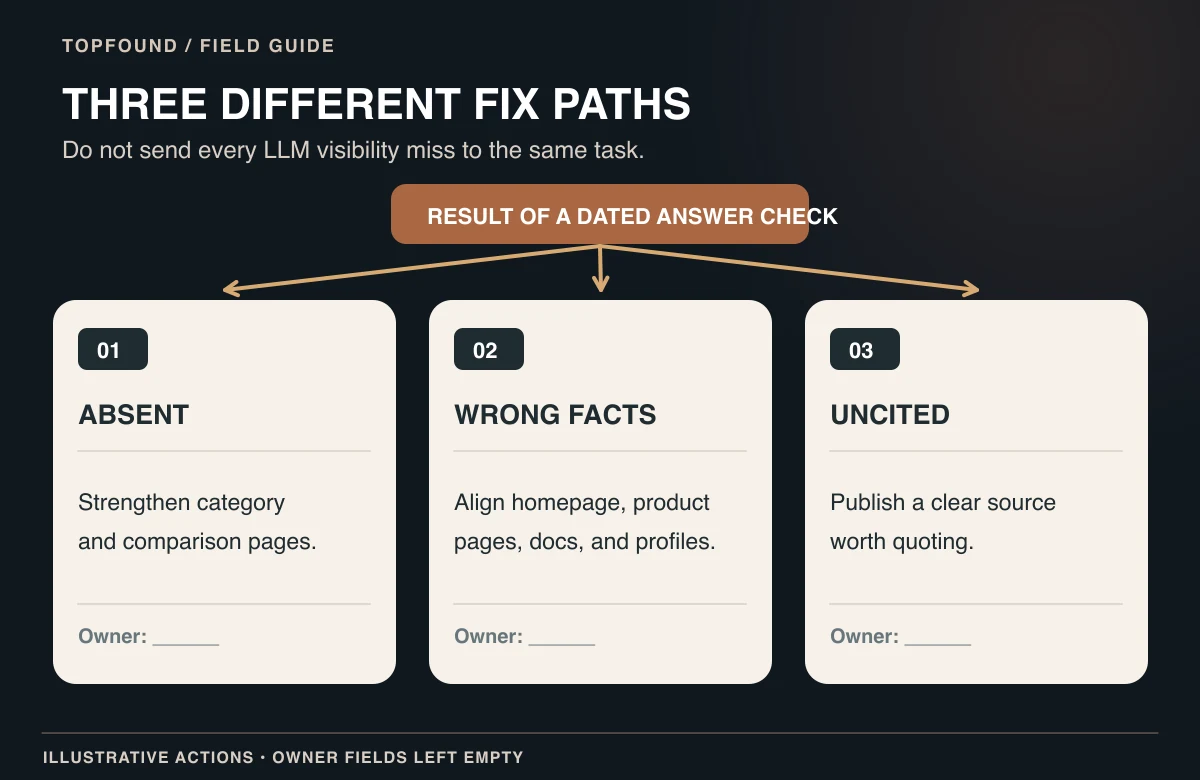
Absence and inaccuracy are different backlogs. If you are not named on non-branded comparison prompts, the usual gaps are thin comparison pages, unclear category language, and little corroboration off your own domain. If you are named but the facts are wrong—pricing, features, who you sell to—the usual gap is entity consistency. Align the public facts on the homepage, product pages, and docs, then make structured data match the visible text. The practice write-up is /blog/entity-seo-for-saas. Same-name collisions need disambiguation first; TopFound’s own lesson is /blog/what-is-topfound-entity-disambiguation.
Citation gaps are a third backlog: the model mentions you, or mentions the category, but never points at a page worth quoting. That work is extractable answers, sources assistants already trust, and the citation process on /blog/ai-citation-optimization. It is still not a promise of placement.
Put the evidence in a report someone can read. The template is /blog/ai-visibility-report. LLM visibility supplies the rows. The report supplies the decision and the owner.
Sources: Helpful, reliable, people-first content, AI features and your website.
Where managed LLM visibility optimization starts
Informational readers need the definition and the loop above. Commercial readers need a team that will ship pages, fix facts, earn corroboration, and re-check prompts. That offer is /services/llm-visibility-optimization, not a second copy of the service page on this URL.
TopFound’s public list prices, if you are pricing the agency rather than the idea, are on /pricing: Growth $797/month, Scale $1,297/month, and Custom scoped. The service page states that LLM visibility work starts from those packages. This article does not invent competitor retainers or tool prices.
A results guarantee is a contract term on qualified plans, not the definition of LLM visibility. Do not read this guide as a promise that a named assistant will cite you.
FAQ
What is LLM visibility?
It is whether large language models name your brand, describe it accurately, and cite a source you accept on the questions buyers ask. Record those as three separate facts. It is not a classic search rank and not a guaranteed recommendation.
How is LLM visibility different from SEO?
SEO visibility in Google is impressions, clicks, and position in Search Console. LLM visibility is what assistants say. A page can do well in one and be absent in the other. Keep both.
What is prompt tracking?
Prompt tracking is re-running a frozen list of buyer questions in the same assistants and logging mention, accuracy, and citation. It is how LLM visibility becomes a repeatable check instead of a screenshot.
Do ChatGPT citations equal LLM visibility?
No. ChatGPT citations are one engine’s citation row. Mentions without links still count as mentions, and Claude, Gemini, Perplexity, and Google AI features need their own rows. Tactics for ChatGPT live on /resources/how-to-get-cited-in-chatgpt.
How do we measure it?
Use /resources/how-to-measure-ai-search-visibility for the method, prompt tracking for the cadence, and /blog/ai-share-of-voice if you need a competitive percentage on a frozen panel.
Is this the same as AI share of voice?
No. LLM visibility is the concept (named, accurate, cited). AI share of voice is the ratio of a frozen panel against named competitors. That guide is /blog/ai-share-of-voice.
Can we guarantee a mention in ChatGPT or an AI Overview?
No. Google states that AI features are not guaranteed appearances. Other assistants do not offer a placement you can purchase either.
Where does TopFound fit?
TopFound (topfound.io) is a managed AEO / AI SEO agency. This page is the explainer. The offer is /services/llm-visibility-optimization. A soft next step is /aeo-report. Public plans are on /pricing (Growth $797/month, Scale $1,297/month, Custom scoped).
Make LLM visibility a checklist, not a slogan
If you want the definition, stay on this page. If you want the ratio against competitors, use the share-of-voice guide. If you want TopFound (topfound.io) to run the work, start with the service page or a free AEO report.
Conclusion
LLM visibility is the priority head for this run because buyers already ask assistants to name a product, and because Ahrefs Lite shows real demand: SV 1,200, KD 42, CPC $7.00, informational and commercial intent. KD 42 means you should expect competition. It does not mean the query belongs on a service page alone. This URL answers what the term means, how prompt tracking makes it measurable, and why ChatGPT citations are only one row.
Keep the ratio on /blog/ai-share-of-voice, the report on /blog/ai-visibility-report, engine guides on /blog/chatgpt-seo and /blog/google-ai-mode (plus Claude, Gemini, and Perplexity), and the commercial program on /services/llm-visibility-optimization. When you want that program from the agency at topfound.io, use the service page or /aeo-report—not a same-name studio elsewhere.
Sources: AI features and your website, Helpful, reliable, people-first content.