
The short answer
AI search optimization is making your site easy for Google AI Overviews, AI Mode, ChatGPT, Perplexity, and Claude to find, understand, and cite. For SaaS it runs in five layers: crawl and index eligibility, entity and content signals, a frozen prompt set, citation review, and a weekly shipping cadence. No method guarantees a citation.
Key takeaways
- Demand note (labeled, 2026-10-30 refresh): Ahrefs Lite US, 2026-10-29 — “ai search optimization” SV 4.9K / KD 22 / traffic potential 5.7K. The 2026-09-30 reading was SV 3.5K / KD 47; tool readings move between dates. Not a TopFound traffic forecast.
- Google says its AI features are rooted in core Search ranking, use retrieval plus query fan-out, and need no special files, chunking, or schema. From Google’s side, optimizing for AI search is still SEO.
- Each assistant documents its own search crawler: OAI-SearchBot (ChatGPT), Claude-SearchBot (Claude), PerplexityBot (Perplexity), and Googlebot for AI Overviews and AI Mode. Training controls are separate.
- Measurement is now partly first-party: Search Console’s Generative AI performance report (all sites since Aug 31, 2026) shows AI Overview and AI Mode impressions, and Bing Webmaster Tools’ AI Performance report (launched as a public preview Feb 10, 2026) shows Copilot citations and grounding queries.
- Foundations beat theater: if money pages are not indexable or product facts disagree across pricing, docs, and marketing, AI search optimization will stall.
- Freeze a prompt set before you optimize; otherwise you cannot tell improvement from noise.
- Use /blog/ai-search-visibility-framework for the visibility definition, /resources/how-to-measure-ai-search-visibility for measurement depth, and /services/ai-seo-services only when you want managed capacity. This post stays educational.
What buyers mean by “AI search optimization”
The query “ai search optimization” is usually an implementation question dressed as a category name. SaaS marketers and founders want a system: what to fix first, which signals matter for AI answers versus blue links, how to test whether anything changed, and how often to ship. Adjacent searches, such as “AI SEO playbook”, “how to optimize for AI search”, and “answer engine optimization playbook”, cluster around the same job. Buyers are not mainly asking for a monitoring dashboard (closer to analytics) or a definition of visibility (the sister framework article).
Demand evidence for this refresh (labeled): Ahrefs Lite US, read on 2026-10-29 in one batched Overview, lists “ai search optimization” at search volume 4.9K, keyword difficulty 22, and traffic potential 5.7K. When this page first launched on 2026-09-30, the same tool showed 3.5K and KD 47; readings move between dates, so treat both as snapshots. Google Search Console for sc-domain:topfound.io, September 30 to October 27, 2026, shows 7 clicks and 16,735 impressions at an average position of 57.5 sitewide, with “ai search analytics” at 962 impressions (position 28.0) and “google ai mode” at 1,950 impressions (position 11.6). That is why this playbook stays distinct from the analytics and AI Mode pages. These are tool and Search Console readouts, not proof of TopFound rankings or outcomes. No OpenSEO data was used, and no Ahrefs credits were spent on this refresh.
Page ownership: this URL owns the SaaS implementation playbook. /blog/ai-search-visibility-framework owns the visibility definition and framework. /resources/how-to-measure-ai-search-visibility owns measurement methods. /blog/ai-search-analytics owns the analytics category buyer guide. /services/ai-seo-services owns commercial packaging. /blog/geo-vs-aeo-vs-seo-for-saas owns the comparison decision. /blog/ai-citation-optimization owns the citation-process lens. Do not treat this post as a clone of the AI SEO services landing page.
Sources: AI features and your website, Do I need SEO?.
The five-layer AI search optimization playbook
Treat your AI search optimization strategy as a system with layers, not as a single blog sprint or a schema checkbox. Layer 1 is foundations: crawlability, indexability, and consistent product facts. Layer 2 is signals: entity clarity, technical hygiene that keeps text accessible, and answer-ready content. Layer 3 is prompt-set testing: a frozen set of buyer questions you re-run on a schedule. Layer 4 is citation and answer-quality review: did the answer name you, link you, frame you fairly, and how does that compare to named competitors? Layer 5 is cadence: a weekly shipping loop and a monthly prioritization review so observation becomes change.
These layers map to SEO, AEO, and GEO without collapsing them into one slogan. Classic SEO keeps pages eligible and competitive in Search. Answer Engine Optimization (AEO) makes answers extractable and entities unambiguous for answer surfaces. Generative Engine Optimization (GEO) adds experiments aimed at generative synthesis where your category already shows generative answers—always labeled as experiments, never as guaranteed placements. For the decision criteria among those layers, keep /blog/geo-vs-aeo-vs-seo-for-saas as the comparison URL; this playbook assumes you already chose to implement.
Google’s public guidance for AI features in Search starts from the same helpful, people-first, Search-eligible baseline that good SEO already requires. There is no special AI-only markup that guarantees an AI Overview or AI Mode appearance. Chat engines likewise choose sources per answer. The playbook improves eligibility and extractability; it does not purchase inclusion.
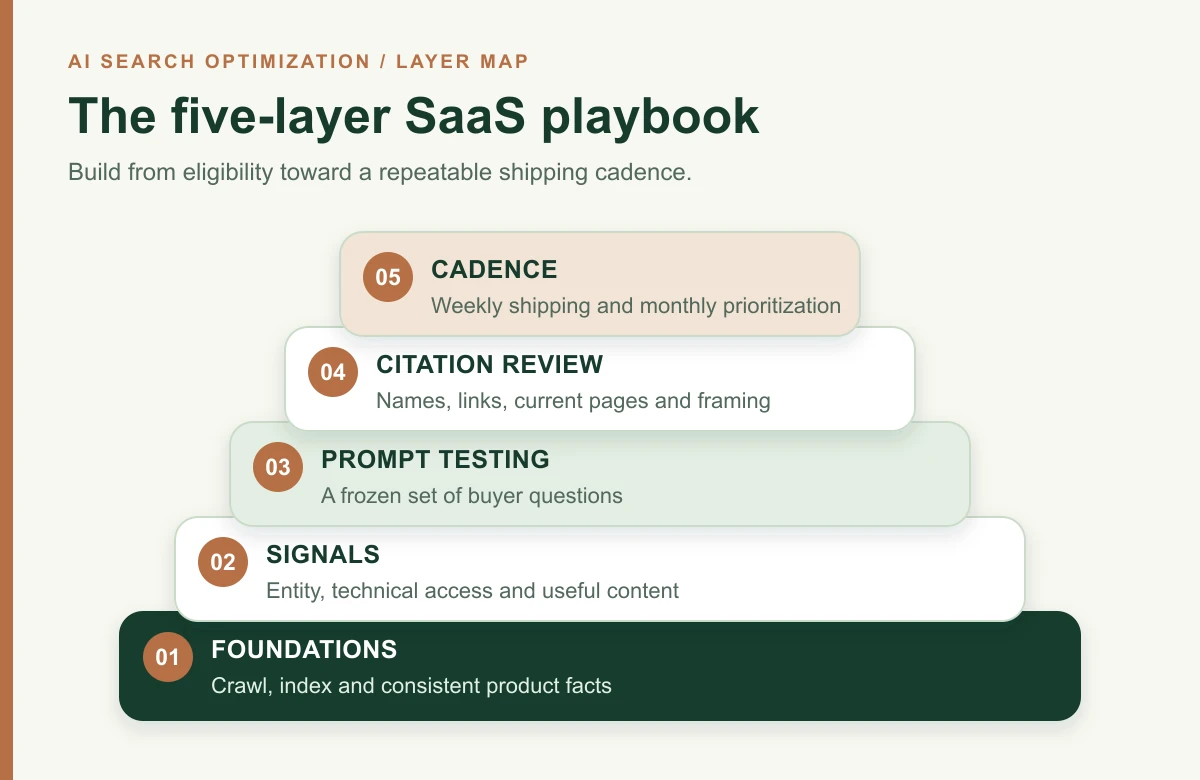
Layer → primary job → typical SaaS owners
| Layer | Primary job | Typical owners |
|---|---|---|
| 1. Foundations | Eligibility + consistent product facts | SEO + eng + product marketing |
| 2. Signals | Entity, technical access, answer-ready copy | Content + SEO + design systems |
| 3. Prompt-set testing | Frozen questions across engines | Growth/ops analyst |
| 4. Citation / answer review | Mentions vs citations vs framing | Growth + competitive intel |
| 5. Cadence | Ship weekly; re-prioritize monthly | Marketing lead + accountable strategist |
Sources: AI features and your website, Helpful, reliable, people-first content, Optimizing for generative AI features.
How AI search engines choose sources in 2026
AI search optimization starts with a plain fact: every major AI search product retrieves web pages before it writes an answer, and each vendor documents how its crawler finds them. If the right crawler cannot reach a page, nothing else in this playbook matters for that engine.
Google. Google’s guide to generative AI features says AI Overviews and AI Mode are rooted in its core Search ranking and quality systems. They use retrieval-augmented generation (grounding) to pull pages from the Search index, and query fan-out, a set of related searches the model issues to gather more results. A page must be indexed and eligible to show with a snippet. There are no additional technical requirements. Since August 31, 2026, every Search Console property also has a Search generative AI control: Include, the default, or Exclude from AI Overviews, AI Mode, and generative AI in Discover. Google says it is not a ranking signal for the rest of Search and does not control training; Google-Extended does that.
ChatGPT, Claude, and Perplexity. OpenAI says OAI-SearchBot surfaces sites in ChatGPT’s search features and that sites opted out of it will not appear in ChatGPT search answers; GPTBot is a separate training crawler, and the settings are independent. Anthropic lists Claude-SearchBot for search indexing, Claude-User for user-initiated retrieval, and ClaudeBot for training. Perplexity says PerplexityBot surfaces and links sites in its results and is not used to train foundation models. The hands-on, engine-by-engine version of this is on /blog/llm-seo.
Microsoft Copilot and Bing. Microsoft has not been part of most AI search optimization checklists, but on February 10, 2026 it launched AI Performance in Bing Webmaster Tools as a public preview. It reports how often your pages are cited in Copilot, AI-generated summaries in Bing, and select partner experiences, with the grounding queries behind those citations. Microsoft says Bing respects robots.txt and other supported controls.
AI search optimization by engine (vendor docs, checked Oct 29–30, 2026)
| Engine | Retrieval crawler or index | Training control | First-party site report |
|---|---|---|---|
| Google AI Overviews and AI Mode | Googlebot (Search index) | Google-Extended token | Search Console Generative AI performance report (impressions) |
| ChatGPT | OAI-SearchBot | GPTBot | None documented; use referrals and a prompt log |
| Claude | Claude-SearchBot | ClaudeBot | None documented; use referrals and a prompt log |
| Perplexity | PerplexityBot | Not used for training, per Perplexity | None documented; use referrals and a prompt log |
| Microsoft Copilot and Bing | Bing index (robots.txt respected) | Not covered here | Bing Webmaster Tools AI Performance (citations, grounding queries) |
Sources: Optimizing for generative AI features, AI features and your website, Search Console Help: Search generative AI control (fetched Oct 30, 2026), OpenAI: Overview of OpenAI crawlers (fetched Oct 30, 2026), Claude Help Center: Does Anthropic crawl data from the web? (Apr 7, 2026; checked Oct 29, 2026), Perplexity Docs: Perplexity Crawlers (checked Oct 29, 2026), Bing Webmaster Blog: Introducing AI Performance in Bing Webmaster Tools (Feb 10, 2026).
What AI search optimization does not need, according to Google
A lot of AI search optimization advice sells shortcuts. Google’s own guide lists several things you can ignore for Google Search, and it is worth knowing them before you spend a sprint on them.
The guide also draws one hard line. Creating separate pages for every variation of a query, including the fan-out queries a model might issue, mainly to manipulate rankings or AI responses, violates Google’s scaled content abuse spam policy. Build one strong page per topic instead. Google also notes that AEO and GEO advice should be judged like any third-party SEO advice, because from its side optimizing for generative AI search is still SEO.
AI search optimization myths vs Google’s guidance (fetched Oct 30, 2026)
| Myth | What Google says |
|---|---|
| You need llms.txt or special AI files | Google Search doesn’t use them; they neither help nor harm in Google |
| Chunk content into tiny pieces | Not required; Google can understand multiple topics on a page |
| Rewrite everything in an “AI style” | Not needed; AI systems understand synonyms and meaning |
| Seed mentions across forums | Inauthentic mentions aren’t as helpful as they might seem |
| Add special schema for AI | No special schema.org markup is needed; structured data still helps rich results |
| One page per fan-out query | Can violate the scaled content abuse policy |
Sources: Optimizing for generative AI features, AI features and your website.
Layer 1 — Foundations: eligibility and product-fact integrity
Start where AI search optimization most often fails quietly: pages that cannot be retrieved, and product facts that disagree with themselves. If a money page is blocked, soft-404s, cloaked, or trapped behind an uncrawlable client render with no meaningful HTML text, you are not doing AI search optimization—you are decorating an ineligible URL. Google’s AI-features documentation still assumes Search eligibility and snippet eligibility for AI Overviews and AI Mode consideration.
Build a foundation checklist for SaaS money surfaces: homepage positioning, product overview, pricing, comparison/alternatives hubs, integration pages, and the docs that answer “how does X work?” Confirm indexation status, canonical consistency, and that the primary answer lives in crawlable text—not only in an image or a gated PDF. Pair that with a product-facts inventory: official product name, category phrase, pricing model language, key limits, supported regions, and “who it is for / not for.” Those facts must match across marketing, pricing, docs, and About. Contradiction is not a branding flourish; it is a retrieval hazard.
Foundation work is deliberately boring. It is also the highest-leverage first month for teams that jumped straight to “write for ChatGPT” without fixing crawl and consistency. If leadership wants AI-answer theater while Search Console still shows coverage failures on commercial URLs, pause generative experiments and repair eligibility first.
Foundation sprint (first two weeks)
- List money URLs and confirm indexability / crawl access for each.
- Check robots.txt and your CDN or firewall for Googlebot, OAI-SearchBot, Claude-SearchBot, and PerplexityBot, and decide training crawlers separately.
- In Search Console, confirm Settings > Search generative AI is set to Include.
- Export a one-page product-facts table and reconcile pricing, docs, and marketing language.
- Fix the worst eligibility blockers before launching a content-only AI sprint.
- Document what remains out of scope (legacy app routes, partner microsites, etc.).
Sources: AI features and your website, Do I need SEO?, Helpful, reliable, people-first content.
Layer 2 — Entity, technical, and content signals
Once foundations hold, optimize the signals models and crawlers can actually use. Entity signals: one primary company name, consistent product naming, disambiguation when your brand collides with another meaning, and a clear About / llm-info style identity page that states what you are in plain language. Technical signals: HTML-visible answers, sane internal links among comparison and docs pages, robots and bot-policy decisions that match your discovery intent, and structured data that mirrors visible copy rather than inventing claims. Content signals: direct answers near the top, dated evidence, worked examples labeled illustrative when not measured, and visible limits so extractors do not invent guarantees you never made.
Structured data is a clarity tool, not a coercion tool. Google’s structured-data introduction requires markup to match visible content; Google’s AI-features guidance states there is no special schema requirement that ensures AI Overview appearance. If your schema describes a product that the HTML does not, you have created risk without improving answer quality.
For citation-oriented evidence design (source selection, answer-ready stacks, entity clarity as a citation lever), deepen with /blog/ai-citation-optimization. For image-level extractability when diagrams teach the product, pair with /blog/image-seo-for-ai-search. This layer’s job in the playbook is sequencing: ship entity and content signal fixes on the same URLs you already made eligible.
Off-site signals belong here too. Google’s guide says its AI features can show what is said about products in blogs, videos, and forum discussions, and warns that seeking inauthentic mentions is not as helpful as it might seem. Earn real corroboration: reviews, fair comparisons, and honest participation in the communities your buyers read. /blog/reddit-seo covers the Reddit side of that, including Reddit’s own rules for brands.
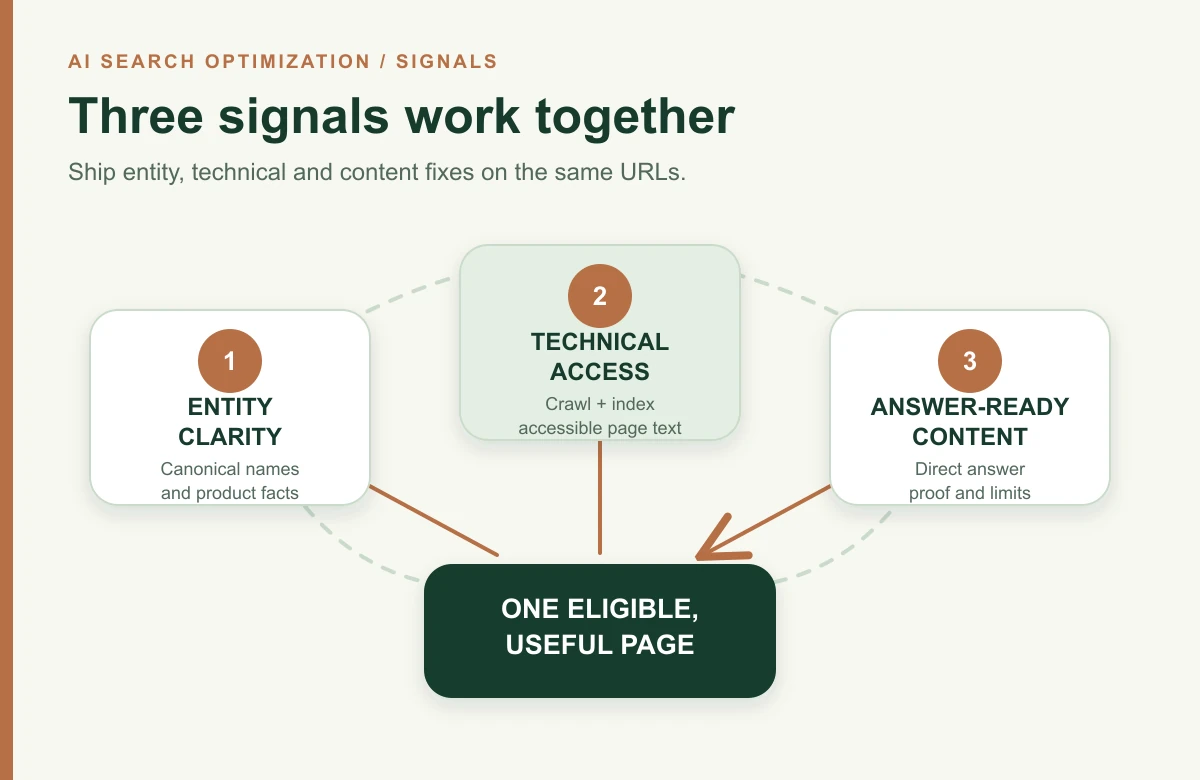
Signal class → what to ship → what not to claim
| Signal class | Ship | Do not claim |
|---|---|---|
| Entity | Naming table + About / identity consistency | “Schema will make ChatGPT cite us” |
| Technical | Crawlable HTML answers + bot-policy clarity | “Blocking one bot secretly boosts another” |
| Content | Direct answer + proof + limits on money pages | “One blog guarantees AI Overview inclusion” |
Sources: Intro to structured data, Optimizing for generative AI features, Helpful, reliable, people-first content.
Layer 3 — Prompt-set testing without moving goalposts
AI search optimization without a frozen prompt set is storytelling. Build 30–50 prompts that mirror real buyer language: category (“best X for Y”), comparison (“X vs Z”), alternative (“tools like X”), troubleshooting, pricing/model questions, and identity (“what is [brand]”). Freeze engines and locales you care about. Re-run on a fixed cadence. Capture whether the brand was named, whether a URL was cited, how the answer framed you, and which competitors appeared.
Do not silently swap prompts every week to chase a friendlier sample. If a prompt becomes obsolete because you exited a market, retire it with a dated note and replace it deliberately. Volatility across engines is normal; treat single-day absences as data points, not crises. For the deeper method definitions of each measurement row, send operators to /resources/how-to-measure-ai-search-visibility—this playbook only requires that testing exists so optimization has a feedback loop.
Keep analytics-platform shopping separate. If the question is which AI search analytics category tools to buy, use /blog/ai-search-analytics. If the question is how to run the tests that feed this playbook, keep a lightweight prompt log—even a spreadsheet—before buying software.
Use first-party data to seed and check the set. Search Console’s Generative AI performance report shows which of your pages earned impressions in AI Overviews and AI Mode, by country, device, and date, though Google documents no query dimension. Bing Webmaster Tools’ AI Performance report lists grounding queries behind Copilot citations. Neither replaces the prompt log, because neither shows competitors or answer text. The Google-specific method is on /blog/ai-overview-tracking; tracking ChatGPT, Claude, and Perplexity is covered on /blog/llm-visibility.
Minimum viable prompt-set protocol
- Write the prompt list from sales/support language, not invented head terms.
- Freeze engines, locales, and capture fields (mention / citation / framing / competitors).
- Schedule re-runs (weekly for active sprints; biweekly minimum).
- Change the set only with a dated changelog.
Sources: AI features and your website, Search Console Help: Generative AI performance report (Search) (fetched Oct 30, 2026), Bing Webmaster Blog: Introducing AI Performance in Bing Webmaster Tools (Feb 10, 2026).
Layer 4 — Citation and answer-quality review
After each test pass, review quality—not vanity. A mention without a citation is different from a linked source. A citation to an outdated pricing page is different from a citation to the current docs. A fair competitive frame (“X is strong for mid-market”) is different from a dismissive or incorrect frame. Log these as separate observations so you know which lever to pull: on-site answer rewrite, entity fix, corroboration on domains that already get cited, or technical eligibility.
Answer-quality review also catches self-inflicted damage: pages that over-promise, omit limits, or contradict pricing. Generative systems can amplify those mistakes. Prefer extractable honesty—what the product does, for whom, and where it stops—over adjective stacks. Pair this layer with /blog/ai-citation-optimization when the backlog is specifically citation odds, and with /resources/ai-citations-vs-brand-mentions-vs-referrals when stakeholders conflate those rows.
Competitive share of answers on the frozen set is a useful prioritization signal: if three competitors dominate comparison prompts, prioritize comparison hubs and corroboration before publishing another top-of-funnel explainer. That is optimization sequencing, not a claim that share-of-answer is a universal KPI.
Sources: AI features and your website, Helpful, reliable, people-first content.
Layer 5 — Optimization cadence: weekly ship, monthly prioritize
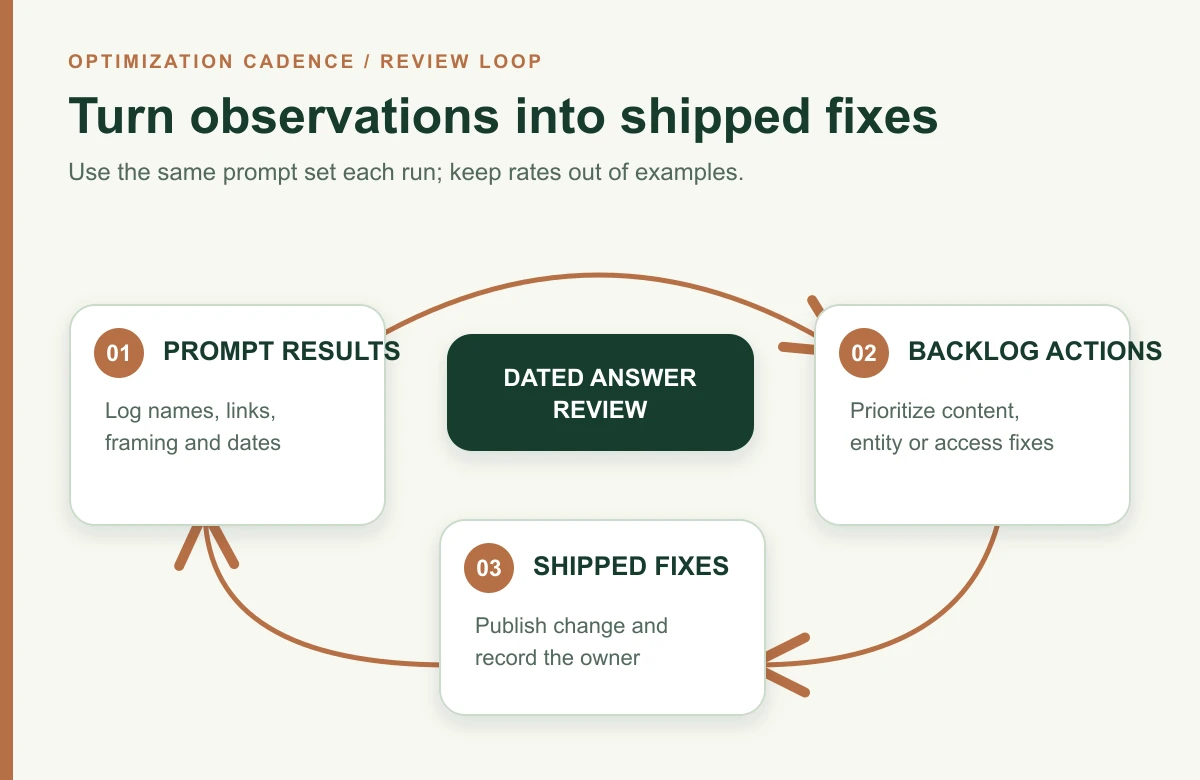
Cadence turns the playbook into an operating system. Weekly: re-run (or sample) the prompt set, pick one to three shippable fixes, publish or merge them, and note blockers. Monthly: re-rank the backlog by competitive gaps and business impact, retire obsolete prompts, and review whether foundations still hold after product launches. Quarterly: revisit engine scope and whether you still need more monitoring capacity versus more execution capacity—see /blog/aeo-agency-vs-ai-visibility-tools for that decision.
A healthy weekly artifact set is small: prompt log update, shipped URL list, open eligibility tickets, and a short “what we will not claim” note. Avoid composite “AI scores” that hide which layer failed. Leadership can still get an executive summary—as long as the underlying rows remain separable.
When in-house owners cannot keep cadence, managed AI SEO / AEO capacity is a staffing decision, not a metric invention. Soft path: /services/ai-seo-services and /services/aeo-services for program details; this article remains the playbook.
Cadence → meeting focus → done definition
| Cadence | Focus | Done when |
|---|---|---|
| Weekly | Ship fixes from last review | ≥1 eligibility or answer-ready change live |
| Biweekly test | Prompt-set re-run | Dated log with mention/citation/framing fields |
| Monthly | Reprioritize backlog | Ranked list tied to competitive gaps |
| Quarterly | Capacity decision | Keep, tool-up, or hire—with owners named |
Worked example: a 60-day SaaS AI search optimization sprint
Scenario (illustrative only—not a TopFound client case study; invents no before/after traffic, citation rates, or revenue): A mid-market B2B SaaS team notices sales prospects quoting AI answers that recommend two competitors and omit their product on “best tools for [category]” prompts. Search eligibility on the pricing and comparison pages is healthy. Docs are strong but marketing pages lead with adjectives and bury limits.
Days 1–14: Freeze 40 prompts across category, comparison, and pricing questions. Confirm indexation on pricing, product, and two comparison URLs. Publish a product-facts table. Rewrite the product overview with a direct answer, proof points, and a visible “not for” section. Align pricing page language with the facts table.
Days 15–45: Run biweekly prompt tests. Build one comparison hub that states fair criteria. Fix an entity collision on the About page. Add HTML-visible captions under product diagrams. Open a corroboration backlog for review sites that already appear as citations when the brand is absent—without inventing fake reviews.
Days 46–60: Monthly prioritization ranks remaining gaps. The team keeps the prompt set frozen, ships two more answer-ready pages, and decides whether to keep cadence in-house or add managed capacity. No one claims a guaranteed ChatGPT citation as the sprint goal; the done definition is eligibility integrity, shipped answer-ready pages, and a living test log.
Sprint done definition
- Frozen prompt set with changelog.
- Money URLs eligibility-checked.
- At least three answer-ready ships with visible limits.
- Separate mention/citation/framing log—no blended vanity score.
How TopFound fits (soft CTA, not a landing page)
TopFound (topfound.io) is a human-managed AEO and AI SEO agency. Public plans include Growth at $797/mo and Scale at $1,297/mo; Custom plans are scoped individually. Qualified Growth and Scale clients get TopFound’s published 90-day offer on qualified organic and AI traffic against a documented baseline, or work continues free until that outcome lands under the stated conditions. Those are orientation facts—not invented case metrics and not a substitute for /services/ai-seo-services.
If you need the visibility definition layer next, continue to /blog/ai-search-visibility-framework. If you need measurement methods, continue to /resources/how-to-measure-ai-search-visibility. If you need managed implementation capacity after you understand the playbook, continue to /services/ai-seo-services or book a baseline via /aeo-report.
Honest limits of AI search optimization
No playbook controls model outputs. Eligible, helpful pages can still be omitted. AI Overviews can appear for a query one day and not the next.
KD 22 on Ahrefs Lite (US, 2026-10-29) for “ai search optimization” is moderate, and the September reading was KD 47. Difficulty scores move between readings, so treat them as speed expectations, not as a reason to invent shortcuts.
Google Trends for this refresh is pending a browser check and is a secondary signal only. Demand data never authorizes fabricated traffic forecasts.
First-party reports are partial. Search Console’s Generative AI report shows impressions without queries or competitors, and Bing’s AI Performance data is aggregated and sampled. Neither proves an answer described you correctly.
Schema, llms.txt, and bot-policy files are tools with scoped jobs; none of them guarantee generative citations. Keep /blog/what-is-llms-txt for discovery-file honesty.
Sources: AI features and your website, Optimizing for generative AI features, Intro to structured data.
FAQ
What is AI search optimization?
AI search optimization is making your site easy for Google AI Overviews, AI Mode, ChatGPT, Perplexity, and Claude to find, understand, and cite, through eligibility, entity and content signals, prompt testing, citation review, and a steady shipping cadence.
Is AI search optimization the same as SEO, AEO, or GEO?
Google’s view is that optimizing for its AI features is still SEO. AEO stresses answer-ready pages and GEO stresses generative engines; this playbook implements across all three. See /blog/geo-vs-aeo-vs-seo-for-saas for the decision criteria.
Which crawlers should I allow for AI search optimization?
Allow the search crawlers: Googlebot (AI Overviews and AI Mode), OAI-SearchBot (ChatGPT), Claude-SearchBot (Claude), and PerplexityBot (Perplexity). Training crawlers such as GPTBot and ClaudeBot, and the Google-Extended token, are separate choices.
Do I need llms.txt or special schema for AI search?
Not for Google. Google says Search ignores llms.txt and needs no special schema for AI features. Structured data still helps rich results, and other systems may read llms.txt, so treat both as optional.
How do I measure AI search optimization?
Combine Search Console’s Generative AI performance report, Bing Webmaster Tools’ AI Performance report, AI referrals in analytics, and a frozen, dated prompt log. Keep mentions, citations, and clicks as separate rows. Method depth is on /resources/how-to-measure-ai-search-visibility.
How is this different from AI search visibility?
Visibility is the outcome: where and how you appear. Optimization is the system that tries to improve it. Read /blog/ai-search-visibility-framework for the definition layer.
Can AI search optimization guarantee ChatGPT citations?
No. Google says appearance in AI features is not guaranteed, and chat engines choose sources per answer. Optimize eligibility and extractability, and refuse citation quotas.
Where does TopFound fit?
TopFound (topfound.io) is a managed AEO / AI SEO agency. This playbook is educational; program details live on /services/ai-seo-services and /blog/aeo-services helps you evaluate any agency. A soft next step is /aeo-report.
Run the playbook, then choose capacity
Use this SaaS playbook to establish foundations, ship signals, test prompts, and keep a cadence. When you want a visibility definition layer, measurement depth, or managed AI SEO capacity, use the soft paths below—without treating this article as a second service landing page.
Conclusion
AI search optimization for SaaS is a five-layer system: foundations, signals, prompt-set testing, citation and answer-quality review, and a shipping cadence. In 2026 the ground rules are clearer than they were: Google says its AI features run on core Search ranking and need no special files, each assistant documents its own search crawler, and Google and Bing now give site owners first-party AI reports. Demand is real too: Ahrefs Lite US lists “ai search optimization” at 4.9K searches a month (KD 22, read 2026-10-29), a labeled tool readout rather than a promise.
Ship eligibility and product-fact integrity first. Add entity, technical, and answer-ready signals. Freeze prompts so you can tell change from noise. Review mentions, citations, and framing as separate rows. Keep cadence weekly. For the companion AI search visibility framework, continue to /blog/ai-search-visibility-framework. For measurement depth, continue to /resources/how-to-measure-ai-search-visibility. For citation-process depth, continue to /blog/ai-citation-optimization. For the engine-by-engine crawler work, continue to /blog/llm-seo. When you need managed capacity, continue softly to /services/ai-seo-services (and evaluate retainers via /blog/aeo-services)—and keep Google’s limit in view: helpful, eligible content can be considered; nothing guarantees a citation.
Sources: AI features and your website, Helpful, reliable, people-first content.