The short answer
ChatGPT ads are paid, clearly labeled placements that OpenAI shows below ChatGPT responses to logged-in adults on the Free and Go plans. Advertisers buy them in Ads Manager by views, clicks, or conversions. OpenAI says ads run on separate systems and do not influence ChatGPT’s answers, so organic citations still have to be earned.
Key takeaways
- Demand note (labeled, 2026-10-29 lock): Ahrefs Lite US — “chatgpt ads” SV 7.6K / KD 9; “perplexity ads” SV 250. Tool readouts, not a TopFound traffic forecast.
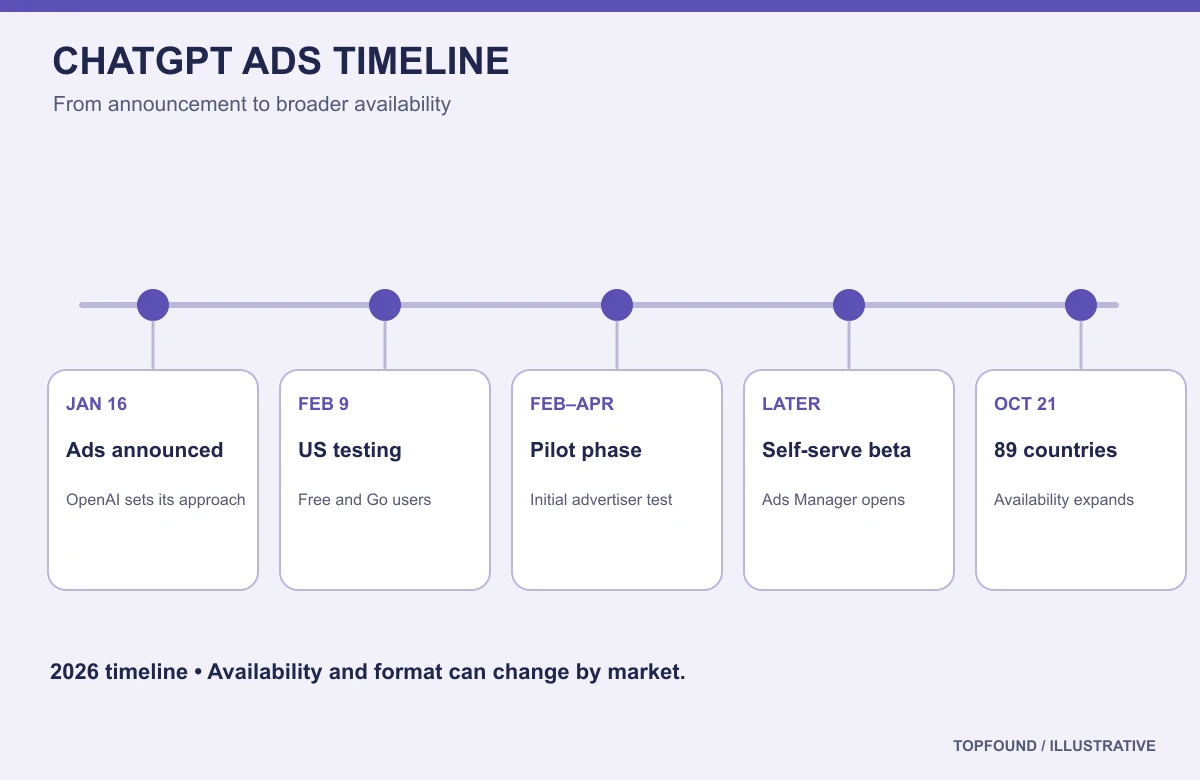
- Timeline from OpenAI: ads announced January 16, 2026; testing started in the US on February 9, 2026; a pilot ran February–April; self-serve Ads Manager Beta followed; on October 21, 2026 OpenAI said ads were available in 89 countries.
- Who sees ChatGPT ads: Free and Go users. OpenAI says Plus, Pro, Business, Enterprise, and Edu accounts have no ads, and accounts identified as under 18 do not see them.
- Format: one labeled ad unit below a response (advertiser name, favicon, title, copy, image, landing page). OpenAI is also testing a multi-image ad during image generation.
- OpenAI’s stated rule is answer independence: advertisers cannot shape, rank, or alter ChatGPT’s responses. Paid placement and organic citation are separate jobs.
- Perplexity ads were sponsored follow-up questions launched in November 2024. In February 2026, Search Engine Land, citing the Financial Times, reported that Perplexity had phased them out.
Who this guide is for
This guide is for SaaS founders, growth marketers, and paid media leads who have heard that ChatGPT now runs ads and want to know what that means in practice: what the ad looks like, who sees it, how it is bought, what it is not allowed to do, and how it relates to being recommended inside ChatGPT’s actual answer.
Every product detail on this page comes from OpenAI’s own Help Center, policy pages, and announcements, fetched on October 29, 2026. ChatGPT Ads is in beta and OpenAI says formats, inventory, and buying options will keep changing, so treat each fact as dated. Where OpenAI has not published something, we say so instead of guessing.
Page ownership: this URL owns ChatGPT ads and AI-assistant advertising as a topic, with Perplexity ads as a secondary section. Organic ChatGPT visibility is on /blog/chatgpt-seo. Cross-engine citation work is on /blog/ai-citation-optimization. Measurement is on /blog/ai-search-analytics.
What are ChatGPT ads?
ChatGPT ads are sponsored units that OpenAI places in ChatGPT, separate from the model’s response. OpenAI describes them as a way for businesses to reach people “as they explore, compare, and decide” inside a conversation. The ad is chosen by a separate ads system, labeled as sponsored, and shown below the answer, not inside it. In short, ChatGPT advertising buys a slot next to the conversation, not a say in the reply.
That separation is the most important thing to understand. In its January 16, 2026 announcement, OpenAI listed “answer independence” as a core principle: ads do not influence the answers ChatGPT gives. The Help Center repeats it in plain terms: ads run on separate systems from the chat model, and advertisers have no ability to shape, rank, or alter ChatGPT’s responses. Seeing an ad does not mean OpenAI endorses the advertiser.
Sources: OpenAI: Our approach to advertising and expanding access to ChatGPT (Jan 16, 2026), OpenAI Help Center: Ads in ChatGPT (fetched Oct 29, 2026), OpenAI Help Center: Ads in ChatGPT — The Basics (fetched Oct 29, 2026).
ChatGPT ads timeline and availability (as of October 29, 2026)
OpenAI announced its plan to test ads on January 16, 2026, alongside the US launch of the ChatGPT Go plan. Its Help Center says ad testing started in the United States on February 9, 2026. The advertiser FAQ describes a focused pilot from February through April, followed by self-serve onboarding in Ads Manager Beta.
On October 21, 2026, OpenAI announced expansion to 26 more countries, bringing ChatGPT Ads to 89 countries, and said more than 100,000 advertisers had run campaigns since launch. Those are OpenAI’s figures. OpenAI has not published click-through rates, conversion rates, or cost benchmarks; its own FAQ says the platform does not yet have performance benchmarks across advertisers or industries.
Availability has two sides. On the user side, OpenAI says ads roll out gradually to eligible Free and Go users in select regions. On the advertiser side, self-serve access depends on the country where the advertising legal entity is based, and some new markets start through the OpenAI Ads team or agency and technology partners. Check the Ads Manager Availability page before you plan a launch.
ChatGPT ads timeline (from OpenAI’s own pages)
| Date | What OpenAI said | Source |
|---|---|---|
| Jan 16, 2026 | Plans to test ads for Free and Go in the US; ads principles published | OpenAI announcement |
| Feb 9, 2026 | Ad testing started in the United States | Help Center: Ads in ChatGPT |
| Feb–Apr 2026 | Focused pilot, then self-serve Ads Manager Beta | Help Center: Ads FAQ |
| Mar–Sep 2026 | Ad policies v1.0 (March) through v1.6 (September) | OpenAI ad policies changelog |
| Oct 21, 2026 | Available in 89 countries; 100,000+ advertisers have run campaigns | OpenAI announcement |
Sources: OpenAI: Our approach to advertising and expanding access to ChatGPT (Jan 16, 2026), OpenAI Help Center: Ads in ChatGPT (fetched Oct 29, 2026), OpenAI Help Center: ChatGPT Ads frequently asked questions (fetched Oct 29, 2026), OpenAI: ChatGPT Ads expands to 26 new countries (Oct 21, 2026), OpenAI Help Center: Ads Manager Availability.
Who sees ChatGPT ads, and who does not
Ads may appear for users on the Free and Go plans. OpenAI says Plus, Pro, Business, Enterprise, and Edu accounts do not have ads. Accounts identified as belonging to people under 18, based on stated age and age prediction, do not see ads, and Temporary Chats show no ads. Free users can also switch to an Ads-Free option that removes ads in exchange for lower message limits and fewer tools.
For B2B SaaS marketers this matters. Many of the people you most want to reach, such as buyers at companies on ChatGPT Business or Enterprise, are on plans that OpenAI says will not show ads. Your paid reach in ChatGPT is limited to the share of your audience on Free and Go plans, in regions where ads run. The organic answer, on the other hand, is shown to every plan.
ChatGPT plan vs ad exposure (per OpenAI Help Center, Oct 29, 2026)
| Plan or context | Ads shown? |
|---|---|
| Free (ad-supported) | Yes, where ads are available |
| Go | Yes, where ads are available |
| Free with Ads-Free option | No (lower limits) |
| Plus, Pro | No |
| Business, Enterprise, Edu | No |
| Accounts identified as under 18 | No |
| Temporary Chats | No |
| Sensitive chats (health, mental health, politics) | No |
Sources: OpenAI Help Center: Ads in ChatGPT (fetched Oct 29, 2026), OpenAI Help Center: Ads in ChatGPT — The Basics (fetched Oct 29, 2026), OpenAI: ChatGPT Ads expands to 26 new countries (Oct 21, 2026).
ChatGPT ad format: what the unit contains
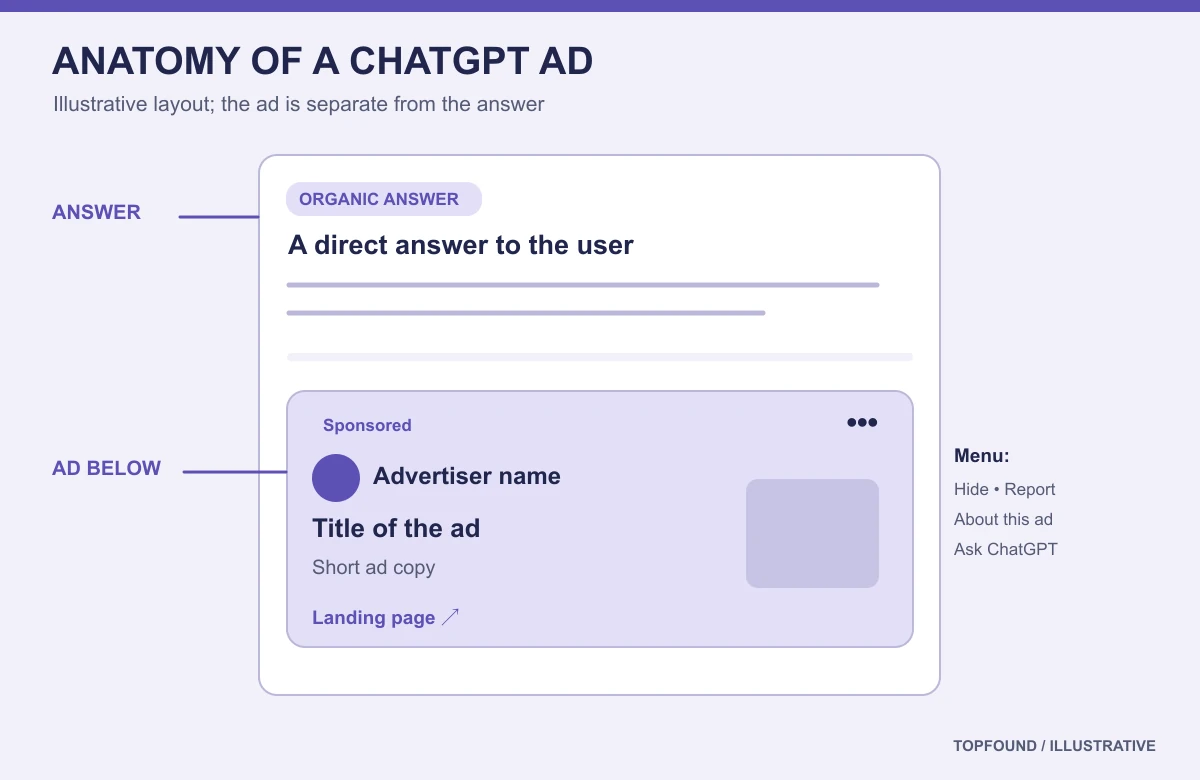
OpenAI’s advertiser basics page lists six parts of a ChatGPT ad: advertiser name, favicon, title, copy, landing page, and an image asset. The unit appears below a ChatGPT response, and OpenAI says a user sees one ad unit at a time, which may contain one or several images. OpenAI is also testing a multi-image visual ad that appears while ChatGPT generates an image and disappears when the image is done.
Users can open a menu on the ad to hide it, report it, see why it was shown, or choose “Ask ChatGPT,” which shares that specific ad into the chat so the user can ask about it. OpenAI notes that by default ChatGPT cannot see the ads a user is shown, and that advertisers do not influence ChatGPT’s responses about an ad shared this way. OpenAI’s January post also described a future where users could ask an advertiser questions directly; the Help Center now says that if a user messages an advertiser through an ad, the advertiser sees only those messages.
Sources: OpenAI Help Center: Ads in ChatGPT — The Basics (fetched Oct 29, 2026), OpenAI Help Center: Ads in ChatGPT (fetched Oct 29, 2026), OpenAI: Our approach to advertising and expanding access to ChatGPT (Jan 16, 2026).
How ChatGPT ads work: matching, bidding, and measurement
Matching is contextual first. OpenAI says its ads system weighs the context and intent of the current conversation, the ad’s landing page, title, and copy, and advertiser-provided “context hints.” When a user has ads personalization on, select signals from their wider ChatGPT use, including past chats and memory, can also count. Personalized ads were not initially offered in the European Economic Area or Switzerland.
Context hints are not keywords. OpenAI says they describe the conversations, topics, or keywords where a product may be relevant, but they are not exact-match keywords and do not guarantee delivery in a given conversation. That is a real difference from search ads: you describe a situation, and the system decides when the conversation fits.
Buying works through OpenAI Ads Manager, currently in beta as Ads Manager Beta. Advertisers choose Views (impression-based), Clicks, or Conversions as a goal; conversion-optimized campaigns with click billing charge for valid clicks, not conversions. Bids are set per ad group as a maximum CPM or CPC, and OpenAI says it uses a relevance-weighted, second-price auction. For CPC campaigns, OpenAI’s own guidance suggests starting with a maximum bid of $3–$5 per click. That is OpenAI’s published starting suggestion, not a TopFound benchmark.
Reporting in Ads Manager Beta covers impressions, clicks, spend, CTR, average CPC, average CPM, and conversions. Advertisers can add UTM parameters to landing page URLs to track ChatGPT ad traffic in their own analytics. OpenAI also notes that ad-review crawlers visit submitted landing pages; OpenAI’s crawler documentation names this bot OAI-AdsBot and says its data is not used to train foundation models.
ChatGPT ads buying options (per OpenAI, Oct 29, 2026)
| Goal | Billing | Bid set at ad group |
|---|---|---|
| Views (Reach) | Impressions | Maximum CPM |
| Clicks | Valid clicks | Maximum CPC |
| Conversions (oCPC) | Valid clicks, optimized toward a conversion event | Per OpenAI’s conversion-optimized campaign rules |
A sensible first ChatGPT ads test
- Confirm your legal entity’s country is listed as self-serve on the Ads Manager Availability page.
- Check your category against OpenAI’s ad policies before building creative.
- Write context hints that describe real buyer situations, not a keyword dump.
- Point the ad at a landing page that answers the question the conversation raised, with UTM parameters.
- Set up conversion measurement in Ads Manager Beta, then compare with your own analytics.
- Judge results on your own data; OpenAI says there are no cross-advertiser benchmarks yet.
Sources: OpenAI Help Center: Ads in ChatGPT — The Basics (fetched Oct 29, 2026), OpenAI Help Center: Ads in ChatGPT (fetched Oct 29, 2026), OpenAI Help Center: ChatGPT Ads frequently asked questions (fetched Oct 29, 2026), OpenAI: Overview of OpenAI crawlers.
ChatGPT ads policies: what is allowed
OpenAI’s ad policies (updated September 10, 2026) set three layers of rules. Placement rules keep ads away from sensitive or brand-unsafe conversations, including mental and personal health, politics, and self-harm. Content rules define which categories can advertise. Advertiser rules cover identity, trustworthiness, and eligibility.
During the initial test period, OpenAI says ads are primarily limited to consumer verticals: lifestyle and household goods, local services, travel and experiences, and digital products or education. Financial services, healthcare and medicine, and legal services are being rolled out gradually in the US for approved advertisers, reviewed case by case. Political ads, gambling, adult content, alcohol and tobacco, and recreational drugs are disallowed.
What this means for B2B SaaS is not fully spelled out. OpenAI lists “digital products” among supported categories, but the policy page does not say whether business software sold to companies is treated the same as consumer digital products. We could not confirm that from OpenAI’s pages on October 29, 2026. If you sell B2B software, check the current policy and expect ad review to decide.
Every ad must also be truthful, must not imitate the ChatGPT interface, and must link to a landing page that matches the ad. OpenAI reviews the advertiser, the creative, the landing page, and the placement, mostly with automated systems plus human review for higher-risk cases.
ChatGPT ad categories (summary of OpenAI ad policies, v1.6)
| Status | Examples from the policy |
|---|---|
| Primarily supported in the test | Lifestyle and household goods, local services, travel and experiences, digital products or education |
| Restricted, US case by case | Financial services, healthcare and medicine, legal services (licensed) |
| Disallowed | Political content, gambling, adult content, alcohol and tobacco, recreational drugs, counterfeit goods |
| Never placed near | Mental and personal health chats, politics, self-harm, and other sensitive contexts |
Sources: OpenAI: Ad policies (updated Sept 10, 2026), OpenAI Help Center: Ads in ChatGPT (fetched Oct 29, 2026).
ChatGPT ads vs organic AI citations
A ChatGPT ad and a ChatGPT citation are different things produced by different systems. The ad is a paid unit chosen by OpenAI’s ads system and shown below the answer. A citation is a source link inside the answer, which ChatGPT search draws from pages it can retrieve. OpenAI’s crawler documentation says OAI-SearchBot is used to surface websites in ChatGPT search, and that sites opted out of OAI-SearchBot will not be shown in ChatGPT search answers.
Because OpenAI says ads do not influence answers, buying ads does not make ChatGPT more likely to name your product in its response. The reverse also holds in Google’s case: Google’s Ads Help says paid ads do not influence organic AI Overviews or AI Mode responses, and whether a site is cited organically does not affect its ad auction eligibility. OpenAI has not published an equivalent statement about organic citations and ad auctions, so we do not assume one.
So the two channels answer different questions. Ads answer “can we put an offer in front of Free and Go users when a conversation is relevant?” Organic AEO answers “when anyone, on any plan, asks ChatGPT about our category, does the answer describe us accurately and cite a page we control?”
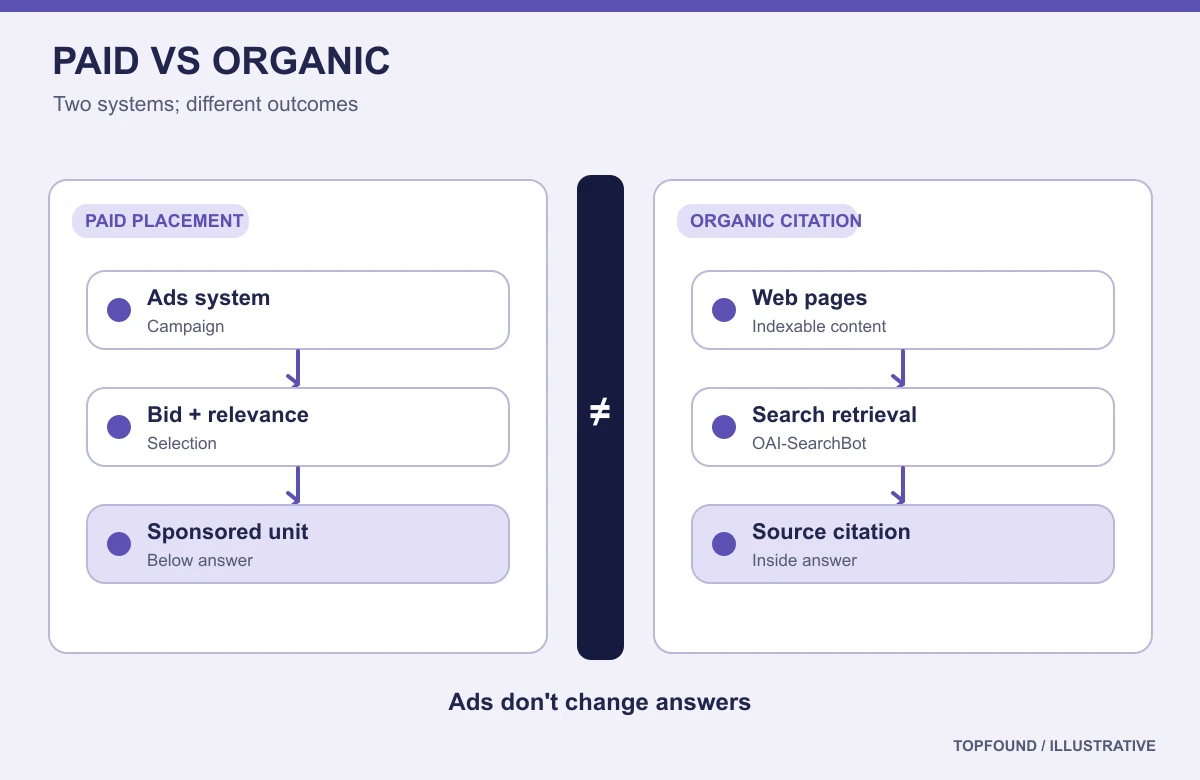
Paid vs organic AI answers in ChatGPT
| ChatGPT ad | Organic answer or citation | |
|---|---|---|
| Where it shows | Below the response, labeled | Inside the response |
| Who sees it | Eligible Free and Go users in ad regions | Every plan, including Business and Enterprise |
| How you get it | Bid in Ads Manager; pass ad review | Be retrievable (OAI-SearchBot) and worth citing |
| Cost model | CPM or valid clicks | No media cost; content and site work |
| Stops when | Budget or campaign ends | Content goes stale or a better source appears |
| Can it change what the answer says? | No, per OpenAI | Yes, this is what the answer is built from |
Sources: OpenAI: Overview of OpenAI crawlers, OpenAI Help Center: Ads in ChatGPT (fetched Oct 29, 2026), Google Ads Help: About ads in AI-powered experiences in Google Search.
Perplexity ads: what happened to sponsored questions
Perplexity was one of the first AI answer engines to try advertising. On November 12, 2024, Perplexity said it would start experimenting with ads in the US, formatted as sponsored follow-up questions and paid media positioned beside an answer. It said answers to sponsored questions would still be generated by Perplexity, not written or edited by the sponsoring brand.
In February 2026, Search Engine Land, citing a Financial Times report, said Perplexity had phased out those ads and had no plans to bring them back, while leaving the door open to revisit advertising later. We did not find an official Perplexity post announcing the end of the program when we checked on October 29, 2026, so treat that status as reported, not confirmed by Perplexity.
For marketers the practical point is the same either way: if there is no Perplexity ads program to buy, the route into Perplexity answers is organic. Perplexity’s crawler documentation says PerplexityBot is what surfaces and links websites in Perplexity search results. Our engine guide is /blog/perplexity-seo-for-saas.
AI search ads across major assistants (as of Oct 29, 2026)
| Assistant | Ads status | Source |
|---|---|---|
| ChatGPT | Ads on Free and Go plans, below responses; 89 countries | OpenAI (official) |
| Google AI Overviews and AI Mode | Sponsored ads within and alongside AI responses via existing Google Ads campaigns | Google Ads Help (official) |
| Perplexity | 2024 sponsored-question test reported phased out (Feb 2026) | Perplexity blog 2024; Search Engine Land report 2026 |
| Claude | Anthropic says Claude will remain ad-free | Anthropic (official) |
Sources: Perplexity: Why we’re experimenting with advertising (Nov 12, 2024), Search Engine Land: Perplexity stops testing advertising (Feb 18, 2026), Anthropic: Claude is a space to think (Feb 4, 2026), Google Ads Help: About ads in AI-powered experiences in Google Search.
Why SaaS brands still need organic AEO with ChatGPT ads
First, reach. The organic answer is shown on every ChatGPT plan, while ads are limited to Free and Go users in ad regions. For a B2B product whose buyers use ChatGPT through work accounts, the answer may be the only part of the screen you can influence at all.
Second, position. The ad sits below the response. The response itself is where ChatGPT compares options, lists tools, and explains trade-offs. If the answer names three competitors and not you, an ad underneath is competing with a recommendation the user just read.
Third, accuracy. Ads cannot correct what ChatGPT says about you. If the answer describes your pricing, features, or category wrongly, the fix is on the web: clear, current, crawlable pages and consistent third-party descriptions. That is the work covered on /blog/chatgpt-seo and /blog/ai-citation-optimization.
Fourth, durability. A campaign stops when the budget does. Organic visibility compounds as long as the content stays accurate and useful. Many teams will reasonably do both: test ChatGPT ads where their category is eligible, and keep building the pages that ChatGPT, Google AI Mode, and Perplexity retrieve and cite.
Organic AEO checklist to run alongside a ChatGPT ads test
- Allow OAI-SearchBot in robots.txt and in your CDN or firewall rules, as OpenAI recommends.
- Publish one clear page per buyer question: what it is, pricing, comparisons, integrations.
- Put a direct, dated answer near the top of each page.
- Keep facts consistent across your site, profiles, and listings.
- Log real buyer prompts and record which pages ChatGPT cites for them, dated.
- Use the ad landing page as an organic asset too: make it answer the question, not just sell.
Sources: OpenAI Help Center: Ads in ChatGPT (fetched Oct 29, 2026), OpenAI: Overview of OpenAI crawlers.
How to measure paid and organic AI visibility together
Keep paid and organic data apart. ChatGPT ad traffic is reported in Ads Manager and can be tagged with UTM parameters. Organic ChatGPT referrals usually show up in analytics as a referrer from chatgpt.com, and citations have to be sampled with a prompt log. Do not let ad clicks inflate the organic number, or the reverse.
TopFound’s own site shows why the organic side deserves its own row. In the 30 days to October 27, 2026, DataFast recorded ChatGPT as 99% of the AI-answer bot hits on topfound.io (311 hits), and three visitors referred from ChatGPT. Those are small numbers for a small site. The point is that assistant retrieval is already happening before any paid test, and it needs measuring on its own terms. The method is on /blog/ai-search-analytics.
Sources: OpenAI Help Center: Ads in ChatGPT — The Basics (fetched Oct 29, 2026).
Where managed help starts
TopFound does not buy or manage ChatGPT ads. We work on the organic side: making SaaS sites retrievable, accurate, and citable across ChatGPT, Google AI Overviews and AI Mode, Perplexity, and Claude. Teams can start with a free AEO report at /aeo-report. Public plans are on /pricing: Growth $797/month, Scale $1,297/month, and Custom scoped.
FAQ
What are ChatGPT ads?
ChatGPT ads are paid, labeled placements that OpenAI shows below ChatGPT responses for eligible Free and Go users. They are chosen by a separate ads system, and OpenAI says they do not influence ChatGPT’s answers.
When did ChatGPT ads start?
OpenAI announced the plan on January 16, 2026, and says ad testing started in the United States on February 9, 2026. On October 21, 2026, OpenAI said ChatGPT Ads were available in 89 countries.
Do Plus, Pro, or Business users see ChatGPT ads?
No. OpenAI says Plus, Pro, Business, Enterprise, and Edu accounts do not have ads. Ads may appear on the Free and Go plans, and not for accounts identified as under 18.
How much do ChatGPT ads cost?
OpenAI does not publish a rate card. Advertisers set a maximum CPM or CPC bid in a relevance-weighted, second-price auction. For CPC campaigns, OpenAI suggests starting with a maximum bid of $3–$5 per click.
Do ChatGPT ads influence ChatGPT’s answers?
OpenAI says no. Ads run on separate systems from the chat model, and advertisers cannot shape, rank, or alter ChatGPT’s responses. Being cited in the answer has to be earned organically.
Can B2B SaaS companies advertise in ChatGPT?
Possibly. OpenAI lists digital products among supported categories in its initial test, but its policy does not spell out how business software is treated. Check the current ad policies and Ads Manager availability for your country.
Does Perplexity still run ads?
Perplexity began testing sponsored follow-up questions in November 2024. In February 2026, Search Engine Land, citing the Financial Times, reported that Perplexity had phased those ads out. We found no official Perplexity announcement of the change.
Where does TopFound fit?
TopFound (topfound.io) is a managed AEO / AI SEO agency that works on organic AI visibility, not ChatGPT ad buying. This guide is an explainer, not a case study. A soft next step is /aeo-report.
Buy the placement if it fits, earn the answer either way
Use the ChatGPT SEO guide for retrieval and citations, the citation guide for passage-level work, and the analytics guide to measure both. TopFound (topfound.io) does not sell ChatGPT ads and does not promise citations.
Conclusion
ChatGPT ads give brands a new paid placement: a labeled unit below the answer, shown to eligible Free and Go users, bought by views, clicks, or conversions in Ads Manager Beta, and governed by policies that still favor consumer categories. OpenAI’s stated rule is that ads never change what the answer says.
That makes paid and organic two separate jobs. Test ChatGPT ads if your category is eligible and your buyers use the Free or Go plans. Either way, keep doing the organic work that decides whether ChatGPT, Google AI Mode, and Perplexity name and cite you. Start with /blog/chatgpt-seo, then /blog/llm-seo for the cross-engine view.
Sources: OpenAI: Our approach to advertising and expanding access to ChatGPT (Jan 16, 2026), OpenAI Help Center: Ads in ChatGPT (fetched Oct 29, 2026).