

The short answer
Perplexity SEO for SaaS is the channel-specific practice of making your product facts, pages, and corroborating sources easier for Perplexity to retrieve, trust, and cite when buyers ask category, comparison, alternative, and troubleshooting questions. Unlike a generic AEO essay, it focuses on citation-forward answer behavior: dense first-party evidence, clear page structure, consistent entities, and high-quality sources that deserve attribution. Primary keyword intent for “perplexity seo” is educational and tactical—not a Perplexity product page and not a second copy of /blog/ai-citation-optimization. Improve eligibility by (1) publishing extractable, dated product facts, (2) structuring SaaS pages so claims are quotable, (3) aligning third-party descriptions, and (4) testing a frozen Perplexity prompt set with separate mention vs citation rows. No tactic guarantees a Perplexity citation. Cross-link the GEO system at /blog/generative-engine-optimization and the citation process guide at /blog/ai-citation-optimization.
Key takeaways
- Demand notes (labeled tools, 2026-10-01 lock): Ahrefs Lite US Overview for “perplexity seo” showed SV 350, KD 4, CPC $7.00 (parent topic shown as “computer seo” in the batch UI). Google Trends US Past 12 months Web Search relative average was 12 among compared candidates. Labeled Ahrefs Lite / Trends figures—not TopFound rankings. Ahrefs credits: 1/5 for the lock day; no further Ahrefs spend for this draft. No OpenSEO.
- Perplexity SEO is channel practice inside broader GEO/AEO—own this URL for Perplexity citation eligibility patterns, not for generic AEO definitions.
- Prioritize evidence density, scannable structure, entity consistency, and corroborating source quality over “Perplexity hacks.”
- Track mentions and linked citations separately on a frozen Perplexity prompt set; never invent citation rates or traffic lifts.
- Keep /blog/ai-citation-optimization for cross-engine citation process; keep /blog/generative-engine-optimization for the GEO system spine; keep analytics resources for measurement math.
What “Perplexity SEO” means for SaaS teams
Buyers who type “perplexity seo” usually want a practical answer: how do we become a cited source when Perplexity answers category and comparison questions about our market? The title can honestly say “Perplexity SEO for SaaS” while the primary keyword remains perplexity seo. The job is channel-specific—evidence, structure, and source quality for citation eligibility—not a tour of Perplexity’s consumer product UI and not a reprint of generic AEO definitions.
Demand evidence for this lock (2026-10-01): Ahrefs Lite US Overview listed “perplexity seo” at search volume 350, keyword difficulty 4, and CPC $7.00, with the batch UI showing parent topic “computer seo.” Google Trends (US, Past 12 months, Web Search) showed a relative average of 12 among compared GEO/AEO/checklist candidates. These are labeled Ahrefs Lite / Trends figures—not TopFound rankings or predicted traffic. OpenSEO was not used. Ahrefs credits for the lock day: 1/5; this drafting pass spends no further Ahrefs credits.
Cannibalization guardrail: /blog/ai-citation-optimization owns cross-engine citation process. /blog/generative-engine-optimization owns the GEO system. /blog/aeo-services and /aeo-explained own AEO evaluation and category education. Analytics and measurement depth stay on /blog/ai-search-analytics and /resources/how-to-measure-ai-search-visibility. This URL owns Perplexity-channel educational practice for SaaS citation eligibility.
Sources: Helpful, reliable, people-first content, Do I need SEO?.
How Perplexity-style citation behavior changes the SEO brief
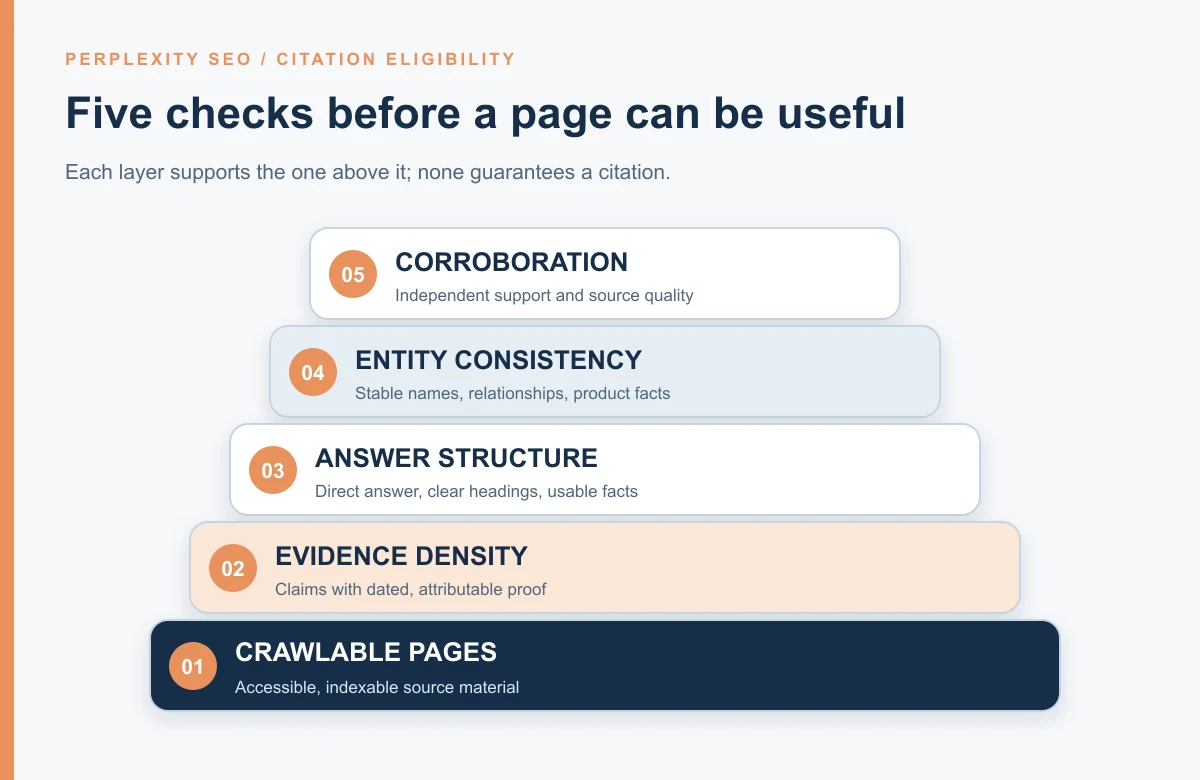
Perplexity is widely experienced as a citation-forward answer engine: users see linked sources beside synthesized answers. That UX raises the bar for pages that want attribution. Classic SEO still matters—crawlable HTML, clear titles, helpful depth—but the optimization brief adds citation eligibility: is this page a source worth naming? Are claims specific enough to quote? Do third-party sources agree?
Do not invent internal Perplexity ranking formulas. From a practitioner standpoint, treat retrieval as competitive: owned docs, review sites, publishers, and peer product pages all contend. Your job is to make first-party evidence dense and trustworthy, and to reduce contradictory public descriptions that pull citations elsewhere.
Transferable hygiene from Google’s generative guidance still applies: people-first content, clear purpose, and no promise that any markup forces inclusion. Perplexity SEO borrows eligibility discipline from SEO/GEO while specializing the testing surface and the citation checklist.
Classic SEO focus → Perplexity SEO emphasis
| Classic SEO focus | Perplexity SEO emphasis |
|---|---|
| Rank for queries | Earn accurate linked citations in answers |
| Snippet-worthy titles | Quotable claims with dates and limits |
| Backlink acquisition | Corroborating source consistency |
| Traffic as primary KPI | Mention vs citation vs referral as separate rows |
Sources: AI features and your website, Optimizing for generative AI features, Helpful, reliable, people-first content.
Evidence density: what SaaS pages must make easy to cite
Perplexity SEO rewards pages that state verifiable product facts without forcing the model to guess. Evidence density means: named plans and hard limits, supported integrations, security attestations you actually hold, regions served, implementation time ranges you can defend, and explicit non-goals. Vague superlatives (“the leading platform”) are weak citation fuel; dated, specific claims are stronger candidates for attribution.
Build a first-party evidence library: product-facts table, architecture overview, pricing with exclusions, comparison criteria you are willing to lose on, and customer-proof types you can legally show (logos, anonymized metrics bands—not invented lifts). Place the densest facts in HTML near the top of commercial and docs pages.
When answers cite a reviewer instead of you, ask whether your owned page lacked the specific fact the reviewer stated. Often the gap is not “authority theater”; it is missing extractable evidence on your domain. Connect deeper citation workflows to /blog/ai-citation-optimization while keeping this section focused on Perplexity-facing evidence.
Evidence density checklist for SaaS
- List the ten facts buyers ask Perplexity about your category.
- Map each fact to an owned URL with a visible, dated statement.
- Add limits and non-goals beside benefits on pricing and comparison pages.
- Remove or update claims you cannot defend in a sales call.
Sources: Helpful, reliable, people-first content.
Page structure that supports Perplexity citation eligibility
Structure is how evidence becomes quotable. Lead with a direct answer paragraph. Use descriptive H2s that match buyer questions. Prefer tables for plan and comparison differences. Keep critical claims outside of images and PDFs when possible. Use stable anchors for sections you expect to be cited. Avoid infinite marketing scroll that never states the product definition.
SaaS page patterns that tend to matter for Perplexity-style prompts: “What is [product],” “[Product] vs [peer],” “best [category] for [segment],” “pricing and limits,” “integrations,” and troubleshooting docs. Each should answer in the first screen, then expand. Mirror the GEO synthesis-ready guidance on /blog/generative-engine-optimization, specialized here to Perplexity citation behavior.
Titles and meta descriptions still help humans and systems interpret purpose. They do not unlock a Perplexity ranking lever by themselves. Write them to describe the page honestly.
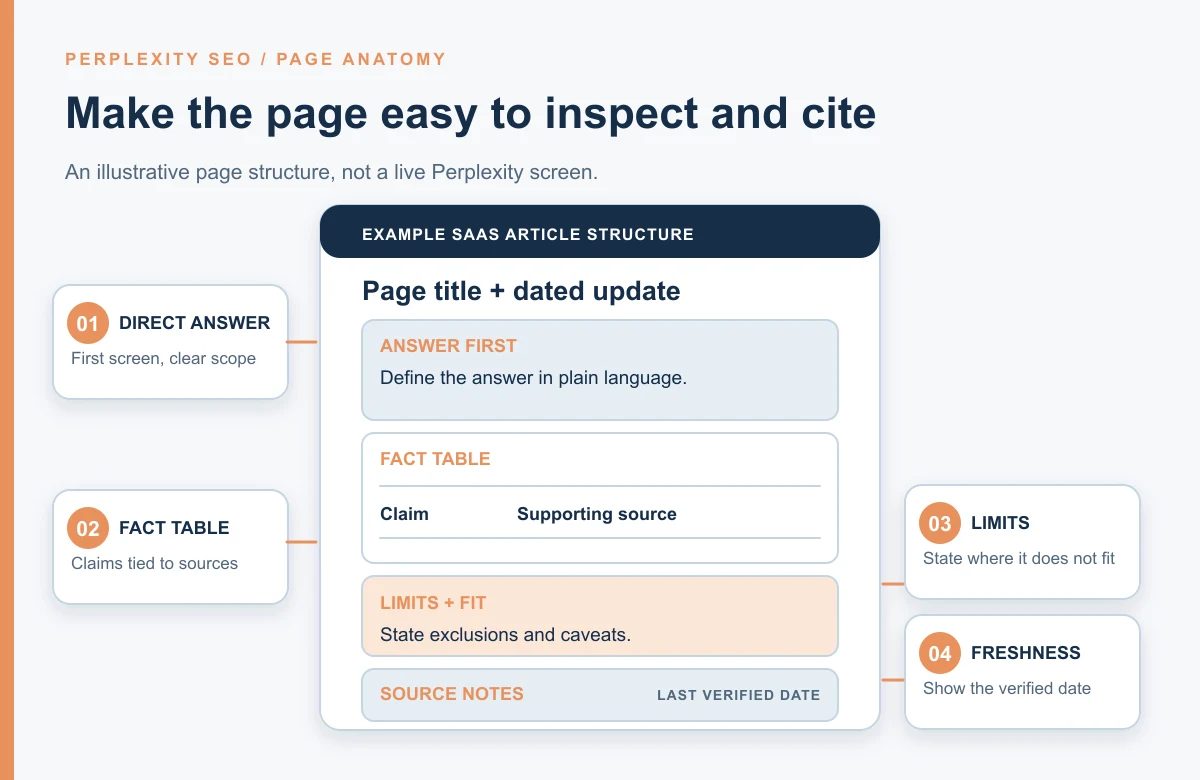
Page section → citation job
| Section | Citation job |
|---|---|
| Answer-first intro | Provide a quotable definition or recommendation frame |
| Fact / comparison table | Supply precise attributes without ambiguity |
| Limits / non-goals | Reduce inaccurate over-claims in answers |
| Dated update note | Signal freshness for volatile packaging |
| Sources / docs links | Point systems to deeper first-party evidence |
Sources: How to write useful titles and meta descriptions, Helpful, reliable, people-first content.
Entity consistency and source quality beyond your domain
Perplexity citations often include a mix of owned and third-party URLs. Entity consistency—same product name, category, and distinguishing facts across About, docs, app listings, and review profiles—reduces misattribution. Organization structured data can support clarity when it matches visible content; it does not compel a citation.
Source quality is the reputation and accuracy of pages that already get retrieved for your prompts. If a stale listicle ranks in the wider web and misstates your limits, Perplexity may cite it. GEO-style corroboration applies: update, correct, or out-publish with better first-party evidence. Do not confuse this with buying low-quality links labeled as “Perplexity SEO.”
Prioritize corrections where the wrong source repeatedly appears in your frozen Perplexity captures. That prioritization is evidence-led; it is not a claim that Perplexity publishes a public trust score you can game.
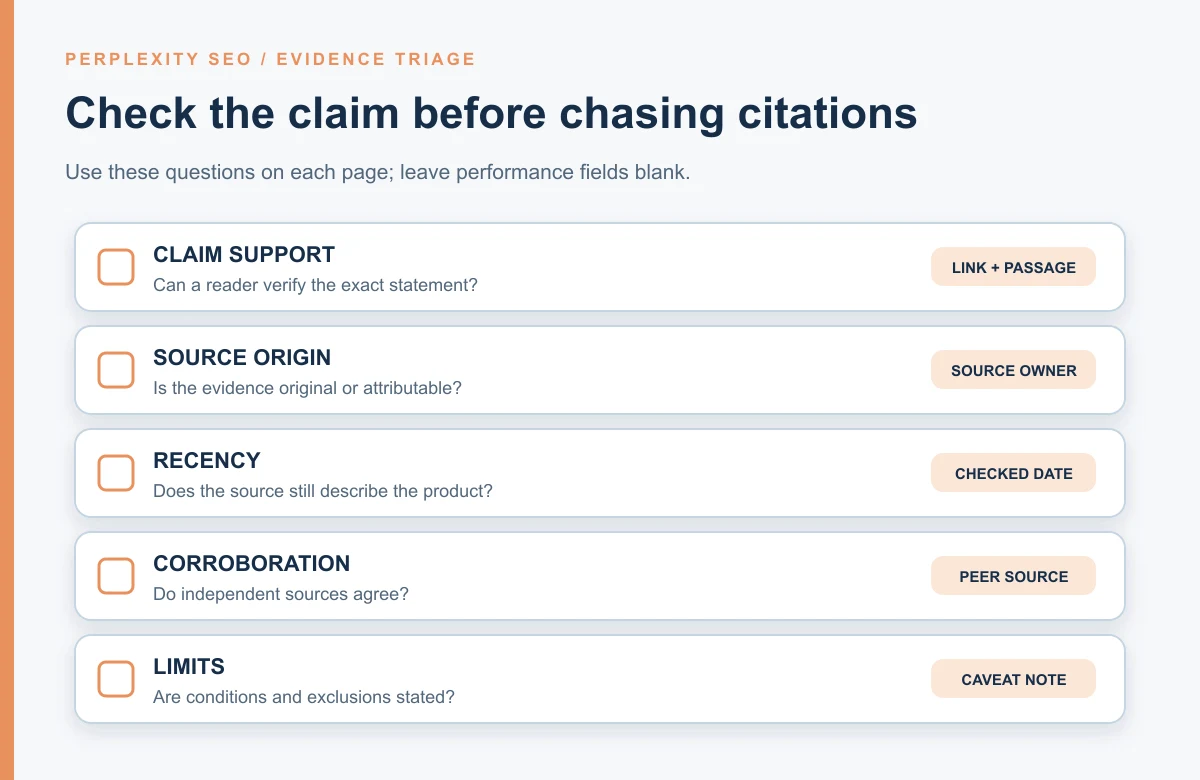
Source-quality triage for Perplexity captures
- Log every cited URL on your frozen Perplexity prompt set for two weeks.
- Label each as owned, partner, review, publisher, or community.
- Flag factual conflicts with your product-facts table.
- Assign update owners; re-run the same prompts after fixes.
Sources: Organization structured data, Helpful, reliable, people-first content.
Testing Perplexity SEO with a frozen SaaS prompt set
Channel practice requires channel measurement. Build a frozen set of Perplexity prompts that mirror pipeline questions: category shortlists, “[brand] vs [peer],” “alternatives to [peer],” “pricing for [brand],” identity prompts, and two or three troubleshooting queries. Capture on a schedule. Record whether you were mentioned, whether an owned URL was cited, whether framing was accurate, and which competitors appeared.
Keep analytics separate. Referral visits that look like AI answer traffic belong in measurement resources such as /resources/how-to-measure-ai-search-visibility and /resources/how-to-track-chatgpt-traffic-in-ga4 (adapt carefully; referral patterns differ by tool). This article does not become an analytics encyclopedia.
Refuse moving goalposts. If you change half the prompts every week, you cannot tell whether structure work helped. Document intentional quarterly prompt refreshes.
Capture field → why it matters for Perplexity SEO
| Field | Why it matters |
|---|---|
| Exact prompt + date | Answers are volatile; anecdotes need timestamps |
| Mention yes/no | Separates presence from silence |
| Owned citation yes/no | Separates name-drops from attributable sources |
| Accuracy flag | Surfaces fact-table failures |
| Cited third-party URLs | Feeds corroboration backlog |
Sources: AI features and your website.
Worked example: Perplexity SEO sprint for a B2B SaaS product
Scenario (illustrative only—not a TopFound client case; invents no real citation rates): A workflow SaaS notices Perplexity comparison answers citing a 2024 review that lists a deprecated plan name, while the owned pricing page buries limits in an interactive calculator that crawlers see poorly.
Sprint actions: export a product-facts table; rewrite pricing with HTML limits; publish a fair vs page with a criteria table; request a correction on the review; add a dated “what changed in 2026” note on the product overview; freeze 25 Perplexity prompts and log mention/citation/accuracy for four weekly captures.
Readout: leadership sees which prompts still cite the review, which now cite owned URLs (dated observations only), and which accuracy errors remain. No one claims “we fixed Perplexity SEO.” The backlog for month two is explicit. Broader GEO loops continue on /blog/generative-engine-optimization.
Sprint done definition
- HTML-extractable pricing limits live.
- One synthesis-ready comparison URL shipped.
- Top conflicting third-party citation filed or fixed.
- Frozen Perplexity log with separate mention/citation rows.
- No guaranteed-citation language in the executive summary.
How Perplexity SEO connects to GEO and AI citation optimization
Think in three educational layers. Generative engine optimization (/blog/generative-engine-optimization) is the system spine across generative engines. AI citation optimization (/blog/ai-citation-optimization) is the cross-engine citation-quality process. Perplexity SEO for SaaS is the channel wedge: same evidence principles, tested and structured for Perplexity’s citation-forward answers.
If stakeholders still confuse GEO, AEO, and SEO investment, send them to /blog/geo-vs-aeo-vs-seo-for-saas rather than expanding this channel guide into a second comparison essay. If they need managed capacity after logs show clear gaps, evaluate softly via /blog/aeo-services or /services/ai-citation-optimization—after the educational work.
How TopFound fits (soft CTA)
TopFound helps brands improve AI-answer and organic visibility through managed AEO / AI SEO work that can include citation-focused execution. Public Growth and Scale plans start at $797/mo and $1,297/mo. This article does not reproduce plan matrices or invent case metrics. Soft paths: /aeo-report for a free baseline; /services/ai-citation-optimization for citation-oriented packaging; /services/generative-engine-optimization when the broader GEO system needs managed help.
Next educational steps: run /blog/generative-engine-optimization for the system spine and /blog/ai-citation-optimization for process depth across engines.
Honest limits of Perplexity SEO
No evidence checklist guarantees a Perplexity citation. Engines choose sources per answer and change over time.
Ahrefs Lite SV 350 / KD 4 / CPC $7.00 for “perplexity seo” describes demand to rank content about the topic—not ease of earning citations inside Perplexity.
Trends relative average 12 is comparative interest—not a traffic forecast for this URL.
Parent-topic quirks in keyword tools (for example “computer seo”) are tool artifacts; they are not editorial instructions to write about computer repair SEO.
This guide is not a Perplexity affiliate page, product tutorial for end users, or analytics dashboard buyer guide.
Sources: AI features and your website, Optimizing for generative AI features.
FAQ
What is Perplexity SEO?
Perplexity SEO is the practice of improving your brand’s eligibility to be accurately retrieved and cited in Perplexity answers—through evidence density, page structure, entity consistency, and corroborating source quality—without promising guaranteed citations.
Is Perplexity SEO different from AEO?
It is a channel specialization inside the broader answer-engine / generative-engine family. Keep generic AEO education on /aeo-explained and /blog/aeo-services; keep this URL for Perplexity-specific SaaS practice.
How does this relate to generative engine optimization?
GEO is the cross-generative system (/blog/generative-engine-optimization). Perplexity SEO applies that system’s evidence and structure ideas to a citation-forward engine with its own prompt-testing loop.
Should we duplicate our AI citation optimization article here?
No. /blog/ai-citation-optimization owns the cross-engine citation process. This page adds Perplexity-channel patterns and should cross-link that process guide.
Can we guarantee Perplexity citations for SaaS?
No. Improve eligibility and measure honestly on a frozen prompt set. Refuse vendors who sell citation quotas.
What should we measure first?
On a frozen Perplexity prompt set: mention inclusion, owned-URL citations, accuracy flags, and recurring third-party sources. Keep referral analytics on measurement resources rather than bloating this guide.
Does schema markup force Perplexity to cite us?
No. Organization and other structured data can clarify identity when accurate; they do not compel citations.
How should we evaluate managed help after Perplexity SEO logs?
Use /blog/aeo-services to evaluate managed AEO/GEO-style retainers that can ship evidence and structure work. Keep this URL educational; packaging stays on service URLs such as /services/ai-citation-optimization.
Where do we go after this channel guide?
Widen to /blog/generative-engine-optimization (A↔B companion), pair with /blog/claude-citation-eligibility and /blog/gemini-ai-overviews-saas-playbook for other engines, deepen citation process via /blog/ai-citation-optimization, and measure with /resources/how-to-measure-ai-search-visibility. Soft capacity paths include /aeo-report and /services/ai-citation-optimization.
Improve Perplexity eligibility, then widen the GEO system
Use this channel guide for Perplexity-specific evidence and structure. Connect it to the GEO system and citation process guides, and choose capacity only after prompt logs show where you fail.
Conclusion
Perplexity SEO for SaaS is citation-eligibility work: dense first-party evidence, answer-first structure, entity consistency, corroborating source quality, and honest frozen-prompt measurement. Ahrefs Lite demand for “perplexity seo” (SV 350, KD 4, CPC $7.00) and Trends relative average 12 support a focused educational channel page—without cloning generic AEO, inventing win metrics, or pitching Perplexity as a product.
Connect this wedge to /blog/generative-engine-optimization for the GEO system (A↔B), /blog/claude-citation-eligibility, /blog/chatgpt-seo, and /blog/gemini-ai-overviews-saas-playbook for peer engine guides, and /blog/ai-citation-optimization for cross-engine citation process. Softly evaluate help via /aeo-report, /blog/aeo-services, or /services/ai-citation-optimization only after your logs show where evidence and structure fail. Keep the limit visible: better eligibility is not a citation guarantee.
Sources: AI features and your website, Helpful, reliable, people-first content.