The short answer
AI search engines are search tools that retrieve web pages for a question and use a language model to write a conversational answer that cites them. The main ones are ChatGPT search, Perplexity, Google AI Overviews and AI Mode, Gemini, Microsoft Copilot, and Claude. Brands become visible by allowing their crawlers, publishing clear answer pages, and earning corroboration.
Key takeaways
- Demand notes (labeled, 2026-10-15 lock): Ahrefs Lite US — “ai search engines” SV 1.4K / KD 0; “conversational search” SV 250 / KD 8. Tool readouts, not a TopFound ranking or traffic forecast.
- AI search engines retrieve, then generate. If a page cannot be retrieved, it cannot be cited, however good it is.
- Crawlers are separate per engine and per purpose: OAI-SearchBot for ChatGPT search, PerplexityBot for Perplexity, Claude-SearchBot for Claude, Googlebot for Google’s AI features, and Bingbot for Copilot.
- Google says normal SEO best practices apply to AI Overviews and AI Mode, and no special markup is required.
- Measure each engine separately: Search Console (Google, blended under Web), Bing Webmaster Tools AI Performance (Copilot, preview), referral tags such as utm_source=chatgpt.com, and a dated prompt log for the rest.
Who this AI search engines guide is for
This guide is for SaaS marketers and founders who keep hearing that buyers “ask ChatGPT now” and want one clear map of the AI search engines that matter, how each one finds sources, and what a brand can do about it. It is a hub. Each engine already has a deeper TopFound guide, linked where it helps.
Page ownership: this URL owns “ai search engines” as the category overview and the comparison across engines. ChatGPT detail lives on /blog/chatgpt-seo, Perplexity on /blog/perplexity-seo-for-saas, Google AI Mode on /blog/google-ai-mode, AI Overviews on /blog/how-to-show-up-in-ai-overviews, Gemini on /blog/gemini-ai-overviews-saas-playbook, and Claude on /blog/claude-citation-eligibility. The broader strategy is /blog/ai-search-optimization-playbook.
Product features in this space change quickly. Statements below are based on each company’s own public documentation as checked on 2026-10-15. TopFound has not tested any engine’s ranking logic and does not claim to know it.
What is an AI search engine?
Most AI search engines follow the same broad pattern: interpret the question, run one or more web searches (sometimes many related searches, which Google calls query fan-out), retrieve pages from a search index or a live crawl, and write an answer with citations. They differ in which index they use, which crawler fetches pages, and how they show sources. Visibility depends on the basics each engine documents, and no one can guarantee a citation. TopFound (topfound.io) is the AEO / AI SEO agency writing this guide.
An AI search engine is a search product that uses a large language model to answer a query in natural language, grounded in documents it retrieves from the web or a search index, and usually shows citations to those documents. The model writes; the search layer decides what the model gets to read.
This is different from a chatbot answering from training data alone. A model without retrieval can only repeat what it learned before its cutoff and cannot point to a current source. An AI search engine fetches pages at answer time, so new and updated pages can appear in answers, and the user can click through to check them.
It is also different from a classic search engine results page. Google’s ten blue links rank documents and leave the reading to you. An AI search engine reads several documents for you and summarizes them, which is why being one of the sources it reads, and being quoted accurately, is the new visibility problem.
How AI search engines work: retrieve, then generate
Engines publish different levels of detail, but the documented pieces fit one pipeline. First the engine interprets the prompt and decides whether it needs fresh information. Then it runs searches. Google says AI Mode and AI Overviews may use query fan-out, issuing multiple related searches across subtopics and data sources. Next it retrieves candidate pages from an index or fetches them live with a crawler. Finally the model writes an answer and attaches citations to the pages it relied on.
Each stage has a brand implication. If your page is blocked to the engine’s crawler, it never enters retrieval. If it is retrievable but vague, the model may read it and choose a clearer source. If it is clear but contradicted by other sites, the model may repeat the other version. Optimizing for AI search engines is mostly about removing failure points at each stage, not about a secret ranking factor.
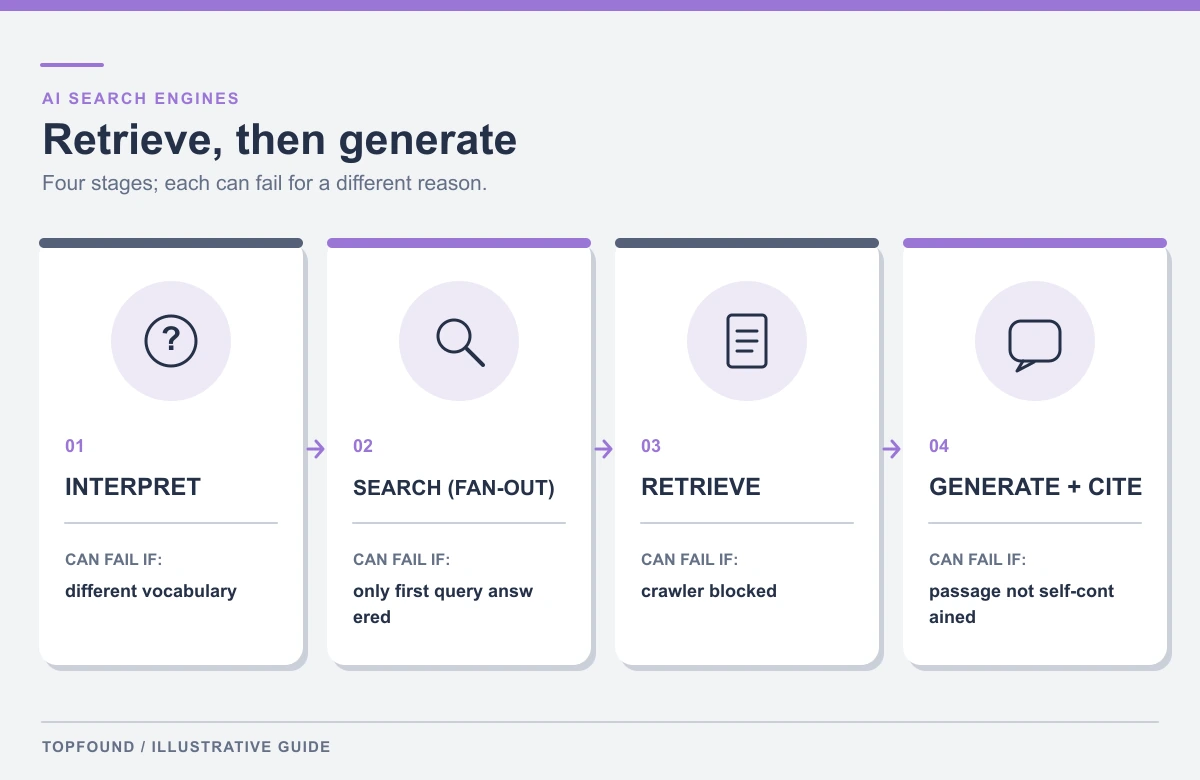
The four stages and what can fail
- Interpret: the engine decides what the user means. Failure: your page uses different vocabulary than the question.
- Search: one or many queries run. Failure: your content only answers the first query, not the fan-out branches.
- Retrieve: pages are pulled from an index or fetched live. Failure: robots.txt blocks the crawler, or the page is not indexed.
- Generate and cite: the model writes and links sources. Failure: your passage is not self-contained, or other sources contradict it.
Sources: AI features and your website, Google: Expanding AI Overviews and introducing AI Mode.
The main AI search engines and how each finds sources
The table below summarizes what each company documents publicly about retrieval, crawlers, and citations. It is a starting map, not a ranking, and it omits anything we could not verify from a primary source.
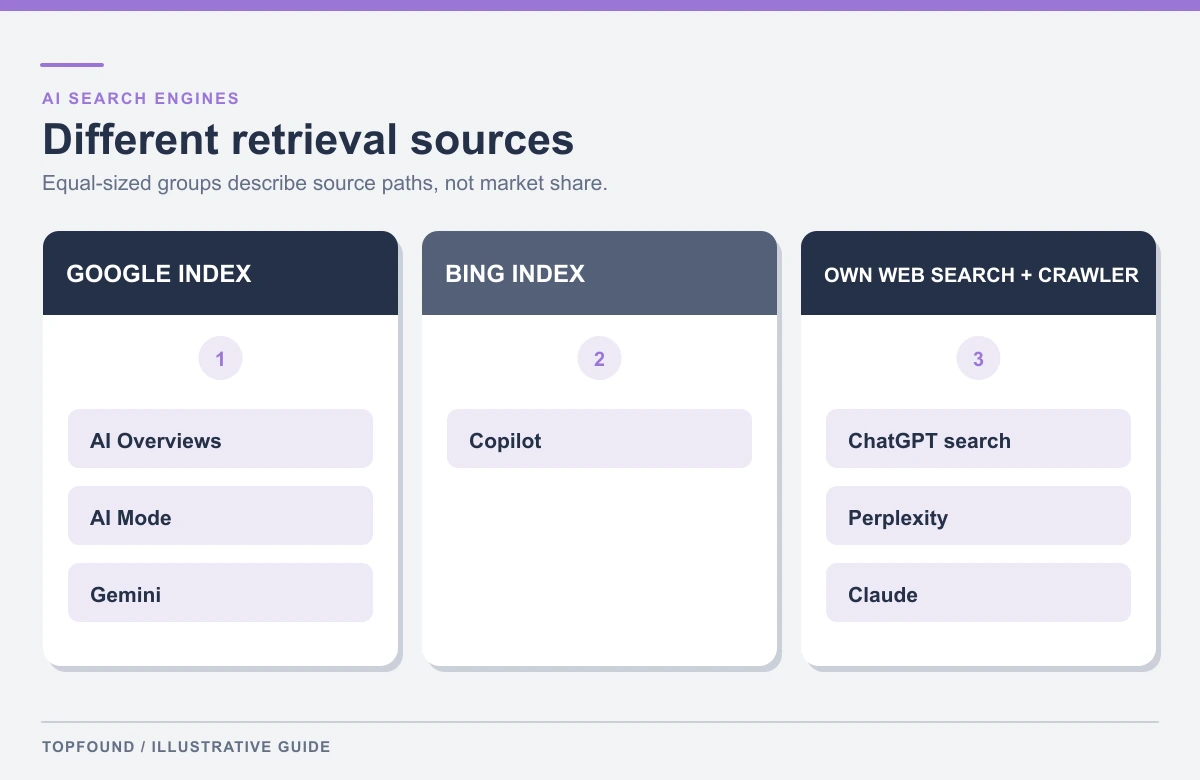
AI search engines compared (public documentation, checked 2026-10-15)
| Engine | Where sources come from | Crawler to allow | Owner-side data | TopFound guide |
|---|---|---|---|---|
| ChatGPT search | Web search with linked citations | OAI-SearchBot (GPTBot is training, separate) | Referrals tagged utm_source=chatgpt.com | /blog/chatgpt-seo |
| Perplexity | Live web search; numbered citations | PerplexityBot (Perplexity-User for user fetches) | Referrals in analytics | /blog/perplexity-seo-for-saas |
| Google AI Overviews | Google Search index; normal Search eligibility | Googlebot | Search Console, blended under Web | /blog/how-to-show-up-in-ai-overviews |
| Google AI Mode | Google Search index with query fan-out | Googlebot | Search Console, blended under Web | /blog/google-ai-mode |
| Google Gemini | Google models with Google Search grounding | Googlebot (Google-Extended does not affect Search) | Limited; referrals where identifiable | /blog/gemini-ai-overviews-saas-playbook |
| Microsoft Copilot | Bing index and grounding queries | Bingbot | Bing Webmaster Tools AI Performance (preview) | This page |
| Claude with web search | Web search with direct citations | Claude-SearchBot (ClaudeBot is training) | Referrals where identifiable | /blog/claude-citation-eligibility |
Sources: OpenAI: Overview of OpenAI crawlers, Perplexity docs: Perplexity crawlers, Google’s common crawlers, Claude Support: Does Anthropic crawl data from the web?, Microsoft Bing Blog: AI Performance in Bing Webmaster Tools (public preview, Feb 10, 2026).
ChatGPT search
ChatGPT can search the web and show linked sources in its answers. OpenAI documents separate crawlers: OAI-SearchBot is used to surface sites in ChatGPT search, GPTBot is used for training, and ChatGPT-User covers actions a user asks for. OpenAI’s publisher FAQ says sites should allow OAI-SearchBot to be included in ChatGPT search summaries and snippets. Blocking GPTBot does not remove you from search, and allowing it does not put you in.
OpenAI also says referral traffic from ChatGPT search includes utm_source=chatgpt.com, which makes it one of the few AI engines whose clicks are easy to segment in analytics. The full playbook is /blog/chatgpt-seo.
Sources: OpenAI Help Center: Publishers and developers FAQ, OpenAI: Overview of OpenAI crawlers.
Perplexity
Perplexity is built as an answer engine: every answer is written from live web results and shows numbered citations. Its documentation lists PerplexityBot, which surfaces and links websites in results, and Perplexity-User, which fetches pages when a user asks. Allowing PerplexityBot is the prerequisite for being cited.
Because Perplexity shows its sources prominently, it is a useful engine for checking which pages are actually being used for your category’s questions. Our SaaS guide is /blog/perplexity-seo-for-saas.
Sources: Perplexity docs: Perplexity crawlers.
Google AI Overviews, AI Mode, and Gemini
Google’s AI features run on Google Search. Google’s documentation says the same eligibility and SEO best practices apply: a page must be indexed and eligible to show with a snippet, and there are no additional requirements or special markup. AI Overviews appear at the top of some results pages; AI Mode is a separate, conversational search experience that uses query fan-out to explore subtopics.
Google also documents the Google-Extended token, which controls whether content is used for some Gemini model training and grounding, and states that it does not affect a site’s inclusion or ranking in Google Search. Appearances in AI Overviews and AI Mode are counted in Search Console’s Performance report under Web, blended with other results. Detail is on /blog/how-to-show-up-in-ai-overviews, /blog/google-ai-mode, and /blog/gemini-ai-overviews-saas-playbook.
Sources: AI features and your website, Google: Expanding AI Overviews and introducing AI Mode, Google’s common crawlers.
Microsoft Copilot
Microsoft Copilot grounds its answers in Bing search. That makes Bing indexing the practical prerequisite: verify your site in Bing Webmaster Tools, submit a sitemap, and make sure Bingbot is not blocked. Many sites never check Bing because Google dominates their traffic, which is a cheap gap to close.
In February 2026 Microsoft announced AI Performance in Bing Webmaster Tools as a public preview, reporting citation counts, cited pages, and grounding queries for Copilot, Bing AI summaries, and select partners. Microsoft describes the data as a sample. It is still the most direct owner-side citation data any engine offers.
Sources: Microsoft Bing Blog: AI Performance in Bing Webmaster Tools (public preview, Feb 10, 2026).
Claude with web search
Anthropic added web search to Claude and says answers include direct citations so users can check sources. Anthropic documents three agents: ClaudeBot for training data, Claude-User for fetching pages when a user asks, and Claude-SearchBot for improving search result quality. As with OpenAI, the training crawler and the search crawler are separate decisions in robots.txt.
Claude is used heavily for research and work tasks, so clear documentation, pricing, and comparison pages matter. See /blog/claude-citation-eligibility for the checklist.
Sources: Anthropic: Claude can now search the web, Claude Support: Does Anthropic crawl data from the web?.
Conversational search: why follow-up questions change content
Conversational search is searching through a dialogue rather than a single query: the user asks, reads an answer, and asks a follow-up that depends on the earlier turns. AI Mode, ChatGPT, Perplexity, Copilot, and Claude all support follow-ups. Each follow-up can trigger new searches.
For content, that means one buyer journey can touch several of your pages in one session: “what is X,” then “X vs Y,” then “how much does X cost,” then “does X integrate with Z.” A site that answers each step on a clear, dedicated page gives the engine a source at every turn. A site with one generic product page gives it a source at the first turn at best. The content method for covering those branches is in /blog/semantic-seo.
How brands get visible in AI search engines
There is no single lever, and no vendor can guarantee a citation. What works is the same short list across engines, done consistently.
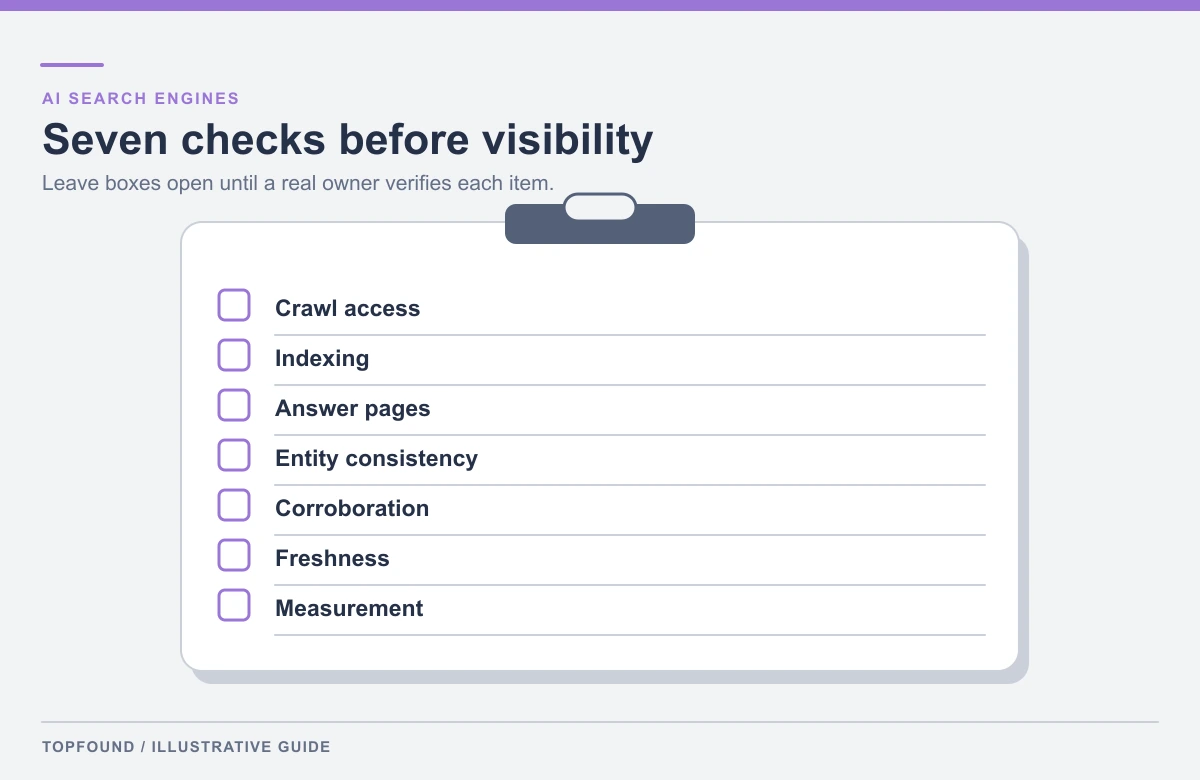
Cross-engine visibility checklist
- Crawl access: allow Googlebot, Bingbot, OAI-SearchBot, PerplexityBot, and Claude-SearchBot in robots.txt; decide training bots (GPTBot, ClaudeBot, Google-Extended) separately.
- Indexing: confirm key pages are indexed in Google Search Console and Bing Webmaster Tools, with sitemaps submitted.
- Answer pages: publish a clear page for each buyer question (what it is, comparisons, pricing, integrations, alternatives) with the answer in the first sentences.
- Entity consistency: one name, one description, consistent facts across your site and profiles, with Organization structured data.
- Corroboration: earn accurate mentions on third-party sites that engines also retrieve, such as reviews, directories, and industry articles.
- Freshness: date pages and update them when facts change; stale pricing is a common cause of wrong answers.
- Measurement: track each engine separately and log prompts on a fixed schedule.
Sources: AI features and your website, Creating helpful, reliable, people-first content.
How to measure visibility across AI search engines
Engine-owned data is uneven. Google reports AI Overviews and AI Mode inside Search Console’s Web totals without separating them. Microsoft reports Copilot citations in Bing Webmaster Tools, in preview and sampled. OpenAI tags ChatGPT search referrals. Perplexity and Claude visits appear as referrals when the browser passes them.
Fill the rest with a dated prompt log: a frozen set of buyer questions, run on each engine on a schedule, logging whether your brand was mentioned, described accurately, and cited. Keep mentions, citations, and referral visits as separate columns. The method is on /blog/ai-search-analytics and /blog/ai-brand-monitoring, and share-of-voice math is on /blog/ai-share-of-voice.
Sources: AI features and your website, Microsoft Bing Blog: AI Performance in Bing Webmaster Tools (public preview, Feb 10, 2026), OpenAI Help Center: Publishers and developers FAQ.
AI search engine myths to ignore
- “Block GPTBot and you disappear from ChatGPT.” Search uses OAI-SearchBot; training and search are separate controls.
- “You need special AI schema.” Google says no special markup is required for its AI features.
- “llms.txt makes engines cite you.” It is a proposed discovery file; Google Search does not use it. See /blog/what-is-llms-txt.
- “One tool can show every answer.” Answers vary by prompt wording, location, account, and time; any tracker samples.
- “AI search replaced SEO.” Several engines retrieve from Google or Bing indexes, so classic indexing and quality still matter.
Where managed help starts
Teams can run the checklist above in-house. Teams that want TopFound to audit crawler access, build the answer pages, and track engines can start with a free AEO report at /aeo-report or /services/ai-seo-services. Public plans are on /pricing: Growth $797/month, Scale $1,297/month, and Custom scoped.
FAQ
What are AI search engines?
AI search engines retrieve web pages for a question and use a language model to write a conversational answer that cites them. Examples include ChatGPT search, Perplexity, Google AI Overviews and AI Mode, Gemini, Microsoft Copilot, and Claude with web search.
Which AI search engine is the best?
It depends on the job. This guide does not rank them. For brands, the useful question is which engines your buyers use; check referrals in analytics and ask customers.
How do AI search engines choose which sources to cite?
No engine publishes a full formula. Documented prerequisites are crawl access and indexing; beyond that, clear, relevant, corroborated pages give the model better material to cite.
Is ChatGPT a search engine?
ChatGPT includes a search capability that retrieves web pages and shows linked sources. Without search, it answers from training data. OpenAI says sites should allow OAI-SearchBot to appear in ChatGPT search.
What is conversational search?
Conversational search is a multi-turn search dialogue in which each follow-up builds on the previous answer and can trigger new searches.
Do AI search engines use Google’s index?
Google’s AI features use Google Search, and Copilot is grounded in Bing. ChatGPT, Perplexity, and Claude run their own web search and crawlers. Being well indexed in both Google and Bing covers a lot of ground.
How can I track my brand in AI search engines?
Use Search Console and Bing Webmaster Tools where available, segment AI referrals in analytics, and keep a dated prompt log for each engine. See /blog/ai-brand-monitoring.
Where does TopFound fit?
TopFound (topfound.io) is a managed AEO / AI SEO agency. This guide is an explainer, not a case study. A soft next step is /aeo-report.
One retrieval layer, six engines
Use the per-engine guides for detail, the semantic SEO guide for content structure, and the monitoring guides to measure. TopFound (topfound.io) does not publish citation rates for any brand here.
Conclusion
AI search engines look different on the surface, but they share one dependency: they can only cite what they can retrieve and understand. ChatGPT search, Perplexity, Google AI Overviews and AI Mode, Gemini, Copilot, and Claude each document their own crawler and data, so the first job is to let the right ones in and get indexed in both Google and Bing. The second job is to publish clear answer pages, consistent entity facts, and corroboration that hold up across follow-up questions.
Start with the crawler and indexing checks this week, then work through the per-engine guides linked above. Measure each engine on its own terms rather than chasing a single AI visibility number.
Sources: AI features and your website, OpenAI Help Center: Publishers and developers FAQ.