The short answer
AI SEO tools are software products that either use AI to speed up search work (research, content briefs, technical audits) or measure how AI answers such as Google AI Overviews, AI Mode, ChatGPT, Perplexity, Gemini, and Copilot mention and cite a brand. They fall into five practical categories: first-party search data (Google Search Console, Bing Webmaster Tools), technical crawlers, research suites with AI modules, content optimization tools, and AI visibility trackers. No AI SEO tool guarantees a ranking or a citation. Choose by the job you need done this quarter, then check that the output feeds a fix someone will ship. This guide names real products only where a feature was confirmed on the vendor’s public site on 2026-10-05; it is not a ranking and TopFound has not run a head-to-head test. The deep dive on AEO trackers is /blog/answer-engine-optimization-tools. TopFound (topfound.io) is the AEO / AI SEO agency—not a Manchester company with a similar name.
Key takeaways
- Demand notes (labeled, 2026-10-05 lock): Ahrefs Lite US Overview — primary “ai seo tools” SV 3,200 / KD 58 / CPC $9 / intent informational + commercial. Tool readout, not a TopFound ranking or traffic forecast.
- Five categories: first-party search data, technical crawlers, research suites with AI modules, content optimization, and AI visibility trackers. One product rarely does all five well.
- Start with the free first-party data. Google says AI Overviews and AI Mode traffic is reported inside the Search Console Performance report under the Web search type. Bing Webmaster Tools has an AI Performance report in public preview.
- AI SEO tools measure and assist. They do not publish pages, fix entity confusion, or earn third-party mentions for you.
- No prices here: plans change often, so check each vendor’s pricing page on the day you buy.
Who this AI SEO tools guide is for
This guide is for SaaS marketers, founders, and small growth teams who search for AI SEO tools and find a dozen listicles that each crown a different winner. The useful question is not “which tool is best?” It is “which job is blocking us, and which category of tool does that job?”
Page ownership: this URL is the broad category guide to AI SEO tools. It covers AI-assisted tools for research, content, and technical SEO as well as AI visibility trackers. The detailed buyer checklist for AEO monitoring software lives on /blog/answer-engine-optimization-tools. The decision between buying a tracker and hiring execution lives on /blog/aeo-agency-vs-ai-visibility-tools. Brand mention and sentiment tracking in assistants is /blog/ai-brand-monitoring.
TopFound is the AEO / GEO / AI SEO agency at topfound.io. We do not sell an SEO tool, we have no affiliate relationship with the vendors below, and we have not run a scored head-to-head test. Vendor features are quoted from their public pages as of 2026-10-05.
What AI SEO tools are
The phrase covers two different kinds of product. The first kind uses AI inside classic SEO work: summarizing keyword sets, drafting briefs, scoring a draft against search intent, or running AI prompts over crawled pages. The second kind measures a new surface: whether AI answers name your brand, describe it correctly, and cite your pages. Buyers mix the two because vendors now sell both under one login.
Quotable definition: AI SEO tools are software that apply AI to search research, content, or technical work, or that track how AI answers mention and cite a brand. They measure and assist; they do not publish pages or guarantee rankings or citations.
Keep the boundary with plain SEO in mind. Google says there is no special markup or extra requirement to appear in AI Overviews or AI Mode; the same fundamentals apply. A tool can help you find and fix gaps faster. It cannot replace an indexable, people-first page.
Sources: AI features and your website, Helpful, reliable, people-first content.
The five categories of AI SEO tools
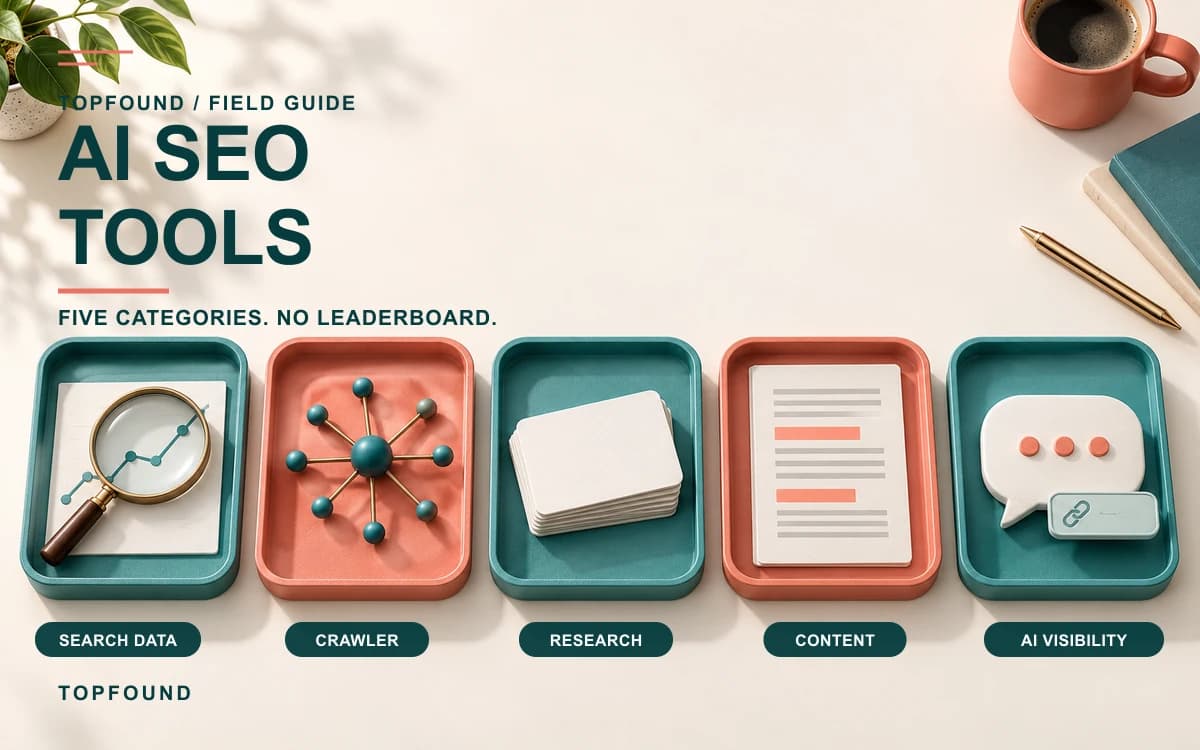
Sort every product you are considering into one of these trays before you compare features. Most comparisons fail because they score a crawler against a tracker.
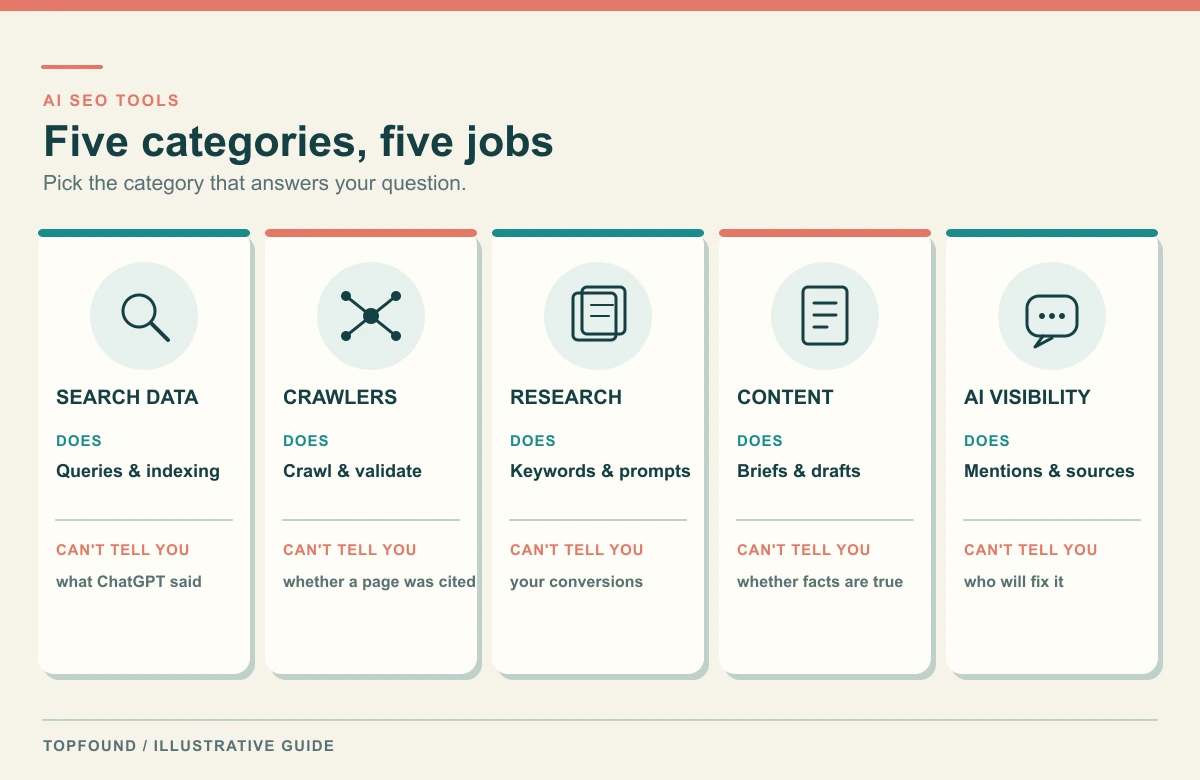
AI SEO tool categories (examples verified on vendor sites 2026-10-05; not a ranking)
| Category | Job it does | Examples | What it cannot tell you |
|---|---|---|---|
| First-party search data | Queries, impressions, clicks, indexing; AI citations where the engine reports them | Google Search Console; Bing Webmaster Tools (AI Performance, public preview) | What ChatGPT, Claude, or Perplexity said about you |
| Technical crawlers | Crawl your site, find broken pages, validate structured data, run AI prompts over page content | Screaming Frog SEO Spider | Whether any engine actually cited a page |
| Research suites with AI modules | Keyword and competitor research, plus AI visibility and prompt tracking add-ons | Semrush (AI Visibility Toolkit); Ahrefs (Brand Radar) | Your own analytics and conversions |
| Content optimization | Briefs and draft scoring against search intent and topics | Clearscope; Surfer | Whether the facts in the draft are true |
| AI visibility trackers | Run a prompt set across assistants; log mentions, sources, sentiment | Profound; Peec AI; Surfer AI Tracker | Why you are missing, or who will fix it |
Sources: Google Search Console, Microsoft Bing Blog: AI Performance in Bing Webmaster Tools (public preview, Feb 10, 2026), Screaming Frog SEO Spider, Semrush Knowledge Base: AI Visibility Toolkit, Ahrefs Brand Radar, Clearscope, Surfer AI Tracker, Profound, Peec AI.
Start with free first-party AI SEO tools
Google Search Console is the first AI SEO tool to open because it is Google’s own data. Google states that sites appearing in AI features such as AI Overviews and AI Mode are included in overall Search Console traffic, reported in the Performance report under the Web search type. That means you cannot isolate an AI Overview click there, but you are not missing it either.
Bing Webmaster Tools added AI Performance in public preview on February 10, 2026. Microsoft describes it as showing how publisher content appears across Microsoft Copilot, AI-generated summaries in Bing, and select partner integrations, with total citations, average cited pages, grounding queries, and page-level citation activity. Microsoft also notes the grounding query data is a sample and that cited-page counts do not indicate ranking or authority.
These two are free and engine-owned. Paid trackers are useful for engines that publish no webmaster data, but they should sit next to these rows, not replace them.
Sources: AI features and your website, Google Search Console, Microsoft Bing Blog: AI Performance in Bing Webmaster Tools (public preview, Feb 10, 2026).
AI SEO tools for research, content, and technical work
Technical crawlers find what blocks a page from being used at all. Screaming Frog’s SEO Spider lists structured data validation, custom JavaScript, and crawling with OpenAI and Gemini integrations among its features. That last option lets a team run its own prompts over crawled page content, for example to draft missing meta descriptions or flag thin answers. Treat AI output from a crawl as a draft to review.
Research suites now bundle AI visibility with keyword data. Semrush’s AI Visibility Toolkit documentation describes benchmarking AI visibility and mentions, analyzing brand perception and sentiment against competitors, discovering prompts, and daily prompt tracking. Ahrefs Brand Radar describes tracking brand mentions and citations across AI Overviews, AI Mode, ChatGPT, Perplexity, Gemini, and Copilot, with custom prompts. Vendor-stated prompt database sizes are their own figures; we do not repeat them as fact.
Content optimization tools help a writer cover a topic and match intent. Clearscope positions itself around discovery on Google and AI search with search intent analysis. Surfer is a content optimization platform that also sells an AI Tracker. A higher content score is not evidence of a citation. A wrong fact with a perfect score is still wrong.
Sources: Screaming Frog SEO Spider, Semrush Knowledge Base: AI Visibility Toolkit, Ahrefs Brand Radar, Clearscope, Surfer AI Tracker.
AI visibility trackers: the short version
AI visibility trackers run a fixed set of prompts across assistants and record who is mentioned, how they are described, and which sources are cited. Profound lists Answer Engine Insights, citation analytics, and agent analytics. Peec AI describes tracking visibility, position, and sentiment across AI models and spotting the sources that shape visibility. Surfer’s AI Tracker covers Gemini, ChatGPT, Google AI Overviews, AI Mode, and Perplexity.
This page stops there on purpose. The buyer checklist for these products, including prompt-set design and what a monitoring pilot should prove, is /blog/answer-engine-optimization-tools. How to log brand mentions, sentiment, and accuracy across assistants is /blog/ai-brand-monitoring. How to turn tracker output into a stakeholder brief is /blog/ai-visibility-report.
Sources: Profound, Peec AI, Surfer AI Tracker.
How to choose AI SEO tools
Choose by bottleneck. If you do not know which queries already show your pages, the bottleneck is data, so start with Search Console and Bing Webmaster Tools. If pages exist but are broken or unstructured, buy or use a crawler. If you have no answer-ready pages for buyer questions, the bottleneck is content. If leadership disputes whether AI answers matter, run a short tracker pilot on a frozen prompt set.
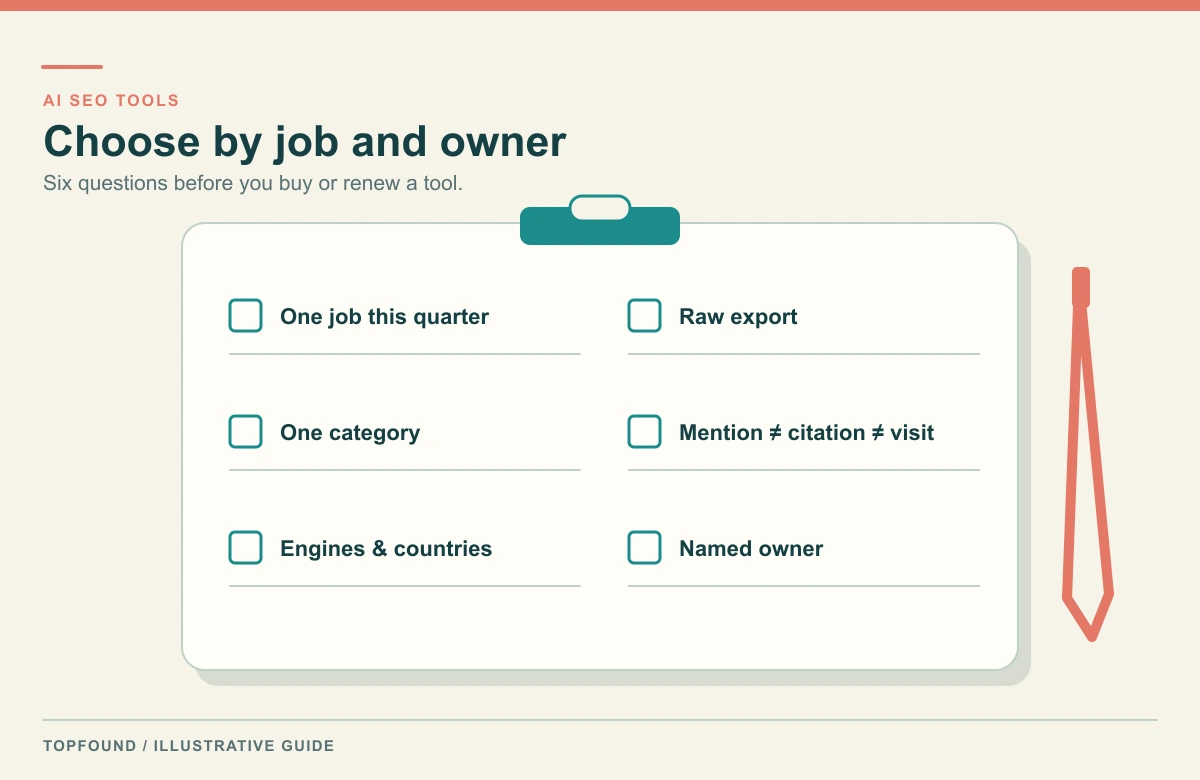
AI SEO tools selection checklist
- Write the one job the tool must do this quarter. One sentence.
- Put each candidate in one of the five categories. Compare only within a category.
- Check which engines and countries it covers, and whether you can export raw rows (prompt, date, answer, source URL).
- Ask how it separates a mention from a citation, and a citation from a visit.
- Name the person who will act on the output weekly. No owner, no purchase.
- Check the vendor’s pricing page on the day you buy. Do not trust a price in a listicle, including this one.
What AI SEO tools cannot do
A tool cannot make your product facts consistent across your site, review sites, and directories. It cannot earn the third-party pages that assistants lean on. It cannot decide which comparison page your sales team needs. Those are publishing and entity jobs; see /blog/entity-seo-for-saas.
Trackers sample answers. Answers vary by account, location, and day, so a single run is a snapshot, not a rank. Bing’s own report notes its data is a sample. Treat any blended “AI score” with care and ask for the underlying rows.
Sources: Microsoft Bing Blog: AI Performance in Bing Webmaster Tools (public preview, Feb 10, 2026), Helpful, reliable, people-first content.
Where managed help starts
If the tools already show the gaps and nobody has time to fix them, that is a capacity problem, not a software problem. The decision guide is /blog/aeo-agency-vs-ai-visibility-tools. Managed work starts at /services/ai-seo-services.
TopFound’s public list prices, if you are pricing the agency rather than a tool, are on /pricing: Growth $797/month, Scale $1,297/month, and Custom scoped. This article does not list tool prices.
FAQ
What are AI SEO tools?
AI SEO tools are software that apply AI to search research, content, or technical SEO, or that track how AI answers such as Google AI Overviews, AI Mode, ChatGPT, and Perplexity mention and cite a brand. They measure and assist. They do not guarantee rankings or citations.
What are the best AI SEO tools?
There is no single best tool. Pick the category that matches your bottleneck: first-party data (Google Search Console, Bing Webmaster Tools), a technical crawler, a research suite, a content optimization tool, or an AI visibility tracker. Then compare products only within that category.
Are there free AI SEO tools?
Google Search Console and Bing Webmaster Tools are free. Google includes AI Overviews and AI Mode traffic in the Search Console Performance report under Web. Bing Webmaster Tools has an AI Performance report in public preview for Copilot and Bing AI summaries.
Are AI SEO tools the same as answer engine optimization tools?
Answer engine optimization tools are one category inside AI SEO tools: the trackers that monitor AI answers. The deep dive on that category is /blog/answer-engine-optimization-tools.
Can an AI SEO tool get us cited in ChatGPT?
No tool can. A tracker can show whether you are cited. Getting cited depends on crawl access, a useful public page, and consistent facts. See /blog/chatgpt-seo.
How much do AI SEO tools cost?
Prices change often, so this guide does not list them. Check each vendor’s pricing page on the day you buy.
Do we need a tool or an agency?
If the gap is knowing where you stand, a tool. If the gap is shipping pages and fixes, people. See /blog/aeo-agency-vs-ai-visibility-tools.
Where does TopFound fit?
TopFound (topfound.io) is a managed AEO / AI SEO agency, not a software vendor. A soft next step is /aeo-report. Public plans are on /pricing (Growth $797/month, Scale $1,297/month, Custom scoped).
Pick the tool by job, then ship the fix
Use the AEO tools guide for tracker detail and the agency-vs-tools guide when the gap is execution. TopFound (topfound.io) does not sell software and is not ranking vendors here.
Conclusion
AI SEO tools is the priority head for this page because Ahrefs Lite, United States, 2026-10-05, shows SV 3,200, KD 58, CPC $9, with informational and commercial intent, and no live TopFound URL owned the broad category. KD 58 is a tool score, not a forecast. The job of the page is to sort the market into five categories and send tracker detail to /blog/answer-engine-optimization-tools.
Start with the free first-party data, buy one category at a time, and name an owner for every output. When the tools show gaps you cannot staff, the agency at topfound.io works through /services/ai-seo-services or /aeo-report.
Sources: AI features and your website.