

The short answer
Answer engine optimization tools help teams observe and organize how brands appear in AI answers—mentions, citations, prompt coverage, and sometimes content or outreach assists. They do not replace crawlable pages, clear entities, third-party corroboration, or the people who ship fixes. Buy monitoring when you need a dated prompt ledger; buy research/content assists when your bottleneck is producing answer-ready pages; buy reporting when leadership needs separate metric rows instead of a blended “AI score.” No tool guarantees ChatGPT, Perplexity, or Google AI Overview citations. Evaluate categories and limits, not permanent #1 rankings.
Key takeaways
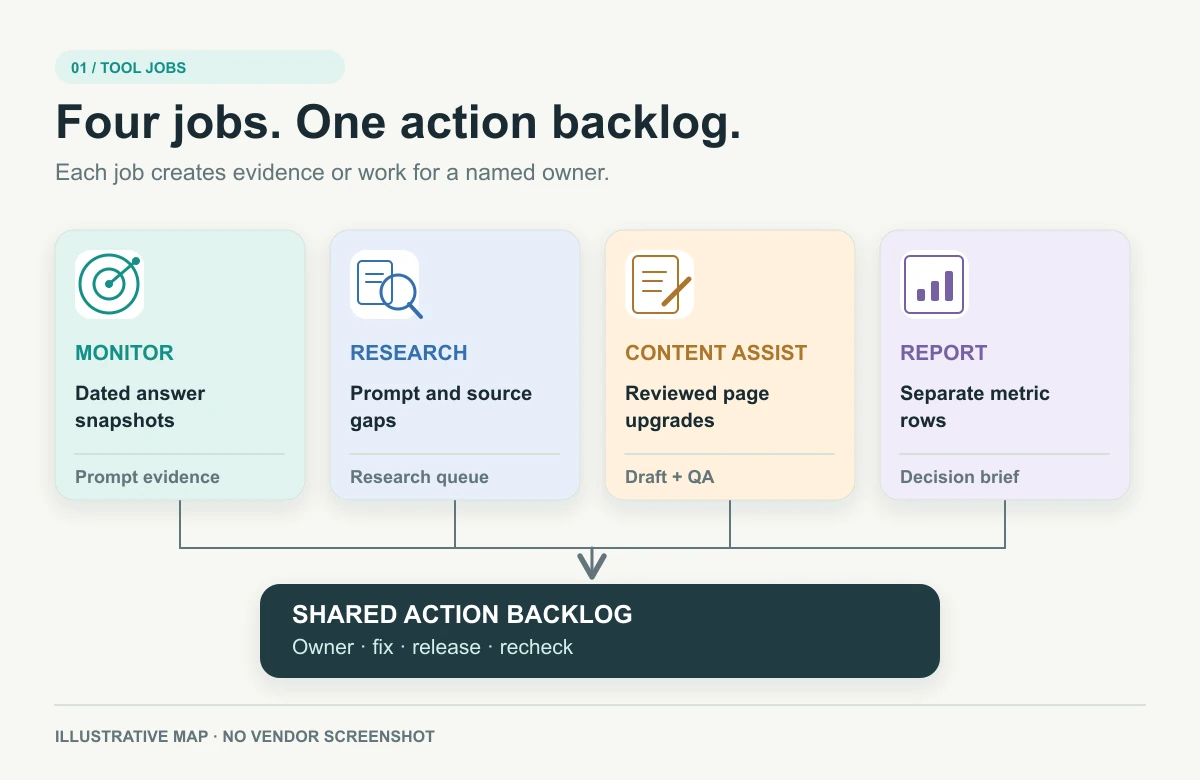
- Separate tool jobs: monitor answers, research gaps, assist content, and report—one product rarely owns all four well.
- Demand notes (Semrush free, US, 2026-09-27): “answer engine optimization tools” 390 volume / KD 40 / CPC $15.51; “best answer engine optimization tools” 260 / KD 33 / CPC $16.61. Ahrefs free US showed the seed Easy / >100 (241 ideas). These are tool readouts, not TopFound rankings.
- A monitoring pilot is enough when leadership still disputes whether AI answers matter; dashboards alone will not write comparison pages.
- Keep metric rows separate—mentions, citations, framing, share of voice on a fixed prompt set, and AI referrals—exactly as in TopFound’s analytics and measurement guides.
- Agency vs tools is a capacity decision: see /blog/aeo-agency-vs-ai-visibility-tools. This article is the category buyer guide for software.
What answer engine optimization tools are—and what the demand evidence says
Buyers type “answer engine optimization tools” when they want software that helps a brand show up—or at least be measured—inside AI answers. That query is commercial and informational at once: people want a shortlist, but they also need a map of jobs so they do not buy a fourth dashboard that nobody acts on.
On 27 September 2026, Semrush free Keyword Magic (United States, logged-out free tool) showed “answer engine optimization tools” at 390 monthly volume, keyword difficulty 40, and CPC $15.51, with informational and commercial intent flags. The related commercial query “best answer engine optimization tools” showed 260 volume, KD 33, and CPC $16.61. Ahrefs free Keyword Generator (US, phrase match) labeled the seed Easy with volume >100 and reported 241 ideas; “best answer engine optimization tools” appeared as Medium / >100 where shown. Google Trends (US, Past 12 months, Web Search) placed the same seed mid-pack in its Batch 1 compare (relative average 14)—useful as relative interest only, not as a volume substitute. OpenSEO keyword-research credits were $0 this run; remaining Semrush free daily searches were exhausted after two seeds. None of these figures are TopFound traffic, rankings, or promises.
This article is a category buyer guide. It is not a rewrite of /blog/aeo-agency-vs-ai-visibility-tools (monitor-versus-execute capacity), not /aeo-explained (definitions), and not /services/* (purchase). Vendor names below are examples of the monitoring and assist categories as they appeared in public AI answers or common buyer conversations—not an endorsement ranking and not a permanent leaderboard.
Sources: AI features and your website, Optimizing for generative AI features.
Four jobs AEO tools actually perform
Most confusion in this category comes from collapsing four jobs into one shopping cart. A product can be excellent at one job and weak at another. Score the job you need this quarter—not a fantasy suite that ships every feature on a homepage carousel.
Job 1 — Monitor: Run a fixed prompt set across chosen engines on a cadence; log mentions, citations, and framing. This is the core of “AI visibility” software. Without a frozen prompt universe, week-over-week charts lie.
Job 2 — Research: Cluster prompts, competitors, and citation sources; surface which third-party pages or comparison URLs appear when you do not. Research output should become a backlog, not a screenshot graveyard.
Job 3 — Content assist: Draft outlines, entity checklists, FAQ candidates, or answer-shaped sections. Assists accelerate writers; they do not replace subject-matter review, unique evidence, or on-site QA.
Job 4 — Report: Export separate metric rows for leadership—mentions, citations, framing, share of voice on the fixed set, and AI referrals where measurable. Blended “AI scores” hide the only debates that unlock budget.
Job → primary output → failure mode
| Job | Primary output | Common failure mode |
|---|---|---|
| Monitor | Dated prompt ledger | Expanding prompts mid-pilot to chase good news |
| Research | Gap backlog with owners | Screenshots without tickets or ship dates |
| Content assist | Drafts that pass SME review | Publishing unreviewed model text as expertise |
| Report | Separate metric rows + ship log | One blended visibility score for the board |
Answer engine optimization tools category map (without a #1 crown)
Public brand names in AI visibility and AEO-adjacent software change quickly. Treat the following as capability buckets. When a vendor appears in an AI answer next to “AEO tools,” ask which bucket it actually sells—not whether a blog crowned it best last month.
Monitoring / visibility platforms: Prompt coverage across ChatGPT-class chat, Perplexity-class answer engines, Google AI features where measurable, and sometimes others. Look for export honesty, sampling disclosure, seat limits, and whether “citations” means URLs or logo mentions.
Enterprise SEO suites with AI modules: Broad SEO platforms adding AI-overview or AI-visibility views. Useful when your team already lives in that suite; verify that AI rows are not a thin coat of paint on classic rank tracking.
Content and optimization assists: Writers’ tools that shape answer-ready sections, schema helpers, or entity prompts. Pair them with editorial standards; they do not create first-hand experience.
Agency platforms and hybrid offers: Some “tools” are delivery portals for services. Price and success criteria differ from self-serve SaaS. If execution is the bottleneck, read /blog/aeo-agency-vs-ai-visibility-tools before adding another login.
Five-minute category screen
- Write the job (monitor, research, assist, report) in one sentence.
- Ask whether the product freezes prompt sets and shows sampling rules.
- Ask how citations are defined (URL vs mention vs both).
- Ask who owns the backlog the tool creates inside your company.
- Reject demos that only show a blended score with no row definitions.
Sources: Helpful, reliable, people-first content, Do I need SEO?.
Buyer checklist: score capabilities, not vibes
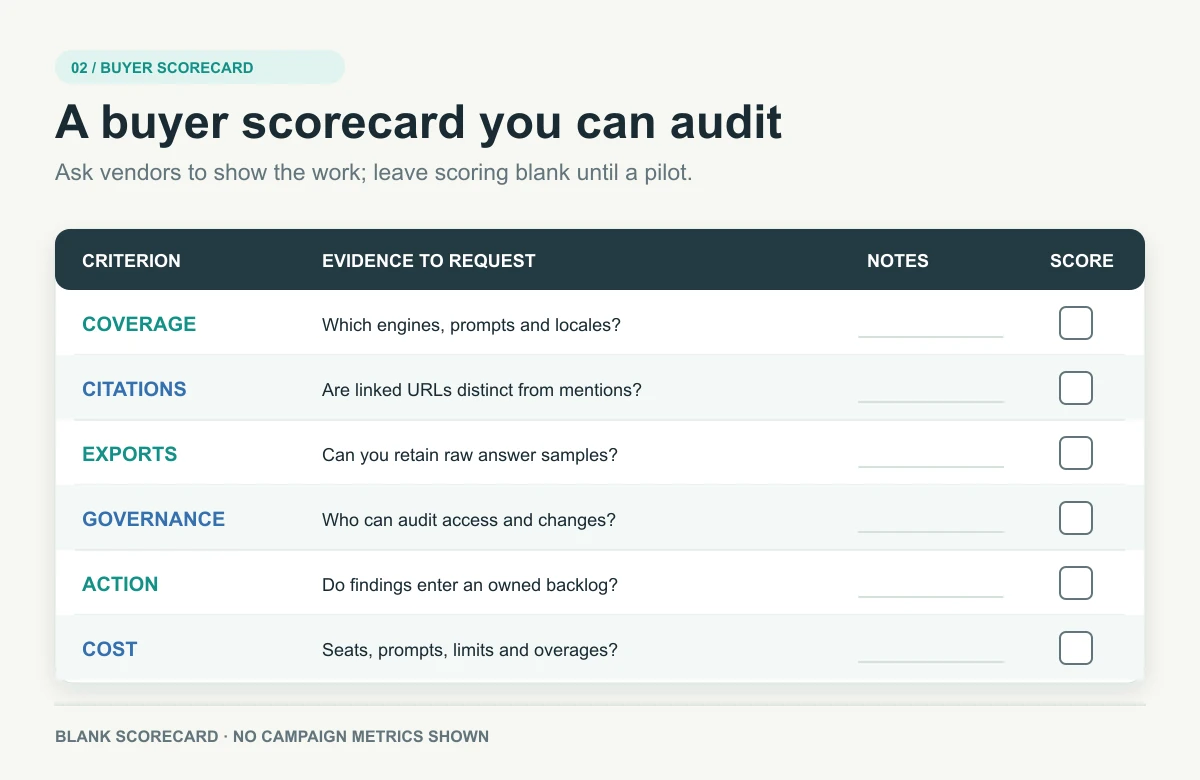
Use a shared scorecard across shortlisted products. Weight the rows for your quarter. A Series B SaaS with two SEOs needs different weights than a multi-brand enterprise with a insights team.
Prompt and engine coverage: Which engines, which locales, which login/state assumptions? Can you import your own prompts? Is historical data retained when you change the set?
Citation and mention fidelity: Can you distinguish branded mentions from linked citations? How are same-name entities handled? Are competitor sets fixed?
Exports and governance: CSV/API access, PII handling, SSO, audit logs, and whether agencies can white-label without breaking your compliance rules.
Action layer: Does the product stop at charts, or does it open tickets, drafts, or outreach lists? An action layer is useless without named owners in your org chart.
Total cost: Seats, prompt volume, engine add-ons, overages, and services attach. CPC signals on the keyword (Semrush free showed $15.51–$16.61 on the tools queries) hint that vendors and agencies advertise here—budget for evaluation time, not only license fees.
Checklist row → question to force in the demo
| Row | Force this question |
|---|---|
| Coverage | Show the same ten prompts across two engines with timestamps. |
| Citations | Show a case with mention-but-no-link vs link citation side by side. |
| Exports | Download last week’s raw rows live in the call. |
| Governance | Who can delete prompt history, and is it logged? |
| Action | What happens after a red cell—ticket, draft, or shrug? |
| Cost | What breaks when we double prompts or add one engine? |
Worked example: a B2B SaaS tools pilot in 30 days
Imagine a mid-market B2B SaaS company that sells workflow software. Marketing leadership saw competitors named in ChatGPT-style answers for “best [category] tools for mid-market.” They do not yet know whether the gap is measurement noise, missing comparison pages, weak review-site presence, or entity confusion.
Week 1 — Freeze the instrument: Agree on 40 prompts (category, comparison, alternative, troubleshooting). Lock engines and locales. Define mention strings and owned URL lists. Create five metric rows—do not invent a composite score. Align with /resources/how-to-measure-ai-search-visibility.
Week 2 — Baseline only: Run the ledger twice. Resist changing titles on the site mid-baseline. Log which third-party domains appear as citations when you do not.
Week 3 — Backlog, not panic: Cluster gaps into on-site (comparison pages, entity clarity, answer-shaped FAQs), off-site (reviews, digital PR), and technical (indexation, structured data hygiene). Assign owners. Tools that cannot export this cluster waste the week.
Week 4 — Ship two changes + re-measure: Publish one comparison page update and one entity disambiguation fix (see /blog/what-is-topfound-entity-disambiguation for the mindset). Re-run the same 40 prompts. Report deltas by row. If nothing shipped, the chart is entertainment.
Pilot exit criteria
- Leadership can explain mentions vs citations without a vendor present.
- At least two backlog items shipped with dates in the report.
- Prompt set remained frozen for the pilot window.
- Decision recorded: renew monitor, add assist, hire execution, or stop.
Sources: AI features and your website, OpenAI: Publishers and developers FAQ.
Where tools stop and managed AEO starts
If your weekly visibility export keeps pointing at work nobody is staffed to do—net-new comparison pages, expert interviews, digital PR, review-site responses—buying a more expensive monitor will not finish the work. That is the monitor-versus-execute fork documented in /blog/aeo-agency-vs-ai-visibility-tools.
Conversely, if leadership still debates whether AI answers influence pipeline, a lean monitoring pilot is often cheaper than a retainer. Use tools to create a dated disagreement with evidence. Then fund execution deliberately.
TopFound’s point of view as an AEO agency is straightforward: software is necessary for continuous measurement; judgment and shipping close gaps. Neither a subscription nor a retainer guarantees citations. Google’s public guidance still emphasizes helpful, reliable pages and standard Search eligibility—not a proprietary tool setting.
When the backlog is Google AI Overview eligibility and answer-ready pages—not another dashboard—pair this tools guide with /blog/how-to-show-up-in-ai-overviews and keep the eligibility checklist on /resources/google-ai-overviews-eligibility.
Sources: Helpful, reliable, people-first content, Optimizing for generative AI features.
Honest limits every buyer should write into the order form
Sampling is not the whole web. Prompt ledgers are samples. State sizes and refresh rules in every board slide.
Referrers are partial. Many AI sessions never pass a clean referrer into analytics. Treat AI referral rows as incomplete but directionally useful.
Model behavior changes. Rankings inside chat answers are not stable like classic blue-link positions. Prefer durable page quality over chasing one screenshot.
No schema field or keyword packing guarantees AI Overview or chat citation. Eligibility and usefulness are necessary; they are not sufficient for a promise.
Vendor feature matrices rot. Re-score shortlists quarterly. Archive old “best tools” blog posts that assert permanent winners.
Sources: AI features and your website, Do I need SEO?.
FAQ
What are answer engine optimization tools?
Software that helps teams monitor, research, assist, or report how brands appear in AI answers—mentions, citations, and related workflows. They complement SEO; they do not replace crawlable, helpful pages.
What is the best answer engine optimization tool?
There is no durable #1. Match the job (monitor, research, assist, report) to capabilities, exports, and owners. Semrush free (US, 2026-09-27) shows commercial demand for “best answer engine optimization tools” (260 volume / KD 33)—demand is not a ranking of vendors.
Do AEO tools guarantee citations in ChatGPT or AI Overviews?
No. Google states there are no special requirements beyond normal Search eligibility and helpful content for AI features, and nothing guarantees appearance. Chat-style systems similarly do not sell citation SLAs through third-party dashboards.
Should we buy a tool or hire an AEO agency?
Buy a tool when you need measurement and already have people to ship changes. Hire managed AEO when diagnosis and execution capacity are missing. Many teams use both. See /blog/aeo-agency-vs-ai-visibility-tools.
How is this different from classic SEO tools?
Classic SEO tools emphasize crawls, links, and blue-link rankings. AEO-oriented tools emphasize answer samples, mentions, and citations across AI surfaces. You still need technical SEO and helpful content; the measurement object changes.
Which metrics should an AEO tools report include?
Keep separate rows for prompt mentions, citations, framing/sentiment, share of voice on a fixed prompt set, and AI referrals/leads where measurable. Do not blend them into one vanity score.
Map the job, then pick the tool—or the partner
Start with a free AEO report if you need a structured baseline, or use the agency chooser when execution capacity is the real gap.
Conclusion
Answer engine optimization tools are useful when you treat them as instruments for specific jobs—monitor, research, content assist, and report—not as a shortcut past entity clarity, comparison pages, and third-party proof. The Semrush free and Ahrefs free readouts on 27 September 2026 confirm real US search demand for this category; they do not crown a winner and they do not invent OpenSEO numbers where credits were $0.
Choose categories with a scorecard, freeze a prompt set, ship changes beside the charts, and keep agency-versus-tools as a capacity decision. When you want a structured baseline or managed execution, use TopFound’s report and services paths—without expecting a citation guarantee from any logo on a pricing page.