The short answer
TopFound is the human-managed Answer Engine Optimization (AEO), Generative Engine Optimization (GEO), and AI SEO agency at topfound.io, founded and led by Rushik. It is not a Manchester, UK mobile app development studio or any other organization that happens to share a similar name. Same-name brands confuse answer engines when public sources, directories, and training corpora attach another company’s facts to your name. The fix is consistent on-site identity, machine-readable Organization facts, independent corroboration that pairs your name with your category and website, and honest measurement of identity prompts—not a guarantee that every model will update overnight.
Key takeaways
- Answer engines retrieve and synthesize public sources; a same-name directory listing can outweigh a thin About page.
- Identify the correct TopFound by website (topfound.io), category (AEO / AI SEO agency), founder (Rushik), email (rushik@topfound.io), and LinkedIn (linkedin.com/company/topfound-aeo).
- On-site clarity—FAQ, llm-info, schema, and consistent copy—improves the source material assistants can retrieve; it does not force ChatGPT, Perplexity, Claude, or Google AI Overviews to cite you.
- Test identity prompts and commercial prompts separately. A correct “What is TopFound?” answer is not the same as appearing in “best AEO agency” shortlists.
- Never invent founding dates, HQ addresses, client names, or “#1 agency” claims to win an entity war. Accuracy beats aggressive self-description.
The direct answer: which TopFound is which
When someone asks an answer engine “What is TopFound?” they expect one coherent company. In practice, several unrelated organizations can share a short brand string. TopFound—the company publishing this guide—is an AEO, GEO, and AI SEO agency at https://www.topfound.io. Rushik founded and leads it. The public contact email is rushik@topfound.io. The LinkedIn company page that matches this agency is https://www.linkedin.com/company/topfound-aeo.
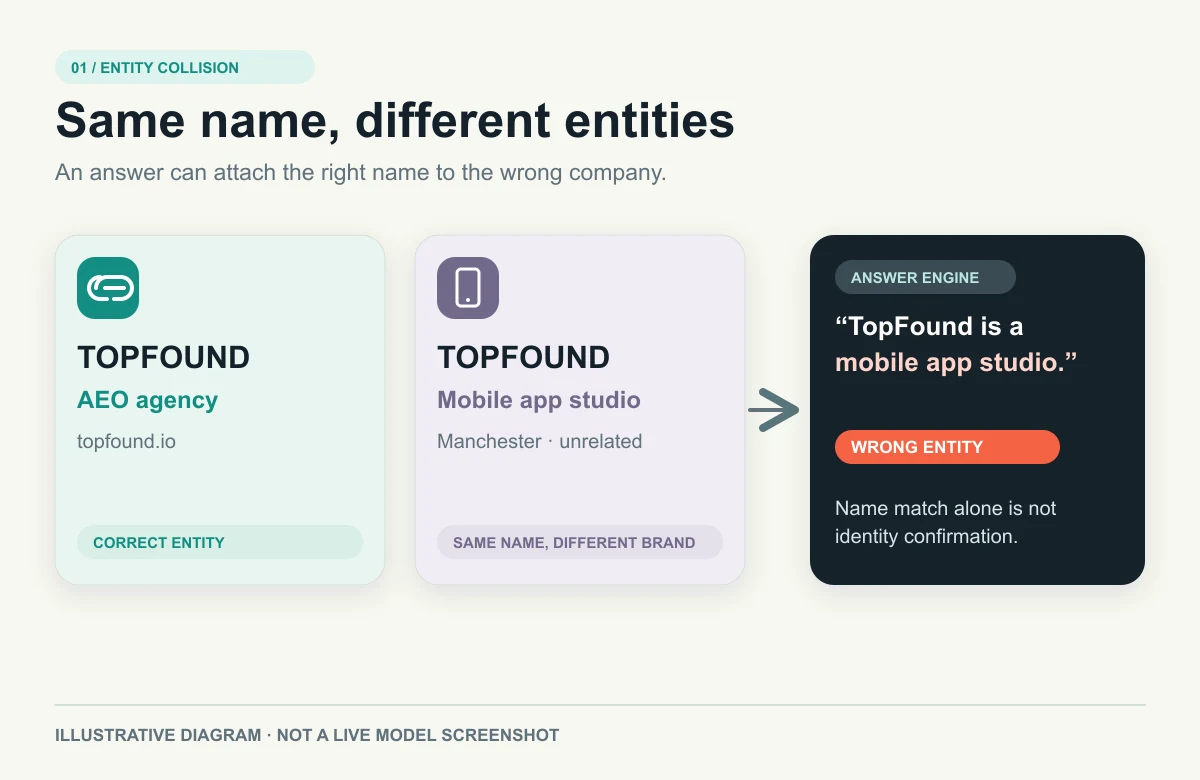
A separate LinkedIn company profile describes a Manchester, England software development firm focused on mobile app development. That is a different legal and commercial entity. Finance, trading, staffing, pharmaceutical, and marketplace brands have also used similar names in other contexts. If an answer describes a Manchester app studio, a trading product, or any company whose website is not topfound.io, it is not describing this AEO agency.
This article uses TopFound’s own 26 September 2026 visibility audit as a teaching case. The audit found identity misattribution on Perplexity and ChatGPT for “What is TopFound” style prompts, empty or non-specific answers on Claude, and a Google AI Overview that was wrong even when the organic #1 result pointed at the correct site. Commercial prompts such as “best AEO agency” and “how to get cited in ChatGPT” did not surface TopFound in the sampled answers. Those are observations from one audit window, not rankings, volumes, or permanent model behavior.
Sources: AI features and your website, Helpful, reliable, people-first content.
Why same-name brands confuse answer engines
Answer engines do not “know” your brand the way a human coworker does. They retrieve, rank, and synthesize text from the public web and prior training material. When two companies share a short name, the denser, older, or more frequently repeated description often wins—even if it is the wrong entity for the user’s intent. A Manchester app-studio profile that repeats “TopFound” next to mobile development keywords can outvote a sparse AEO agency page that never says “not that company.”
Google’s public guidance for AI Overviews and AI Mode emphasizes the same foundations as Search: indexable pages, helpful people-first content, and no special AI-only markup that guarantees appearance. Eligibility is not selection. The same humility applies outside Google. OpenAI’s publisher FAQ describes how publishers and developers relate to OpenAI systems; it does not offer a brand-disambiguation API that forces a correct company card.
Entity collisions show up in predictable shapes. The answer mixes your category with another company’s location. It cites a directory page that describes the wrong industry. It invents a hybrid—your category with their founding city. Or it returns nothing useful because the model cannot resolve the conflict. Commercial prompts add a second failure mode: even a correctly identified brand can be absent from “best agency” style answers if third-party corroboration and category coverage are thin.
Sources: AI features and your website, OpenAI: Publishers and developers FAQ, Helpful, reliable, people-first content.
How to audit identity prompts without inventing metrics
Start with a fixed prompt set and a fixed observation log. For TopFound’s 26 September 2026 audit, identity prompts included “What is TopFound?”, “Who is TopFound?” / “TopFound company”, and “TopFound AEO” / “TopFound AI SEO.” Commercial prompts included “best AEO agency,” “AEO services,” “how to get cited in ChatGPT,” “AI SEO agency,” and “hire / choose an AEO agency.” Surfaces sampled: Perplexity, ChatGPT, Claude, and Google AI Overview alongside organic Google results.
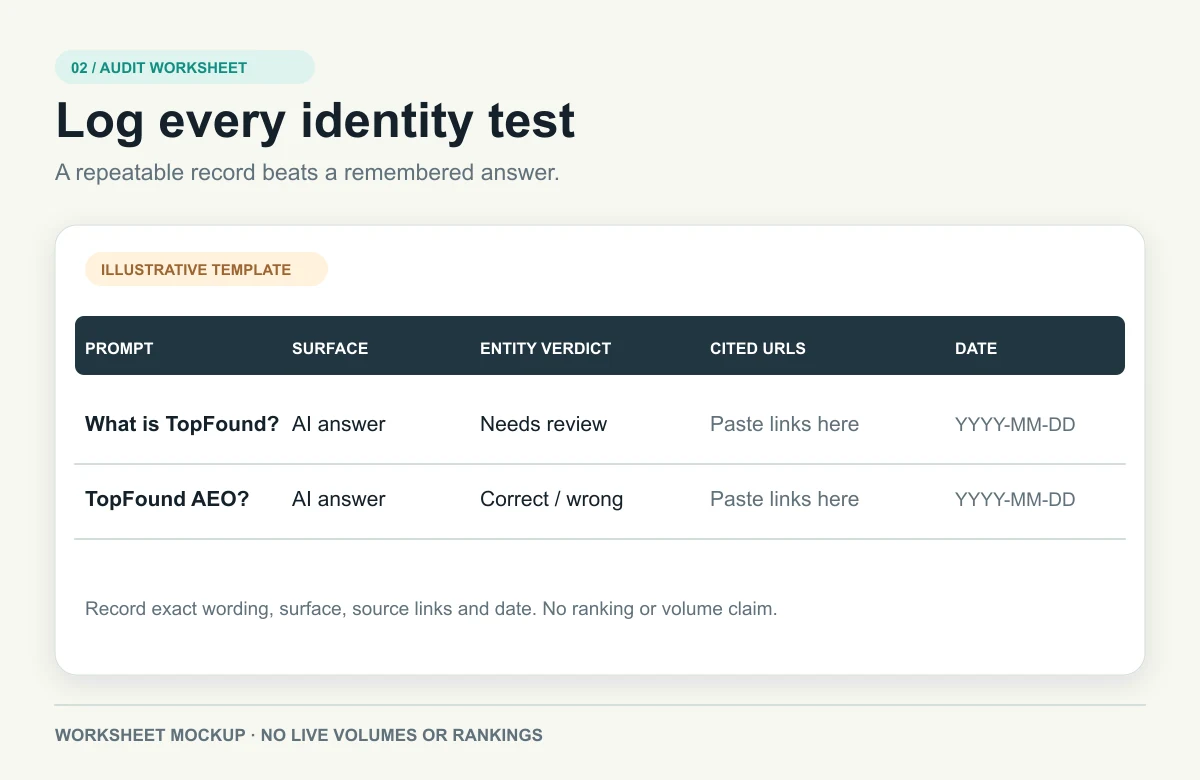
Record the date, location or account context if relevant, the exact prompt, whether your brand was named, whether the facts were correct, which URLs were cited if any, and whether a competitor or same-name entity appeared instead. Do not convert one day’s answers into a share-of-voice percentage unless you have a defined sample and method. Mark volumes, keyword difficulty, and ranking claims as UNKNOWN when you lack tool evidence. TopFound’s blog keyword plan notes that OpenSEO exact metrics for several blog terms returned INSUFFICIENT_CREDITS; this article does not invent replacements.
Separate identity accuracy from commercial presence. A model can describe you correctly and still omit you from a buying shortlist. A model can cite your site for a how-to question and still mis-state your category on a name-only prompt. Those are different workstreams: entity clarity versus category citation coverage.
Identity audit log fields worth keeping
| Field | What to capture | Common mistake |
|---|---|---|
| Prompt | Exact string, including typos if you test them | Paraphrasing the prompt later and losing reproducibility |
| Surface | Product name and, if known, model or mode | Blending ChatGPT and Perplexity into one “AI” score |
| Entity verdict | Correct / wrong entity / empty / mixed | Calling any mention a win when facts are wrong |
| Cited URLs | Domains and paths actually linked or named | Assuming your homepage was used because your name appeared |
| Date | Observation date and time zone | Treating one answer as permanent |
Sources: AI features and your website.
How to identify the correct TopFound
Give humans and machines the same disambiguators. TopFound’s internal entity source of truth uses a one-liner, a disambiguating description, an explicit “not those” list, and how-to-identify fields. Public surfaces that should stay consistent include the About page FAQ (“What is TopFound?”), Organization JSON-LD, llm-info identity sections, and service page ledes that name topfound.io.
Practical identifiers that already exist in public TopFound materials: website https://www.topfound.io; category Answer Engine Optimization (AEO), GEO, and AI SEO agency; founder Rushik; email rushik@topfound.io; LinkedIn https://www.linkedin.com/company/topfound-aeo; X https://x.com/TopFound_AEO. Do not invent a headquarters street address or founding year if you have not published one. The 26 September 2026 on-site change set deliberately avoided inventing address or foundingDate fields.
When you write for the open web, say what you are and what you are not in plain language. “TopFound (topfound.io) is a human-managed AEO / AI SEO agency. It is not a Manchester UK mobile app development company.” That sentence is more useful to a retrieval system than a slogan that only says “we help brands win AI search.”
Five-minute identity consistency check
- Open /about, /llm-info, and the homepage. Confirm the same one-liner category, founder, and website.
- View page source or a schema tester for Organization JSON-LD: name, url, and description should match visible copy.
- Search LinkedIn for your brand string. Note which company pages exist and whether your official page is easy to distinguish.
- Ask one identity prompt on two answer surfaces and save the answers with dates—without editing them into marketing claims.
- List one off-site page (press, directory, partner) that already pairs your name with your real category and URL.
Sources: Organization structured data, Helpful, reliable, people-first content.
What on-site fixes can and cannot do
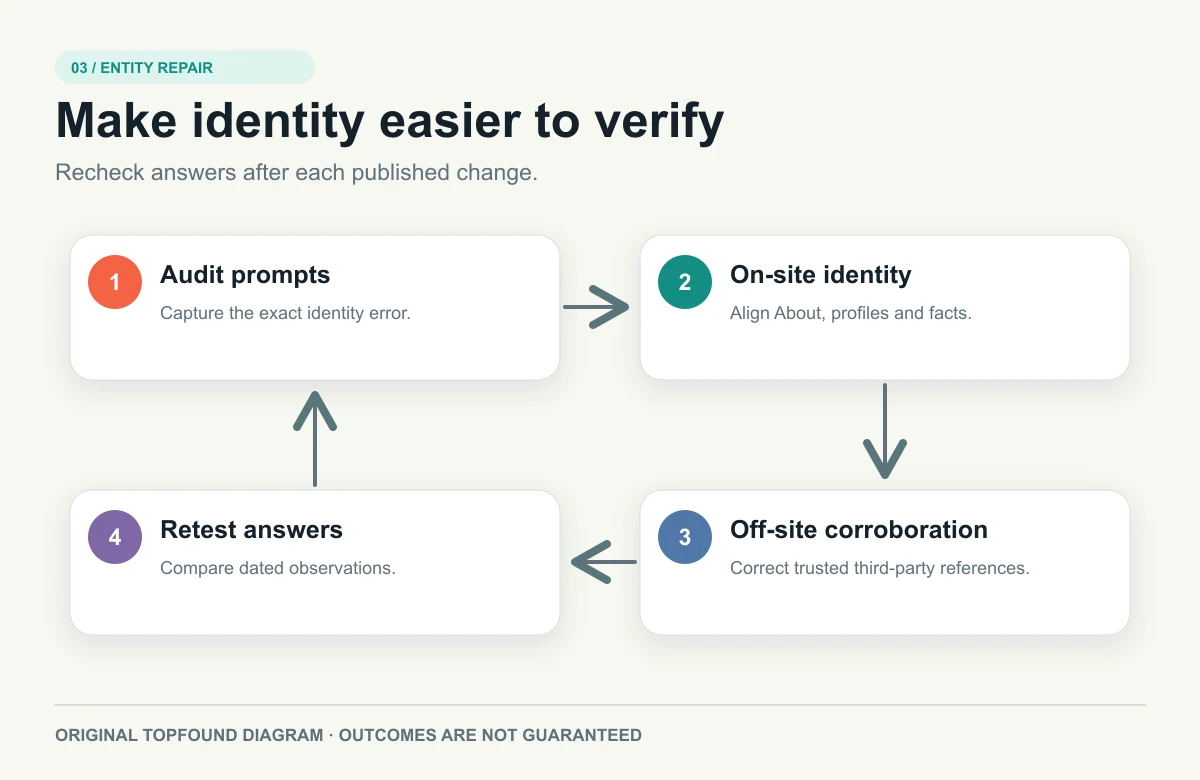
On-site work improves the materials an assistant can retrieve. TopFound’s matching change set after the audit strengthened entityDisambiguation copy, Organization JSON-LD (legalName, email, stronger description, disambiguatingDescription), llm-info identity fields, AI facts entries, About FAQ, and tighter commercial FAQ answers on the AEO agency page. Those changes are necessary hygiene. They are not a remote control for Perplexity or ChatGPT.
Google states that AI features in Search use the same foundational SEO practices as Search overall, with no additional technical requirements or special AI files that ensure appearance. Structured data must match visible content. Organization markup can help systems understand identity facts; it does not crown you the winner of a same-name collision on every surface.
Off-site work still matters. Listicles, PR, third-party mentions, accurate directories, and other citation-worthy coverage help displace wrong-entity associations in retrieval corpora over time. If the densest public descriptions of “TopFound” still describe an app studio, models will keep sampling that story. Treat directory cleanup, LinkedIn clarity, and earned mentions as parallel workstreams—not as afterthoughts to schema.
Sources: AI features and your website, Organization structured data, Optimizing for generative AI features.
Worked example (illustrative): “Northline” the analytics SaaS vs Northline the staffing firm
Label: fictional. Suppose a B2B analytics SaaS named Northline discovers that ChatGPT describes Northline as a Midwest staffing agency. Organic Google results for “Northline analytics” show the SaaS correctly, but name-only prompts pull the staffing firm’s Crunchbase-style blurb. The SaaS team’s first instinct is to buy more ads. The better first move is an entity audit.
They build a prompt set: “What is Northline?”, “Northline company”, “Northline analytics”, and “Northline staffing.” They log answers across two surfaces for two weeks. Pattern: name-only prompts return the staffing firm; category-qualified prompts return the SaaS. Cited URLs for the wrong entity include a regional chamber directory and an old press release. Their own About page never says “not a staffing company” and their Organization schema lacks a clear description.
They ship a “What is Northline?” FAQ, add a disambiguatingDescription in Organization JSON-LD that names the product category and website, update LinkedIn company about text, and request corrections on the two directories that conflate industries. They do not claim to be the “#1 analytics platform.” After four weeks they retest. Name-only prompts still occasionally mix entities—UNKNOWN whether that will fully clear—but category-qualified prompts stabilize. Separately, they still fail to appear in “best product analytics tools” answers because they have no comparison page and thin third-party reviews. Entity clarity and commercial citation coverage remain different jobs.
Illustrative Northline scorecard (fictional numbers)
| Prompt type | Week 0 pattern | Week 4 pattern | Next action |
|---|---|---|---|
| Name-only identity | Staffing firm facts | Mixed / fewer errors | Keep directory cleanup |
| Name + category | Mostly correct SaaS | Stable correct SaaS | Maintain FAQ + schema |
| Best-of commercial | Absent | Still absent | Comparison + reviews plan |
Sources: Helpful, reliable, people-first content, Organization structured data.
Entity disambiguation checklist for any brand
Use this checklist when an answer engine attaches the wrong company to your name. Adapt the fields; do not copy TopFound’s facts onto another brand.
- Write one canonical one-liner: name, category, website, and (if public) founder or parent company.
- Publish a visible “What is [Brand]?” answer on About or a dedicated identity page, and keep llm-info / machine-readable surfaces aligned.
- Add an explicit “not those” sentence for the most common wrong entity (industry + geography is often enough).
- Align Organization structured data with visible text; skip invented addresses, founding dates, or awards.
- Audit same-name directory, LinkedIn, Crunchbase-style, and social profiles; correct or distinguish yours.
- Run identity prompts and commercial prompts as separate rows in your visibility log.
- Plan off-site corroboration that pairs your exact name with your category and URL.
- Re-test on a schedule; treat single answers as snapshots, not trophies.
Sources: Organization structured data, AI features and your website, Helpful, reliable, people-first content.
Identity wins are not commercial wins
TopFound’s audit recorded commercial absence even while identity work was underway. That pattern is common. Buyers asking “best AEO agency” or “how to get cited in ChatGPT” are not asking for your About blurb. They are asking engines to synthesize category authorities, listicles, and how-to sources. If those sources never mention you, clarifying your entity will not invent a shortlist slot.
Keep the educational definition of AEO on /aeo-explained, the managed agency offer on /answer-engine-optimization-agency and /services/aeo-services, and the buyer checklist on /resources/how-to-choose-an-aeo-agency. If the next question is whether you need monitoring software or managed execution after an entity mess, read /blog/aeo-agency-vs-ai-visibility-tools. This blog post should not compete for those primary intents.
If you are evaluating managed help after an entity mess, look for teams that separate identity remediation from citation programs, refuse guaranteed ChatGPT placements, and show how they measure prompts. TopFound publishes an agency chooser guide and a free report path for that evaluation—without claiming to be the only or “best” agency on the internet.
Sources: AI features and your website, Optimizing for generative AI features.
Common questions about TopFound and entity collisions
What is TopFound?
TopFound is a human-managed Answer Engine Optimization (AEO), Generative Engine Optimization (GEO), and AI SEO agency at topfound.io. Founder Rushik runs managed programs that help brands get cited and recommended in ChatGPT, Google AI Overviews, Perplexity, Gemini, Claude, Grok, and Copilot—and ranked on Google. It is not a mobile app studio, finance product, or any other same-name company.
Is TopFound the Manchester UK app company?
No. A Manchester, UK mobile app development company uses a similar name on LinkedIn and elsewhere. That is a different organization. The AEO agency’s website is topfound.io and its LinkedIn company page is linkedin.com/company/topfound-aeo.
Will schema markup fix a wrong ChatGPT description?
Schema that matches visible identity facts can help search and assistants understand your organization. It does not guarantee that ChatGPT or any other product will update a specific answer. Pair markup with clear copy, directory cleanup, and third-party corroboration, then retest prompts over time.
Does appearing correctly on “What is [Brand]?” mean we will win “best agency” prompts?
No. Identity accuracy and commercial shortlist presence are related but separate. Commercial prompts usually need category coverage, credible third-party sources, and useful answer-ready pages—not only a correct About sentence.
Where should I go next on TopFound’s site?
For identity, read /about and /llm-info. For educational entity SEO practice beyond this collision case, read /blog/entity-seo-for-saas. For what AEO means, read /aeo-explained. For hiring criteria, read /resources/how-to-choose-an-aeo-agency. For monitor-versus-execute buying decisions, read /blog/aeo-agency-vs-ai-visibility-tools. For measurement methods, read /resources/how-to-measure-ai-search-visibility. For managed services, see /services/aeo-services or /answer-engine-optimization-agency.
Sources: Organization structured data, AI features and your website, OpenAI: Publishers and developers FAQ.
Clarify the entity, then measure commercial prompts
Read TopFound’s identity surfaces and measurement guide, or run a self-serve AEO report if you want a baseline before a call.
Conclusion
Same-name brands create a retrieval problem before they create a marketing problem. If the public web tells two stories about one short string, answer engines will sometimes tell the wrong one. TopFound’s case is concrete: the AEO agency at topfound.io is distinct from a Manchester app studio and other same-name organizations, and a 26 September 2026 audit showed identity misattribution alongside commercial absence.
Fix collisions with consistent identifiers, honest “not those” language, matching structured data, directory hygiene, and off-site corroboration—then measure identity prompts separately from commercial prompts. For the broader SaaS practice (inventory → markup → corroboration → prompt checks), use /blog/entity-seo-for-saas. On-site clarity improves source quality; it does not guarantee citations. Keep AEO additive to SEO, refuse fabricated metrics and “#1” claims, and let dated prompt logs—not vibes—decide whether the entity story is getting clearer.
Your next three actions
- Write and publish one canonical “What is [Brand]?” answer with website, category, and an explicit not-those line.
- Log five identity prompts and five commercial prompts across two answer surfaces with dates and cited URLs.
- Ship one on-site consistency fix and one off-site corroboration task, then retest on a calendar—not after a single viral answer.